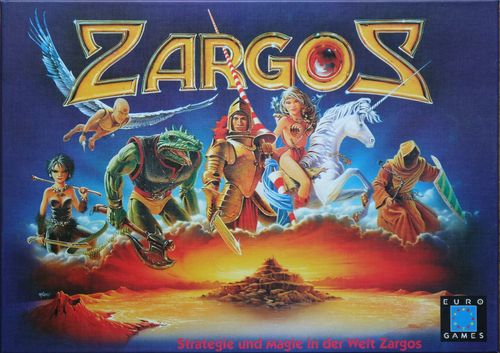
Zargos
Zargos Rulebook
Table of Contents
Table of Contents
Components
The Zargos box contains:
- A circular mat representing the planet Zargos with its 11 kingdoms.
- 312 pawns representing the 6 peoples of Zargos. Small pawns are worth one unit; large pawns are worth five units.
- 15 boat pawns, used for movement at sea.
- 40 magic cards, 10 Kingdom cards and 1 Master of the Winds card.
- 6 player sheets (one for each people) and 4 dice.
- The rulebook you are holding.
Object of the Game
The aim of the game is to conquer the Forbidden City, capital of the Kingdom of Zargos, and the three provinces surrounding it. The first people to occupy these 4 territories wins the game.
Presentation
Each player chooses a people (Knights, Spiders, Amazons, Monks, Dragons or Winged) and sets out to conquer the various kingdoms. Holding a kingdom gives reinforcements and a magic card each turn. Each people moves or fights in a particular way. Magic cards interfere with the course of the game, either to help a player or to hinder them.
Setup
Before starting the game, assemble the game mat and shuffle the magic cards well. The Kingdom cards are set aside. One player is designated to deal the Kingdom cards and the magic cards during the game. Then each player rolls a die. The player who rolls the highest number chooses first one of the six peoples of the planet. Each player does likewise, following the order obtained from the dice.
With 2 or 3 players, each player in turn chooses one people, then a second. After choosing their people, each player receives the corresponding player sheet and:
- 25 pawns if there are 6 players.
- 30 pawns if there are 5 players.
- 35 pawns if there are 4 players.
- 25 pawns per people if there are 3 players, so 50 pawns in total.
- 35 pawns per people if there are 2 players, so 70 pawns in total.
Attention! Small pawns are worth ONE and large pawns are worth FIVE. At any time, a player may exchange one pawn of 5 for five pawns of 1, and vice versa.
Then, still in the same order, the players place one pawn each in turn on a province, provided it is not already occupied by another people. Attention! Before the game begins, the provinces of the Kingdom of Zargos must remain empty: no pawns may be placed there. The players continue to place one pawn at a time until all the provinces of the other kingdoms are occupied. As soon as there are no free provinces left, the players then distribute their remaining pawns among the provinces they occupy, still respecting the same order of play.
Once all pawns are placed, the first turn of the game may begin.
Course of a Turn
Each turn of the game proceeds as follows:
a) Each player, in turn*, makes attacks from the provinces they control. When they have finished their attacks, they reorganise their forces within their territory.
* On the first turn, the order of play is the one used for distributing pawns.
b) When all players have made their attacks, the territory points gained by each are counted and the new order of play is determined.
c) The Kingdom cards and magic cards are dealt. Following the new order of play, each player buys boat pawns and reinforcement pawns, which they place among the provinces they control. When the last player has finished placing their reinforcements, a new turn begins in the new order of play.
Attacks
Land Attacks
To make a land attack, a player moves their pawns from one province to another, leaving at least one pawn in the province of origin. The departure province and the arrival province must share a common border and be occupied by different peoples (it is not possible to attack oneself!). From a single province, a player may split their forces to attack several surrounding provinces. In the same way, from several provinces, they may combine their forces for a grouped attack against a single province.
A player may make as many land attacks as they wish during their turn, provided that: 1) they leave at least one pawn in the province of origin each time; 2) no pawn moves more than one province to attack; 3) no pawn takes part in more than one combat.
Sea Attacks
In exchange for one or more boat pawns, a player may mount a sea attack by transporting a group of pawns from a coastal province they control to another coastal province controlled by another people. For each sea space crossed, they must give one boat pawn. The pawns to be transported must already be in the departure province at the start of the turn. In other words, it is not possible to gather pawns from different provinces to ship them by sea in the same turn. Nor is it possible to drop off or pick up pawns along the way.
A player may make as many sea attacks as they wish during their turn, provided that: 1) they leave at least one pawn in the province of origin each time; 2) the departure province borders the first sea space used; 3) the arrival province borders the last sea space used; 4) for each attack, they actually give as many boat pawns as sea spaces crossed; 5) no pawn takes part in more than one combat.
Combat
Once all their movements are finished, a player resolves the combats that have been engaged, one by one, in any order they wish. There is combat whenever the pawns of two peoples are in the same province. A combat lasts one or more rounds, until all the pawns of one of the peoples have been eliminated from the province. Each round takes place in 3 successive phases:
-
Forces engaged: to know how many dice they may roll, each player counts the pawns they have committed to the battle:
- 1 to 3 pawns: 1 die.
- 4 to 6 pawns: 2 dice.
- 7 pawns or more: 3 dice.
-
The battle: each player rolls the number of dice they are entitled to and divides the total by two. Each thus obtains the number of pawns they have eliminated from their opponent (round down if necessary). The elimination of pawns takes place simultaneously on both sides.
-
Outcome of the combat: if, after removing the eliminated pawns on each side, one of the two sides has no pawns left, the combat stops automatically. The people that won gains control of the territory. Otherwise, if pawns remain on both sides, a new round is begun in the same way as the previous one. Attention! The number of dice each player will roll is calculated from the new balance of forces.
Attacking a Capital
When a player attacks a province that contains the capital of a kingdom, including the Forbidden City, the combat is modified as follows:
- Because of the protection of the city walls, the defender's losses are calculated by dividing by 3 (and no longer by 2) the total the attacker obtained on the dice.
- The attacker's losses continue to be calculated normally, by dividing by 2 the total the defender obtained on the dice.
In both cases, round down if necessary.
Reorganisation
Once its attacks are finished, a player may reorganise their forces, that is, partially redeploy their pawns among the provinces they occupy. They are entitled to move 1 group of pawns across 2 provinces, or 2 groups of pawns from one province. They must always leave at least one pawn in each province. If they make a consecutive move across 2 provinces, they may pick up or drop off pawns along the way. Unlike attacks, only movements between provinces they control are allowed. They may include as many sea spaces as they wish in their movements, provided they respect the limits above and spend the corresponding number of boat pawns.
Important: some peoples have special powers in the way they attack (the Knights), move (the Winged, the Spiders and the Dragons) or fight (the Amazons and the Monks). The powers of each people are explained in detail on the corresponding player sheet.
NOTE: the lake space between the kingdoms of KORI and LUDOS is considered a SEA space, for attacks as well as for reorganisation.
Territory Points
When all players have finished their turn, the points scored by each are counted:
- 1 point per province.
- 2 points per province where the capital of a kingdom is located.
- 2 points per province of the Kingdom of Zargos.
- 4 points for the Forbidden City, capital of the Kingdom of Zargos.
When a player occupies all the provinces of a kingdom, instead of counting points per province, they receive the number of points shown on the capital. If they lose one of the provinces of the kingdom, they recalculate points per province.
New Order of Play
The points obtained by the players determine the new order of play: the player with the most points plays first, and so on in descending order. In the event of a tie in points between two players, they settle it by rolling a die.
The new order of play determines the order in which players receive their cards, then the order in which they buy and place their reinforcements, and finally the order in which they attack and reorganise.
To remember the order of play, each player places one of their pawns on the game mat, in the circle corresponding to their rank.
Kingdom Cards
When a player controls all the provinces of a kingdom at the time of the points count, they receive the corresponding Kingdom card and place it in front of them.
Afterwards, they keep the Kingdom card as long as they control the capital. In other words, losing control of certain provinces of a kingdom does not cost the corresponding Kingdom card as long as the capital is not taken.
If, at the time of the points count, a player no longer controls the capital, they lose the corresponding Kingdom card.
Magic Cards
A player receives one magic card per Kingdom card in their possession each turn. No player may hold more than 3 magic cards at a time. If they have more than three, they must immediately choose the 3 cards they keep and discard the others. Excess cards are returned to the bottom of the magic card deck.
There are 40 magic cards in 2 categories:
a) Red cards: these cards disadvantage the other players. They make pawns be lost (Wind of Madness, Wind of Death), block certain movements (Wind of Ice, Wind of Storm), or temporarily cancel the powers of a people (Floods, Typhoon, Eclipse, etc.).
They may only be played before a player's turn, not during it. Once a player has begun moving their pawns, it is no longer possible to play them.
Several magic cards may be played in the same turn. A magic card is not necessarily aimed at the player whose turn it is. It may perfectly well target a player who has already played or who will play later.
As soon as a card has no further effect, it is returned to the bottom of the magic card deck.
The 20 red cards are distributed as follows: 4 Winds of Madness, 4 Winds of Ice, 4 Winds of Storm, 2 Winds of Death, 1 Typhoon, 1 Eclipse, 1 Heatwave, 1 Floods, 1 Tidal Wave and 1 Earthquake.
b) Green cards: these cards favour the player who plays them. They ease their movements (Winds of Land, Winds of Elsewhere), reinforce them during combat (Winds of War), or help their reorganisation (Winds of Mist).
They are played at the precise moment they apply. As soon as a card has been played, it is returned to the bottom of the magic card deck.
The 20 green cards are distributed as follows: 12 Winds of War, 4 Winds of Land, 2 Winds of Mist and 2 Winds of Elsewhere.
Reinforcement Pawns and Boat Pawns
After receiving their cards, each player may acquire, in turn*, reinforcement pawns and boat pawns with the points they obtained. Each reinforcement pawn costs 2 points (large pawns cost 10 points). Each boat pawn costs 5 points. Points that are not spent are lost: they cannot be set aside for the following turn.
* In other words, following the new order of play obtained at the time of the points count.
As soon as a player has acquired their reinforcement pawns, they distribute them as they see fit among the various provinces they control, including those that are part of the Kingdom of Zargos. Boat pawns, on the other hand, they place in front of them, beside the Kingdom cards they hold.
The Kingdom of Zargos
The disappearance of the last Master of the Winds has unleashed the evil powers throughout the Kingdom of Zargos. Therefore, when a player places their pawns on an unoccupied province of the Kingdom, they must fight the demons that are there. The combat is limited to a single round, and the losses suffered by the player equal the sum of the dice divided by two. The number of dice to roll increases the closer one gets to the Forbidden City:
- For the six coastal provinces, roll 2 dice.
- For the three provinces surrounding the Forbidden City, roll 3 dice.
- For the Forbidden City, roll 4 dice.
If, at the end of the combat, the player still has pawns on the province, they have succeeded in driving out the demons. They therefore take control of the territory. If, on the other hand, they have no pawns left, the demons have won and everything must be done again!
This rule applies only to unoccupied provinces. If a player attacks a province of the Kingdom controlled by another player, the combat takes place in the usual way. But attention! In the Kingdom of Zargos, all the special powers of the various peoples are neutralised. Thus, inside the 10 provinces of the Kingdom, the peoples move and fight in exactly the same way.
The player who takes possession of the Forbidden City immediately becomes the Master of the Winds and places the corresponding card in front of them.
The Master of the Winds automatically receives 3 magic cards each turn and controls all magic spells cast on Zargos. Consequently, Kingdom cards no longer grant any magic card. Players may continue to use the magic cards they still have in hand, but they receive no new ones as long as there is a Master of the Winds.
If a player is driven out of the Forbidden City by another player, they must immediately hand over the Master of the Winds card to that player. If there are no pawns left on the Forbidden City, all the powers of the Master of the Winds are cancelled and the usual rules apply again.
Questions
Setup
Q: During setup, may a player place a second pawn on one of the provinces they already occupy, rather than on an empty province?
A: Yes, a player may voluntarily limit the extent of their territory in order to defend it better afterwards.
Kingdom Cards
Q: A player who loses control of a kingdom's capital and then retakes it in the same turn — must they give back the Kingdom card?
A: No, only the situation at the time of the points count is taken into account. This also applies to the Master of the Winds card.
Q: When a kingdom is lost, is its Kingdom card given to the player who has just taken the capital?
A: Only if that player also controls all the other territories of the kingdom. Otherwise, the card is not awarded.
Magic Cards
Q: Must a player give back their magic cards if they no longer have a Kingdom card?
A: No, they may continue to use the magic cards they still have in hand. However, they may no longer receive new ones.
Q: May several magic cards be played at the same time?
A: Yes, as long as one does not play two identical cards to do the same thing. A player may not, for example, play 2 Winds of Madness against the same kingdom at the same moment. To play the second card, they must wait for the next player's turn. In the same way, a player may not play more than one Wind of War per combat.
Q: May players swap magic cards?
A: Yes, provided that no player ever has more than 3 magic cards at the end of the swaps. To avoid lengthening the game too much, it is advised to limit swaps to 3 minutes after the cards are dealt.
Q: When a Wind of Madness strikes a kingdom, how are the losses calculated?
A: For each province, the player who played the card rolls a die and divides the result by 2. They immediately remove the corresponding number of pawns. For the capital, the calculation is done in exactly the same way. The city walls, indeed, offer no special protection against madness. ..
Q: What is done with a magic card aimed at the people the player is representing?
A: The player may keep it to make sure no one else uses it, or discard it by returning it to the bottom of the magic card deck.
Q: What is done with a magic card that applies to a people that is not playing? (case of games with fewer than 6 players)
A: It is discarded immediately, without being returned to the deck, and another card is drawn.
Combat
Q: During a combat, can two peoples eliminate each other?
A: Yes, if each rolls a number high enough to eliminate all of the opponent's pawns. In that case the province remains unoccupied.
Q: Is it possible to occupy that province during the reorganisation that follows?
A: No, because reorganisation is limited to provinces already controlled by a player. However, one of the following players may attack and seize the province in question without a fight.
Kingdom of Zargos
Q: If a province of the Kingdom of Zargos, conquered by a player, becomes unoccupied following a combat or a Wind of Madness, does it again inflict losses when it is occupied for the second time?
A: Yes, as soon as the province is unoccupied again, the evil forces regain the upper hand and everything must be done again.
Q: Must the Master of the Winds fight the demons of Zargos?
A: Yes. The demons attack the Master of the Winds just as they attack the other players.
Games with 2 or 3 Players
Q: May a player make two peoples they control fight each other?
A: Yes, the peoples remain completely independent, even though they are directed by the same player. Magic cards, however, are used by the player as they see fit. Recall that the aim of the game applies to a people and not to a player. In other words, to win, the same people must occupy the Forbidden City and the 3 provinces around it.
Q: With 2 players, may each choose 3 peoples instead of 2?
A: Yes, if you already know the game well. In that case each receives 25 pawns per people, so 75 pawns per player in total.