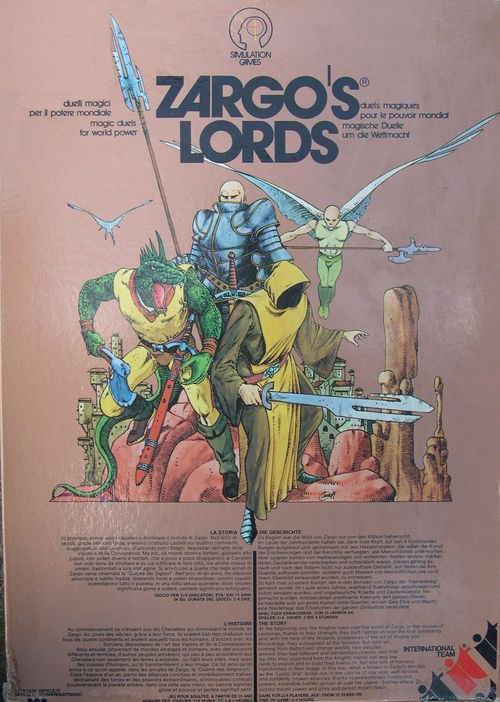
Zargo's Lords: Magic Duels for World Power
Zargo's Lords: Magic Duels for World Power Rulebook
Table of Contents
Table of Contents
Components
The box contains: 1 die, 1 map, table for archer rolls, flames, visions and fights, 240 pawns, 4 cards representing the 4 peoples.
The Map
The map represents the Zargo world map, with its seas, continents, mountains, forests, magic whirlpools and cloud bridges. A hexagonal grid is printed on it, to calculate the movement.
Where the continents "turn" on the edges, letters are printed, to facilitate the calculation of the passages from one point to another on the map: coming out of an edge for the hexagon E, the movement from points E or F of the corresponding edge will continue.
The Pieces You Play With
The pawns represent the various characters of the peoples who fought on Zargo, with their movement and combat characteristics, shown on them.
The movement factor, which is located on the pawn on the left, corresponds to the maximum number of hexes that a piece can travel on the map with each move.
The combat factor, which is located on the pawn on the right, corresponds to the value and strength of the various pieces, and is used to calculate the result of the fights (as we will see in the appropriate paragraphs).
Preparation of the Game
If there are 2 players, you only play with 2 peoples arranged on two continents for each; if there are 3 players, with 3 peoples; if there are 4, with 4 peoples, each on a continent, drawing them by lot in the following way: one player takes the cards representing the peoples, and arranges them face down, one on each continent.
The other players choose one by one, and in this way the peoples and the corresponding continents are distributed.
After that you begin to place all the pieces on the map:
- the cities in whatever hexagon one wishes on one's own continent;
- the garrisons of the cities, placed up to a maximum of four pieces, at the player's choice, above each city, but overturned, so that the enemies do not know how many forces defend them. (If these pawns were to come out, they would be uncovered, returning to cover them as soon as they returned);
- the rest of the forces, uncovered, are placed where the player sees fit, even in the mountains, in the woods or in the whirlpools, as long as they are always on their own continent.
ONLY AFTER THIS HAS BEEN DONE CAN THE FIRST ALLIANCES BE DISCUSSED.
How to Play
The first to move is always the Knight, then the Dragon, the Winged and the Monks move, always in this succession, whatever the regime of alliances that is created.
There are three periods that make up each player's move:
- possible new alliances are proposed;
- all the pieces that are intended to be moved are moved, placing those that have to attack or throw arrows or flames or visions in the positions chosen to do so;
- all the clashes are resolved, one after the other, starting with the throws and then the fights.
These three periods are repeated by each player, when it is up to him to move.
DURING A PLAYER'S MOVE, NO OTHER PLAYER'S PIECE CAN BE MOVED.
The Calendar and the Aim of the Game
The Year of Zargo is divided into 25 months, and within these months the game takes place. Each month corresponds to a move.
The Knight, before his move, deletes a month from the calendar, communicating it to the other players. At the end of the 25th month, whoever has the most cities, counting his own and conquered, is the winner.
It doesn't matter how many pieces each player has left: with 8 cities and 8 pieces, you win over opponents with 8 cities and 30 pieces.
Movement
General Rules
In any move you can move all the pieces that are in play (unlike chess where only one moves). You can move any piece (except cities) in any direction, even in a zigzag, of a number any of hexagons, as long as they do not exceed their maximum number of hexagons that can be walked on (movement factor).
There is no obligation to move everyone the pieces; if you want, you can move few or none. You cannot move pieces through enemies.
On the other hand, you can move through friendly and allied pieces, but do not leave them overlapping, except for infantry and in cities (see paragraphs cities and stocks).
Movement factors are not transferable from one pawn to another, nor can they be accumulated from one move to another.
THE DIE IS ONLY USED TO RESOLVE FIGHTS. IT HAS NO INFLUENCE ON MOVEMENT.
Special Rules
Apart from the exceptions of the individual pieces, which we will see by examining them one by one, there are some influences of the terrain that act regularly for everyone: the sea is never passable, except on bridges of clouds, and only from one coast to the other, not from one bridge to another.
There are no movement restrictions for passage on bridges. The mountains take a month to pass through (one move); then the approach movement will stop at their feet (adjacent hexagons), the move next move you will climb them and then on the third move you can start again normally, on the other side. If you want to transit through Along the way, every move is made in a hexagon.
[Translator's text is garbled here: "If you want to transit through Along the way, every move is made in a hexagon." Transcribed as printed.]
Each forest hexagon requires two points of movement to be passed. If there is only one point left at the end of a movement, there is no could enter a hexagon of wood.
[Translator's text is garbled here: "there is no could enter a hexagon of wood" is printed as such; the sense is that a piece with only one point left cannot enter a forest hexagon. Transcribed as printed.]
The magic whirlpools paralyze all activity of the piece that passes through it, stopping it, even if the movement could be longer, for three consecutive moves. A piece paralyzed in a whirlpool is unassailable. The Winged and the Falcons they only suffer the limitations of whirlpools and seas (the air currents over them do not allow flight, except over the bridges of clouds).
Battle
General Rules
Regardless of the position on the field, the one who acts is the attacker, the one who suffers the action is the defender.
To attack a piece, you move the attacking pawn into one of the hexes adjacent to the defender.
These hexes are his zone of influence, and are not passable except to attack him.
The zone of influence ceases to exist when a piece is attacked by even a single enemy and therefore can no longer control other hexes.
The flu will resume regularly from the end of the fight onwards.
[Translator's text reads "The flu will resume regularly" here; the sense is that the zone of influence resumes regularly from the end of the fight onwards. Transcribed as printed.]
You can attack an enemy with several pieces, placing them all in his zone of influence, adding up the individual values but retreating or losing them all in case of failure of the attack.
You can attack multiple enemies with a single one, if it has a combat factor that allows it to fight against the sum of the others, placing it in a hexagon of influence of both.
With a difference less than the minimum difference provided for in the combat table, it is not possible to attack.
At the end of the movement, all the pieces (1st period of the move) you will have some pieces adjacent to the enemies you have attacked, thus forming a series of clashes.
For each clash the attacker throws the die and, after setting the "combat table" disc on the sector corresponding to the number given by the die, the outcome of the fight will be seen which coincides with the band indicating the difference between the combat factors of those pieces.
E.g. three pieces of the Infantry Monks attack a falcon of the Winged.
- The die marks 4.
- Monks = combat factors 4 + 4 + 4 = 12.
- Falcon = combat factor 5.
- The difference between the combat factors is 12 − 5 = 7.
[The source prints "12 5 = 7"; the minus sign is restored here.]
Taking the combat table set on die 4, you look at the band next to the difference from 4 to 7, in which this case falls, and you see that the outcome of the fight is D3, that is, the falcon, defender, must move back 3 hexagons.
The compulsory retreat, indicated by the combat and vision tables, must take place along a straight line chosen by the retreat, which does not lead either to obstacles or other areas of influence of the attacker or other enemies, otherwise he is eliminated. Instead, he could pass over magical whirlpools, but normally remain paralyzed there.
If the repulsed retreat passes over to other own or allied pieces, they are also involved in the flight and must retreat on the same line, up to to allow the conclusion of the former's escape, just as if this were pushing them.
If, in turn, the retreat of the latter were to end up against an obstacle, they would be eliminated.
You can choose in this case between the elimination of the first piece, without retreating others, and the elimination of that or those in the back as a result of the movement of the former.
The retreat takes place immediately, at the end of each fight.
Special Rules
This system, generally valid for all pieces, (moving all the pieces, setting the fights that are resolved in a later period) can be replaced by another, limited to some pieces, such as the Winged, the Serpents and the Hawks.
These pieces can fight individually, that is, move for a part of the movement, immediately resolve the set fight and end the movement if they win, all without waiting for the movements and fights of others.
This is due to their nature, the Winged Ones attacking in flight, like hawks, while the snake overwhelms everything in its path, if it is not stopped by killing or repelling it.
THESE "SINGLE" FIGHTS MUST BE CARRIED OUT BEFORE ANY OTHER MOVEMENT, one at a time, for all the pieces that you want to make act in this way.
Once these individual attacks are over, the other pieces will move normally together, then also resolving their fights.
During a single attack, there are no enemy zones of influence.
The consequence of this type of attack is that clashes always take place one-on-one. Therefore, a piece attacked by several Winged Men with a single movement, for example, subsequently encounters them one at a time, with the possibility of eliminating them all as well.
For attacks with several pieces against one, the normal attack is always required.
If after a series of attacks, normal or single, there are enemy pieces left adjacent to each other, the first player who has to move, whose If the pawns are in such a position, he can choose between leaving them there, necessarily attacking the neighbors, or withdrawing them from that hexagon.
[Translator's text is garbled here ("whose If the pawns are in such a position"). Transcribed as printed.]
Increases for the Land
The terrain, in addition to affecting movement, can also affect the value of a piece: mountains increase the value of an attacked piece by three points while it is placed on them; woods, on the other hand, increase the value of an attacked piece while on them by one point.
These increases only apply to the defending pieces; if an attack were to be carried out from a mountain or woodland hexagon, there would be no increase for the attacker.
Covenants
(Only for three or four players)
As we have already seen from the first move, alliances can be established between one people and another.
These alliances are free, i.e. based only on the agreement of the players; THEY ARE NEVER BOUND.
If a player wants to betray the ally at some point, joining another or others, he can do it as he wants, limited only by being able to PROPOSE the alliance BEFORE his move.
Given this political instability, also caused by the fact that in the end only one people wins (the one that has the most cities), an exchange of hostages is planned at the time of the alliance to make it stronger.
The number and type of hostages is left to the bargaining of the players (at the limit a maximum time for bargaining will be established at each move).
The delivery of hostages takes place by bringing, with normal movement during the moves, the requested pieces to the continent of the ally, who will take them over by superimposing his escort who will accompany them to a city, where the hostage must stay, even if there is no garrison (up to two hostages can be placed in each city).
From the moment of delivery to the allied escort, the hostages will lose all power, they will have to remain locked in the city, and they can be eliminated, one per city in every move, and only if they are in the city, even without a garrison, at the will of the custodian.
They can eventually be freed by occupying the city in which they are captive, before they are eliminated, if the conquest takes place by their own, or captured by others along with the city.
The Pieces
Let's now examine the various pieces with their characteristics one by one.
Knights
Lords of their people. If they attack with a movement entirely in a straight line (charge) they are worth three more points or one depending on whether the impact against the enemy takes place frontally or laterally.
Fanti
Movement and value as it is written on the pawn, without other powers.
Wizards
Movement and value as on the pawn. In addition, they increase the value of all the pieces adjacent to them (as long as they belong to their people) by two points.
They can then cast visions to an enemy per move, within a radius of 5 hexagons, in this way: you throw the die, rotate the disc of visions up to the band corresponding to that die, then calculated the distance in hexagons between the Wizard and his target, you see next to the band corresponding to that distance the effect of the vision. The closer the goal, and the higher the die, the longer the flight in the throes of vision. (flight that occurs exactly as in the retreat of the fighting). Of course, or launches visions or fights with his pawn value.
Visions are not limited by any obstacles, and they do not necessarily have to be cast in a straight line.
Fantarceri
To hit an enemy within 8 hexes they shoot (if they are attacked instead they defend themselves like infantrymen with written combat value on the pawn) in this way: each toss is made at the end of the movement (if they move) together with all the others fighting, IN A STRAIGHT LINE; They can move and shoot in the same move.
To see if they hit effectively, roll the die once to fantasy, rotate the arrow table until you frame the sector corresponding to that die, and, based on the distance as for the visions, you know how many arrows they have hit.
Each goal requires a certain number of arrows to be eliminated (see notes on the shooting table). If you do not reach that minimum number, the shot is ineffective. However, if you shoot with several archers on the same target, to eliminate it you will calculate the sum of the arrows of all these shots.
E.g. Against a Dragon you need 6 arrows;
- 1st archer = 1 arrow;
- 2nd archer = 3 arrows;
- 3rd archer = 2 arrows;
- Total = 6 arrows.
Even if every single archer he does not eliminate it, the sum of the arrows is enough and the Dragon dies.
You cannot pull over a mountain, a forest, a city, even a friend, into or from within a forest, beyond a magical whirlpool. Instead, you can pull over other friendly or enemy pieces.
City of Knights
They can hold up to 4 pieces of garrison, hidden, and two hostages.
They cannot be placed at a distance of less than 4 hexes from each other.
The pieces contained in a city placed on a mountain or in a forest do not enjoy the increases given by that terrain.
Winged
Lords of their people. Since they fly, they have no movement restrictions, save for magical whirlpools and seas, and can pass over enemies and their zones of influence.
They have the option of attacking normally or individually, as already seen. At the end of each move they land, so they can be attacked normally.
If under escort, they travel as infantrymen (see paragraph "Escorts").
Hawks
They move like the Winged Ones, with the same limitations and possibilities, but they have lesser values.
Fanti
They do not fly; movement and value as written on the pawns, without other powers.
Fantarceri
They do not fly; for the rest they act as the Knights' fantasico.
[Source reads "fantasico" here, apparently a garbled form of "fantarceri"; transcribed as printed.]
City of the Winged
Like those of the Knights.
Dragons
Lords of their people.
They move and fight according to the values shown on the pawns. In addition, as an alternative to normal combat, they can throw flames at targets within 5 hexes.
To determine if the flames eliminate the target, take the fire table by seeing, as with arrows, based on the ratio between distance and die, if the shot hits. Here too the flashes can be added.
The Dragon can throw flames either before moving or after moving. If it suffers an attack, it only fights normally.
Fanti
Movement and value as written on the pawns, without other powers.
Flamethrower
They normally move according to the values written on the pawn, and normally fight if attacked.
Instead in attack, instead of normal clash, they throw flames like Dragons, but only at the end of the movement (i.e. they cannot flame and then move).
Snakes
They move and fight with the values reported on the pawn but, if they make the path in a straight line, they can continue the movement beyond the defeated enemy and continuing to load other pieces are on the same line in which it had started, until all his possibilities of movement are exhausted.
This movement, as already seen, is single.
Dragon City
Like those of the Knights.
Monks
Lords of their people.
They fight and move normally.
In addition, they can disappear by putting, on the move in which they disappear, the "disappeared" signal on the hexagon they were in and reappearing, on the next move, where they want, even beyond obstacles, as long as they are within the range of their maximum movement.
The Monks cannot first move and then disappear, because disappearance is already a move in itself, and when they disappear they cannot cross either the sea without bridges or the whirlpools.
They can immediately move and attack on the move they respawn.
Infantry Monks:
They fight and move according to the values written on the pawns.
Knight Monks:
They fight and move according to the values written on the pawns. They don't have point additions for charges like Knights.
Illusionist Monk:
Fights and moves according to the values of the pawn, but in addition, as an alternative to combat, he can give visions like a magician, without increasing the points to neighboring pieces.
City of Monks
Like those of the Knights.
Stocks
All the pieces must be arranged and moved without overlapping them, except for the infantrymen, who overlap and escort another piece that is not an infantryman, suffering alone all the attacks that may be carried out on the two pieces together.
The escorted piece, however, has no power nor does it add anything to the escort that fights as if it were alone.
In one move you can overlap the stock or remove it, without losing movement points, but you cannot do the two things at the same time. In the move in which the escort is removed, the escort can immediately act with all his powers.
If an escort has to retreat, at the end of a fight, the escort also follows the movement of the escort.
[Source wording: "the escort also follows the movement of the escort." Transcribed as printed.]
If, on the other hand, the escort is eliminated, the escort must retreat normally (i.e. being eliminated if he encounters obstacles, etc.) by the maximum of his movement.
[Source wording: "the escort must retreat" is printed here; the sense is the escorted piece retreats. Transcribed as printed.]
The Conquest of a City
We have already seen that conquering a city means bringing pieces into it. To do this, it is necessary to eliminate the garrison if there is one, a garrison consisting of a maximum of four pieces, which adding up their combat, as a single piece of greater value, and which the attacker does not normally know.
To attack the garrison you have to besieging pieces to hexes adjacent to the city, and at that moment the garrison he will find out, declaring himself and providing data to see if the attack, again based on the combat table, was successful.
BOWS, FIRE, AND VISIONS HAVE NO HOLD ON THE CITY, WHILE THEY CAN ACT FROM THE CITY AGAINST THE BESIEGERS.
To discover the forces of a city, you cannot send a single piece against it, but you need at least as many as there are garrison pieces, since attacks with differences smaller than those foreseen in the combat table are prohibited.
If, once the garrison pieces have been discovered, the attackers are still inferior to this minimum difference, even though they are as many as the defenders in terms of the number of pieces, the besiegers would be automatically eliminated.
The besieged are not obliged to attack all the besieging pieces, but they can attack only a part of them separately.
Cities cannot be placed in coastal hexes.
End of rulebook.