Zarcana
Zarcana Rulebook
Table of Contents
Table of Contents
Overview
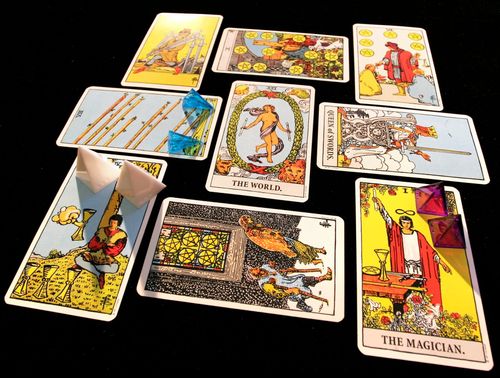
Zarcana is a game of war, journeys, growth, life, and death. The pyramids will become your minions, who will march across a gameboard formed by an arrangement of tarot cards. Each face up card (or territory) provides the pieces standing on it with a special ability; you will also have a hand of cards with powers you can use on any of your pieces. As your minions fight for control of existing territories, the board also expands and changes, with more cards being added or even removed from the table. Each territory has a point value, and when the game ends, the player whose territories have the greatest total value will be the winner!
Goal
Become the player with the highest total score by controlling the most valuable territories at the end.
Equipment
- 3-5 trios of one color for each player
- Tarot deck
Regarding Number of Pyramids
Zarcana is one of the earliest pyramid games and as such was designed to use a "full stash" of 15 pyramids for each player. This remains the ideal. However, you can still play this game even if you only have 3 or 4 trios per player.
Regarding Tarot Cards
Almost any deck of tarot cards can be used to play Zarcana. However, many tarot decks vary considerably from the classic Rider-Waite standard. Be sure to remove (or discuss how to handle) any unusual cards before starting to play.
Tarot decks are available in numerous different styles, however, most still contain the same set of cards: four suits with four royalty cards each, plus 22 unique Major Arcana cards. However, even if the cards are the same, the names are often different. Cups and Swords are usually still called Cups and Swords, but Discs may be called Coins or Pentacles, and Rods are often Staffs, Wands, or Batons. As for the Major Arcana cards, the traditional names will often vary slightly. (For example, the Hierophant is often called the High Priest or the Pope.) The more unusual your deck is, the more adaptations you will need to agree upon in order to use the cards for this game.
You will need to consult these rules frequently during your first few games, but don't worry: you will quickly start to remember what each of these cards is used for.
Terminology
- Minions: Your collection of pyramids.
- Territory: A card on the table.
- Wasteland: The empty areas surrounding the Territories.
- Occupy vs. Control: You occupy a card if one or more of your pyramids is on it; you control a card if you are the only player occupying that card.
- Adjacent: Two cards on the board are adjacent to each other if their sides are touching.
- Major Arcana: The 22 special cards, as opposed to the Minor Arcana (i.e. the Cups, Swords, Discs, and Rods).
Setup
Each player starts by taking their set of pyramids and stacking them on their side of the table.
Shuffle the deck, then put at least 3 random cards back in the box without letting any be seen. (For a shorter game, set aside 25 or 30 cards.)
Deal out 9 cards, face up, in the center of the table, using the pattern shown in the rulebook diagram.
Deal 3 cards to each player.
Who Starts
You decide, unless you want to use the complex ritual described near the end of these rules.
How to Play
The game begins with the players taking a look at the nine random cards that form the gameboard. Zarcana is always unique because every different combination of cards creates a different situation.
Each player will need to decide which card they think is the best place for them to start, and how they will react if someone else chooses it first.
Once you have a piece on the board, you can grow your army of minions (using the power of Cups) and move your pieces to neighboring territories (using the power of Rods). When you come into contact with other players' pieces, you can attack them (using the power of Swords), and you can expand the board by adding new cards (using the power of Discs). Lastly, there are two dozen special cards (the Major Arcana) which each provide a unique, special power.
Each space on the board will have a point value, ranging from 0-21. You score those points at the end of the game if you are the only player with a piece on that space.
You will have 8 possible game actions to consider, but you can only take one action each turn. This results in a game with fast action and short turns.
The game continues until someone declares the final turn, which can only be done after the deck has been reshuffled.
The Wasteland
The open region surrounding the cards is the Wasteland. Minions can survive in the Wasteland, but only if they are close to the edge. They cannot move beyond an imaginary card adjacent to a real card. A piece in the Wasteland can be destroyed if the territory next to it is removed.
The Ever-Changing Game Board
As already mentioned, the gameboard can be expanded by adding new cards. Typically, this will be done in empty spaces adjacent to a card you occupy; however, it is also possible for new cards to be placed on top of cards already in place. Cards can also be removed from the table, by attacking the card itself (using the power of Swords). Lastly, one of the Major Arcana cards (the Moon) will allow a card to be moved to another location.
The Eight Turn Options
On your turn, you will choose one of the following:
- START: Place a small pyramid on any card territory, standing up. (Only if you have no pieces on the board.)
- PLAY A CARD: Select a pyramid to use the power of a card you play from your hand.
- USE A TERRITORY POWER: Select a pyramid to use the power of the card on which it sits.
- DISCARD FOR WILD: Discard 2 cards of the same type to gain a Wild action.
- REORIENT: Change the orientation of any or all of your pyramids. (They can point in one of five directions.)
- DRAW: Draw up to 3 cards. (Hand limit: 6.)
- PASS: Do nothing. (This happens very rarely.)
- END: Declare the final round of the game. (Only if the deck has been used up and reshuffled.)
Targeting
The direction in which a pyramid is pointing will determine what other pieces or territories it can affect. Pyramids can be pointed up, or they may be lying down, pointed in one of the four possible directions. Upright pieces target the space they are in, and sideways pieces target the space they are pointed at.
Restriction Icons
Many cards have restrictions. These icons are used to indicate these limitations.
- Upright pyramid icon: This power may only be used by an upright pyramid.
- Lying-down pyramid icon: This power may only be used by a pyramid which is lying down.
- Pyramid-on-card icon: This power may only be used by a pyramid on a card, not in the Wasteland.
- Population Limit icon (3): The Population Limit of 3 total pieces per space must be obeyed when using this power.
- Hand Limit icon (6): You cannot exceed the Hand Limit of 6 cards when you use this power.
- Standing-up icon: The active piece must be placed standing up when the turn ends.
Exceeding Limits
The Population and Hand Limits restrict your ability to use a power. (For example, if you have 4 cards, you can only draw 2, rather than drawing 3 then discarding to 6.) If a restriction does not apply, you can then remain in excess of the limit.
The Four Main Powers
Here are the functions and limitations of the four Minor Arcana suits.
Cups: Grow/Clone
With this power, you can replace one of your pieces with the next larger size (Grow), or you can add a new piece to the territory of the same size (or smaller) as one you already have in that space (Clone).
Rods: Move
With this power, you can move a piece from its current location to the territory (or Wasteland location) at which the piece is pointing. Arrive standing up.
Discs: Build Territory
Add a new card to the board by drawing from the deck and placing the card face up in the targeted location. You can build in the Wasteland or you can cover an existing card (only the topmost card counts for anything). You can build underneath minions, but only if all of those pieces belong to you.
Swords: Attack
This power allows your piece to attack another piece in the targeted space, or, if the territory is unoccupied, the card itself. You can attack your own pieces, but the active piece cannot attack itself.
If the targeted piece is larger than the attacker, it is reduced in size; but if the targeted piece is smaller or the same size, remove it from the board.
If the territory is unoccupied, the topmost card is removed and discarded.
Wild Cards
Wild cards can be used to gain any of the four main powers. There are three ways to get a wild card:
- Doubles: You can discard two cards of the same suit to gain a wild card power. For the purposes of this rule, all Major Arcana cards are considered to be the same suit.
- Royalty: Each suit has four royalty cards: King, Queen, Knight, and Page. Each of these cards can be used as a wild card, but ONLY when played from the hand. Royalty on the table can only be used as its indicated suit.
- The Magician: This Major Arcana card is a wild card.
Ending the Game
The game ends when someone declares the end. This can only happen after the deck has run out and been reshuffled. When someone uses their turn to call for the end, each player gets one final turn. This includes the player who ended the game, who gets the final action.
Scoring
When the game ends, each player scores points for all territories they occupy exclusively, as follows:
- Basic Minor Arcana: These cards each score their indicated values: 1-10. (Aces are ones, not Royalty.)
- Royalty: Each of these cards is worth 11 points.
- Major Arcana: The point value for these cards is whatever number appears on them. (Note that the traditional number for these cards have been listed on the previous pages; however, these numbers sometimes differ, and priority should be given to whatever numbers actually appear on your cards.)
Other Notes
Bidding for the First Turn: Each player must decide which of their cards to discard as their bid, or choose not to participate in the bidding. All players must select a card and hold it out, face down; everyone then simultaneously either reveals and discards their card, or hides it again in their hand. The player whose card had the highest point value goes first. If there's a tie, all tied players must bid again. If all players withdraw their bids, repeat the process with bidding becoming mandatory for all.
Invincible Minions: When attacking, if a piece is to be reduced in size, but the next smaller size is not available, the piece cannot be attacked. The exception to this is Death, which can be used to combine both attacks to destroy an invincible piece. Nobody can escape Death.
Adjusting the Initial Layout: With 2 players, start the game with a smaller board, consisting of just 4 cards. When 5 or 6 are playing, create a 13-card initial setup by adding an extra card to each side.
The Gateway and The Doppleganger: These two cards do not appear in traditional tarot decks. It is, however, very common for a tarot deck to include one or two extra cards, like the Jokers in a standard card deck, typically featuring publisher info. The extra powers of the Gateway and the Doppleganger were added to make use of these cover cards.
Historical Notes
Zarcana was originally published in 1996 (under the name Arcana) in the first booklet of new games for Icehouse pieces, called More Icehouse Games. Zarcana was the inspiration for a superficially similar game called Gnostica (which also requires a Tarot deck) as well as Zark City (which instead uses standard playing cards).
Card Powers
Each Major Arcana card is listed with its point value (the number in the corner of the card) and its power. Royalty and Minor Arcana powers are listed under the four main powers above.
Power Reference
- Cups — Grow or Clone: Replace a piece with next larger size, or duplicate a piece.
- Rods — Move: Move piece to targeted space and stand it up.
- Discs — Build Territory: Draw a card and place it in the targeted location, if said space contains no enemies.
- Swords — Attack: Reduce/destroy targeted piece, or remove empty territory.
- The Fool (0) — Play 2 Random Cards: Draw a card and play it. Do it again. Royals are not Wild.
- The Magician (1) — Wild: Counts as any one of Cups, Rods, Discs, or Swords.
- The High Priestess (2) — Draw 2 & Play Again: Draw up to 2 cards, then take another turn. (Go Again.)
- The Empress (3) — Grow or Clone Without Limitation: Ignore the population limit or grow in the Wasteland.
- The Emperor (4) — Attack & Take Cards: In addition to piece damage, demand up to 3 cards (their choice) from other player.
- The Hierophant (5) — Attack to Convert: Attack as with Swords, but replace targeted piece with one of yours, standing up.
- The Lovers (6) — Build in Wasteland: Place a piece of any size into any empty Wasteland space.
- The Chariot (7) — Move Twice: One piece moves either once or twice, without regard to original orientation.
Transcription Notes
- The original card table prints restriction pictograms beside several powers, and the rulebook text does not spell out which pictogram belongs to which card. Those pictograms are not reproduced as words in this entry; the restriction legend above is transcribed from the rulebook's Restriction Icons section.
- The Hand Limit and Population Limit numbers printed on the card table (6 and 3) are the same limits described in the Restriction Icons section.
- The Doppleganger's point value is printed as "?" on the source card table; it is transcribed as printed.
- The rulebook's Goal text reads "controling"; it is transcribed here as "controlling" (typographical correction).