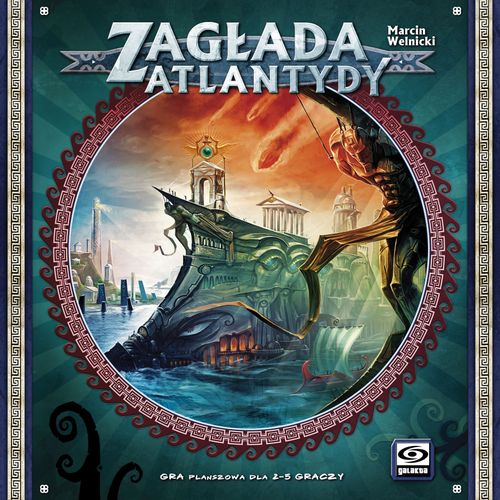
Zagłada Atlantydy
Zagłada Atlantydy Rulebook
Table of Contents
Table of Contents
- Overview
- Object of the Game
- Components
- Setup (4-player)
- Game Turn
- End of the Game
- Ships and Upgrading Ships
- Moving Ships
- Moving Ships During the Doom Phase
- Victory Points Track
- Receiving Victory Points
- Revealing Event Cards
- Neutral Refugees
- Discarding Refugees and Influence Tokens
- Breaking Ties
- Variants
- Tips
- Card Descriptions
- Factions of Atlantis
Overview
End of Atlantis is a board game about a great escape from the mythological island for 2 to 5 players. In End of Atlantis each player becomes a leader of one of the royal houses and his job is to save as many of his kinsmen as he can. To this end he will have to use his wit to manipulate the Senate, anticipate his rivals moves and forge alliances with the Factions of Atlantis.
In End of Atlantis not everything goes according to plans – half-empty ships will prematurely leave the port, saboteurs will destroy vessels at sea, and treacherous agents will throw our your kinsmen overboard. In the face of extinction, even a civilization as proud as the Atlanteans shows it's darker side.
Object of the Game
At the end of the game the player with the most victory points wins.
Components
End of Atlantis includes the following components:
- 1 game board
- 1 Support tile (for placing cards)
- 5 player screens
- 3 Doom markers
- 100 wooden cubes in five colors (influence tokens and refugees): 20 yellow cubes, 20 green cubes, 20 red cubes, 20 blue cubes, 20 purple cubes
- 10 neutral refugee tokens (black cubes)
- 10 player markers (2 in each of the five colors)
- 10 Ship tiles
- 7 Faction tokens
- 120 cards: 80 Politics cards, 25 Special cards, 10 Event cards, 5 Player Aid cards
Setup (4-player)
The following rules are intended for 3-4 players. Rules for 2-player and 5-player games can be found at the end of this rulebook, along with a simpler family variant especially suited for new players.
- Unfold the game board and place it in the center of the play area. Put the Support tile next to the game board.
- Shuffle the Politics cards and Special cards separately to form the Politics and Special decks. Place those decks on the spaces provided on the Support tile.
- Now you must prepare the Event deck. Separate the 3 "Doom!" cards from the rest of the Event cards and put them aside. Then randomly remove four of the remaining Event cards and without looking at them, put them in the game box – they won't be used during this game. Then add the 3 "Doom!" cards to the remaining cards and shuffle the deck. Finally, place the deck on the space provided on the Support tile.
- Place the 3 Doom markers on the Doom spaces at the top of the board.
- Separate the 5 starting ships (marked with a letter on the tile back) from the 5 advanced ships (marked with a letter in a circle on the tile back) and place the starting ships on the five port spaces on the game board. The ships must be placed alphabetically from left to right (i.e. the "A" ship should be placed on the first space from the left, the "B" ship should be placed on the second space from the left and so on). The advanced ships should be placed near the game board – they will be used later.
- Place 2 neutral refugee tokens on the ship with the most spaces, that is on the ark (A).
- Place the rest of the neutral refugee tokens on the refugee camp in the middle of the board.
- Place the Faction tokens on their respective spaces above the Senate. Each token should be placed on the bust with its likeness, with the "+1" side down.
- Each player receives 1 player screen (which is placed in front of him) and 1 Player Aid card.
- Each player chooses one color (blue, red, green, yellow or purple) and takes 20 cubes and 2 markers in that color. The player hides his cubes behind his screen.
- Each player receives 7 random Politics cards and 2 Special cards. Players may look at their own cards, but should not show them to the other players.
- Each player places one of his player markers on the "02" space of the victory track. This is his victory points marker.
Player cubes: influence tokens and refugees
Depending on the way players use the cubes, they will be called either:
- Influence tokens: Those are the cubes that are placed in the Senate pool, used to pay for the Faction tokens and used for voting.
- Refugees: Those are the cubes that are placed on the ships.
Example of the game board after setup for a 4-player game
The setup example diagram is numbered as follows:
- Senate pool
- Faction tokens
- Player markers on the Faction spaces
- Neutral refugee tokens in the refugee camp
- Starting ship with refugees
- Doom markers
- Support tile
- Special cards deck
- Event deck
- Current Event card space
- Politics deck
- Player markers on the victory points track
- Victory points track
- Player area
- Player screen
- Influence tokens
- Special cards
- Player's hand (Politics cards)
- Player Aid card
Game Turn
End of Atlantis is played over several game turns (from 4 to 8), each consisting of the following four phases:
- Senate phase
- Factions phase
- Voting phase
- Doom phase
1. Senate Phase
During the Senate phase players can strengthen their positions in the Senate by sending followers, who will influence the assembly.
Each player secretly places any number of his available influence tokens into his hand, hiding them in a closed fist. Once all players have made their selections, everyone simultaneously reveals their bid by opening their hands. Then each player places those tokens in the Senate pool.
The number of tokens in the Senate pool dictates the order of players (called "the Senate order"). The player with a higher position in Senate order wins ties against a player in a lower position (in other words, a player wins all ties with other players, who have less influence tokens in the Senate pool than him). If 2 or more players have the same amount of tokens in the Senate pool, the tie will be won by the player, whose player marker is on the Faction space closer to the left side of the board (i.e. the player with the "Basileus" token would win a tie with a player holding the "Demiurgos" token).
The influence tokens remain in the Senate pool for the duration of the turn – players will recover them during the Doom phase.
2. Factions Phase
During the Factions phase players can forge alliances with different Atlantean Factions. The Factions provide players with different abilities.
In Senate order, each player may take one Faction token. The player with the highest number of tokens in the Senate pool goes first – he can take one Faction token or pass. Then the player with the second highest number of tokens in the Senate pool chooses his Faction token or passes and so on.
If a player wants to take a Faction token, he must pay for it with influence tokens he still has left (not the ones in the Senate pool). The number of tokens he is required to pay depends on the number of players in the game.
The cost of acquiring a Faction token (in influence tokens)
| Position | 5 players | 4 players | 3 players | 2 players |
|---|---|---|---|---|
| First player | 2 | 2 | 2 | 1 |
| Second player | 2 | 1 | 1 | 0 |
| Third player | 1 | 1 | 0 | 0 |
| Fourth player | 1 | 0 | 0 | 0 |
| Fifth player | 0 | 0 | 0 | 0 |
When a player acquires a Faction token, he takes it and places it in his player area. Then, he moves his player marker to this Faction token's space. Finally, he places the influence tokens he spent on the building next to this space. Notice, that this may lead to a situation, when for a brief time two markers share the same space.
Players will recover the influence tokens spent on Faction tokens during the Doom phase.
Notice, that the decision to acquire a Faction token or pass doesn't influence the cost of the Faction token for the next player. For example, during a 4-player game, the second player always pays (that is, if he does not pass) one influence token for a Faction token, whether or not the first player acquires a Faction token or passes.
After each player has a chance to acquire a Faction token or pass, the players who passed must select their Faction tokens. In Senate order, each of those players must select and acquire a Faction token for free.
A player may choose the same Faction token that he chose in the previous turn (if it's still available).
Example: In a 4-player game Martin plays blue, Paul red, Leopold yellow and Michael green. Martin (blue) is first in Senate order, so he chooses his Faction first. If he decides to acquire a Faction, he must pay for it with 2 influence tokens. Martin passes. Next is Paul (red), the second player according to Senate order. If he wanted to acquire a Faction token, it would cost him only 1 influence token (regardless of Martin's decision). Paul also passes. Leopold (yellow), the third player according to Senate order, pays 1 influence token and acquires the "Basileus" token. He moves his marker to the space he took the "Basileus" token from and places the influence token he spent on the building next to that space. The "Basileus" token had a "+1" on the side facing up, so Leopold immediately receives one victory point. The last player to choose a Faction is Michael (green). He takes the "Demiurgos" token for free (and moves his marker to that space). Now it's Martin's turn again. He takes the "Philosophios" token for free (and moves his marker to the "Philosophios" space). Finally, Paul takes the "Strategos" token for free (and moves his marker to the "Strategos" space) and receives 1 victory point (because of the "+1").
At the end of the Factions phase players flip the tokens that were not chosen to the "+1" side (do not flip tokens, that are already flipped to this side).
During the next Factions phase those tokens are worth an extra victory point. If a player acquires such a Faction, he will immediately receive 1 victory point.
Roles and special abilities provided by each Faction are detailed under "Factions of Atlantis" below.
3. Voting Phase
During the Voting phase players will try to influence the Atlantean Moot, so that it will take actions that favor them.
From the 7 cards he has in his hand, each player chooses 5 cards and places them in front of himself facedown in a chosen order, from left to right. It should be clear in what order the cards have been placed. This is important, because the cards will be voted for in that order (from left to right) – first, players will vote for the left-most cards, then the second card from the left and so on.
When all cards are in place, players reveal them simultaneously (they cannot change their order).
Now players will vote for those cards. First, players will vote for the left-most cards, then cards next to the left-most cards and so on. Players should slightly move the cards that are currently voted for forward.
Example: In the diagram above players are voting for the second card. To mark this fact, it was moved slightly forward.
The symbol on the Event card drawn during the previous turn dictates the voting type for the whole Voting phase.
Important: During the first turn of the game there is no Event card in play. However, there is a voting symbol printed on the space for the current Event card on the Support tile, telling players, that during the first turn of the game they will be using the "hidden" voting.
In End of Atlantis there are two voting types: open voting and hidden voting.
During each voting (players will vote five times, once for each card) each player votes for his own card. The two players who will win a given voting will have a chance to play their cards. Players play their cards just after finishing one voting and before they start another one.
Additionally, the player who won first place in a voting receives a bonus: he can play his own card or the card of the player to his left. If a player chooses to play the card of the player to his left, he doesn't play his own card.
Important: If the player to the left also won the voting (he won second place), the first player cannot play his card. In such a case he can play the card of the next player to the left.
Politics cards are detailed under "Card Descriptions: Politics cards" below.
Playing a card is always optional. That means, that the players who won a voting can play their cards, but are not forced to do so. If they don't want to play their cards, they can pass. However, if they do want to play their cards, they must fully apply their effects; if they cannot do so, they cannot play the cards (i.e. a player playing a "Refugees (2)" card must place two refugees on a ship; if he can only place one refugee – either because he doesn't have enough tokens or there's not enough room on the ship – he cannot play the card, so he doesn't place any refugees on the ship).
The influence tokens used in a given voting are placed on the cards that the players where voting for.
Example: In the first voting, Martin (blue) spent 3 influence tokens, and in the second voting, 2 influence tokens. Now Martin will be voting for his third card (he slightly moved it forward, to mark this).
Important: All influence tokens bid by players, regardless of outcome, are discarded and placed on the cards. This means that even if a player didn't win the voting, he still loses the influence tokens he used during that voting.
Types of Voting
Hidden voting
Each player secretly places any number of his available influence tokens into his hand, hiding them in a closed fist. Once all players have made their selections, everyone simultaneously reveals their bid by opening their hands.
A hidden voting is won by the player who bid the most influence tokens and the player who bid the second-most influence tokens. If there is tie, it is resolved according to Senate order.
Example: A 3-player game. Paul has 16 influence tokens, Leopold 14 and Michael 12. Each player secretly chooses a number of tokens, hides them in a fist and then simultaneously reveals them. Paul bid '4', Leopold also '4' and Michael '5'. Michael is the clear winner of the voting. Paul and Leopold bid the same amount of tokens, but Paul is higher in Senate order, so he takes second place. In the end, Michael and Paul will play their cards. Michael takes his action first – he can play his own card or Leopold's card. When he finishes his action, Paul will be able to play his own card. Leopold will not play any cards, but he still discards 4 influence tokens and places them on his own Politics card.
Open voting
Each player, in reverse Senate order (the player who has the least amount tokens in the Senate pool goes first and so on), openly states his bid or passes (a bid of '0' influence tokens is considered the same as passing). A player's bid must be different than the bids of other players (it can be higher or lower). Exception: More than one player may pass.
An open voting is won by the player who bid the most influence tokens and the player who bid the second-most influence tokens. If there is tie, it is resolved according to Senate order.
4. Doom Phase
During the Doom phase players will perform the following actions (in this order):
-
The player with the most influence tokens on Promised Land this turn receives 2 victory points. If there is a tie, the points go to the player with a higher position in Senate order.
-
The player with the most influence tokens in the Senate pool this turn receives 2 victory points. If there is a tie, the points go to the player with a higher position in Senate order.
-
Players reveal the top Event card. If this is not the end of Atlantis, they resolve the card (see "Revealing Event cards" below). The revealed Event card is then placed on the current Event card space on the Support tile.
Each Event card will have one of two symbols: a 'hidden' symbol or an 'open' symbol. Those symbols indicate the type of voting players will use next turn.
-
Three of the five ships move forward (see "Moving ships during the Doom phase" below). If some ships reach the Promised Land, players receive points as normal.
-
Each player returns his Faction token, placing it on its original space on the board, and takes all of his influence tokens from that space and hides them behind his screen (the player marker stays in its place).
-
Each player takes all of his influence tokens from the Politics cards used during that turn and hides them behind his screen. The Politics cards themselves are discarded to the discard pile next to the board.
-
Each player takes all of his influence tokens from the Promised Land and hides them behind his screen.
-
Each player takes half of his influence tokens from the Senate pool (rounding up) and hides them behind his screen.
Important: If during the Doom phase players reveal a "Doom!", "Senate Pays Its Debts" or "Under The Senate's Leadership" card, each player takes all of his influence tokens from the Senate pool.
Influence tokens that were placed onboard the ships (refugees) stay in their places!
End of the Game
When players reveal the third "Doom!" card, they remove the last Doom marker from the board and the game ends immediately.
Each player reveals his Special cards and adds any additional victory points to his score.
The player with the most victory points wins the game. In case of a tie, the player with the higher position in Senate order wins.
Ships and Upgrading Ships
There are 5 ships in End of Atlantis:
- The Ark (A), which has 7 spaces
- The Science Vessel (B), which has 5 spaces
- The Royal Vessel (C), which has 5 spaces
- The Airship (D), which has 3 spaces
- The Warship (E), which has 3 spaces
During play each of those ships will be upgraded. The advanced versions of the ships are marked with the same letters, but the letters are printed in a circle.
At the beginning of the game the advanced ships should be placed near the board. They will come into play at a specific moment (see "Revealing Event cards" below). The starting ships vary in size: each has a different number of spaces for the refugees. The advanced ships gain unique special abilities:
- Advanced Ark: The advanced ark has 8 spaces, one of which is permanently occupied by a neutral refugee. The neutral refugee appears on the ship as soon as it is upgraded (even if the ship is on the ocean). This neutral refugee can be targeted by cards, like the "Aristocracy" Politics card or the "Empath" or "Alliance" Special cards.
- Advanced Science Vessel: The advanced science vessel has 5 spaces, but the technology carried onboard is very valuable. The player that uses a "Ships" or "Royal Ship" card to move the advanced science vessel from the ocean to the Promised Land receives 2 bonus victory points.
- Advanced Royal Vessel: The advanced royal vessel has 5 spaces, but the officials onboard are very influential. The player that uses a "Ships" or "Royal Ship" card to move the advanced royal vessel from the ocean to the Promised Land receives a Special card.
- Advanced Airship: The advanced airship has 3 spaces, but is extremely fast. It can travel from Atlantis to the Promised Land in one move. In other words, a player needs only to use one "Ships" card to move the ship to the Promised Land. If the airship is upgraded while on the ocean, it will remain in its place (it won't automatically reach the Promised Land). The special ability of the advanced airship will come into play on the next voyage from Atlantis to the Promised Land. Important: Players can't use a "Royal Ship" card on the advanced airship!
- Advanced Warship: The advanced warship has 3 spaces, but the security onboard is impeccable. Players can't play red Politics cards ("Betrayal" and "Sabotage") on the advanced warship.
Moving Ships
Players will move ships between three areas of the board:
- The Port of Atlantis – Here players can place refugees on ships.
- The ocean – A transitory area.
- The Promised Land – When a ship reaches this area, players will receive victory points for the refugees that were on that ship.
Two of the Politics cards ("Ships" and "Royal Ship" cards) allow players to move the ships forward. Each ship begins its voyage in the port of Atlantis, then moves to the ocean and finally to the Promised Land.
Exception: The advanced airship moves directly from the port of Atlantis to the Promised Land.
When a ship reaches the Promised Land, players receive victory points for the refugees that were onboard. Then the ship immediately returns to its place in the port of Atlantis.
Important: Players can never move empty ship!
Important: Players can never move ships backwards (the ships move only in one direction, towards the Promised Land)!
Moving Ships During the Doom Phase
Players can move the ships in the Voting phase, but some of the ships will also move on their own during the Doom phase. After the Event card is resolved, players have to move three of the five ships, one area each. The movement of the ships during the Doom phase is governed by the following rules:
- First, players have to move the ships that are completely full.
- If, after moving all of the ships that are full, players haven't moved three ships, they next move the ship with the most refugees onboard. If they still haven't moved three ships, they move the ship with the second most refugees onboard and so on.
- If there are more than 3 ships that are completely full or there's more than 2 ships with the same amount of refugees onboard, players move the ships that are closer to the left side of the board first (marked with an earlier letter of the alphabet).
- Players should never move empty ships. If they haven't moved three ships, but the rest of the ships are empty, during that turn no move ships are moved.
Example: Ships A and B are completely full, ship C is empty and ships D and E have 2 refugees onboard each. In this situation players should move ships A and B (because they are completely full) and ship D (ships D and E have the same amount of refugees onboard, but ship D is closer to the left side of the board). If ships A, B and C were empty, players would only move ships D and E.
Victory Points Track
The victory points track encircles the main part of the game board. When players gain or lose points, they move their player marker on this track to reflect the change. Each space on this track is equal to 1 victory point.
Receiving Victory Points
When a ship reaches the Promised Land, players gain victory points for the refugees that are onboard:
-
If the ship reached the Promised Land as a consequence of playing a "Ships" card or by automatically moving during the Doom phase, players receive victory points for the refugees of their own color according to the following chart:
Number of refugees of your color on the ship 1 2 3 4 5 Victory points 1 3 6 10 15 Players receive points for maximum 5 refugees. Players don't receive points for any refugees in excess of five.
-
If the ship reached the Promised Land as a consequence of playing a "Royal Ship" card, players receive victory points for the refugees of their own color according to the following chart:
Number of refugees of your color on the ship 1 2 3 4 5 Victory points
After receiving points for the refugees, players move their cubes from the ship to the Promised Land. They will remain here until the Doom phase.
The ships that reached the Promised Land immediately return to the port of Atlantis.
Example: A 3-player game. Martin played a "Ships" card and with part of this action moved a ship from the ocean to the Promised Land. Michael has 3 refugees on this ship, Paul has 2 refugees, Martin has only 1 refugee; there's also a neutral refugee onboard. Michael receives 9 points (6 points for his three refugees and 3 points for other colors), Paul receives 6 points (3 points for his two refugees and 3 points for other colors) and Martin receives 5 points (1 point for his only refugee, 3 points for other colors and 1 point for moving the ship to the Promised Land).
Notice that refugees that reached the Promised Land during the Doom phase are not taken into account, when the victory points for "most refugees on Promised Land" are awarded at the beginning of the Doom phase.
Revealing Event Cards
During the Doom phase players have to reveal and resolve an Event card.
-
If it is a "Doom!" card, players should remove one Doom marker from the board and return it to the box.
The "Doom!" card represents the crumbling of one of the mysterious pillars, heralding the coming cataclysm that will destroy Atlantis.
Removing the first Doom marker reveals letters A and B. This means, that the players should upgrade the ark (A) and science vessel (B) to their advanced versions. The refugees that are on those ships stay in their places.
Removing the second Doom marker reveals letters C, D and E. This means, that the players should upgrade the royal vessel (C), airship (D) and warship (E) to their advanced versions. The refugees that are on those ships stay in their places.
When players remove the third Doom marker, the game ends immediately.
Important: If the third "Doom!" card is drawn before the end of the third game turn, a new card should be drawn in its place, and the "Doom!" card should be shuffled back into the Event deck.
-
If it is not a "Doom!" card, it should be placed on the current Event card space on the Support tile. Then players should resolve it.
An Event card informs players about three things:
- About events that take place on Atlantis ("Doom!" cards don't have this information)
- About the number of neutral refugees that will come onboard the ships in the port.
- About the type of voting players will be using next turn.
First, players will resolve the event described on the card (a complete list of Event cards can be found under "Card Descriptions: Event cards" below).
After resolving the event, players check how many neutral refugees get onboard the ships. For each cube symbol in the lower part of the card one neutral refugee should be placed on the ships in the port. The first neutral refugee is placed on a free space of the largest ship in the port, the second on a free space of the second largest ship in the port and so on.
Neutral Refugees
Neutral refugees are there to take precious free space on the ships from the players. They can also deny players the 2 victory points awarded for most refugees on the Promised Land (if there's more neutral refugees there). Also, when a ship reaches the Promised Land, neutral refugees provide an additional point for their color (black). Finally, some Special and Event cards provide players with an opportunity to receive victory points directly.
Discarding Refugees and Influence Tokens
Each time a player has to discard refugees or influence tokens for whatever reason, those refugees or tokens are placed on the Faction building of the Faction that player acquired this turn. Discarded neutral refugees return to the refugee camp.
Breaking Ties
All ties during play are resolved by consulting the Senate order. The player with a higher position in Senate order wins ties against a player in a lower position (in other words, a player wins all ties with other players, who have less influence tokens in the Senate pool than him). If 2 or more players have the same amount of tokens in the Senate pool, the tie will be won by the player, whose player marker is on the Faction space closer to the left side of the board.
Variants
2-Player Game
In a 2-player game the following rules changes are in effect:
-
The ark ('A' ship) is not used. Both of the tiles for this ship should be returned to the box. This means that there are only 4 ships in play.
-
During setup, neutral refugees should be placed on the science vessel (B).
-
All rules from the family variant are also in effect (see below).
-
During the Factions phase each player chooses 2 Factions (instead of one). Players alternate when choosing their Factions. The first player picks one Faction, then the second player picks his Faction, then the first player picks a second Faction, and then finally the second player picks a second Faction. Players only pay for the first Faction (the second one is free).
Important: Each player picks 2 Factions, so each player will move his player marker twice.
-
The Philosophios and Demagogos Factions function differently:
- Philosophios – the player that wins first place in a voting cannot play the card of the player with the Philosophios Faction.
- Demagogos – you are immune to the effects of red Politics cards ("Betrayal" and "Sabotage" cards).
-
During the Voting phase only one player wins a voting and only he can play a card (or the card of the other player).
-
During the Doom phase players move only 2 ships (not three).
5-Player Game
In a 5-player game the following rules changes are in effect:
- During the Voting phase three players (instead of two) with the highest bids will play their cards.
Family Variant
This variant is especially suited for new players and people who want a simpler, quicker game.
You should use all the normal rules (taking into account the changes needed for a 2-player or a 5-player game) with the following changes:
- There is no Senate phase. A turn starts with the Factions phase and ends with the Doom phase.
- During the Doom phase no player receives victory points for the highest number of influence tokens in the Senate pool (there are no tokens there).
- During the Doom phase players don't recover influence tokens from the Senate pool (there are no tokens there).
- All ties are resolved according to the order of the player markers on the Faction spaces – a player with a marker closer to the left wins all ties with a player with a marker closer to the right.
Variant: Chosen Ships
Instead of using the upgrade system, players may wish to start the game with a different set of ships. Every player has to agree to this new set of ships.
Important: Some combinations of ships may change the flow of the game. For example, starting a 5-player game with 4 of the smallest ships on the board will make placing refugees on the ships a lot harder.
Variant: Tactical Play
Some players like to limit the luck factor involved to a minimum. In End of Atlantis there are two ways you can do this:
- Revealed Event deck: Players should prepare the game as normal, but the Event deck should be placed faceup. That way players will always know what the next event will be and can take that into account when formulating a strategy.
- Revealed Special cards: Players should prepare the game as normal, but then draw 3 cards from the Special cards deck and place them faceup near the deck. Each time a player receives a Special card, he can choose one of those 3 faceup cards (he should draw a new card in its place as soon as he takes it) or a facedown card from the top of the deck.
Variant: Aggressive Neutral Refugees
When you are placing neutral refugees on the ships, whenever there's not enough space on a ship, you should remove one refugee belonging to the player who's last in Senate order and place the neutral refugee on the freed space.
Tips
Cooperation is the most important aspect of End of Atlantis. A player who tries to fill a ship with his own refugees only and then tries to move that ship to the Promised Land will most likely fall victim to negative cards played by the other players.
Sometimes it's beneficial to move even those ships that carry more enemy refugees than our own. The player who can adapt to the actions of others will win the game.
Players should not underestimate the power of the Senate. A majority in the Senate will make winning votes easier, can provide bonus points and other advantages.
The color of the Politics card informs you of its general purpose – green cards are beneficial to the player who plays them, blue cards are used to move ships and red cards harm other players.
Players should try to reach the Promised Land before the end of the Voting phase and should not rely on the automatic move during the Doom phase. When the third "Doom!" card is drawn, the game ends immediately (no ships will reach the Promised Land). Also, some Event cards can harm the ships at sea (for example the "Wrath of the Ocean God" card).
Card Descriptions
Special Cards
Special cards are used to break the normal rules of the game or give players bonus victory points. The effects of an Event card and the moment it should be played are explained in its text. Often, some kind of requirement must be met for the effects of the card to apply. Some of the cards may be played anytime during a specific game phase, others require the player to win a voting and play a specific Politics card (in such a case the title of the Politics card is written in bold before the effect). Some of those cards will modify the effect of the Politics card, others will completely replace its effect.
Players can receive Special cards in three ways:
- acquiring the Demiurgos Faction,
- playing the "Support" Politics card or,
- moving the advanced royal ship (C) to the Promised Land.
(The individual texts of the 25 Special cards are printed on the cards themselves and are not reproduced in this rulebook.)
Politics Cards
The 80 Politics cards are divided into seven kinds. The color of each card indicates its general purpose (see Tips above).
Refugees (24x "1", 12x "2", 4x "2+1" cards)
The "Refugees" card allows you to place 1, 2 or 3 (depending on the card) refugees on the ships in the port of Atlantis, provided there are still free spaces left. If the card allows you to place 1 or 2 refugees, you must place them on one ship. If the card allows you to place 3 refugees, you must place 2 of them on one ship and the third one on another ship.
Aristocracy (8 cards)
The "Aristocracy" card allows you to place 1 refugee on a ship in the port of Atlantis. If there are no free spaces on the ship you want to place your refugee on, remove and discard one refugee belonging to another player (or a neutral refugee) and place your own refugee on the freed space.
Ships (12 cards)
The "Ships" card allows you to move exactly two ships. Each of the ships can be moved once (from the port to the ocean or from the ocean to the Promised Land).
Royal Ship (8 cards)
The "Royal Ship" card allows you to move one ship once. If, as the result of this move, the ship reaches the Promised Land, each player will receive points according to the royal ship's chart.
Support (4 cards)
The "Support" card allows you to draw 1 Special card.
Sabotage (4 cards)
The "Sabotage" card allows you to remove one of the ships on the ocean. The chosen ship returns to the port of Atlantis and all refugees that were onboard are discarded.
Exception: The advanced warship is immune to this card.
Betrayal (4 cards)
You may use the "Betrayal" card in one of two ways:
- Remove up to 4 refugees from a ship in the port of Atlantis. You choose which of the refugees are to be discarded.
- Remove up to 4 refugees belonging to one player from the Senate pool (you cannot use this action when playing the family variant).
When you play this card you must choose one of the above actions.
Exception: The advanced warship is immune to this card.
Event Cards
The 10 Event cards are: three "Doom!" cards and seven other Event cards.
Doom! (3 cards)
The "Doom!" card indicates the approaching end of Atlantis. When this card is revealed, players upgrade ships and remove all influence tokens from the Senate pool.
When the third "Doom!" card is revealed, the game immediately ends.
Important: If the third "Doom!" card is drawn before the end of the fourth game turn, a new card should be drawn in its place, and the "Doom!" card should be shuffled back into the Event deck.
(Note: the Revealing Event cards section gives "third game turn" for this rule; the Event card text gives "fourth game turn". Both are transcribed as printed.)
The Senate Pays Its Debts
Players gain points for the Senate pool. The player with the most tokens in the pool gains 5 victory points. The player with the second most tokens in the pool gains 3 victory points. All tokens from the Senate pool are returned to the players.
Family rules: The player with the marker on the left-most Faction gains 5 victory points. The player with the marker on the second left-most Faction gains 3 victory points.
Wrath of the Ocean God!
All ships on the ocean are lost! Remove all refugees from those ships and place those ships back in the port of Atlantis.
We're All In This Together!
Each player, in Senate order, can place up to 3 refugees on the ships in the port of Atlantis (players must have the appropriate number of unused influence tokens). Players place refugees in turns (one at a time) until there are no empty spaces left, they run out of tokens or everyone has already placed 3 refugees.
Chaos Spreads!
On the next turn players skip the Senate phase and the Factions phase (players retain their Faction tokens and do not remove tokens from the Senate pool).
Family rules: On the next turn players skip the Factions phase (players retain their Faction tokens).
We're All Doomed!
During the next Voting phase only the player who wins first place will be able to play a card (instead of the first two players).
2-player game: During the next Voting phase players will place only 3 Politics cards.
5-player game: During the next Voting phase only the players who win first place and second place will be able to play their cards (instead of the first three players).
No Mercy For The Weak!
During the next Voting phase the player who bids the least amount of influence tokens in each voting loses 1 victory point.
Each voting is treated separately.
Under The Senate's Leadership!
The player with the most tokens in the Senate pool at the start of the next Doom phase gains as many victory points, as there are neutral refugees on the Promised Land. The player with the second most tokens in the Senate pool gains half of those points (rounding up).
Family rules: The above points are awarded to the players who have their markers on, accordingly, the left-most Faction and the second left-most Faction.
Factions of Atlantis
Atlantis is home to seven Factions. Each Faction grants the player a certain ability. Players can acquire Factions during the Factions phase.
Using a Factions ability is always voluntary.
The seven Factions are:
Archont (The Judge)
The Archont oversees the meetings of the Senate and the just distribution of goods. In time Atlantean Houses started to appoint their followers as Archonts, so the distribution of goods would remain just – for them.
At the end of the Factions phase draw five Politics cards and then discard five Politics cards from your hand.
Basileus (The King)
In ancient times Atlantis was ruled by a king. When the tyranny was overthrown, the Basileus was demoted from the "gods' chosen" to a hereditary official. Today his duties include the administration of the refugee camps.
At the end of the Factions phase place 1 of your refugees on any ship in the port of Atlantis (if there is a free space).
Demagogos (The Firebrand)
Despised by nobles, loved by the people. The Demagogos exhibits powerful psychic abilities that allow him to control the moods of the masses – or the thoughts of individual politicians.
- Hidden voting: After the players choose their bids, but before they are revealed, you can look at the bid of a chosen player and then change your own bid.
- Open voting: You can force another player to immediately state his bid (outside of the reverse Senate order). Afterwards the voting resumes in reverse Senate order.
You can use this ability once per turn.
Demiurgos (The Tinker)
The Demiurgos is the most talented of the orichalcum craftsmen. Through the ages the workshops of the Demiurgos were the birthplace of such wondrous inventions as airships and automated carriages.
At the end of the Factions phase draw 1 Special card.
Oraklos (The Prophetess)
A relic of the old, gods-fearing Atlantean culture. The Oraklos is the vessel of the gods, a prophetess that can read the future from the night sky. Only the Oraklos can decipher the glyphs that cover the ancient obelisks.
At the start of the Voting phase, when everyone reveals their cards, you can leave 2 of your cards facedown. You will reveal each of those cards only when the voting for that card is finished.
Philosophios (The Philosopher)
A thinker and an advisor. Philosophios does not take sides. He knows, that the continuing existence of Atlantis hinges on the cooperation of the royal Houses.
- Instead of your own cards, you can play the Politics cards of the player to your left (even if you did not win first place in the voting).
- You can play your Politics cards first (even if you did not win first place in the voting).
Important: To use this ability you must be able to play your card (in other words, you still have to be one of the players, who win the voting).
Strategos (The Tactician)
The supreme commander of the Atlantean army. During his overseas' campaigns he learned how to keep in check the insolent crowds. Now he uses that experience to keep the peace in the port of Atlantis.
If you don't play a card during a voting (because you didn't win or because you decided not to play your card), you regain 2 of the influence tokens you used for that voting.