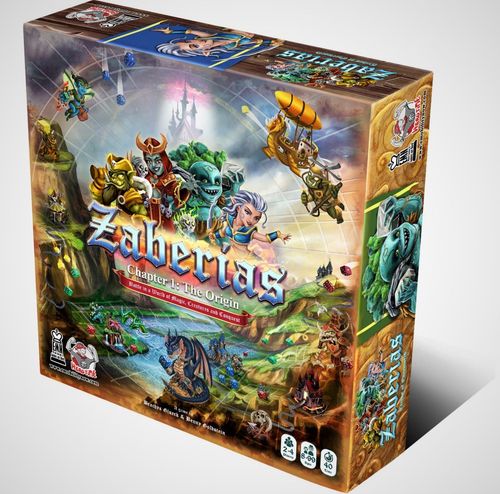
Zaberias
Zaberias Rulebook
Table of Contents
Table of Contents
1: Starting
Setting up the Map Boards: Players choose the tribe they want to play with: the Undead are red, Humans are blue, Orcs are yellow, and the Guardians are green. Depending on the number of players, you place your boards as shown in the Example picture.
- 2 players: They play across from each other.
- 3 players: Two boards are placed across from each other and the third board is placed to the side, between the second square and the third square so the squares are aligned, it will not align exactly in the middle so don't worry.
- 4 players: Setting up the boards where all 4 cities are at the corners and all 4 power stars are in the center. Each player then will place one of their wood cities into the slot above their corner city.
The Armory: This is where all your pieces are kept.
How do the Coins work? There are 6 dragon coins in the holder but you start the game with only 5. You keep track of your money by flipping over the coins you use. You can't make more than six coins per turn.
Who goes first? Everyone rolls a die, the one with the highest number goes first, and the rest take their turn clockwise.
When does your turn end? It ends when you say it ends, usually, when your units run out of moves and you run out of coins to spend. When you finish you declare your turn is over, and the person to your left will play next.
3: Cities
Tribes use cities to show ownership over their land. There are three grades of cities: Wood, Metal, and Gold, and they are placed into the slots on the maps. Creating a city gives 3 things:
- Defense: On each city, it shows the number of dice you roll when defending against attackers.
- Income/Cost: The number of coins in the city represents both the cost to buy the city and the number of coins the city gives you at the beginning of each turn. 1 for wood, 2 for metal, and 3 for gold. A wood city is free to build even though it has 1 coin.
- Grade: A city's grade represents the units that can be created. The highest grade is gold and can create every unit type, the metal grade can only create metal and wood units, and the wood grade can only create wood units. To upgrade from a wood city directly to a gold city is not allowed, you must first buy a metal city before buying a gold city, which can all be done in one turn.
When upgrading do you need a unit in a city? No.
Can I attack an enemy unit and take over a city on the same turn? No, taking over a city is considered an attack, and each unit can only attack once per turn.
Can you leave a city once it has been created? Yes, but by doing so you are leaving it exposed to an attack.
4: Units
In this game warriors or fighters are referred to as units. To get a unit on the board, you need to buy it with coins. The type of units bought, and their powers will make a difference in the game's outcome. Each unit takes up one square on the board.
The unit card's parts are numbered on the illustration:
- Tribe background color
- Warrior's image
- Strength: base + muscle
- Range: The distance of squares you can reach for an attack or an ability.
- Steps: The number of squares a unit can move in a single turn.
- City grade: wood, metal, and gold
- Cost. The number of coins you pay for a unit.
- Fighter's Name
- Ability: Many warriors have special powers, some help their friends while others deliver terrible harm to their enemies.
Each tribe has different special abilities, and there isn't any one tribe stronger than another, actually, victory or defeat is up to the player's skill. See the tribe's Q&A booklet and youtube videos for more in-depth about their individual powers.
Units can move anywhere on the board: on the paths, on the grass, or through the trees, except over water, unless it has a special ability allowing it to move over water. The ability also allows you to end your turn on water but not on other units. Each unit takes up one square on the board and cannot be placed on top of another. Units cannot jump over each other, even if they belong to the same tribe. Units with the ability to fly, of course, can fly over other units, friendly or enemy but they must land on an empty square.
Units can only move in straight lines from one square to the next, up/down, or side to side, but cannot cross from one square to the next diagonally, only if it is following a diagonal road.
During a turn, you can move as many units as you want. Each unit can only move once per turn, you cannot move a little and then attack, and then come back and move some more.
5: Steps
Each square on the board is considered one step. The number of steps shown on the unit is the maximum amount of steps you can move on your turn, but you can also move less.
6: Range
Like an archer using a bow and arrow to reach a distant target, here too, units with long-range capabilities can attack and use their abilities from afar. Unlike regular units, also called melee units which have no range and can only attack 1 square away. The range is measured like steps in straight lines, up/down or side to side, and can only go diagonally if following a road.
Does using range also refer to using their ability? Yes.
Can a unit with range attack over water? Yes, even if they cannot move over water themselves.
If a unit with range attacks a unit with no range from afar and loses, does he die? No, because the enemy does not have enough range to reach the attacker back to kill him.
What is a melee unit? Units that have no range, and can only attack one square away.
Example: The blue Archer on the right is attacking the Red Skeleton on the left. The Archer has a weapons range of 2, so she can attack even over water. If she loses the battle, she will continue to stay in the game as Skeleton has no range and can only attack a target one square away and cannot attack the Archer back.
7: Strength and Attack
Each unit's Strength is combined of both Muscle and Dice, together they are the fighter's physical strength in battle. The same is used for an attack or for a defense. When you declare an attack on an enemy unit you first roll the amount of dice the unit has, and then add the muscle for your total attack. The enemy will do the same and roll their dice and add their muscle for their total defense. The unit with the highest battle score wins the battle, and the losing unit is removed from the board. The losing unit goes back into the armory to be bought again at a later time. During a turn, you can attack with as many units as you want, but each unit can only attack one unit at a time. It's up to you if you want to attack first then move or move first and then attack, but you cannot move a little then attack, and then move some more. Always make sure you are within the range of the unit you're attacking.
Example: your Human Knight declares an attack on the Undead Crow. You go first by rolling one die which comes to 2 and add the 3 muscle, totaling 5 strength. The Crow now defends even though it is not his turn to play, he rolls his die and gets a 1 and adds his 2 muscle, totaling 3 strength. 3 to 5 you are declared the winner and the Crow must be removed from the board.
What if in battle the strength is a tie? The attacker has the choice to stand down or to continue attacking until one wins. The attacker always rolls first, and the defender always rolls second! Because if the defender rolls first and gets a high number, the attacker will change his mind immediately and say he decided not to attack. For more in-depth dice rules, see the Q&A booklet.
8: Ambush
An Ambush is a coordinated attack by many units attacking a single enemy unit or city. When two or more of your units are within range of an enemy unit, you can combine the strength of all attacking units as one. This makes it easier to win. However, if the defender wins, all the attacking units in its range will be eliminated from the board. It is important to remember! Each fighter can only attack once during a turn, so if several fighters ambush together, they cannot attack again until the next turn.
Example: you have realized that the only way to defeat your enemy, the mighty mutant, is to do a coordinated ambush. You quickly gather 3 of your skilled fighters in an ambush position and start rolling for all of them. Your total strength is 15, and your enemy's strength comes to 12. You were lucky to be declared the winner because if not you would have lost all 3 of your units. Because, when you attack in an ambush you are acting as a single group, so if the attack goes bad, all the units in the defender's weapons range are destroyed too.
9: Magical Places
Zaberias is a land of many magical places that gives your tribe special powers, and abilities when standing on them:
Portal: Many years ago when the tribes lived in peace with one another they built magical portals to help them get from one tribe's location to another quickly. These portals still exist but are very dangerous to travel through and must be guarded, because you never know which enemy can sneak up on you. Traveling from one portal to another is considered one step, and you can choose where you want to come out. Can a unit use its range through a portal? No. If a unit stands on a portal, does he block anyone from coming through? Yes, even if it's a flying unit.
Gold Mine: This is where tribes mine for gold and make coins. When a unit of yours occupies a gold mine, it gives you 1 coin at the beginning of your turn. Your unit must be standing on it at the beginning of your turn to get the 1 coin. Do I still get a coin if I occupy an enemy's gold mine? Yes. Can I occupy more than 1 gold mine at a time? Yes.
Power Star: Each map has its own power star, when a unit of yours stands on a star, it gives all the units of your tribe 1 extra muscle. But only as long as the unit is standing on the star, once they move off the star or get defeated in battle while on the star, the tribe stops receiving that 1 muscle. If your units are occupying more than one star, then all your units will get 1 extra muscle in the number of stars being occupied. For example: Let's say you have 3 units positioned on 3 different stars. Now, each of your tribe units will receive a bonus of 3 (1+1+1) muscle. Tip! Players should try to take control of as many stars as possible. The stars can strongly influence the outcome of the battles, especially if the battles involve ambushes with large numbers of fighters. With the help of power stars, a tribe can become truly great. Does the power star also give 1 extra muscle for defense? Yes, it is for attacking and defending.
10: Attacking and Defending Cities
The castle images on the board are called vacant cities. You take over a vacant city by simply placing a unit on it and declaring you are taking it over. You then place a wood city in the slot above the image, and you don't pay for the wood city as wood cities are free even though it shows one coin. New units are always created first in a city, it doesn't matter which city, and can be immediately moved out. You cannot create new units if there is a unit standing in the city, even if that unit you want to create is a flying unit, you must first move that unit out.
Taking over a city is considered an attack, and a unit can only attack once per turn, so a player will need to decide which is more important, taking over a city, or attacking an enemy unit. You can also just stand in a vacant city and not take it over. A city can only defend itself and cannot initiate an attack outside its square. Different grade cities give different defenses, a wood city gives 1 die, metal 2 dice, and gold 3 dice. When you have a unit in your city and it is being attacked by an enemy, they are actually attacking both your unit's strength and your city's dice. Attacking an enemy city has 3 scenarios:
-
Attacking a city occupied by an enemy: If you win the battle, the unit and the city are removed from the board. The city will be vacant again and does not become yours unless you move one of your units into the city itself to take it over. If you lose the battle, your unit is removed from the board only if the enemy unit occupying the city reaches your attacking unit within its range, otherwise, your unit is safe. Note: even though the city's dice are only used for defense, in this case alone its defense is combined with the unit to counterattack you.
-
Entering directly into an unoccupied enemy city and attacking it, the city can only defend itself with its dice. If you lose the battle, your unit is removed from the board. If you win the battle, then the enemy's city is taken down and you get to put up a wood city immediately. In this case, only, attacking and taking over a city is considered one action. If you decide not to battle, just stand in the city preventing the enemy from creating new units. In this scenario when it's the enemy's turn the city can initiate an attack on the unit, but it will only have its dice to use, It will be recommended for him to bring reinforcements.
-
Attacking an unoccupied city from a nearby square, or from afar by a range unit. If you lose the battle, you do not get killed as the city does not have any range. If you win the battle, the city is removed from the board.
11: Defending Units
When one of your units is being attacked, your other units within range of the attacker can assist with defending. Defending units can only help with their muscle, not their dice, so if you have a unit standing on a Power Star all your units defending will get an extra muscle.
Example: The soul collector is attacking the weak mermaid, and has a high chance of winning. But, the Mermaid has her fellow teammates on her side assisting with their muscle, as both her teammates have enough range to reach the soul collector. The Dragon assists with 5 muscle and the Archer with 1 Muscle, totaling 6 muscle, which will enhance her chances of winning! In the chance the Mermaid loses the battle, just she is removed from the board, and her teammates remain. Because when defending units assist they only lend their muscle for help.
Does an unoccupied city also get help from defending units when attacked? Yes.
Q and A
Frequently Asked Questions
Do you think you're the Best!? A great player needs to know the abilities and powers of all the units in the game, not just those of his own tribe. Knowing your opponent's strengths and weaknesses is the key to victory!
Contents: The Undead; The Humans; The Orcs; The Guardians; Unit Groups; Dice Rolling Rules.
Dark Angel
Belongs to the category of the Sorcerers.
Ability: The Dark Angel shoots a cupid arrow at an enemy unit within its range and makes that unit fall in love with the Undead tribe and they cannot attack for one turn.
Explanation: The Dark Angel shoots a cupid arrow, which before shooting, he prepares with a potent love potion that makes anyone and their bloodline instantly fall in love with the Undead.
Q: Can a unit from the enemy tribe capture an unaccompanied city while still under the cupid arrows effect? A: Yes. The love arrow only forces the enemy tribe to fall in love with the Undead units, not any cities.
Q: Can a unit affected by the love arrow attack another tribe other than the Undead? A: Yes. The love arrow is only engineered to work on fellow units from the Undead, the affected enemy tribe can still attack other tribes.
Q: If the Dark Angel affected another tribe with its love arrow, and is killed before that affected tribe's turn comes up, is the Dark Angel's power still under effect? A: Yes. Because even though the Dark Angel dies, the arrow is still there and disappears after one turn.
Vampire
Belongs to the category of Siphons, who absorb their defeated enemies.
Ability: If the Vampire defeats an enemy unit, the defeated unit's card is placed under the Vampire. The Vampire now receives the basic strength of the defeated unit, which is added to his own strength rating. The defeated unit will remain under the Vampire until he's defeated.
Explanation: The vampire sucks the blood out of his opponent, and by doing this he also absorbs the opponent's soul, adding its strength points to its own.
Q: Is there a limit to the number of defeated enemy units the Vampire can store underneath him? A: Yes. The maximum amount the Vampire can store underneath him are up to 3 units.
Q: If the Vampire already has 3 enemy units underneath him and he defeats a 4th, can he choose which 3 units he will have underneath him and which not? A: Yes. This way if the Vampire defeats a 4th enemy unit that has greater strength, he can choose to switch him with another weaker unit underneath.
Q: If the Undead ambush an enemy unit, with one Vampire and one other friendly unit, does the Vampire still get all the blood? A: Yes. Only Vampires suck blood. The other unit has no use for it. The Vampire gets it all!
Q: If the Vampire is defending, not attacking, does he still get the attacker's blood and strength? A: Yes, he does. If the Vampire attacks and wins or if he defends and wins, he will get the opponent's blood and strength! However, the attacker must be within the Vampire's range. In such a case, the attacker will fail to kill the Vampire, but will not be killed.
Q: If a Vampire is attacked by two units at the same time in an ambush, and he beats both units, does he keep them both underneath him and receive both their strengths? A: If two or more enemy units join in to attack the Vampire at the same time, and the vampire wins, the Vampire can receive both their strength. The Vampire will keep all defeated units underneath. But remember, this is only true if both the attacking units are in the Vampire's range.
Q: If I want to strengthen my Vampire before sending him out to fight, can he attack a friendly unit to increase his strength rating? A: No. A Tribe cannot attack its own units.
Q: Can an enemy tribe create a unit that is already held underneath the Vampire? A: No. When the Vampire defeats an enemy unit, that unit is possessed and controlled by the Vampire until he is defeated, and the unit goes back to its tribe.
Q: If a Vampire holds enemy units beneath him and is defeated, then is resurrected by the Necromancer, do the enemy units he previously had beneath him resurrect with him too? A: No. If a Vampire comes back to life, he does not take back the defeated enemy units he had.
Q: If a friendly unit is standing on a power star, does each enemy unit located under the Vampire also receive an extra strength point? A: No. Only the Vampire himself receives the additional strength points, not the souls in his possession.
Q: If the Vampire attacks another "Siphon" and wins, will the Vampire receive the enemy units stacked underneath the defeated enemy? A: Yes, and your units are released back to you. But remember you can only keep up to 3 units in total.
Necromancer
Belongs to the category of Helpers, giving assistance to friendly units.
Abilities: Restores life to friendly units who have been defeated in the previous round. Instead of attacking.
Explanation: The Necromancer has the power to re-animate fallen undead units. He can bring a dead friendly unit back to life. (at no cost)
Q: Can the Necromancer bring himself back to life? A: No. His magic works only on other friendly units!
Q: Can the Necromancer revive any units or just those of a lower grade? A: The Necromancer can revive any friendly units, regardless of the unit's grade be it wood, iron or Gold.
Q: Will the revived unit be able to move and attack again? A: Yes. a revived unit gets all his powers back and can move and attack again, even in the same turn.
Q: If a Necromancer has already revived a defeated friendly unit, can he still attack? A: No. Once the Necromancer has used his magic, he cannot attack in that turn.
Q: Can you revive a friendly unit, if the space he was on is occupied, can he still be revived? A: No. The defeated friendly unit cannot be revived on an occupied square, even if that square is occupied by a friendly unit that cannot move anymore.
Q: Can the Necromancer Revive units from other tribes besides the undead? A: No. His reviving abilities are only applicable to friendly units.
Q: If a Necromancer revies a defeated Vampire who possessed souls beneath him…do those souls return to the Vampire as well? A: No, if the Necromancer revives a Vampire that previously had enemy units beneath it, the Vampire is revived without the units beneath him.
Q: Can a Necromancer revive a unit that is absorbed by a Siphon, meaning a unit that is already underneath a Ninja or a Phantom? A: No, because their body and soul are captured beneath the Siphon unit and you cannot revive them unless you kill the Ninja or Phantom and release their body back into the world.
Q: Can a Necromancer revive a unit that was just killed by a Headhunter? A: Yes.
Mutant Corpse
Belongs to the category of Mighty Titan Units.
Ability: This unit is indeed very heavy, but instead of regular armor he is encased in deep layers of rancid blubber. The Mutant Corpse can spread plague across the entire board on which it stands. All units not belonging to the undead tribe must roll one die. Any unit that rolls a blank, is removed from the board. After releasing the plague the mutant corpse still has the ability to move and/or attack.
Explanation: The mutant Corpse oozes plague carrying mucus. Members of the undead tribe are immune to the disease. Any other units on the board where the Mutant corpse stands will become infected. The disease kills without regard for the strength or grade of the unit who catches it.
Q: If an enemy unit is located in a city, will he still be affected? A: Yes. The disease strikes everywhere, even in protected cities. The unit in the city must still roll a die to see if he survives or not.
Q: If a unit occupying a city is killed by the plague, is the city also taken out? A: No, the city will not die. It can withstand the plague.
Q: I have many units on the plagued board, I rolled a 'blank' how do I know which one dies? A: Simple. Before you roll, you have to point at the unit you are rolling for, and if you roll a blank, that unit you pointed on dies!
Q: I have many units on the plagued board, can I just roll several dice at the same time? A: No. You must roll the die individually for every unit you have on the board, and point to the unit you are rolling for before you roll.
Q: The Mutant Corpse has infected the board, can it still attack? A: Yes, the infectious mucus oozes all by itself. The mutant corpse doesn't have to make it happen. So it can still attack.
Q: Can the Mutant corpse infect the board twice in one move? A: No. Since it only releases the disease by moving, it can only do that once in a turn.
Skull Dragon
Belongs to the category of the Flying Dragons.
Ability: The skull dragon gives 1 extra basic strength to all friendly units & himself. It can also fly over water and units, friendly or enemy. However, when it finishes moving, it must land on an empty square, and assume a defensive position, like any flying unit.
Explanation: The undead tribe worship the Skull Dragon as a god. When undead units see it, it awakens in them a fanatical desire to KILL THE LIVING! This makes all undead units stronger!
Q: Does the Skull Dragon give 1 strength point just to the friendly units on the same board, or to all friendly units in the game? A: All undead units are inspired to KILL THE LIVING, even those who are not on the same board as the Skull Dragon get 1 extra strength.
Q: Does the Skull Dragon give itself an extra strength point? A: Yes. It is a deity of the undead, so it can inspire itself along with others.
Q: Does the 1 extra strength also apply to friendly units while they're defending an attack from enemy units? A: Yes. The extra strength works both for attacking and defending. It's a passive aura.
Dazzle Walker
Belongs to the category of the Sorcerers.
Ability: The Dazzle Walker shoots a dizzy potion at an enemy unit within its range and stuns them, as a result, disabling that unit's ability.
Explanation: The Dazzle Walker has crafted a glass-encased potion with many secret ingredients, one of which is speculated to be a goats ear wax, and once the potion lands on an enemy unit, it makes them dizzy, and forget their ability for one turn, hence they cannot use it.
Q: Can the Dazzle Walker shoot her potion at an enemy unit occupying a city? A: Yes. The Dazzle Walker can shoot this potion at an enemy unit who is occupying a city, only if it's within its range.
Q: If the Dazzle Walker shoots her potion at a Siphon unit, and during that Siphons turn they defeat an enemy, can they use their power and keep the defeated enemy underneath them? A: No, even though the Siphon can attack, and has killed a unit, he cannot use his ability due to the Dazzle Walkers potion.
Q: If the Dazzle Walker shoots a potion at an Undead unit, and then that unit ends up dying by another tribe, and when it's the Undead's turn the Necromancer revives that same unit, are they still under the potions effects? A: No. Since the unit is revived, they are also renewed.
Q: Can the Dazzle Walker use her ability while riding the Dragon's back? A: Yes. The Dazzle Walker can shoot the potion even while on the Flying Dragons back.
Q: When the Dazzle Walker uses her power, does she disable everyone's ability within her range? A: No. Only one enemy unit at a time in his range.
The Ninja
Belongs to the category of Siphons, who absorb their defeated enemies.
Ability: Enemy units defeated by the Ninja are placed underneath him. The Ninja acquires an additional die to roll for each defeated unit placed underneath.
Explanation: When the Ninja absorbs the soul of a defeated enemy unit, he keeps the defeated enemy unit underneath him and now can roll an extra 1 dice every time he attacks, based on how many defeated enemy units are underneath him.
Q: Is there a limit to the number of defeated enemy units a Ninja can store underneath him? A: Yes. The maximum amount the Ninja can store underneath him is 3.
Q: If the Ninja already has 3 enemy units underneath him and he defeats a 4th, can he choose which 3 units he will have underneath him and which not? A: Yes. This way if the Ninja defeats a 4th enemy unit that is more valuable to the enemy tribe, he can choose to switch him with a weaker unit underneath, this can also be a winning strategy, this way if your Ninja is never captured, your enemy will never get back their valuable top ranking unit!
Q: If a Ninja attacks together with a friendly unit and they win, Does the Ninja still get the soul and keep that unit underneath him? A: Yes. The other friendly unit has no use with the enemy unit's soul, the Ninja still keeps the defeated unit underneath him.
Q: If the Ninja is attacked by one or two enemies and wins, does he still get to keep them? A: Yes. Regardless if he attacks or defends he gets to keep the units.
Q: If the Ninja attacks another "Siphon" unit (Vampire or Phantom) and wins, will he receive the enemy units stacked underneath them? A: Yes, but if there are some of your units underneath then they are released back to you. But remember you can only keep up to 3 units in total.
Teleporter
Belongs to the category of Helpers, giving assistance to friendly units.
Ability: The Teleporter can move any friendly unit within its range, to another location within its range.
Explanation: The Teleporter has a surprising ability that can be used in unexpected ways, giving the human tribe have the strong tactical element of surprise. It can cause friendly units to disappear from one location and appear in a second location without moving. A friendly unit can move then be teleported, or be teleported then move. Just remember that the Teleporter can only move units that are in its range to other locations within its range.
Q: Can the Teleporter teleport a friendly unit, and while it's in the air, move 2 steps then place the unit within its range? A: Yes! This is one of the surprising aspects of the Teleporter's ability. The teleported unit can move great distances by taking advantage of the Teleporter's own ability to move. Just be sure to put the teleported unit down in a square that is within the Teleporter's range at its new location.
Q: Can the Teleporter move a unit who has already moved and attacked? A: Yes, the Teleporter can move any friendly unit, even if they have already moved or attacked.
Q: When the Teleporter moves a unit who has already moved or attacked, does that friendly unit receive the ability to attack or move again? A: No. A Teleporter only moves units, it does not renew their strengths or abilities.
Q: Can the Teleporter teleport a friendly unit over water or other units? A: Yes. A Teleporter can move any human unit over bodies of water or over other units, either enemy or friendly. But the teleported friendly unit cannot land on water or on a square occupied by another unit, friendly or enemy. And of course, the final destination of the teleported unit must be within the Teleporter's own range.
Q: Can the Teleporter teleport units that are not from the Human tribe? A: No. Human technology is adapted to only human DNA.
Q: Can the Teleporter move a unit into a city that belongs to another tribe? A: That depends. If there is an enemy unit stationed in the city, then the Teleporter cannot place the friendly unit there. But if the city happens to be unoccupied, then the Teleporter can place a friendly unit on it. You can then attack the empty city, only if the teleported friendly unit has not attacked that round.
Giant Armor
Belongs to the category of Mighty Titan Units.
Ability: The Giant Armor gives 1 extra die to all his units and himself, think of him as a skull dragon, but with an extra die rather than strength.
Explanation: The Giant Armor's armor is so strong, it radiates a strength aura hence all friendly units including himself gain an extra 1 die to their fighting and defending powers.
Q: Does the Giant Armor's power apply even when a friendly unit is being attacked? A: Yes. His shield aura is passive, so even if you're defending an attack from an enemy unit you get to roll an extra die.
Q: Does the Giant Armor give 1 dice just to the friendly units on the same board, or to all friendly units in the game? A: Even those who are not on the same board as the Giant Armor get 1 extra dice to roll.
Q: Does the Giant Armor give itself an extra dice to roll too? A: Yes. Its armor is tough enough to withstand and support both himself and all other friendly units.
Dragon
Belongs to the category of the Flying Dragons.
Ability: The dragon can carry a wood grade unit and the power of the wood grade unit is added to that of the dragon. When being carried, the wood unit is flying on the Flying Dragons back, hence also the wooden unit can fly over water and other units.
Explanation: Ancient Legends tell of humans who can fly Flying Dragons. The Human Flying Dragons are bred and trained to carry human units, who can get on and off as they please. The dragon can easily fly over water and enemy units. When carrying a human unit, the dragon and his rider fight and fly as one.
Q: When the Dragon attacks together with a unit on its back, and the wood unit only has a range of one, can they still attack together using a range of two? A: Yes.
Q: When the dragon carries a unit and attacks, does he receive the carried unit's strength and dice? A: Yes. The Dragon adds these ratings to its own strength and dice ratings. So they both fight as one.
Q: If the wood grade unit either gets on or off the Dragon, does this stop the wooden unit from attacking that move? A: No. The carried unit can still attack.
Q: The Dragon has 4 steps. Can it move 2, let a unit climb on from an adjacent square, and then move another two squares? A: No, because it will interrupt the dragon's movement, and all movements of a single unit must be taken in on go.
Q: Can the Dragon fly over a wood unit that has not moved, then pick it up as it flies? Can that unit get off the Dragon and move when the Dragon lands? A: Yes. As long as the unit does not move itself, it can get off the Dragon when it stops.
Q: Can friendly wood units climb on and off the Dragon as they move from one place to another? A: Yes, only wood units can do this. If the wood unit, instead of riding the Dragon, wants to climb up one side and down the other on the way to its destination, the Dragon doesn't mind.
Q: If a city is occupied by the Dragon, can a wood-grade unit be created right on top of it? A: Yes!
Q: If a city is occupied by a wood-grade unit, can a Dragon be created in that city space? A: Yes! The Dragon can share a space with a wood unit.
Q: When the Dragon attacks together with a unit on its back, can that wood-grade unit attack again once it gets off? A: No. The wood-grade unit has already attacked.
Q: Can a wood-grade unit move to get on the Dragon, let the Dragon move, then get off the Dragon? A: No. The wood-grade unit has finished its move for that turn. It can't get off the Dragon until the next turn… even if it has more steps left.
Q: Can the Dragon carry enemy units? A: No. A dragon can only carry friendly wood-grade units.
Q: Does the Dragon's strength and dice ratings combine with the powers of its rider only when attacking or also when defending? A: As long as the rider is on the Dragon, their dice and strength are combined also for defending.
Q: If I have a wooden friendly unit on the Dragon, and another friendly unit occupying the power star, do they both individually get 1 extra strength? A: Yes. The dragon and its wood grade rider each receive 1 extra strength if a friendly unit is on the power star. So together, they both get an extra 2 strength.
Cyclops
Belongs to the category of the Sorcerers.
Ability: The Cyclops throws a boulder at an enemy unit to shock them from attacking for one turn.
Explanation: The Cyclops is a huge monster that trained his whole life throwing rocks, until eventually he became a grownup and started throwing huge boulders. These boulders are so powerful in force, that once they hit an enemy, he is in shock and is not able to attack for one turn.
Q: Can the unit being attacked still move? A: Yes. He is able to walk but not fight.
Q: When the Cyclops throw the boulder at an enemy, can they still use their ability? A: Yes.
Q: When the Cyclops throw the boulder at a two headed dragon, does he lose one or two attacks? A: He only loses one attack. Because the second attack is really a skill.
Q: When the Cyclops throws the boulder at Helper units which say instead of attacking on the back, do they lose their skill too? A: The skill and attacking are two separate things. You only disable their attacking ability, not their skill.
Head Hunter
Belongs to the category of Siphons, which absorb their defeated enemies.
Ability: When the headhunter defeats an enemy he captures their head and gets 2 coins. The player gets to flip over 2 of his coins and may use them right away.
Explanation: Most "Siphons" take the life force of the defeated unit. The headhunter is different. It couldn't care less for the dead unit's soul. Instead, it takes the dead body of the defeated unit and sells its enemy's head, getting 2 coins for it.
Q: Can the player use the coins in the same turn he killed the enemy? A: Yes. When the headhunter wins a battle, the money he makes can be used immediately.
Q: If the Headhunter attacks an enemy unit together with a friendly unit, does he still gets 2 coins? A: Yes. The Headhunter is the only one interested in the enemy's head.
Q: If the Headhunter is the one being attacked, does he still collect 2 coins if he wins the battle? A: Yes. It makes no difference if the Headhunter is the attacker or the defender, if he wins, he gets 2 coins. But! This is only true if the attacker is within range of the Headhunter. If the attacker is able to strike from far away, and the headhunter's range cannot reach, then the Headhunter can only defend himself and can't kill the attacker and collect his head.
Q: If the headhunter is attacked by a number of opponents at the same time and he beats them, does he collect 2 coins from each opponent? A: Yes. If he is attacked by 2 enemies at once, and successfully beats them both (and is within their range of course) he gets 4 coins, 2 from each attacker, as per his ability.
Q: If the Head Hunter attacks a blue dragon carrying a unit on it, does he get 4 coins? A: Yes
Q: If I am short of money, can I attack my own units and collect 2 coins from them? A: No. You can't attack your own tribe mates!
Energon
Belongs to the category of Helpers, giving assistance to friendly units.
Ability: Gives a friendly unit the ability to move and attack again after they have already moved and attacked in that turn.
Explanation: The Energon has the incredible ability to extend energy to friendly units that have become exhausted (because they moved and fought). This energy gives them the ability to move and attack again. However, if the Energon has already used its power to assist friendly units, it cannot attack that turn. So he can either attack or use his ability.
Q: Can the Energon give power to itself? A: No. It can only give power to other friendly units.
Q: Can an Energon give power to all units in the Orc Tribe? A: Yes. An Energon can give power to all orc units, be they Wood Grade, Iron Grade or Gold Grade.
Q: Can an Energon give additional power of movement and attack to the Rhino Rider? A: Yes. It is a really good idea too!
Q: Can an Energon give power to a head hunter so it can attack, defeat and make money twice or more times during one turn? A: Yes. That is also a powerful strategy.
Q: Can an Energon attack after it has given power to another unit? A: No. Once an Energon assists, it cannot attack during that same turn. Unless he gets killed and you create him again.
Rhino Rider
Belongs to the category of Mighty Titan Units.
Ability: The rhino rider stomps on smaller units as it moves, destroying them. It cannot crush units located in a fortress. It can kill while it moves and then attack.
Explanation: The Rhino is a huge beast, and when it runs, it crushes any wood or iron-grade enemy units in its path, even if it does not attack them. Although it cannot crush gold-grade units, or units located on top of a city.
Q: If an enemy unit is located in a city with a flag on it, can the Rhino Rider still trample the unit with the flag? A: No. He can't trample units located in a city with a flag
Q: If an enemy unit is located in a city, but it does not control the city (meaning there is no flag) can the Rhino Rider still trample that unit? A: Yes. The rhino rider can trample that unit as it moves through the city if the city has no flag.
Q: Can a rhino Rider trample a flying unit like a bat or a dragon? A: Yes. Because during your turn, all other flying units are resting on the ground.
Q: Can a Rhino Rider trample an enemy unit on its last step? A: Yes.
Q: When a Rhino Rider tramples, is this considered an attack, or does he still have his complete attack abilities after he stops moving? A: The Rhino Rider tramples as it walks. It does not take any effort. Therefore it has its full attack abilities after it stops moving.
Q: Can a Rhino Rider trample over a siphon unit that has other units underneath him? A: Yes.
Balloon Dragon
Belongs to the category of Flying Dragons.
Ability: Like any flying unit, the Balloon Dragon can move over other units both enemy and friendly, as well as bodies of water. When attacking, it receives 1 extra die to roll for every time he rolls a one. In other words, according to its unit card, the Balloon Dragon rolls 3 dice in battle. If one of those dice is a one, the player will roll one more die. If that roll produced two ones, then 2 extra dice will be rolled, etc.
Explanation: The Balloon Dragon drops cluster bombs. Orcs have not yet perfected their technique for making these bombs. Sometimes they explode like regular bombs and sometimes they produce mega destruction. You can't know in advance how well these bombs will work. The more ones you roll, the more destructive the bombs are!
Q: Can the Balloon Dragon end its move by landing on a friendly unit? A: No. The Balloon Dragon can pass over other units but it must land on an unoccupied space. It cannot land on any other units, friendly or enemy.
Q: Does the Balloon Dragon have the ability to drop its primitive cluster bombs when it is defending, or just when it is attacking? A: Even when stationary and defending, the Balloon Dragon can fight with its cluster bombs. This means that for every die you roll that comes out a 1, an additional die will be rolled.
Q: If a player continues to roll twos and threes, will he continue to roll additional dice? A: The Balloon Dragon can roll many dice, as long as it keeps getting ones. If the cluster bombs work, there is no end to their destructive potential. But they don't always work. Fortunately for the other tribes, Orc technology is not always foolproof!
Turtle Goo
Belongs to the category of the Sorcerers.
Ability: The Turtle Goo shoots its goo at an enemy unit within its range and glues him in his place for one turn, but the enemy can still attack.
Explanation: The Turtle Goo used to live under sea with his fellow Turtle Goos and has now matured enough to aid the Guardians in battle.
Q: Can the Turtle Goo shoot an enemy unit occupying a city? A: No. Because the city walls prevent the glue from penetrating.
Phantom
Belongs to the category of Siphons, who absorb their defeated enemies.
Ability: Each unit defeated by the phantom is placed underneath the phantom. The Phantom receives the amount of steps of all the units whose souls he has absorbed. It can then move much further in a turn than is possible for any other unit.
Explanation: When a phantom absorbs the soul of a defeated unit, it captures their legs, sucks their feets remaining energy and absorbs their step count, increasing the number of squares it can move in a turn for each soul it has absorbed.
Q: When the Phantom absorbs a soul of a defeated unit, can it use the extra speed in that turn? A: Yes, but only if the Phantom has not yet moved that turn.
Q: How many defeated units can the Phantom store underneath him? A: No more than 3.
Q: If the Phantom already has 3 enemy units underneath him and he defeats a 4th, can he choose which 3 units he will have underneath him and which not? A: Yes. This way if the Phantom defeats a 4th enemy unit that has a higher amount of steps, he can choose to switch him with another unit underneath.
Q: If the Phantom attacks along with another friendly unit, will he still take the defeated unit's soul? A: Yes. The Phantom gets the soul, as the other unit has no use for it.
Q: If the Phantom is attacked, and he defeats the attacker, does he still take the attacker's soul? A: yes. It doesn't matter if the phantom is attacking or defending, it still takes the soul of its defeated opponent. But remember, this is only true if the attacker is within the phantom's range.
Q: If the Phantom is attacked by 2 or more enemy units and he defeats the attackers, will he take both of the attackers souls? A: Yes. The Phantom can absorb all the souls who attacked him who are in his range.
Q: If I want to speed up my phantom, can I have him attack a friendly unit to absorb its step count? A: No. You cannot attack friendly units.
Q: If an enemy tribe wants to create a unit that is already captured and is underneath the Phantom, does the Phantom have to release the unit from underneath him? A: No. The soul of the fallen unit belongs to the Phantom, it cannot be re-created on the board until the Phantom is defeated in battle. And the units underneath are brought back to their home tribes.
Q: My Phantom attacked another siphon unit that had units underneath it, and defeated it. Will my Phantom take those souls too? A: Yes, except for friendly units. Those are released back into the world so they can be created again.
Spider Witch
Belongs to the category of Helpers, giving assistance to friendly units.
Ability: Transmits her strength, dice and steps to other friendly units. Instead of attacking. She can only add to the strength or steps to a friendly unit who has not used its own strength or steps by moving or attacking. She can only increase powers that have not yet been used.
Explanation: The Spider Witch has a telepathic ability to share her power and give her strength, dice & speed to any other friendly units in her range, without sacrificing her own powers. If she does this, she loses the strength to attack for the duration of that move.
Q: Does the Spider Witch share her dice too? A: Yes. There was a mistake in the printing and we forgot to include dice.
Q: Let's say that a Spiderwitch has moved 2 steps, the farthest she can go in a single move. Can she still give a friendly unit the ability to move two extra steps? A: Yes. The Spider Witch can give her 2 steps and 1 strength point to any friendly unit within her range even if she herself has already moved. However, once a friendly unit has moved, it cannot get any extra steps. If it has already attacked and it cannot get any extra strength.
Q: Can the Spider Witch share her strength and steps with any friendly unit, wood, iron or gold? A: Yes. She can share her strength and steps with any friendly unit.
Q: Once the Spider Witch has passed her strength on to another unit, can she still attack? A: No. Assisting comes instead of attacking.
Q: Can the Spider Witch transfer her strength to another friendly unit while having another friendly unit stand on the power star? A: Yes. The assisted unit receives the total steps and strength of the Spider Witch, even if she has an extra one strength from a friendly unit standing on the power star.
Q: Can the Spider Witch still defend herself if she has already transferred her strength to another friendly unit in the previous round? A: Yes. The Spider Witch does not lose any strength because she shares it. She only loses the ability to attack in that turn she shares her strength.
Earth Mover
Belongs to the category of Mighty Titan Units.
Ability: The Earth Mover can turn around the board on which he is standing, changing the position of enemy units and making them vulnerable to attack from new directions.
Explanation: The Earth Mover can thrust its roots so deeply down into the earth that it brings about giant shifts in the tectonic plates of Zaberias. As a result, the board on which it stands can spin around and become re-aligned in any way the Earth Mover decides. However, this is considered to be a passive ability, because it is a natural result of the Earth Mover's relationship with the earth. The earth moves due to the Earth Mover's stimulation. The Earth Mover does not need to exert any effort to make it happen.
Q: Can the Earth Mover spin the board and then attack? A: Yes, exactly. However this can only happen once in a turn.
Q: Can the Earth Mover spin the board 180 degrees in one spin, or does it take two turns of 90 degrees? A: The board can spin 90 degrees either right or left, as well as 180 degrees. You could even turn it 360 degrees, but that would just put everything back the way it was before.
Q: When I spin the board, do the units stay in their new positions? A: All the units stay in their new positions, without considering where they were before. Actually, the units never actually moved at all, it was just the board.
Q: Can the Earth Mover also move enemy boards? Not just his own? A: Yes. The Earth Mover can move any board it is located on.
Two Headed Dragon
Belongs to the category of the Flying Dragons.
Ability: This unit can attack twice each turn. It can also move over water and other units.
Explanation: The Two Headed Dragon attacks with its fiery breath, so it has no difficulty attacking twice in a move. Since he is two headed.
Q: Can the 2 Headed Dragon attack an enemy unit first and then take over a city? A: Yes, the 2 Headed Dragon can attack twice, once, being a city and the other being an enemy unit, as long as both are in range!
Q: If the Two Headed Dragon lands on an unoccupied enemy city and takes it over, can it still attack another target? A: Yes. Since acquiring an empty city is considered an action, the Two Headed Dragon can still attack after that.
Q: Can the Two-Headed Dragon attack first then move and then attack again? A: Yes
Unit Groups
A true warrior of Zaberias will constantly be in search of the answer to the ultimate question "Which tribe is the strongest of them all?". Search no longer my fellow warriors as the answer is simple. In the world of Zaberias there is a true balance of nature, skills, and strength, therefore there is no one true tribe stronger than the other. Rather, the true strength of the tribe lies within the most skillful player. To become the strongest player you must learn the following groups of units and their similar abilities. Once you understand the true balance of their skills and strengths, only then you can truly become the strongest player amongst us all and become the true ruler of Zaberias.
Sorcerers
The Sorcerers all have high range, and unique control abilities that allow them to cast their ability and affect enemy units within their range. Sorcerers can also attack after using their ability.
Siphons
The Siphons gain a strategic advantage once they defeat an enemy unit, and they then keep that unit underneath them, and gain a certain power. They cannot kill friendly units to gain power, and have a limit to 3 units that can be kept underneath them.
Helpers
The Helper units have the ability to assist and support other friendly units, they are the only unit group that can either attack, or only use their ability in that turn.
Mighty Titans
These units are considered the strongest units in terms of shear strength, with destructive powers that can change a battlefield within an instant.
Flying Dragons
The Flying Dragons are all capable of flying above units and water. Additionally, each Dragon has a unique ability that fits their own friendly tribe and if used correctly can help change the odds of a battlefield.
Dice Rolling Rules
Playing Zaberias can be very instance, especially when rolling dice. So over the years we came up with dice rules that can cover all kinds of rolling seneroes.
- The person attacking always rolls first, and the person defending always rolls second. If the defender rolls first, that roll does not count! The reason for this is: because if the defender rules first and gets a high number, the attacker will change his mind immediately and say he decided not to attack. So by the attacker rolling first, he declares his intention that he has committed to the attack and can no longer go back on his decision.
- It is not allowed to roll the dice while no one is watching! While rolling the die, all players should stay alert, especially the defender should be present during the roll.
- Make sure there are no other dice from your color tribe near your rolling area! So there's no confusion over which dice were rolled and which dice were there before. If this happens you must roll all your dice again!
- What should you do if you need more dice to roll than what you have on hand? You should split it into two throwing cycles or barrow dice from another tribe. Just make sure not to confuse your color dice with their color dice.
- When rolling multiple dice, it's not allowed to roll one at a time individually. They must all be rolled together at the same time!
- After a roll you must keep your dice in place until after a winner is declared! Many times the defender or the attacker will forget one's dice roll and will want to re-validate it again. Therefore you must keep the dice in place until after each dice roll and not touch them only until after everyone has had a chance to review them clearly and a winner will be declared.
- You cannot roll using another tribe's dice! You must use only your own tribe's color dice.
- If one of the dice you rolled fell on the floor, or is tilted sideways where it is not 100% clear which side it landed on? If this happens you only have to roll that specific die again.
- In odd situations, when there are non-obeying players: it is recommended to roll the dice on a rolling mat or in a box, for optimal efficiency and trust. Some even use a special cup designated for dice rolling.
- What happens if in battle the amount of dice and strength are a tie? The attacker has the choice if to attack again or to stand down and leave the fight. This can repeat itself for as long as the attacker wants or until one wins or loses.