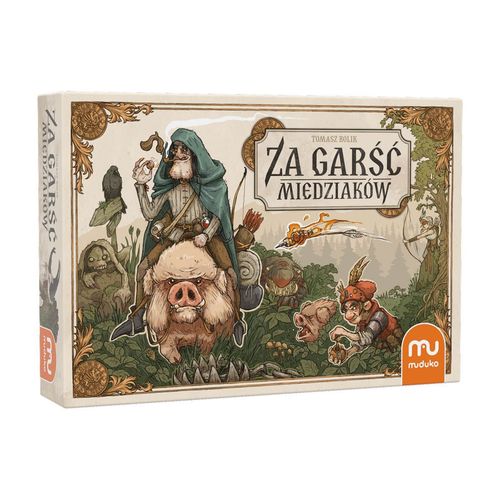
Za garść miedziaków
Za garść miedziaków Rulebook
Table of Contents
Table of Contents
Components
The rulebook's component list, as printed:
- 4 player pawns (in 4 colours)
- 4 Health strips (in 4 colours)
- 21 Health markers
- 10 Pig tokens (2 in each player colour and 2 black)
- 9 Resource markers (3 Flasks, 3 Plants, 3 Messages)
- Board
- Adventure deck (12 cards)
- 3 Creature decks (12 blue, 12 green, 12 red)
- Szpej deck (66 cards in 4 colours: 10 blue, 10 green, 10 red, 36 brown)
- Quest deck (30 cards)
- 4 Character cards
- 5 Help cards (1 for solo play, 4 for multiplayer play)
- 30 Coppers (25 of value 1 and 5 of value 3)
- First player marker
- 5 dice
- 11 double-sided special markers
NOTE! Za garść miedziaków is a competitive board game with a large dose of negative interaction!
Setup
The setup steps are numbered on the board illustration in the printed rulebook.
- Place the board in the middle of the table, and next to it create the supply: the Coppers (the Resource pool), the Health markers and the special markers.
- Place the Resource markers for Flasks, Plants and Messages on the appropriate spaces on the board.
- Shuffle each of the 3 Creature decks separately and place each one in the Lair matching its colour, creature illustrations face up.
- Shuffle the Szpej deck and place it face down in the designated space next to the board. Turn the top two Szpej cards face up and place them on the discard space next to the board (the Scrapheap).
- Shuffle the Quest deck and place it face down in the designated space. Draw and reveal 3 quests and place them in the designated spaces on the Notice Board.
- Each player receives a set of components in their chosen colour: a player pawn, 1 Pig token (2 Pig tokens in a 2-player game) and a Health strip, on which they place 2 Health markers (placed from the left side).
- Each player chooses or draws a Character card and places it below their Health strip. Character cards are double-sided and come in a basic and an advanced version. On the advanced side each Character has a unique ability. It is recommended to play the basic version for the first few games.
- Each player receives 4 random cards from the Szpej deck. They hold them in hand, hidden from the other players.
- Each player receives 1 Copper to start (value 1).
- Choose the player who will start the game by any method – that player receives the first player marker.
- All players place their pawns in the starting location – the Town (Gród).
- Draw or choose 1 card from the Adventure deck and place it on the board in the upper right corner. Before the game, read aloud the back of the card, which contains the introduction and special rules.
- Before the game starts, each player places 1 Pig token on the board on any free space without a symbol, or under their own pawn. This is done in order, from the last player to the player who starts the game. Details of placing Pig tokens are on page 11. In a 2-player game, players place 2 Pig tokens each (starting with the last player and placing one Pig in alternating turns).
Key Map Elements
The key map elements are shown with callouts in the printed rulebook.
- River (Rzeka) – a river on the map.
- White border (Granica biała) – passable. A white border can be crossed.
- Black border (Granica czarna) – impassable. A black border cannot be crossed.
- Red border (Granica czerwona) – mandatory action. Crossing a red border triggers a mandatory action.
- Location (Miejsce) – a location has a number and a name (for example, 6. Zajazd, 7. Świątynia, 8. Kurhany, 10. Rubieże).
- Field (Pole) – a field (space) on the map, shown along the routes between locations.
- Sanctuary (Sanktuarium) – a sanctuary on the map.
- Lair (Siedlisko) – a lair, shown on the map as a blue area with the label "Magic creatures" (Stwory magiczne), where Creature cards are accessed.
- Adventure card (Karta przygody) – the box in the upper right corner of the board, where the Adventure card is placed.
Goal of the Game
The goal of the game is to gather as many Coppers as possible. The main source of Coppers is completing Quests from the Notice Board, but there are other, less honourable ways to get ahead.
Unless the Adventure card says otherwise, the game ends at the moment any player gains 4 Seals for completed Quests. Finish the current round so that every player has taken the same number of turns. Then it is time to check who managed their time and their Pigs most efficiently: the player who collected the most Coppers wins!
Cards in Play
Adventure deck: These are 12 cards that represent events in the land of Balibalda. For each game, draw (or choose) 1 card. It contains an introduction and special modifications of the general rules, and sometimes even a Boss that can be defeated. For the purposes of the rules, Bosses are treated as Creatures. After reading the card, place it illustration side up on the appropriate space on the board (unless the card's text says otherwise). Some adventures use special markers.
Quest deck: Completing Quests is the most straightforward path to victory. On the Notice Board, various commissions will appear: from searching for rare ingredients, through fighting the creatures plaguing the land, to gathering messages. Each Quest lists the requirements to be fulfilled, the number of the location to which it must be delivered, and a reward. After completing a Quest, place the card on its reverse, with the Seal side facing up, next to your Character card.
Creature decks: Creatures come in 3 basic colours: green, blue and red. Each Creature has a Strength value from 1 to 3. The stronger the Creature, the more Resources can be gained from it. On the reverse of each Creature card there is Equipment (a weapon, a magic item or a protective item).
A card may be taken as a Creature (front side) or as Equipment (reverse side). The decision must be made at the moment the card is acquired and cannot be changed later. Each player may hold at most 2 weapons ("once per combat") and an unlimited number of magic items ("single-use card") and protective items ("permanent effect"). All of these should be laid out face up next to the Character card. When the last Creature card in a given deck is taken, shuffle the discarded cards and create a new deck.
Szpej deck: These are cards that players hold in hand and that help them carry out their nefarious plans. They come in 4 colours: green, blue and red (like Creatures), and the universal brown.
Unless special rules say otherwise, the Szpej hand limit is 7. If, as a result of any game effect, you have more cards in hand than the limit, you must immediately discard cards until you are within the limit. If at any moment there are no cards left to draw, take all cards from the Scrapheap (except the top one), shuffle them and create a new Szpej deck.
Character cards: Before the game starts, choose or draw a Reaper (Żniwiarz, male) or a Reaper (Żniwiarka, female). Character cards are double-sided: a Basic side and an Advanced side (with a special ability). We suggest playing the Basic side for the first few games. All players in a given game must choose the same side.
Gameplay
Starting with the first player, players take turns clockwise. A player's turn consists of 2 phases, performed in order:
- Movement and Actions
- Placing Pigs
Phase 1: Movement and Actions
Normally a player has 2 moves to perform. One move is moving your pawn from one space to an adjacent space, separated by a white or a red border, and optionally performing one or more different actions:
- Space action
- Completing a Quest
- Attack (Napad)
Movement details: At the start of their turn, a player determines the number of movement points they have. Normally each player starts the turn with two movement points. A player may gain additional movement points for Pig tokens tucked under their pawn during the Placing Pigs phase; each such token gives +1 move. Another way to gain an extra move is to discard a Szpej card bearing the crossed-box (X) symbol from hand. Each card discarded this way gives +1 move. You may discard any number of such cards during your turn. Playing a card with this symbol during combat does not activate this effect.
When a player has 1 Health marker, they are wounded, and their number of moves is reduced by 1. Note that the number of movement points is calculated at the start of the turn, so if a player is wounded during their current turn, it does not reduce their remaining moves. Being wounded only matters from their next turn.
The situation is analogous when a wounded player gains a Health marker during their turn.
Engaging in combat with a Creature always ends the Movement and Actions phase, and any unused movement points are lost.
Example: It is the start of Tomek's turn. He has a Pig under his Character pawn, but he is unfortunately wounded (he has 1 Health marker), so he is entitled to 2 movement points (2 standard points − 1 for being wounded + 1 for the Pig = 2). Tomek makes 1 move and uses the action of the Cyrulik (Barber-surgeon) space, then makes a 2nd move and uses the action of the Śmietnisko (Scrapheap) space. He then decides to discard 2 Szpej cards from his hand, to gain 2 additional movement points, and moves to the Zajazd (Inn) and takes a Flask token.
Space Action
When entering a space, you may optionally perform the action assigned to it. The exception is spaces with a red outline, where performing the action is mandatory. Starting the Movement and Actions phase on a given space does not entitle you to perform that space's action; you may only perform it immediately upon entering the space. A description of all spaces on the map is given later in the rulebook.
Completing a Quest
If you have all the elements required by a Quest card, you may go to the location indicated on that card to complete the Quest. Return all required elements to the board or to the appropriate discard piles. Take the completed Quest card and place it face down, reverse side (the Seal) facing up, next to your Character card.
At the end of the game, a completed Quest card provides the number of Coppers indicated on it. They are not collected when the Quest is completed.
In the standard game, the game ends when any player gains 4 Seals. Then finish the round so that every player has taken the same number of turns.
Quests have a limited time to be completed. Next to each Quest card there are spaces for Health markers lost during the game. Each time any player loses Health, they place a marker on any empty space next to the chosen Quest card on the Notice Board. The number of available spaces depends on the number of players (1–3 players: 2 spaces; 4 players: 3 spaces). When all available spaces next to a Quest card are filled, the Quest loses its validity and is discarded. The Health markers lying next to that card are returned to the Resources next to the board. Then a new Quest from the top of the Quest deck is placed in that position.
Note: Other players should always be able to see how many Seals you have in front of you, so that they can monitor how close you are to the end of the game.
Quest Requirements
Quest requirements are divided into several categories, distinguished by the icons on the side of the card:
- Resources (Flasks, Plants, Messages) – shown as a purple flask, a green plant and a yellow message icon.
- Ingredients (Meat, Feathers, Horns, Teeth, Venom, Hide) – shown as six different ingredient icons.
- Creature card (Blue, Green, Red) – a Creature card of the given colour.
- Szpej card (Blue, Green, Red, any) – a Szpej card of the given colour; "any" means a card of any colour, including brown.
- Combat – treated as a Creature on the given space.
Anatomy of a Quest Card
A Quest card contains the following information:
- Title and flavour text – the name of the Quest and its story description.
- Quest completion location – the number of the location to which the Quest must be delivered (the number on the card, e.g. 6.).
- Quest requirements – the elements that must be delivered (see above).
- Reward for completion – the number of Coppers gained at the end of the game for completing the Quest.
- Seal – on the reverse of the card, the Seal side used to mark a completed Quest.
Attack (Napad)
When you want to rob another player of Coppers, Creature cards or Resources, stand on the same space as that player. The space cannot have the shield symbol (see the symbol on the board).
-
Step 1: The attacking player must play a set of at least 2 Szpej cards of the same colour in this same space. The colour must be red, green or blue (you cannot attack with brown cards!).
-
Step 2: The attacked player may, in response, show a set of cards consisting of cards in the colour played by the attacker, in a number 1 smaller than the attacker's set. If they do so, they defend themselves and immediately proceed to Step 4.
-
Step 3: If the attacked player cannot (or does not want to) play cards, they lose and are robbed. In this case the attacking player may take one of the following:
- ANY CREATURE CARD (Equipment is not treated as a Creature card);
- 1 COPPER (value 1);
- ANY RESOURCE MARKER (Flask, Plant, Message).
We do not kick a man when he is down: the robbed player lays their Character pawn on its side to show that it cannot be the target of an attack until their next turn. In their next turn they stand the pawn upright and play a normal turn.
-
Step 4: The attacking player discards the set of cards played, regardless of whether the attack succeeded. The attacked player may decide between keeping the cards they showed in hand, or discarding them and drawing new cards from the Szpej deck.
Action Details
Upon entering a space, you may perform any number of actions: Space Action, Completing a Quest, Attack, provided you meet their requirements. Actions do not cost movement points, unless their description says otherwise.
The following actions are available (the icons of the printed rulebook are rendered here as words):
- Draw 1 Szpej card from the Szpej deck.
- Draw 2 Szpej cards from the Szpej deck.
- Discard 1 card from hand. Cards are always discarded to the Scrapheap.
- Gain 1 Health marker. The action has no effect if you are already at full health (you already have 3 markers on your Health strip).
- Lose 1 Health marker.
- Gain as many Health markers as needed to be at full health. The action has no effect if you are already at full health (you already have 3 markers on your Health strip).
- Begin combat with a Creature. Details of combat are on page 11 of the printed rulebook (see Combat with a Creature below).
- Draw 1 card of your choice from all the cards lying on the Scrapheap.
- Sanctuary: Spaces with the shield icon are sanctuaries – places where every form of violence is forbidden. You cannot place Pigs or carry out Attacks on these spaces. You can, however, tuck Pig tokens under your own pawn there.
- Lose 1 Health marker, and then remove from the board 1 Pig token of another player of your choice. The owner of that Pig token places it normally in the nearest Placing Pigs phase.
- Discard 1 card from hand to move to any space adjacent to a river.
Phase 2: Placing Pigs
In this phase the player places their Pig tokens. Pig tokens fulfil 3 different functions, depending on where they are placed:
- Further journey (Dalsza podróż): Tuck the token(s) under your own pawn. Thanks to this reliable means of transport, in your next turn you will have +1 move for each Pig tucked in this way.
- Slowing opponents (Spowolnienie przeciwników): Place the token on any space that has no Pig token yet and does not have the shield symbol. To enter a space with a Pig, an opponent must spend an additional movement point. Your own Pigs do not slow you down.
- Combat help (Pomoc w walce): Place a Pig token on any Creature card. Each of your Pigs gives you the option to play an extra card in combat with that Creature. There is no limit on how many Pigs players may place on Creature cards: any number of Pigs from any number of players may be there. Some Quests require defeating the Creature on the Quest card; placing a Pig token on the card of such a Quest counts as combat help.
Combat with a Creature (Walka ze Stworem)
Combat begins when one of the players moves their pawn onto a space from which a Creature card is accessible (most often a Lair) and initiates the combat. The other players who have Pig tokens on the Creature card, or pawns on a space with access to the Creature with which the combat was initiated, take part in the combat.
WARNING! In one combat, a maximum of 5 dice may be used.
To defeat a Creature, the sum of the results on all rolled dice must be exactly equal to the Creature's Strength. If the result is lower or higher, the combat is lost. The number of dice rolled and their results are modified by playing Szpej cards from hand and by using Equipment. A player may play as many cards from hand as the number of elements they have in the combat. The elements are the player's pawn on a Lair space, or Pigs on the Creature card. A Pig tucked under a Character pawn does not count as an element in combat.
Each die has 6 faces with the following values: skull, 0, 1, 1, 1, 2. The skull symbol counts as 0, unless an Adventure card says otherwise.
Anatomy of a Creature Card
A Creature card contains the following information:
- Strength of the Creature – the number shown on the card.
- Name and description of the Creature.
- Components – the icons of the ingredients (Meat, Feathers, Horns, Teeth, Venom, Hide) whose presence helps fulfil Quests. The attacker gets them by taking the Creature side (front) of the card.
- Type of Equipment – on the reverse of the card (for example, a protective item).
- Effect of the Equipment – for example, the Dragon Armour (Smocza zbroja), a permanent effect, reads: "You do not lose Health after a lost combat."
Anatomy of a Szpej Card
A Szpej card contains the following information:
- Optional effect to consider during combat with a Creature – the effect applies during combat with a Creature (your own or another player's).
- Discard symbol – you may discard a card with this symbol to move one additional space.
- Combo symbol – "COMBO!" If you play 2 cards which together form a symbol in the same colour, they count as 1 card toward the limit of played cards (see Combos below).
- Optional effect to consider during another player's combat – an effect that applies when the card is played in another player's combat.
Basic Effects on Szpej Cards
- Add 1 die to the attacking player's dice pool and roll it. That die remains in the attacking player's pool until the end of the combat. Remember the limit of 5 dice per combat.
- Choose 1 die from the attacking player's pool and set it to the value indicated by the card (0/1/2).
- Choose 1 die from the attacking player's pool and reroll it.
- Play this effect at any moment of the combat to discard the last card played.
Combat Sequence
- Combat initiation – The active player, standing on a space with access to the Creature, rolls 1 die.
- Playing cards – Players taking part in the combat, in turn, play 1 Szpej card or pass. The combat starts with the player sitting to the left of the combat initiator, and the others join in clockwise order. The effect of a card is resolved immediately after the card is played. All effects of played cards are optional, and the player playing the card decides which of them to use. They may even choose not to use any effect of a played card, for example to outlast their opponents.
- Played cards MUST MATCH THE COLOUR OF THE CREATURE OR BE UNIVERSAL (brown). The special abilities in the lower parts of brown cards work only when they are played in a combat initiated by another player.
- Cards are played for as long as each player uses up the card limit set by the number of elements in the combat (the Character pawn on a Lair space, or Pigs on the Creature card), or passes. After passing, a player cannot return to the combat.
Combos
On Szpej cards there are halves of symbols corresponding to the 3 colours of Creatures. Playing 2 cards with a common symbol in a colour matching the Creature being fought counts as playing 1 card for the purposes of card limits. The effects of both cards may be fully applied.
You may complete a combo at any moment: by playing 2 cards at once in your combat turn, by playing 1 card in each of 2 combat turns, and, exceptionally, by completing a combo when you have already exhausted your card limit. If you are entitled to play 2 cards, you may play 2 combos (4 cards), and so on.
Equipment (Ekwipunek)
You may use an Equipment card at any moment of your combat turn, instead of or simultaneously with a Szpej card or a Combo. Using Equipment counts toward the limit of played cards in combat. You may use several Equipment cards in the same combat turn. If an Equipment card can be used "once per combat" (raz na walkę), its effect must match the colour of the Creature you are currently fighting.
In longer combats, we suggest that after using the ability of an Equipment card you place a special marker (the X marker) on it, to remember that the ability is no longer available in this combat.
-
Combat result
A. Success (Sukces) – If the sum of all dice used by the attacking player in this combat is exactly equal to the Creature's Strength, the attack succeeds. The attacker takes the Creature card and looks at it. There may be weapons and special items there, which will help in the further adventure. The attacker must decide whether to take the Equipment (reverse side) or the Creature (front side), whose Components help in fulfilling Quests. The attacker then places the chosen side in front of them, face up. The decision cannot be changed later in the game. When a player acquires an Equipment card that would exceed the limit of 2 Weapon cards, they must discard an old Weapon card.
B. Defeat (Porażka) – If the sum of all dice used indicates more or less than the Creature's Strength, the attacker suffers defeat. They lose 1 Health (the marker is placed beside the chosen Quest; see Losing Health on page 14 of the printed rulebook), and a Copper of value 1 (from the general Resources) is placed on the Creature card. A spectacular defeat raises the value of the Creature, so whoever defeats it will gain, together with the card, an additional payment.
Regardless of the combat result, Pig tokens do not change position. If the Creature was defeated, the Pig tokens are moved to the next Creature card in this Lair. After the combat is fought, the attacking player's Movement and Actions phase ends immediately, and they move on to the Placing Pigs phase.
Regardless of the combat result, all played cards go to the Scrapheap.
Combat Example
Kasia and Michał are going to fight Tryk. The combat is initiated by Kasia, whose pawn stands in the Silver Mountains (Góry Srebrzyste) Lair. Michał placed a Pig on the Tryk card in his previous turn, so he will hinder her.
In the initiating roll Kasia gets a result of 2. That is just right to defeat Tryk, but first Michał has a chance to interfere: and indeed he plays Srebrne Wyniki (Silver Results) and adds another die to the pool!
The die shows 1. In total that gives 3, which is more than the Creature's Strength. Kasia faces defeat! Luckily she has the Szabrownik card in hand, which changes the value of the added die to 0! This restores her result to 2. Since Michał has already used up his card limit (he takes part in the combat thanks to a Pig on the Creature card), and has no card matching to form a combo, he cannot interfere further. Kasia defeats Tryk!
Health (Zdrowie)
Each time a player loses Health, they must move a Health marker from their Health strip (starting from the right side) to any empty space next to the chosen Quest on the Notice Board.
If all the available spaces next to a given Quest, for the number of players in the game, are filled, the Quest immediately falls from the Notice Board (together with its own Health markers), and a new Quest card is drawn.
If as a result of any game effect a player gains a Health marker, it is always taken from the general supply, never from the Notice Board. Gained Health markers are placed on the Health strip from left to right.
Wounded: When a player has only 1 Health marker on their Health strip, they are wounded, and the number of moves they can make with standard movement is reduced by 1. A reminder of this rule is printed on the Health strip (−1 movement point).
Unconsciousness: When a player loses their last Health, they are unconscious:
- The player's Character pawn is laid on its side and moved to the Cyrulik (Barber) space.
- All of this player's Pigs return to their Character card and are not placed in this turn.
- During their next turn, the unconscious player stands their Character pawn upright and regains all Health markers. Unfortunately, time heals wounds better than the local doctor: the player does nothing more in this turn, but they may place their Pigs. They play the following turn by the standard rules.
Example
- Tomek loses a combat with a Creature and loses his last Health marker. He must immediately lay his Character pawn on its side and move it to the Cyrulik space. He removes his Pigs from the board and from the Creature cards, and does not place them.
- In his next turn, Tomek stands his pawn upright and takes Health markers up to the maximum number. He skips the Movement and Actions phase and goes to the Placing Pigs phase.
- Tomek plays his next turn normally.
WARNING! Some effects of brown cards are related to the result of the combat. Remember to apply them.
End of Game
Unless the Adventure card says otherwise, the game ends at the moment when any of the players obtains 4 or more Seals on completed Quest cards and a defeated Boss. Finish the current round, so that each player takes the same number of turns.
Then proceed to counting Coppers. Each player adds up:
- the Coppers (Copper markers) they have gathered;
- the Coppers on their completed Quest cards;
- the Coppers on the completed Adventure card or Boss;
- sets of 2 Resources of any kind, each worth 1 Copper;
- special conditions from the Adventure card (if they apply).
THE PLAYER WITH THE MOST COPPERS WINS. The land of Balibalda needs such Reapers. In case of a tie, the players share the victory and arrange a rematch!
Anatomy of an Adventure Card
An Adventure card contains the following information:
- Difficulty level and number of players – for example "Normal, 1–4".
- Strength of the card and the reward for defeating the Boss.
- Title and special rules – the name of the Adventure and its special rules.
- Flavour description and special rules – the story text and the special rules of the Adventure.
For the purposes of the mechanics, the Boss card is treated as a Creature card, with one difference: other players cannot interfere in combat with the Boss.
Solo Mode
Setup
Leave the Coppers of value 3 in the box; they will not be needed in this game. Start the game with 5 Coppers and 2 Pigs. Place 2 black Pigs on the board: one on the Zajazd (Inn) space, and the second on the Ciemna Knieja (Dark Woods) space.
Draw or choose 1 of the Adventure cards designated for solo play.
Goal
You must defeat the Boss before you lose your last Copper.
Gameplay
In solo play, each of the player's turns gains a new 3rd phase: Kłopociki (Troubles). It consists of the following steps:
- Lose one of your Coppers and place it next to the Boss card. You make an offering so that the Boss does not attack the lands.
- Place a Health marker from the Resources next to the Quest with the fewest Health markers. In case of a tie, choose any of them. Two Health markers next to a Quest card mean that the Quest is discarded.
- Move each of the black Pigs 1 space along its route. When a black Pig reaches the last space of its route, it turns around and moves in the opposite direction, and so on in a circle. If you enter a space with a black Pig, your Movement and Actions phase immediately ends. If a black Pig enters the space with your Character pawn during the Troubles phase, you skip your next Movement and Actions phase. You can play your Pig onto the space with a black Pig (or onto the space that a black Pig is about to enter) to cancel its negative effect.
Completing Quests: Unlike the standard game, after completing a Quest in solo mode you draw the appropriate number of Coppers from the Resources.
Combat with a Creature: At the start of each combat with a Creature, draw and reveal as many Szpej cards as the Creature's Strength. If you reveal a brown card, or a card in a colour matching the Creature, you apply its upper effect. If the colour does not match, ignore the card. Resolve the cards one after another. Then carry out your turn. After your turn, if any 2 of the revealed cards together form the symbol of any Combo, reveal an additional Szpej card. Whenever the upper effect of a card can be applied to several dice, choose the variant that lowers the sum on the dice the most.
Combat with the Boss: During combat with the Boss you do not draw Szpej cards from the Szpej deck.
Example of Combat in Solo Mode
Ania begins combat with Harap, a blue Creature of Strength 3. In the initiating roll the die shows 2. Ania then reveals 3 cards from the Szpej deck and resolves them one after another:
- Szuler – Ania must apply its upper effect: reroll the die. It shows 1.
- Mina ogniowa (Fire Mine) – no effect, because the combat is against a blue Creature.
- Ząb Izydora (Izydor's Tooth) – Ania must apply its upper effect: add a die. The additional die also shows 1.
- Ania plays Śmieciarz (Scavenger) and rerolls one of the dice. It shows 2.
- The cards Ząb Izydora and Szuler form a Combo, so Ania must draw another card from the Szpej deck. It is a brown card, which lowers the value of the chosen die to 0. Ania chooses die 2, because this way she lowers the sum on the dice the most.
- Ania plays Srebrne wyniki (Silver Results): she adds a new die to the pool and rolls it. It shows 2.
- Unfortunately, the drawn Szabrownik forms a Combo with Mina ogniowa, so Ania must draw one more card from the Szpej deck. It is a green card, Rozjuszona wiewiórka (Enraged Squirrel), which has no effect, because its colour does not match the Creature.
- The sum on Ania's dice is 3 (1 for Ząb Izydora and 2 for Srebrne wyniki). Harap is defeated! Ania discards all cards played in the combat to the Scrapheap.
End of the Game in Solo Mode
- If at any moment the Coppers in the bank run out, you lose immediately.
- If at any moment of the game you run out of Coppers, you lose immediately.
- If you defeat the Boss before you lose your last Copper, you win the game!
The more Quests you complete, the better for the land of Balibalda!
Rules Summary
The printed rulebook closes with a one-page rules summary, transcribed below.
Course of a Turn
1. Movement and Actions
- Perform 2 Movement and Actions (Health, Pigs and cards that modify the number of moves).
- Actions:
- Space action: after entering a space you may perform its action.
- Quest completion: meet the requirements of a Quest, take the Quest card and turn it with the Seal side up.
- Attack: an attack on another player to gain Coppers or Resources.
2. Placing Pigs
- Place the available Pig tokens. Pigs fulfil different functions depending on where they are placed:
- under your pawn: +1 move in your next turn;
- on an empty space on the board: slows opponents (to enter a space with an opponent's Pig, they must spend an additional movement point);
- on a Creature card: increases the limit of cards played in combat (+1 per Pig).
Combat with a Creature
- The attacker rolls a die. Then, in order starting from the player on the left, each participant in the combat may play a card or pass. If a player passes, they may no longer return to the combat.
- A player may play as many cards as the number of elements they have on the space (their Character pawn on a Lair and/or Pigs on the Creature card).
- Played cards must match the colour of the Creature or be universal (brown).
- Combo: if you play 2 cards which together form one symbol, they count as 1 card for the purposes of card limits. The effects of cards are optional.
- Equipment: may be used at the same time as a Szpej card or a Combo, or instead of one; it counts toward the limit of played cards.
- Victory: if, after everyone has passed, the sum of the dice equals the Creature's Strength, the attacker takes the Creature card (front) or the Equipment (reverse).
- Defeat: if the condition of victory is not met, lose 1 Health and place a Copper of value 1 from the Resources on the Creature card.
Attack (Napad)
- If you are on the same space as another player, and the space does not have the shield symbol, play 2 or more cards of the same colour.
- The attacked player must show 1 card fewer in that same colour, otherwise they lose.
- If the attacked player lost, the attacking player may take from them a Creature card, a Copper or a Resource marker.
- Regardless of the result, the attacking player always discards the cards played, and the attacked player may keep or discard their cards and draw new ones.
End of the Game
When any player gains 4 Seals, finish the round and add up: the Copper markers; the Coppers on completed Quest cards; the Coppers on the completed Adventure card; 2 Resources of any kind = 1 Copper; and special conditions from the Adventure card (if any).
THE PLAYER WITH THE MOST COPPERS WINS!