Yundao
Yundao Rulebook
Table of Contents
Table of Contents
Contents of the Game
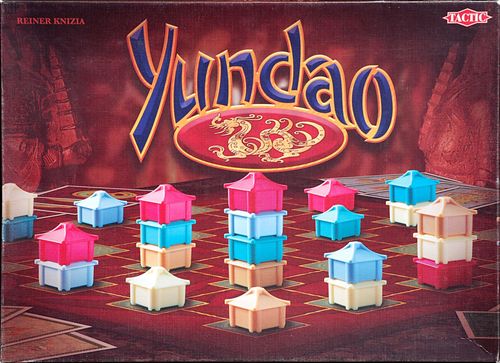
Game board, 25 pagodas (5 x 5 different colours), 55 cards (11 each of 5 colours), 1 totem.
Aim of the Game
The aim of the game is to capture more pagodas than your opponents do.
Before the Game Begins
Lay out the game board on the table and place the totem next to it. Each player chooses one of the five colours and takes 11 cards and 5 pagodas of the same colour. Choose one of the players to begin the game and give him/her the totem.
How to Play
Placing the Pagodas
First you play five rounds of placing the pagodas on the game board. The player who has the totem begins and play progresses clockwise. On your turn, place one of your pagodas on a vacant square on the game board (a crossing of two lines). If possible place your pagodas so that they are not situated in squares right next to each other. Continue in this way until each player has placed his/her 5 pagodas on the game board.
If there are fewer than five players, there will be vacant squares left on the game board. These are filled with the pagodas of the remaining colours. These are neutral and do not belong to any of the players.
Challenging and Capturing
When all 25 squares on the game board have been filled with pagodas, the challenging and capturing can begin. The player with the totem begins and play progresses clockwise.
On your turn you must always do one of the following:
- Challenge a pagoda situated next to one of your own pagodas. The pagodas are situated next to each other when the squares are connected with one single line. Place the totem between the pagodas to mark a challenge.
- Move one of your pagodas to an empty square and challenge a pagoda situated next to it. Moving your pagoda must be done in a straight line and only over empty squares. Note: Your pagoda is not allowed to take corners while moving. Place the totem between the pagodas to mark a challenge.
Remember: You are only allowed to challenge a pagoda situated next to one of your own pagodas. However, you are allowed to first move your pagoda to an empty square next to another pagoda. If possible, on each turn you must challenge an opponent's pagoda, a neutral pagoda or one of your own pagodas.
- If you are unable to challenge any pagodas (even by moving one of your pagodas), place one of your pagodas onto any empty square where some other pagoda will be able to challenge you on a later turn.
Note! 'Your pagoda' refers to one single pagoda or a stack of pagodas that has your pagoda on top. When you move your pagoda, you must also move all pagodas under it. You are only allowed to move your own pagodas.
Challenge
If you have challenged an opponent's pagoda, you and the challenged player both choose one card from your hands and place it face down on the table. The cards are turned over simultaneously and they are removed from the game after the challenge. Removed cards may no longer be looked at.
-
If you both chose a number card: Count together the number on your card and the number of pagodas in your stack. The player with the higher total wins and places his/her pagoda (or stack) on top of the opponent's pagoda (or stack).
For example: Blue has 2 pagodas in his/her stack and a number 4 card, whereas Red has 3 pagodas and a number 2 card. Blue's total is 6 and Red's total is 5. Blue wins and places his/her stack on top of Red's stack. The result is a stack of five pagodas with a blue pagoda on top.
-
If you both chose a number card and it's a tie: The pagodas (or stacks) of both players are removed from the game. The removed pagodas are not counted for the player at the end of the game.
-
If one of you chose a Dragon card and the other a number card: The Dragon card wins against all number cards. The winner places his/her pagoda (or stack) on top of the opponent's pagoda (or stack).
-
If you both chose the Dragon card: It's a tie and the pagodas (or stacks) of both players are removed from the game.
-
If one or both of you chose a Tiger card: Nothing happens. The Tiger card is neutral and it neutralizes all cards.
Note: If you have challenged a neutral pagoda or one of your own pagodas, there is no need to play any cards, because you win the challenge. Just place your pagoda on top of the challenged pagoda.
If you run out of cards (i.e. you have used and removed all of them from the game), remove all your pagodas (stacks) from the game board and place them in front of you on the table. You are not allowed to take part in the further course of the game. All the pagodas in front of you will count for you at the end of the game.
Stacks
There may not be more than 5 pagodas in a stack. If you gather more than 5 pagodas into your stack, remove some of them from the bottom of the stack so that there are only 5 left in the stack. Place the removed pagodas on the table in front of you; at the end of the game they will count for you.
Taking Turns
When your turn is over, pass the totem to the player sitting to your left; it is now his/her turn. The game will progress in this way until only one of the players has pagodas left on the game board.
Game End and Winner
The game ends when only one player has pagodas on the game board. He/she removes them from the game board and places them on the table in front of him/her. He/she also takes the totem. Then all players count the pagodas on the table in front of them. The player with the most pagodas is the winner.
Ties
If the player with the totem is involved in a tie for victory, this player wins. If other players are tied for victory, the one with the most cards left in his/her hand wins.