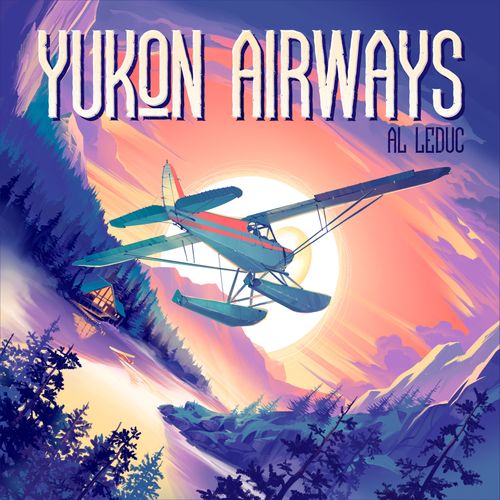
Yukon Airways
Yukon Airways Rulebook
Table of Contents
Table of Contents
Designing from Memory
The sun is low and the clouds are a dozen shades of orange which are reflected in the lakes below. What a view!
You've got your map sitting on your lap but you don't really need it since you know the way to Whitehorse like the back of your hand. It is your hometown, after all. You're running on fumes, but you're confident you'll make it. You tap your fuel gauge just to be sure. Taking that prospector and those two hunters to Dawson is pushing your little Super Cub to the limit.
"Damn, it's fun to fly!" you think to yourself with a smile. The lakes ahead are as smooth as glass, so you know you'll have a smooth flight for the entire way home. It shouldn't be long before you can see the floatplane base on Schwatka Lake. There is simply nothing more satisfying than ending the day with a quiet flight home under the midnight sun.
My personal connection to the theme and setting
Yukon Airways originally began as a small charter outfit in 1927 when Andrew Cruickshank bought the Queen of The Yukon. This plane was the sister plane to the more-famous Spirit of St. Louis, flown by Charles Lindbergh on the first non-stop, transatlantic flight from New York to Paris on May 20th, 1927. Today the Queen of the Yukon is still on display in the Aviation Museum in Whitehorse. Yukon Airways is still in operation today but now they offer helicopter services. When I grew up in the Yukon, my father was owner and operator of Yukon Airways, so I was pretty familiar with bush planes from a young age.
When I started working on this game, I knew there were several places which had to be included: two thirds of the Yukon's population lives in Whitehorse, which is the territory's capital. It serves as the communication/transportation hub in the game, as it does in real-life. Plus, that's where I was born and raised so my ego required its inclusion.
Dawson City is most famous as the setting for the Gold Rush. When Gold was discovered near Dawson City in 1896, word quickly spread across the world, which brought an unprecedented number of gold-seekers to the Yukon. Over 100,000 prospectors stampeded to the Klondike region which led to the establishment of Dawson City and, eventually, the Yukon Territory. Dawson City quickly became known as the 'Paris of the North' and in 1898, it was the largest city north of Seattle and west of Winnipeg.
Old Crow is the most northerly community in the Yukon and the only one that is not accessible by road.
Cinnamon Strip is famous in the Yukon because you can land your plane beside Braeburn Lodge to pick up cinnamon buns that are almost as big as your head!
Taco Bar is known to local bush pilots and outfitters but you won't find it on any map. Despite the name, it's not a Mexican restaurant–rather, it's a small gravel island, the end point for canoe trips along the Snake river. The waters here are deep and straight enough to allow a float plane to land. It was named after a memorable dinner made there.
You'll find some personal touches in the Objective cards, too. Paid with Gold Nuggets which was not uncommon, reveals that yellow dice represent Miners. Better Safe than Sorry rewards you for having fuel left at the end of your flight – it was also one of my father's favourite expressions. Love is in the Air is a nod to how my parents met. My mother was a doctor who used to work in small communities around the Yukon, and she was often flown around by my dad. These cards also hint that red dice are Mounties, green are Adventurers, pink are Tourists, and the blue dice are Doctors.
Even the photos taped to each plane's dashboard are authentic. Yes, I was super cute back then; thank you for noticing!
Feeling the theme
I knew that managing fuel and passengers would be the crux of the game, as fuel management is a bush pilot's most important skill and any error can be fatal. Because I didn't want to include player elimination in the game, there is an assumption that you always reserve the necessary fuel to return to Whitehorse. Now you only need to worry about having enough fuel to get all the way to Old Crow. As you can imagine, the further you want to travel, the more fuel you'll need to carry. That said, this is a game, not a simulation, so there are other ways to increase your range.
Passengers limit the distance you can fly. A plane can only carry a fixed weight and when you're flying solo, you can use all that capacity for fuel and travel a longer distance. If you've got passengers on board, then you can't take as much fuel and consequently you can't fly as far. I wanted to invoke the importance of fuel management without unnecessarily burdening the players, and the trade-off between passengers and fuel seemed like an elegant way to do that.
In Memoriam
While I'm very pleased with how Yukon Airways turned out, I'm saddened that my father, who passed away in 2014, will never see it. His life provided the impetus for the original design, and I hope you will enjoy this little tribute to the man who taught me how to soar. I think he would have.
— Al Leduc
Components
- 1 Main Board
- 4 Personal Boards
- 4 Seaplanes
- 4 Seaplane Cards
- 4 Player Markers
- 4 Turn Overview Cards
- 15 Dice (3 of each colour)
- 80 Cubes
- 72 Ticket Cards
- 9 Objective Cards
- 60 Money Tokens (15x $1, 15x $2, 10x $5, 10x $10, 10x $25)
- 1 Black Round Marker
- 24 Needles (for the dials)
- 28 Switch Tokens
- 1 Rulebook
Note: Replacement Needles and Switch Tokens are included in the punchboards.
Setup
A. Place the Main Board in the centre of the table.
B. Shuffle the Objective Cards, choose 3 randomly and place them face up in the lower left corner of the Main Board. For the first game it is recommended that cards 1, 7 and 9 are used.
C. Place the Black Round Marker on the second box of the calendar (Tuesday).
D. Each player chooses a Personal Board and places it in their play area. On each of the Switches of the Personal Boards, a Switch Token is placed so that the word OFF is visible and all the Dial Needles are positioned so that they indicate their lowest value, except the Fuel Dial which starts the game at 4.
E. Each player takes the Seaplane Card which corresponds to their plane model and the Player Marker of one colour, placing both next to their Personal Board. The card should show the side of the initial improvement. This improvement is immediately applied to each player's Personal Board (see Seaplane Cards).
Note: For experienced players it is recommended that the side of the card that shows no initial improvement is used. Both options can be combined if experienced and novice players are playing together.
F. Shuffle the deck of Ticket Cards and deal 6 cards to each player. Each player's hand is always hidden. Form a Draw Deck with the remaining cards and place it next to the Main Board.
G. Place all Seaplanes in play at the Whitehorse location on the Main Board.
H. Roll all the dice and place each of them on the Gate which corresponds to the number shown by the roll.
Note: In a two player game remove 1 die of each colour before the game.
I. Separate the grey cubes from the rest and place them in a pile next to the Main Board. At each location of the map on the Main Board, randomly place as many cubes of the other colours as players that are playing, except Whitehorse. I.e. if there are 3 players, place 3 cubes of any colour at each location.
J. Form a pile with all the Money Tokens next to the Main Board.
K. Choose the Starting Player at random: they place their Player Marker in space "1" of the Turn Track. The other players, clockwise, place their Markers in the first free space, from left to right, on the Turn Track. Finally, the Starting Player takes $1, the second $2, the third $3 and the fourth $4.
Note: Remove all leftover components from the game: Objective Cards, Cubes, Switch Tokens, Personal Boards, Seaplanes, Seaplane Cards and Player Markers.
Summary and Objective
In Yukon Airways you will be at the controls of your very own seaplane with the mission of transporting travellers to the different points of the Yukon. Embark your passengers (dice) using a draft system and use your Ticket Cards to take them to the different locations on the map. For each passenger you will get money and the possibility of improving your plane, if the passenger finds a point of interest that satisfies their tastes at the destination (when the colour of the die matches the colour of one of the cubes at that destination). At the end of the game, you will earn extra money according to the different locations you have visited. The player who has earned the most money at the end of the week will be the winner.
Playing
One game of Yukon Airways consists of 6 rounds, from Tuesday to Sunday (Monday is a rest day). Each of these rounds is divided into 4 phases that must be carried out in the following order:
- Boarding Phase
- Flight Phase
- Income Phase
- Maintenance Phase
Phase 1: Boarding
Beginning with the Starting Player, each player must complete these 4 steps before moving on to the next player in turn order:
a. Take the Marker from the Turn Track and place it on one of the Gates. If there is already one or more Markers of any other players at the chosen Gate, the active player places their Marker below the ones which are already there.
b. Carry out the action of the chosen Gate (optional, see Gates).
c. Board one or more dice of the same colour which are at the chosen Gate. Each Seaplane has space for 4 passengers (dice): these spaces are marked with the symbol on the Seaplane Card.
Important: Before performing this action, you can move dice from one Gate to another adjacent Gate (the one with the number immediately above or below). Moving a die from one Gate to an adjacent one costs $1. You can make as many moves as you want with the same die or with several dice, as long as they can be paid. To this end, Gates 1 and 6 are considered adjacent.
d. Adjust the fuel. This consists of advancing the Fuel Dial needle:
- One step for each free-space symbol that has been left free on the Seaplane Card after the dice have been boarded, and
- As many steps as the value indicated by the Bonus Fuel Dial (see Dashboard: Dials).
The maximum capacity is 7, so if this limit is exceeded, the excess is lost.
Example: Marco chooses to go to Gate 5. Thanks to the action of this Gate, he advances the needle on his Fuel Dial 2 steps. Then, he decides to move the red die from Gate 3 to Gate 5 by paying $2. Then, he boards the 2 red dice that are at his Gate, placing them on his Seaplane Card. Finally, he advances the needle of his Fuel Dial a total of 3 steps: 2 for the free spaces on his Seaplane Card and 1 more because the needle of his Bonus Fuel Dial currently indicates that value.
Once all players have boarded their passengers (dice) and adjusted the fuel on their Seaplane, the Player Markers are returned to the Turn Track to determine the new order of the next phase: the Flight Phase. The Starting Player is the player who is at the Gate with the lowest number and they place themselves in space "1" on the Turn Track. The player who is at the Gate with the next lowest number will be placed in space "2", and so on. In the event that there is more than one Marker at the same Gate, the order will be from top to bottom, that is, the Marker that is on top of another Marker will precede it.
Phase 2: Flight
Following the new turn order, each player will use their Ticket Cards to make a flight. A flight consists of travelling from the location where your Seaplane is to another that you choose as a destination. At the beginning of each round, all Seaplanes always depart from Whitehorse. To carry out a flight, you must transport at least one die and have the necessary fuel.
Each flight turn consists of the following steps that must be carried out in the order indicated before the turn passes to the next player:
a. Play one or more Ticket Cards corresponding to the same destination (Destination Tickets).
You have to play a Ticket Card face up that corresponds to the destination for each die (passenger) that you want to take to that location. One card is only for one die. If you do not have the Ticket Card of the destination you want to fly to, playing 3 Ticket Cards face down is equivalent to playing any Ticket Card (valid for a single die).
Example: Marco plays a Fort Norman card face up as his Destination Ticket, and also 3 face down Ticket Cards which count as another Fort Norman Ticket.
b. Play additional cards under the Destination Tickets to obtain a bonus (this is optional).
These additional cards must be played under the Destination Tickets as shown in the example. They can correspond to any destination since they are only used for their icon, but they all must have the same icon as the Destination Tickets under which they are played. Bonuses are applied as soon as 3 of the same icons are collected out of all the cards which have been played face up during a round (this includes the Destination Tickets themselves), even if they belong to different flights (see Bonuses). You can get more than one bonus in the same round.
In the case when 3 cards have been played face down as a Destination Ticket, the cards which are played under them can have any icon, but they must all be the same.
Example: The Fort Norman Card shows an icon and Marco decides to play under it 2 cards which have the same icon, thus collecting the bonus which allows him to immediately advance his Fuel Dial needle 2 steps.
c. Place the dice on the Destination Tickets.
Take one or more dice from the Seaplane Card and place them on the Destination Tickets. Remember that each Destination Ticket can only be used for one die and that you have to put a die on each Ticket.
Example: Once Marco has played his Ticket Cards, he places the red dice from his Seaplane Card onto his Destination Tickets: one on the Fort Norman Card and one on the 3 face down Cards.
d. Move the Seaplane to the destination and deduct the fuel used.
Move the Seaplane to the destination and deduct the fuel used by lowering the Fuel Dial needle.
The cost of fuel to travel from one location to another is calculated by adding up the cost of each of the connections through which the plane passes. These costs are indicated next to each connection on a yellow label.
The number shown in each location on the Main Board indicates the fuel needed to fly from Whitehorse to the location in question via the shortest route.
Example: Marco now moves his Seaplane to Fort Norman and deducts the fuel used on his Fuel Dial: -7.
e. Get Cubes from the Destination and make Improvements.
If the colour of the die the player places on the Destination Ticket matches the colour of one of the cubes present at the destination, the player takes the cube and places it on the map of their Personal Board, on the location where it was obtained.
When the colour does not match or there is no cube at the destination, the player takes a grey cube from the reserve and places it on the map of their Personal Board, on the visited location.
Note: The fact that the colour of a die matches the colour of a cube at the destination represents that the traveller has found a point of interest that corresponds to their personal preferences.
For each coloured cube obtained that is not grey, it will be possible to make an improvement on the Dashboard of the plane. An improvement consists of turning on a Switch, that is, changing it from OFF to ON by moving the Switch token, or advancing the needle of one of the black Dials (i.e. all but the Fuel Dial; see Dashboard) by one step. The effects of the improvements are immediate.
Example: At Fort Norman, Marco gets a red cube and a grey cube (there was only one red cube), placing both on the map of his Personal Board at Fort Norman. The red cube that he has achieved allows him to make an improvement on his Dashboard: he decides to turn on a Switch.
f. Rewards for Fulfilled Objectives.
If the requirements of one or more of the Objective Cards in play with the "immediate" symbol has been met, the corresponding rewards are obtained (see Objective Cards).
Example: Finally, Marco earns $2 since he has obtained the last cube that was in Fort Norman, thus fulfilling the Objective Card 5 that is in play.
Once these steps have been taken, if the player is clear that they do not want to, or can not, make any other flight on their next turn, they go directly to the Income Phase, even if they still have dice on their Seaplane Card. Otherwise, the player must wait for their next turn in order to make a new flight to another destination, following once again the steps above (a-f), but starting from the location where their Seaplane is currently located.
Example: After his flight to Fort Norman, Marco no longer has dice on his Seaplane Card. As it is evident that he will not be able to make more flights when his turn comes around again, he goes directly to the Income Phase.
Phase 3: Income
After finishing the last flight of the round, each player will get:
- As many dollars as indicated by the number of the single highest value destination among those visited in the round, including those visited using 3 face down Tickets. If there is more than one location with the highest value, only the income from one is gained.
- $1 for each die placed on their Destination Tickets. In the case of flying to the remote locations of Old Crow or Inuvik, each die also grants $2 and $3 respectively.
- The reward indicated by the Objective Cards with the "end of phase" symbol that has been fulfilled.
Once all the players have carried out the Income Phase, they will move on to the Maintenance Phase.
Example: In this round Marco has only travelled to Fort Norman, which gives him $7 (the value of the location). Next, he earns $2 more, one for each die (passenger) placed on his Destination Tickets. Finally, he earns another $2 for having spent 7 of fuel, thus fulfilling the Objective Card 3 that is in play.
Phase 4: Maintenance
All players must:
a. Roll the dice they have placed on their Destination Tickets and those that still remain on their Seaplane Cards. Each rolled die is placed at the Gate corresponding to the number on the die rolled. The dice that were already at Gates remain in the same place.
b. Discard face up all the cards they have used during their flights.
c. Draw as many Ticket Cards as their Card Draw Dial indicates (see Dashboard: Dials). If the Draw Deck is exhausted, the discarded cards are shuffled to form a new deck.
d. Discard the number of cards in their hand that exceed the limit allowed by their Hand Size Dial (see Dashboard: Dials).
Once these steps are completed, all Seaplanes return to Whitehorse and the Black Round Marker is advanced to the next day on the Calendar.
End of Game
The game ends at the end of the sixth round (Sunday). Each player will add up:
- The money that they have accumulated during the game.
- The money obtained through the Christmas Bonus Dial.
- The money obtained through Switch 7, only if it is ON.
- The money obtained from having travelled to distinct locations according to the following table (it can also be found in the lower right corner of the Personal Boards):
| Locations | 1 | 2 | 3 | 4 | 5 | 6 | 7 | 8 | 9 | 10+ |
|---|---|---|---|---|---|---|---|---|---|---|
| $ | 0 | 1 | 2 | 4 | 7 | 11 | 16 | 22 | 29 | 37 |
The player with the most money will be the winner. In the case of a tie, the player who has visited more distinct locations will win, out of those who are tied. If the tie persists, the tied players share the victory.
Example: Marco has achieved $58 during the game. In addition, he has travelled to 8 distinct destinations, earning $22. Finally, Switch 7 is activated: he has more blue cubes (4) than any other colour on the map of his Personal Board, which gives him $8. His final score is therefore $88 ($58 + $22 + $8). He did not activate his Christmas Bonus Dial so does not earn anything from it.
Bonuses, Dashboards, Boarding Gates, Objective Cards and Seaplane Cards
Below are detailed explanations of actions, improvements and rewards that Bonuses give, Dials and Switches on the Dashboard, Boarding Gates, Objective Cards and the Seaplane Cards. All of them are usually exceptions and modifications to the rules described above and, therefore, always prevail over them if not indicated otherwise.
Bonuses
As explained in the Flight Phase, you can play other cards under the Destination Tickets in order to collect 3 identical icons among all the cards played face up for the flights in the same round and get the corresponding bonus.
The three possible bonuses are:
- You get $3.
- Advance the needle of your Fuel Dial 2 steps.
- Make an improvement of your choice, Dial or Switch.
Example: On his first flight of the round, Marco travelled to Cinnamon Strip. When it is his turn again, he decides to make a second flight to June Lake, playing under this card another one with the same icon. By collecting the icon among his played cards (even if they are on different flights), he can immediately make an improvement of his choice.
Dashboard
The advantages obtained when turning on a Switch or advancing the needle of a Dial are permanent and, therefore, can be used for the rest of the game.
Dashboard: Dials
Fuel Dial: This Dial indicates the amount of fuel you have available at all times. You must advance the needle when you get fuel and lower it when you have to deduct the fuel used during a flight. The limit of your deposit is 7 and if for any reason you exceed that limit, you lose the excess.
Note: This Dial is the only one that can not be modified as an improvement.
Bonus Fuel Dial: When adjusting the fuel during the Boarding Phase, add to the Fuel Dial what this Dial indicates.
May Use Cards as Fuel Dial: When it comes to spending fuel during the Flight Phase, and only if you do not have enough fuel in your tank (Fuel Dial), you can discard on each flight as many Ticket Cards from your hand as this Dial indicates: each card discarded will count as one fuel. The fuel obtained in this way is independent of the Fuel Dial and is not reflected on it. This is the only way a player can exceed the fuel limit of 7.
Hand Size Dial: This Dial indicates the maximum number of Ticket Cards that you can keep in your hand after drawing cards during the Maintenance Phase. If you exceed this limit you have to discard the excess. In any other Phase of the game players are allowed to have more cards than this limit indicates.
Card Draw Dial: Draw as many Ticket Cards during the Maintenance Phase as indicated by this Dial.
Christmas Bonus Dial: This Dial represents the bookings that you have made during the game for the Christmas season. At the end of the game, add what this Dial indicates to your income.
Dashboard: Switches
Switch 1: From now on, each Destination Ticket can be used for 2 dice (passengers) instead of 1.
Switch 2: From now on, you can make up to 2 Gate movements without paying their cost during the Boarding Phase.
Switch 3: From now on, you get an additional $2 each time you get a bonus.
Switch 4: From now on, you can board dice of 2 different colours during the Boarding Phase.
Switch 5: From now on, you only need to collect 2 identical icons instead of 3 to get the corresponding bonus. This Switch can only be used once per round.
Switch 6: From now on, you can play 2 Ticket Cards face down instead of 3 to fly to any destination.
Switch 7: At the end of the game, you get $2 for each cube of the colour you have the most of (the colour grey also counts), on the map of your Personal Board. If you have more than one main colour, only one of them scores.
Gates
Gate 1: This Gate does not provide any action, but allows the first player to be placed on it to become the Starting Player.
Gate 2: You can draw one Ticket Card and place it in your hand.
Gate 3: You can board dice of 2 different colours from those present in this gate. Combined with Switch 4, you could board dice of 3 different colours.
Gate 4: You can make one Gate movement without paying its cost and advance your Fuel Dial needle one step.
Gate 5: You can advance your Fuel Dial needle 2 steps.
Gate 6: You can make an improvement on one of your Dials or Switches by paying $1 for it.
Objective Cards
The "immediate" type objectives provide rewards at the end of each flight, while the "end of phase" type objectives provide rewards only during the Income Phase.
The nine Objective Cards are:
- Better safe than sorry: Earn $2 if you have used at least 7 of your fuel.
- Long flight specialist: Draw 1 Ticket Card if after your final flight your Fuel Dial is at 2 or more.
- The wind beneath my wings: Make an improvement if you have travelled to Old Crow or Inuvik.
- Scenic Route: Earn $3 if on a second or later flight you have placed at least one pink die on a Destination Ticket.
- Last Call: Collect $2 each time you take the last cube of a location.
- Mounties' Priority: Advance the needle of your Fuel Dial 1 step and draw 1 Ticket Card if you only board red dice (Boarding Phase).
- Paid with Gold Nuggets: Collect $1 for each yellow die placed on your Destination Tickets.
- Love is in the air: Advance the needle of your Fuel Dial 1 step for each blue die placed on your Destination Tickets.
- …and the canoe?!?: Draw 2 Ticket Cards for each green die placed on your Destination Tickets.
Seaplane Cards
Each Seaplane Card has a face that provides an initial improvement related to one of the Dials of the Dashboard (Personal Board):
- Super Cub: Start with the Bonus Fuel Dial at 1.
- Turbo Beaver: Start with the May Use Cards as Fuel Dial at 2.
- Norseman: Start with the Card Draw Dial at 3.
- Cessna 172: Start with the Hand Size Dial at 4.
Solo Mode
You can play Yukon Airways alone with hardly any modification to the basic rules. You just have to keep in mind the following:
- The setup is identical to a two player game: use only 2 dice of each colour and place 2 cubes on each location.
- Start the game with $3.
- Before starting the game you must choose an improvement of your choice: Dial or Switch. Therefore, you must use the Seaplane Card on the side that does not show an Initial Improvement.
At the end of the game calculate your score in the usual way and compare it with the following table to determine if you have achieved a pilot title:
| Distinct Locations | Money Earned | Title |
|---|---|---|
| 8 or more | $60 or more | Rookie |
| 9 or more | $70 or more | Sourdough |
| 10 or more | $80 or more | Yukoner |
| 11 or more | $90 or more | Sky King |
| 12 | $100 or more | Legend |
You must reach both of the objectives: distinct locations and money earned to obtain the corresponding title. On your first attempt, you win the game if you get at least the Rookie title. In the following games, you must get a higher title than the previous one in order to win.
If you achieve the Legendary Pilot title share it on social networks using the hashtag #LegendaryPilotYukon.