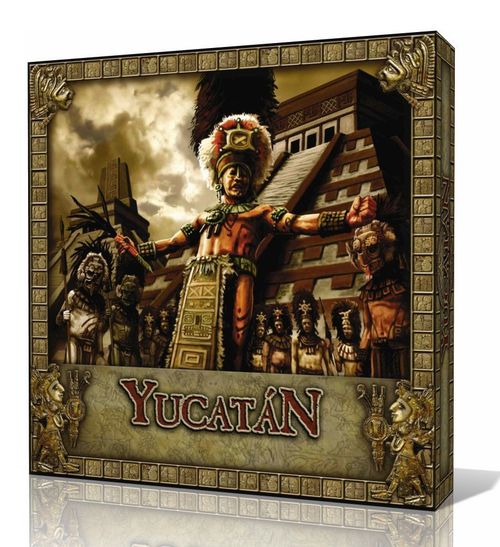
Yucatán
Yucatán Rulebook
Table of Contents
Table of Contents
Contents
- 12 game board tiles
- 36 warrior pawns, 9 per colour
- 20 pyramid elements, 5 per colour
- 32 village tokens, 8 per colour
- 12 neutral village tokens
- 50 prisoner tokens
- Rulebook in three languages
If any of the above elements are missing, please contact us at [email protected] and we will provide you with the missing piece.
Game Components
The game board
The board consists of six-sided tiles, which are subdivided into hexagonal spaces that will hold the players' villages and warrior pawns. Before starting the game, assemble the board as shown below depending on the number of players.
Diagrams: Two-player board, Three-player board, Four-player board.
On the tiles you will find:
- Stone cities, the cradle of the American civilisation – the city tiles are double-sided; use the side with one or two rivers, depending on the number of players.
- Impassable mountains – spaces that can hold neither villages nor warriors.
- River banks, which are marked with a special symbol.
- Smaller rivers, which are tributaries of the Great River.
- The Great River, which divides the region.
- Deep jungle spaces.
Pawns
Village tokens in the four player colours are double-sided, with one side representing a small, less-populated village and the other side a large, prospering village. Neutral tokens have a small village icon on both sides and may not be enlarged during the game.
Village tokens
Village tokens in the four player colours are double-sided, with one side representing a small, less-populated village and the other side a large, prospering village. Neutral tokens have a small village icon on both sides and may not be enlarged during the game.
Pyramid pieces
Each player has five wooden pyramid levels which he will try to build in his city. During the game the players will place new levels on the board to show their progress (that is, how close they are to victory). The finished pyramid should look as shown.
ATTENTION! Stickers are provided for the pyramid pieces. Before the first game, place them on their respective levels to make the pyramid look as shown.
Prisoner tokens
Prisoner tokens represent captured workers who will be used to build a pyramid. Each token represents a group of prisoners captured by warriors.
Setup
Board setup
The board setup depends on the number of people playing. The rulebook includes suggested setups for two, three and four players, but once you get utterly bored of them, you can use the tiles to create boards of your own design.
First, assemble the game board. Then each player chooses a colour and takes the set of nine pawns and eight villages of that colour, in addition to a set of five pyramid levels. Divide the neutral villages evenly among all players. Create a prisoner token pool by the board.
The person who was most recently in the jungle takes the first turn. If there is no such a person, choose the first player randomly.
Next, the player to the right of the first player places one village token on the board, with the large village icon face-up. The token must be placed on a space adjacent to the river that flows through that player's stone city, but not adjacent to the city itself. Then the player to his right places a large village on the board, and so on, in counter-clockwise order.
Regarding the villages
A village token may never be placed next to another village token or a city. In these rules, "large village" refers to a village token with the large village icon facing up, and "small village" refers to a village token with the small village icon facing up.
Once all the players have each placed one large village, the player sitting to the left of the first player places one small village of his colour on the board. He may place it on a space next to the river flowing from his city or next to a river that's adjacent to his large village (assuming the player placed his large village adjacent to both the river flowing from his city and the Great River). A village may not be placed on a space next to any other village or city. Then, the player to his right places a small village on the board, and so on, in counter-clockwise order.
If a player placed his large village here, he may (but doesn't have to) place his small village on any space along the Great River on either bank. A village may not be placed adjacent to another village.
Once all players have placed one small village of their colour, the player sitting to the right of the first player places the first neutral village on the board. He does not have to place it adjacent to a river, but may instead place it on any space other than mountain spaces, Great River spaces, and spaces next to other villages. Next, the player to his right places a neutral village on the board, and so on, in counter-clockwise order. Players place neutral villages on the board until they place all of them or no more villages may be placed on the board without breaking the rules above (that is, the next village would have to be placed in the mountains, on the Great River, or next to a village or city).
Return any unused neutral village tokens to the box as they won't be needed during this game.
Warrior brotherhoods
A warrior's brotherhood identity is secret. While a player may check his pawns' affinity at any time, he may not show the brotherhood symbols to another player, unless the warrior is engaged in combat when all symbols are revealed. If a player accidentally sees the symbol on an opponent's pawn, the owner of the pawn should immediately replace it with a different pawn from his supply.
Finally, all players, starting with the person sitting to the right of the first player, place two warrior pawns on the board in counter-clockwise order. A player must place them on spaces next to his city. Only one warrior token may stand on a single space at a given time.
Players place both pawns simultaneously. Their two pawns may be from the same or different brotherhoods, but their brotherhood identity should remain a secret from other players.
Once each player has placed two warriors on the board, the game begins.
The Game
Each player, beginning with the first player, takes one action from the list of possibilities below, then the person sitting to his left takes one action, and so on, in clockwise order. The game ends when one player finishes his pyramid by placing the fifth and final level on the board.
On a turn, a player must choose one of the following actions:
- Establish a village
- Enlarge a village
- Dispatch a warrior
- Move a warrior
- Build a pyramid level
1. Establish a village
This action allows a player to increase the number of villages he has on the board. To do so, he takes one village token and places it on one of the board spaces with the small village icon face-up.
Villages may be placed either:
a. on a space next to a river that is adjacent to a village owned by that player or connected to that player's city, or
b. on a space containing one of that player's warrior pawns, regardless of rivers.
Each space may contain only one village. A village may never be placed next to any other village or city, in the mountains, or on within the Great River.
Illustrations: a player places his village next to a river which already has one of his villages next to it; a player places his village under a warrior pawn.
2. Enlarge a village
By taking this action a player flips one of his small village tokens to the large village side, which will provide benefits (and risks) in future turns.
3. Dispatch a warrior
A player that chooses this option sends another group of warriors (that is, another pawn) into the jungle. To do this, he takes one of his pawns not currently on the board and places it either:
a. on an empty space next to his city, or
b. in one of his large villages.
In the latter case, the player must first flip the village token to the side showing the small village – after all, some members of the village are now heading out to capture prisoners to work on the pyramid! If an opponent's warrior stands on your large village, you may not choose this option and must place your warrior adjacent to your city.
Warrior limit
A player may place an additional warrior on the board only if his civilization can support that warrior. To know how many warriors a player can support, add up how many villages he has on the board (regardless of their size), then add one to this total to account for the player's city.
Example: Boniface has two villages on the board, so he may support three warrior pawns (two for his villages and one for his city). Since he already has that many warriors on the board, he cannot place another one on the board.
If a player loses a village (see below) and the number of his warriors on the board now exceeds the number that he can support, he must immediately remove one pawn of his choice from the board.
Placing warriors
A warrior pawn cannot occupy a space that holds another pawn. A new warrior may be placed on one of the spaces next to a city. A player may also place his pawn in one of his large villages. However, he must first flip the large village token to the other side, reducing it to a small village. A player is not allowed to remove one of his small villages from the board in order to exchange it for a warrior.
If an opposing warrior is present in a large village, a player cannot reduce the size of the village in order to place his own pawn there and initiate combat.
Illustrations: place a warrior on a space next to a city, or flip a large village token to place a warrior on it.
4. Move a warrior
A player that takes this action moves one of his warrior pawns to another space. A warrior moves only one space, except if it moves alongside a river (that is, on the hexes marked with the river symbol), in which case it may move one or two spaces. In this situation, the warrior cannot return to the space on which it started the turn.
Crossing the Great River
A pawn may not stop on the Great River, but it may cross in a single move of two spaces, the first space being a River hex adjacent to where the pawn began its movement, and the second space being a River bank adjacent to that River space.
Movement restrictions
A warrior pawn cannot cross a space occupied by another warrior. It can, however, enter a space occupied by an opponent's warrior in order to start combat (see below). A warrior must stop when it crosses a village owned by an opponent or a neutral village. A warrior may not enter a mountain space or stop on a space of the Great River.
Entering a village
A warrior pawn may move through villages of its colour or stop there with no restrictions.
If a warrior enters an opposing or neutral village, it must stop. The player controlling that warrior takes one prisoner token from the pool and places it under that warrior. If the warrior stopped in a large village, the player flips it to the small village side; if the warrior stopped in a small village, the player removes that village from the board.
Remember that a warrior collects prisoners only when the pawn enters a village; standing on a village does not give a warrior additional prisoners. To receive another prisoner, the warrior would have to leave the village, then return to that location on a later turn.
Example: One of Boniface's warrior pawns enters a large village belonging to Ferdinand. The pawn must stop there even if it could move one space further along the river. Next, Boniface takes a prisoner counter and flips Ferdinand's village token to the small village side. On his next action, Boniface can leave his warrior in the village, but he cannot take another prisoner. Ferdinand may enlarge this village despite the presence of Boniface's pawn, but he may not place warriors there until the opponent's pawn leaves, either by choice or through combat.
Encountering other warriors
When a warrior pawn enters a space occupied by another player's pawn, its movement ends immediately, and combat begins.
The players simultaneously raise their pawns and reveal their brotherhood memberships to all players. The outcome of combat depends on the symbols found on the bottom of the pawns: the Jaguar defeats the Snake, the Snake defeats the Hummingbird, and the Hummingbird defeats the Jaguar. If both pawns belong to the same brotherhood, the defender wins.
The defeated pawn is removed from the board. The winning pawn remains on the space, and the player controlling that pawn takes one prisoner token from the pool and places it under the warrior.
If a pawn standing in a village is attacked and defeated by a pawn that doesn't match the colour of that village, the winner moves onto that village space, but does not receive an additional prisoner or reduce the size of the village.
Example: Boniface's warrior enters a village belonging to Ferdinand that also contains one of Ferdinand's pawns. Both players simultaneously reveal the bottom of their pawns: it turns out that Boniface's warrior belongs to the Snake brotherhood while Ferdinand's warrior belongs to the Hummingbird brotherhood. Ferdinand is defeated, his pawn is removed from the board, and Boniface receives a prisoner token. The victorious warrior enters Ferdinand's village, but does not take a prisoner there, and the size of the village is not reduced.
Transporting prisoners
When a player captures a prisoner (whether after a fight or by pillaging a village), he takes a prisoner token and places it under the warrior pawn that caught the prisoner. This token now moves with this pawn. A warrior pawn may transport up to three prisoner tokens at a time. If a pawn already has three tokens, it must discard any additional prisoners that it captures.
When a warrior who is transporting prisoners enters a large village or a city owned by the player who controls that warrior, the prisoner tokens are moved to that player's city. The warrior can now march into the jungle again to try to capture up to three more prisoners. The transported prisoners remain in the city until they are taken by another player or used to build the pyramid (see below).
Example: Boniface's warrior, transporting two prisoners, enters a small village belonging to Boniface. During his next turn the player decides to enlarge the village. Once he turns over the village token, the warrior transporting the prisoners is present in a large village, so Boniface immediately moves both prisoner tokens to his city.
Winning back prisoners
If a warrior who is transporting prisoners is defeated by another warrior, the victor takes all the tokens from the defeated warrior as well as an additional prisoner token due to his victory.
Example: Boniface's warrior, transporting two prisoners, is attacked and defeated by Ferdinand's warrior. The two tokens carried by the defeated warrior are placed under the victorious pawn, then an additional token (representing the defeated warrior) is added. Thus Ferdinand's warrior is now transporting three prisoner tokens. Until the warrior brings them to a city, it cannot capture additional prisoners; if it wins another fight, the new prisoner token will be discarded.
When prisoners are held in a city, all players other than the city owner may try to win them back. When a warrior enters an enemy city (from any of the adjacent spaces), the player controlling that warrior may place up to three prisoners in that city under his pawn. From that moment on that warrior is transporting them, using normal rules.
Example: Ferdinand's warrior enters Boniface's city, where there are five prisoner tokens. Three of the tokens are placed under the warrior's pawn, which is now transporting them and can move them to his city when he reaches his city or big village. The two tokens remain in Boniface's city as Ferdinand's warrior can transport no more than three prisoners.
5. Building the pyramid
During this action the player returns three prisoner tokens from his city to the prisoner token pool and builds one level of his pyramid. The first level is placed next to his city, and all levels built after that will be stacked on one another, as shown on the final page of this rulebook.
Example: Boniface has six prisoners and decides to devote his attention to the pyramid. He discards three tokens and places the first pyramid level on the board. He may not discard all six tokens at once to build two levels, but he may build more levels during future actions.
Winning the Game
The game ends as soon as any player builds the fifth and final level of his pyramid. That player wins the game!
Notes on This Transcription
- The English text is transcribed as printed. The following obvious typographical slips in the printed rulebook were read as their evident intent and are rendered accordingly: "or on within the Great River" (read as "or within the Great River"), "either::" (read as "either:"), "T two tokens" (read as "The two tokens"), and "a prisoner counter" (kept as printed; the prisoner token is meant).
- Diagrams and illustrations are not reproduced; their captions are noted in brackets.
- Credits, the publisher's advertisement pages and the blurb for other Wolf Fang titles are omitted.