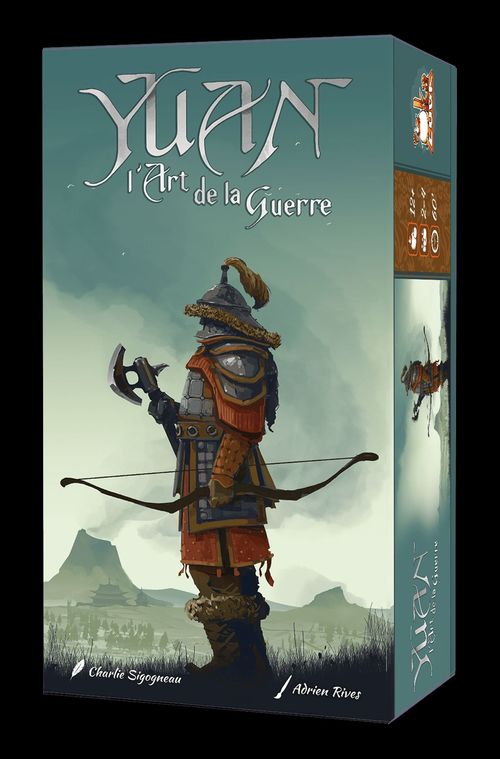
Yuan: l'Art de la guerre – Mongolie
Yuan: l'Art de la Guerre – Mongolie Rulebook
Table of Contents
Table of Contents
Material
- 15 Territory tiles
- 4 screens
- 4 Clan boards
- 4 pencils
- 34 Chão (printed money, pronounced "chao")
- 1 Wheel of Time
- 72 Villages
- 56 Cities
- 36 Armies
- 18 Temples
- 24 Ramparts
- 28 level markers (action / non-action cubes)
Set up
- Set the wheel of time to turn 1, placing it where everyone can see it.
- Choose the tiles according to the number of players. On the back of the tiles, the number of players and the letter of the tile (to be used for imposed scenarios) are indicated:
- 8 tiles for 2 players
-
- 4 tiles for 3 players
-
- 3 tiles for 4 players
You can play Yuan with several scenarios (Free or Imposed, see the end of the booklet), and with or without bidding. The assembly of the Territory tiles and the placement of the capitals will then be different.
For your first game, we advise you to play a free scenario without bidding!
Free scenario without bidding
- Distribute the Territory tiles equally to each player. Each player in turn places a tile in the center of the table, next to another. Repeat until the last Territory tile has been placed. (With 4 players, one player will place one tile fewer than the other players.)
- Place a Temple on each Hill Province.
- Place one City per player (of a different color) on a Province (other than Mountain and Water), in agreement with your opponents.
- Each player draws at random one of the colors in play. They will play this color and this Clan for the whole game. (When the Cities are placed, the players do not yet know what their color and starting City will be.)
- Each player takes a pencil, the screen, the Villages, the Cities, the Armies of their color and their Clan board.
- Each Clan takes 4 Chão (printed money, pronounced "chao"). Make the necessary Chão deductions for each Clan if you are playing with the Clan powers (see p. 17).
Free scenario with bidding
- Distribute the tiles to each player. Each player in turn places a tile in the center of the table, next to another. Repeat until the last "Territory" tile has been placed.
- Place a Temple on each Hill Province.
- Place the Cities at random on Provinces (other than Mountain and Water), in agreement with all players.
- Each Clan takes 6 Chão.
- All players, at the same time, make a hidden bid in their hand. They then reveal their bids simultaneously. The player who bid the most spends the Chão and chooses their capital, and therefore their Clan.
- Repeat this bidding until every player has a Clan.
- Each player takes a pencil, the screen, the Villages, the Cities, the Armies of their color and their Clan board.
REMARK: In the event of a tie in the bidding, repeat the auction between the players who bid the most. If there is another tie and all the players bid the maximum (6), determine the winner at random.
Also, if you are playing with the Clan powers in bidding mode, do not take into account the financial adjustments of each Clan.
Goal of the game
At the end of each round, the Clan that controls a number of Temples greater than or equal to the number shown on the wheel of time wins the game! In the event of a tie, the Clan that controls the most Mines wins. In the event of a further tie, it is the Clan with the most Chão, and failing that the most Armies.
Use the Clan powers only once you have mastered the rules of the game. A first game usually gives a good grasp of the mechanics and makes it possible to use this option.
During a game of YUAN, you are allowed to talk and negotiate your future actions with your opponents. You may not, of course, show your programming until all the other players have finished theirs, but this can help you get into the role of Clan leader.
But beware: as Sun Tzu's treatise tells us, assess the intentions of your enemies carefully!
Detailed description
Tile
A tile is made up of 7 "squares" of different types of terrain. There are three types of terrain on the Territory tiles:
- A. Mountains (grey background) are impassable.
- B. Lakes (blue background) allow connections (Water squares).
- C. Provinces, recognizable by their name, generate resources for more powerful actions. There are four different types:
- Rice paddies, for Development actions.
- Forests, for Fortification actions.
- Mines, for Militarization actions.
- Hills, which generate no resources but are the locations of the initial Temples!
Village and City
Village. A Village of your color symbolizes that you control this Province.
City. A City has the same effect as a Village, but can also generate more powerful effects. A second City in the same Province means that the Province produces twice the resources.
Rampart. A Rampart around a City gives a defense of 2 (on the wood side). Two Ramparts around a City make the City indestructible and give a defense of 1 to the adjacent Provinces (second Rampart on the stone side).
Armies. They have a Strength of 1. A maximum of 3 Armies may be in the same Province at the end of the turn.
Free, controlled and enemy Province
A free Province is a Province empty of any occupant (City or Village). It may contain a Temple.
A controlled Province is a Province containing at least one Village or City of its Clan.
An enemy Province is a Province containing a Village or City of a Clan other than your own.
Adjacent and connected
An adjacent Province is a Province next to one of its own Provinces.
A connected Province is a Province linked to another by a lake, whatever the number of Water squares.
Group of Provinces
A group of Provinces is a set of adjacent Provinces belonging to the same Clan, whether they are Villages or Cities.
EXAMPLE: in the situation shown in the booklet, we identify 3 distinct groups.
Cost of actions
Each action has a cost in Chão depending on its level: Level I costs 0 Chão, Level II costs 4 Chão and Level III costs 7 Chão.
The cost of the programd actions is paid at the start of the resolution phase. You must therefore have enough Chão to program your actions, but the cost may be reduced depending on the type of Province controlled.
The real cost of actions. As seen above, the cost of an action depends on its level. This cost can be reduced by the number of Provinces controlled of each type (Rice paddy, Forest or Mine). Each Province controlled reduces by 1 the cost of the action linked to its type:
- Rice paddies for Development actions.
- Forests for Fortification actions.
- Mines for Militarization actions.
EXAMPLE 1: if we want to carry out a Level II Development action (Rice paddy) and we control 2 Rice paddies, the action will cost us only 2 Chão instead of 4. No Chão if we control 4 Rice paddies or more.
EXAMPLE 2: if we want to carry out Development I, Fortification III and Militarization II, it will cost us 11 Chão (0 for Development I, 7 Chão for Fortification III and 4 Chão for Militarization II). If we control 4 Rice paddies, 5 Forests and 2 Mines (or produce their equivalent, thanks to the City which doubles production), the cost will be 4 Chão. Development I costs 0, so the Rice paddies controlled are not taken into account. Fortification III costs 7 Chão, minus the 5 Forests controlled, giving a final cost of 2 Chão. Militarization II costs 4 Chão, minus the two Mines controlled, giving a final cost of 2 Chão. The total cost of the turn, to be paid at the start of the resolution phase, is therefore 4 Chão!
Turn sequence
I. Update the wheel of time II. Planning III. Resolution IV. Victory control
I. The Wheel of Time
At the start of each turn, except the first, turn the wheel one notch to determine the number of Temples to control in phase IV in order to win!
II. Planning
Each Clan must plan, simultaneously and hidden behind its screen, which actions it will undertake this turn. There are two possibilities:
- Write down the name of the Province where it intends to play, which we call the Target Province, and place an action cube or a non-action cube in the Level I, II or III action box for each type of action it intends to carry out on the Target Province: Development, Fortification, Militarization. It is therefore possible to carry out from one to three actions, of the same or different levels, on a Province in the same turn! IMPORTANT: only one Province can be targeted per turn!
- Pass your turn: indicate nothing, neither a Province nor an action. The player is considered to have passed their turn and will gain 6 Chão in the "income" step of the resolution.
III. Resolution
Each Clan simultaneously removes its screen, clearly showing the Province it is targeting this turn. All Clans then pay for and carry out their actions simultaneously, in the following order:
- Development
- Fortification
- Militarization – creation of Armies
- Militarization – Attack
- Fortification – following an attack
- Income
- Upgrade of Armies, Temples and Provinces
IMPORTANT: as shown in the resolutions, you cannot carry out a Development after an attack! Each action will specify the order of priority in case the same Province is targeted by several players, or for equivalent actions on adjacent Provinces.
Development
Colonization
Targets a free Province (belonging to no one).
Level I (0 Chão / Rice paddies). Acquire the free Province adjacent or connected to one of the Provinces you own, as well as the free Provinces adjacent to it, by adding one Village per Province (special case, see Automatic urbanization).
Level II (4 Chão / Rice paddies). Identical to Level I Colonization, but with a gain of 2 Chão in the income phase.
Level III (7 Chão / Rice paddies). Acquire the free Province and the free Provinces adjacent to it by adding one Village per Province. (PRECISION: anywhere on the tiles, not necessarily adjacent or connected to one of our Provinces. Special case, see Automatic urbanization.)
Expansion
Targets one of your Provinces.
Level I (0 Chão / Rice paddies). Acquire the free Provinces adjacent to the group of the Target Province by adding Villages.
Level II (4 Chão / Rice paddies). Identical to Level I Expansion, but with a gain of 2 Chão in the income phase. (This action can be carried out even if it does not allow the acquisition of new Provinces.)
Level III (7 Chão / Rice paddies). Build a Temple and immediately steal 2 Chão from the Clans adjacent to the Temple.
Automatic urbanization
After the end of a Colonization, if the group newly created from the Target Province does not contain at least one City, the Village in the Target Province (the first Village) instantly becomes a City. All the following actions will then apply to a City and no longer to a Village.
EXAMPLE: the Red Clan colonises a Province with the Colonization Level I action, placing a Village on the Province and on all the adjacent Provinces. At the end of this phase, no City is adjacent to the group of Villages created, so the first Village (the Target Province) becomes a City. Any other action in the turn will therefore apply to a City and not to a Village.
Fortification
Urbanization
Targets one of your Villages.
Level I (0 Chão / Forest). No effect.
Level II (4 Chão / Forests). Turns the Village into a City.
Level III (7 Chão / Forests). Turns the Village into a fortified City. Replace the Village with a City and place a wooden Rampart around the City (defense 2). Add an Army to the Province!
Reinforcement
Targets one of your Cities.
Level I (0 Chão / Forest). Add a City to the first one. Doubles the production of the City in the upgrade phase.
IMPORTANT: you can never increase the production of a doubled City.
Level II (4 Chão / Forests). Turns the City into a fortified City. Place a wooden Rampart around the City (gives a defense of 2) and add a City to the first one, which doubles its production.
IMPORTANT: you can never increase the production of a doubled City.
Level III (7 Chão / Forests). Turns the City into an indestructible City, and gives a defense of 1 to all adjacent Provinces. Add an Army to the Province!
REMARK: Indestructible City: as its name suggests, the City can no longer be destroyed, but its Armies can be attacked! This action does not double the City's production, but if it was already doubled, the doubling is kept.
EXAMPLE: for a fortified City, place a Rampart on the wood side. When you turn a City, or an already fortified City, into an indestructible City, place 2 Ramparts (for a City) or 1 Rampart (for a fortified City) on the stone side. So the symbol of a fortified City is a single wooden Rampart, and that of an indestructible City is two Ramparts, the top one in stone.
Militarization
Recruitment
Targets one of your Cities.
Level I (0 Chão / Mine). No effect.
Level II (4 Chão / Mines). Add an Army to the Province.
Level III (7 Chão / Mines). Add three Armies to the Province!
IMPORTANT: at the end of the turn, each Province may receive no more than three Armies; any surplus Army is destroyed and returned to the Clan's available stock.
Attack
Targets an enemy Province.
Level I (0 Chão / Mine). Attack an enemy Province adjacent or connected to at least one of your Armies.
Level II (4 Chão / Mines). Attack an enemy Province adjacent or connected to at least one of your Armies, and add an Army from your reserve to the battle.
Level III (7 Chão / Mines). Attack an enemy Province adjacent or connected to at least one of your Armies, and add an Army from your reserve to the battle. In the event of victory, carry out a Force 1 attack on the adjacent Provinces occupied by an enemy (this attack takes place after any other enemy attack).
REMARK: the number of Armies for each Clan is limited. If all the Armies are in play, no new ones can be created.
IMPORTANT: whatever the level of the attack, all the Armies beyond the first, adjacent or connected to the Target Province, must attack!
Combat / Attack
At least one Army present on the Territory must take part in the initial attack (you cannot initiate an attack just by creating an Army. For example, a Level II Attack does not allow you to attack with this newly created Army if at least one existing Army does not take part in the combat).
The attacker cannot decide which Armies will join the battle on the Target Province. All the Armies adjacent or connected to the Target Province must attack, and will therefore no longer be on their home Province to defend it.
When Armies clash, each has a value of 1.
On a 1-to-1 clash, they annihilate each other. In the event of a tie, the advantage goes to the defender. The attacker needs one more Army than the defender to take his Province.
In the case of a fortification, the Armies face each other first, and if the attacker still has Armies, their Strength is compared with the defense of the fortification.
REMARK: against a defense of two, three Armies are needed to take the Province!
Surviving Armies remain on the Target Province.
If the attacker wins, the defender loses its Province. All Villages, Cities and any Rampart are removed from it. If the defender's group of Provinces no longer has a City, any Armies there are removed and its Villages are replaced by those of the attacker.
Once all the attacks have been resolved, the automatic urbanization rule below may apply.
Automatic urbanization
After a successful attack, if the newly acquired Provinces do not belong to a group containing at least one City, the Village of the Target Province instantly becomes a City. All the following actions will then apply to a City and no longer to a Village.
EXAMPLE: the Red Clan attacks the HU Province with the Attack Level I action, destroying the targeted City. The adjacent Villages, having no City left in their group, are replaced by Villages of the attacker. At the end of this phase, if the newly acquired Provinces do not belong to a group containing at least one City, the first Village (the Target Province) becomes a City. The next programd action is a Level II Fortification, so it will be a Reinforcement (since it targets a City), which will add a wooden Rampart and double the production!
Fortification after attack
Following an attack, a Clan may program a fortification. The rules for a fortification after an attack are identical to those of the fortification on page 13. This fortification follows a successful attack and cannot be carried out if the attacker has not conquered the Target Province! In that case, exceptionally, the Chão spent on this fortification is refunded.
Income
- Possible gain of Chão, through Development.
- Gain of 6 Chão for having passed your turn.
Army upgrades by Clan
Each Clan upgrades its Clan board, adjusting the markers for the Temples, Rice paddies, Forests and Mines it controls. On the Territories, it removes the surplus Armies from the Provinces (reminder: maximum 3 Armies per Province).
IV. Victory control
Once each Clan has upgraded its Temple control, check whether one of them meets the victory condition by controlling as many Temples as shown on the wheel of time.
If a Clan controls the required number of Temples, it wins!
In the event of a tie, the Clan that controls the most Mines wins. In the event of another tie, it is the Clan with the most Chão, and finally the most Armies.
Tie management
Here is a priority system for cases where several Clans act on the same Provinces in the same turn.
Colonization or Expansion
If several Clans target the same Province for Colonization, their action is cancelled, as are their subsequent actions (Fortification and/or Militarization). This means that they do not spend the Chão required for these actions. However, each Clan gains 6 Chão (as if it had passed its turn).
If several Clans, through the Colonization or Expansion action, were to extend their territory by adding Villages around their Target Province, there are two possible cases:
- The Clans must place a Village on a Province that is not their Target Province for the turn: nobody places a Village, and the Province remains empty.
- One of the Clans must place a Village on a Province that is not its Target Province for the turn, and another Clan has targeted that Province: this Clan has priority and takes the Province.
Attack
If several Clans attack the same Province, first resolve the mutual attack of the attacking Clans' Armies using the same combat rules: on a 1-to-1 clash, they annihilate each other. And only if attacking Armies remain, the attack on the Province is resolved!
Optional rule: The Volcanoes
On every turn, the Territories adjacent to the Volcanoes produce double resources (so 2 resources, or 4 resources for doubled Cities).
VOLCANO ERUPTION: at the end of turns 5, 9 and 13 (during step 7, upgrade, so before victory control), the Provinces adjacent to the Volcanoes become neutral again. The Clans remove the Villages, the Cities (even indestructible ones) and the Armies on these Provinces.
The Clans
Clan Mu (Black). Starting Chão -2. You win the game with 3 times the objective in number of Provinces owned. A Temple counts as two Provinces. In the event of a tie, you win the game!
Clan Suhey (Red). Starting Chão -1. During a Development action, if Provinces you must acquire have remained neutral (because of another player), take them anyway.
Clan Weyu (Green). Starting Chão +0. In the Attack action, isolated Armies may cross one Mountain and up to two Water squares.
Clan Xiangi (Orange). Starting Chão +0. You cannot move through more than 2 Water squares (Development or Attack). If one of your Provinces lies between 2 Mountains and has at least one Army on it, it has a defense of +2.
Scenarios
River Control – 4 players
Imposed initial placement of the tiles and free placement of the first Cities. No special rules.
Crossing the Waters – 3 players
Imposed initial placement of the tiles and of the first Cities. Mandatory placement auctions. No other special rules.
Generalized Conflict – 5 players
Scenario possible only with both boxes, China and Mongolia. Imposed initial placement of the tiles and of the first Cities. No special rules.
Special cases
Expansion Level III
If two Clans build a Temple at the same time and each must steal from the other, they steal nothing from each other.
On the other hand, if they both have to steal from a third Clan (which has not built a Temple), each takes 1 Chão, then a second one. If they cannot, or can no longer, steal, they take nothing more. In short, they must have stolen the same number of Chão.
Simultaneous attacks
Several Clans attack adjacent Provinces at the same time.
-
For simultaneous attacks that succeed on different Provinces, the actions are carried out in a certain order:
- Each Clan removes the enemy Village or City and acquires the Target Province by placing one of its Villages there. The Province thus acquired is definitively acquired for this turn. (In the case of a Level III attack, the Clan also removes the Villages or Cities lost to the adjacent Force 1 attacks, if they succeed.)
- If an enemy group is left without a City, it is destroyed. Each Clan that caused the destruction of the group or sub-group places one of its Villages on these Provinces (before removing the enemy Village).
- If the attacker is the only one present on a Province, that Province is under its control. It leaves its Village there.
- If several attackers are present on a Province, that Province is freed.
- The automatic urbanization rules apply after the attack (page 15).
EXAMPLE: the Red Clan attacks the Orange City and the Orange Clan attacks the Red Village. Each takes possession of its Target Province. The Orange Clan no longer has a City (for the moment) in its group, so the Red Clan takes possession of the Orange Village. On automatic urbanization, the two newly conquered Provinces become Cities.
-
If two Clans attack the same group of Villages on different Provinces, each attacking Clan becomes the owner of the Villages it has isolated.
EXAMPLE: the Red Clan attacks the Orange Village, isolating one Village from the group and taking possession of it. At the same time, the Green Clan attacks the Orange Village, isolating a single Village from the group.
-
If the attacks of several Clans destroy Provinces that would not have been destroyed by the attack of only one Clan, these Provinces are freed.
EXAMPLE: a group of Villages with two Cities belonging to the same Clan: if both Cities are destroyed in the same turn (that is, by two different Clans), the Provinces become free again (empty), and there is no sharing between the attacking Clans. Exception: if one of the two attackers is carrying out a Level III Attack action, it takes possession of the adjacent enemy Provinces through its Force 1 bonus attack.
Two different boxes
You can play with up to 8 players using these two boxes (China and Mongolia). The rules are the same! The bidding and Clan rules are unchanged and remain optional.
The only differences are:
- The Clan powers, the Clan colors, the names of the Provinces, the effect of the volcanoes in the Mongolia box or of the rivers in the China box, and different scenarios.
- When setting up, divide the choice of tiles according to the number of players:
- 5 players: take the tiles for 4 players from one box and the tiles for the 3rd player from the other box. 19 tiles in all.
- 6 players: take the tiles for 4 players from one box and the tiles for the 3rd and 4th players from the other box. 22 tiles in all.
- 7 players: take the tiles for 4 players from one box and the tiles for 3 players from the other box. 27 tiles in all.
- 8 players: take all the tiles from both boxes. 30 tiles in all.
Game aid
Material: Village, City, Army, Rampart, Temple.
Provinces: Free Province; Controlled Province; Controlled Province with a Village; Controlled Province with a City; Province with a defense of 1; Indestructible City; Province containing a controlled Army; Enemy Provinces.
Actions: Connected Province; Adjacent Province; Replace; Add; Steal (2 Chão); Attack.