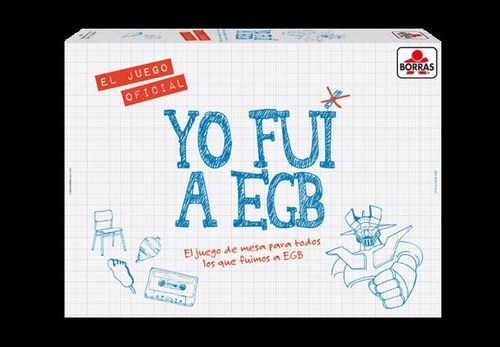
Yo Fui a EGB: El Juego Oficial
Yo Fui a EGB: El Juego Oficial Rulebook
Table of Contents
Table of Contents
Contents
- 6 tokens + 6 stickers
- 1 die (6-sided)
- 1 sheet of punch-out cards
- 1 game board
- 5 plastic soldiers
- 192 cards
- 68 "Individual Question" cards
- 22 "Everyone Plays" cards
- 22 "Challenges and Effects" cards
- 40 "Exam" cards
- 40 "TV Challenge" cards
- 1 marble
- 10 cardboard candies
- 6 marker folders
- 30 end-of-stage tokens (6 of each type)
Objective of the Game
Be the first player to complete the route that runs from school to the bedroom, passing through the kiosk, the park and the living room. To do this you must answer the questions and complete the challenges that come up along the route, and win each of the 5 markers that identify the stages of the game.
Setup
Place the board in the centre of the table.
You will see 5 different types of cards. Shuffle each group of cards before placing them face down on the table in piles:
- "Individual Question" (Pregunta individual): usable in all stages of the game.
- "Everyone Plays" (Todos juegan): usable in all stages of the game.
- "Challenges and Effects" (Retos y efectos): usable in all stages of the game.
- "Exam" (Examen): usable only in the school stage.
- "TV Challenge" (Prueba TV): usable only in the living-room stage.
Cover the "Individual Question" pile with the card that has two backs so that the questions cannot be read.
The "Individual Question", "Everyone Plays" and "Challenges and Effects" cards each have a question or challenge for every stage of the game. Use the one marked with a chair for the school stage; the ice cream for the kiosk stage; the spinning top for the park; the TV for the living room; and the cassette tape for the bedroom.
Next, place as many end-of-stage markers on the matching spaces as there are players, and give each player a marker folder to store the markers as they win them.
Finally, each player takes a token and places it on the start space. Roll the die and whoever rolls the highest number goes first. Play then passes to the right.
(If it is your first time playing, stick the stickers onto the tokens before you start.)
Rules of Play
1. "Individual Question", "Everyone Plays" and "Challenges and Effects"
On their turn, the player rolls the die and moves their token as many spaces as the number rolled. Depending on the type of space where their move ends, they carry out one kind of challenge or another.
Empty space: the player to the left of the active player takes an "Individual Question" card and reads it aloud. There are three types of "Individual Question":
- Do you remember? (¿Te acuerdas?): questions about various topics that shaped our childhood. For example: "Who was the blond one, Starsky or Hutch?" Answer: Hutch.
- Which one doesn't belong? (¿Cuál sobra?): from a group of 4 items, the player must work out which one has no connection to the rest. For example: Curro – Gazpacho – Cobi – Naranjito.
- Complete it (Completa): the player must finish a song or a slogan that is incomplete. For example: "Who eats chocolate and nougat… and anise balls." (a partial line as printed on the card, translated from the Spanish "Que come chocolate y turrón… y bolitas de anís.").
The correct answer is always printed in bold. When a player answers an individual question correctly, they roll again and keep playing.
Space marked with the silhouette of two schoolchildren: the player must take an "Everyone Plays" card and read it aloud so that everyone plays together. There are two types of "Everyone Plays" question:
-
Rebound (En mí rebota): the card is read, and in turn, starting with the player who read it, each player must say something that answers the topic of the challenge. This continues until a player is unable to add a new item to the list, repeats one already said, or takes more than 5 seconds to answer. All players except the one who failed move forward one space, and the turn passes to the next player.
Example: the topic is "pen brands". Antonio says "Bic"; María, "Inoxcrom"; Juan, "Paper Mate"; it is Antonio's turn again and he adds "Parker"; María follows with "Rocky"; and Juan cannot add a new answer within 5 seconds, so he loses the challenge. Antonio and María each move their token forward one space, and the turn then passes to María.
-
Majority Rules (Mayoría manda): the card reads a common action from our childhood and everyone extends an arm with the thumb pointing up. The player who read the card counts to three out loud and, when they finish, those who did the action on the card keep their thumb up and those who did not turn it down. Then the thumbs are counted, and those in the majority move forward one space. In case of a tie, nobody moves. Then the turn passes to the next player.
Example: "Who has the vaccination mark?" After counting to three, María and Juan keep their thumbs up because they have the mark, and Antonio turns his thumb down because his shoulder is unmarked. As there are more players with the mark, María and Juan each move forward one space, and the turn passes to the next player.
Space marked with the Pac-Man symbol (comecocos): when a player lands on this space, a "Challenges and Effects" card must be played. These can be:
-
Challenges (Retos): the player who landed on the space must complete the challenge shown on the card. Some challenges are individual and others involve more than one player. In every case, if the participating players succeed, they move forward one space and the turn passes to the next player. If the challenge is to guess something, both the player who gave the clue and the player who guessed move forward. In challenges that require imitation, the other players decide whether the imitation was good enough to pass the challenge and move forward one space.
-
Effects (Efectos): the player reads the card, which refers to an everyday situation from the stage of the board they are on, and applies the effect to their move.
Example: "Congratulations! It's your birthday and you have to hand out sweets. Move forward one space."
2. End of Stage
When a player reaches the end of a stage, they must leave their token on the final space even if their roll would have allowed them to keep moving.
Each end of stage is identified by a space with the stage symbol: a chair for the school stage; an ice cream for the kiosk stage; a spinning top for the park; a TV for the living room; and a cassette tape for the bedroom.
On their next turn, the player may attempt the final challenge of that stage and so win the marker and place it in their folder. If they pass it, they may roll again. If they fail, they remain on that space and repeat the challenge each turn until they pass it or have attempted it three times. If they still fail on the third attempt, on their next turn they may take the marker directly and roll the die again to continue the route.
The end-of-stage challenges are as follows:
- School (Colegio): take an "Exam" card, and the player to the left reads out all of the questions, one by one, to the player on this space. To win the marker, the player must answer correctly at least three of the five questions to pass the exam.
- Kiosk (Quiosco): place the 10 candies on the table, and the player may look at them for 10 seconds. They then close their eyes and 3 candies are removed from the table. The player must identify which candies were removed in order to win the marker.
- Park (Parque): the player must flip at least three of the five punch-out cards in no more than five attempts to win the marker for this stage.
- Living room (Salón): the player is shown a TV card and the player to their left reads the question on the back. If they answer correctly, they win the marker.
- Bedroom (Habitación): place the 5 plastic soldiers on the table and, from a distance of two hand-spans, the player has 5 attempts to hit 3 of them with the marble. If they succeed, they win the marker.
End of the Game
The first player to collect the markers for all five stages wins the game.