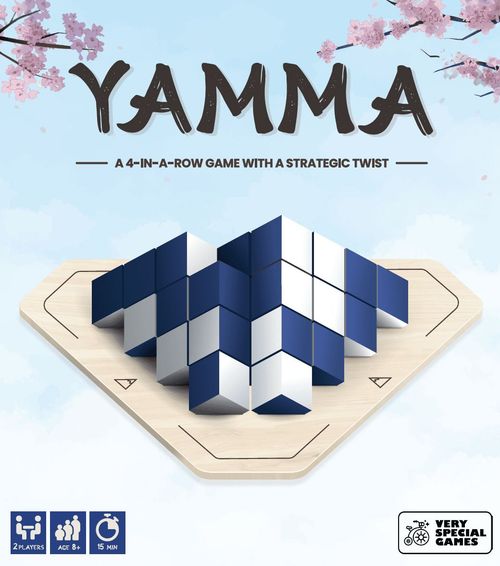
Yamma
Yamma Rulebook
Table of Contents
Table of Contents
Introduction
Yama is an abstract strategy game inspired by one of the classics - Connect Four.
The goal is still the same; make a line of four-in-a-row of your color and win. The twist here is that the rotating board of Yama contains triangular slots that stand the cube up on its corner - revealing three sides, each of which can be seen from a different point of view. And it is in one of these three points of view that you must try to form your line of four-in-a-row.
The components are designed to convey the rules themselves. The cubes are painted in a way that no matter how you place them, one side will show a different color than the other two. When placing three cubes in a cluster, a valley is formed, that allows placement of a cube on a higher level, which can be used to cover and block your opponent... and perhaps, help you clinch victory.
The game is treacherously easy to lose if you don't pay attention, but it becomes deeply strategic and tactical when played by two equally skilled players. The three-dimensional aspect of the cube placement, as well as the victory condition can be very tricky to wrap your head around, leading to surprising twists and turns that belie its simple rules and components.
Setup
Decide the starting player in whatever manner you prefer. Then players choose their color and begin taking alternating turns, adding a cube to the board in each turn.
Placement
A cube can be placed on any empty well on the board.
A cube can also be placed on a higher level if it can be supported by three other cubes below it.
When placing, the player may choose to place the cube in any orientation they prefer. Note, however, that regardless of the orientation, the cube will show two sides of their color, and the other will be their opponent's color!
Winning
The first player to make a line of four consecutive cubes of their color, when viewed from any of the three perspectives, becomes the winner. The cubes on different planes are considered connected as long as they look connected, when viewed from either of the three perspectives.
Diagonally adjacent cubes are not considered connected.
Tactics
Placing a cube randomly and hoping for your opponent to make a mistake is one way of playing the game, but one that will likely yield limited success. Instead, consider these tactics:
- Create two simultaneous lines of 3 cubes, so your opponent cannot block both spots.
- Force an opponent to block you, but in a way that creates a valley, where you can place the last cube needed to win.
- Force an opponent to block you, but in a way that allows you to make a four-in-a-row on your next turn, using the side with your color.