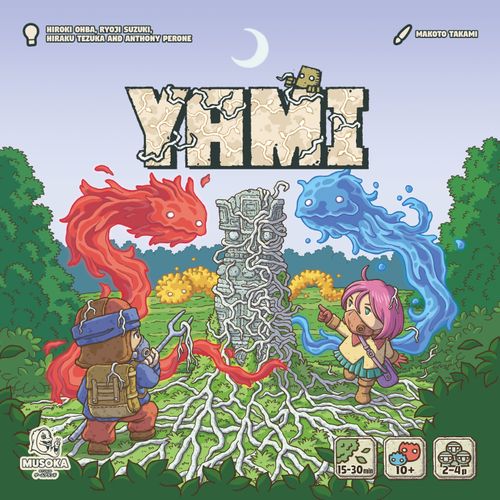
Yami
Yami Rulebook
Table of Contents
Table of Contents
Overview and Goal of the Game
Yami is a cooperative game with limited communication, combining trick-taking mechanics and polyomino placement, all set in an open world.
The open world includes 22 missions. Successfully completing Mission 22 earns you final victory.
To complete a mission, you'll need to play a series of tricks to fully surround the tiles on the board, while meeting specific conditions.
Components
- 35 Spirit tiles (numbered from 1 to 7, in 5 different colours). Spirit tiles represent the spirits that adventurers can now see thanks to the mist generated by the lianas. These tiles are used to completely surround the Mission tiles.
- 35 Spirit cards (numbered from 1 to 7, in 5 different colours). Each Spirit card corresponds to a unique Spirit tile, indicated at its centre.
- 1 double-sided game board (Front: Forest / Back: Water)
- 1 double-sided 2-player board
- 1 Trump card. This card serves as the trump for the first round of each mission.
- 8 Player aids (4 cards × 2 types, double sided)
- 29 Mission tiles
- 8 Adventurer meeples (2 × 4 colours) and 1 Kakapo meeple
- 6 Power tokens
- 8 Whirlpool tokens (to be used only when indicated)
- 10 Mist tokens (to be used only when indicated)
- 5 Magic Tiles (to be used only when indicated)
- 10 envelopes (5 white, 4 black, and 1 red). The envelopes contain additional elements (Power tiles, Spirit cards, etc.). Only open them when instructed to do so.
- 1 rulebook, 1 introduction card, 1 scorepad and 1 travel journal. The introduction card features a message from King Kakapo, who welcomes you into the game's universe. The travel journal guides you through the setup of the different missions, and shows the rewards to be earned. The scorepad includes the map to track the progress of your adventure.
Warning: You will find envelopes in the box. Only open them when instructed to do so. At the end of each game, store all the items in their respective envelopes.
Cooperation and Communication
Since communication is limited during missions, players are not allowed to talk to each other whenever a rule point is marked with the no-talking symbol.
Set Up
Here's how to set up Mission 1:
-
Place the game board in the centre of the table, on its Forest side.
In a 2-player game, take the 2-player board and place it next to the game board. You will play with an Automa, which will act as a third player, and you will place the Automa cards on the 2-player board.
-
Sort the Spirit tiles by colour and place them next to the game board.
-
Place the Trump card in the corresponding space on the game board.
-
Place the Mission tiles on the board. For Mission 1, take tiles 5 and 9, then place them as shown in the setup illustration.
-
Shuffle the 35 Spirit cards and deal a certain number to each player, as indicated in the table below:
Players Total Number of Cards Cards to Deal Unused Cards 2 35 10 cards per player (including the Automa) 5 3 35 10 cards per player 5 4 35 9 cards for the 1st, 2nd, and 3rd players, and 8 cards for the 4th
Mission Flow
For each mission, you play up to 7 rounds, either until you succeed at some point or fail at the 7th round.
Each round consists of four phases, which occur in the following order:
- Determining the Decision Card (Trick Phase)
- Selecting the Spirit Tile
- Placing the Spirit Tile
- Checking the Victory Condition of the Mission
1. Determining the Decision Card (Trick Phase)
The Decision card determines the winning card of the current trick. It also sets the trump colour for the next round, meaning the trump can change every round. The Trump card, provided in the box, sets the colour of the trump for the first round only.
During this phase, all players participate in the trick.
The first player begins by playing a Spirit card from their hand, face up, in front of them.
Then, the other players play a Spirit card one after the other, in clockwise order.
They must follow the colour of the first card played if possible (Must Follow). If they don't have a Spirit card of that colour, they can play any card.
Once every player has played a card, the winner is determined based on the following rule:
The player who played the Spirit card of the requested colour (the colour of the first card played) with the highest value wins the trick.
However, if one or more Spirit cards of the trump colour have been played, the player who played the trump card with the highest value wins the trick instead.
Example 1: In the 1st trick, the trump colour is red and the first player plays blue. The blue 5 wins the first trick and becomes the Decision card. Blue is now the trump for the second trick. Players must follow purple in the second trick, but the last player has no purple in hand: they play the blue 2, win the trick thanks to the trump, and their card becomes the new Decision card.
At the end of the current phase, gather all the cards from the trick into a pile, place the Decision card on top, and place this pile on the corresponding space on the game board. This allows you to keep track of the number of rounds played, as well as to remember the colour of the trump for the next round.
Example 2: Six rounds have already been played. The red 4 is the Decision card. Red is the trump colour for the final round.
In a 2-player game, the player (excluding the automa) who wins the trick takes the Kakapo meeple and becomes the Leader. The Leader is the one who decides the Automa's choices. The automa never receives the Kakapo meeple, even if it wins the trick and becomes the first player.
If the Automa is not the first player:
- If one of the Automa's visible cards matches the colour of the first card played, the Automa must play that card.
- If multiple visible cards of the Automa are of the same colour as the first card played, the Leader chooses which card to play from these cards.
- If none of the Automa's visible cards match the colour of the first card played, the Leader chooses a card from the visible cards or takes the first card from the Automa's deck.
If the Automa is the first player (it becomes the first player if its Spirit card won the previous round's trick):
- The Leader chooses one of the Automa's visible cards or takes the first card from the Automa's deck to determine the first card played.
2. Selecting the Spirit Tile
The players then take the Spirit tile that corresponds to the Decision card.
Example 3: The blue 5 wins the first trick and becomes the Decision card (see Example 1); the corresponding tile is then taken.
3. Placing the Spirit Tile
Place the Spirit tile on the game board, following the placement rules below.
Placement rules:
- You may only communicate about the placement of the Spirit tile; you cannot share information about your hand or intentions.
- You cannot exceed the limits of the 12 × 12 grid.
- You cannot place the Spirit tiles on already placed Mission tiles or Spirit tiles.
- You cannot move already placed Spirit tiles unless you use a Power tile that allows it.
- You can place the Spirit tiles on the side of your choice (front or back).
- You can place the Spirit tiles only on empty spaces (unless stated otherwise).
- You may place Spirit tiles only on empty spaces, unless otherwise indicated (see Whirlpool and Mist tokens in the Travel Journal).
You may place Spirit tiles on spaces containing a Rock icon. These icons will be used later in your adventure, in the Water and Corrupted Forest environments (see Travel Journal).
Example 4: Valid Spirit Tile Placements
- You can place them on any empty space.
- You can place them on either their front or back.
- You can place them on an adjacent space next to a Mission tile border of a different colour. However, if you do so, the mission will fail because you won't have respected the constraint of the Mission tile.
Example 5: Invalid Spirit Tile Placements
- You cannot exceed the limits of the 12 × 12 grid. Therefore, placing the green 6 Spirit tile is not valid.
- You cannot place tiles on already existing tiles. Therefore, placing the orange 3 Spirit and purple 6 Spirit tiles is not valid.
If no empty spaces are available on the grid to place a Spirit tile, the mission is automatically considered as failed.
4. Checking the Victory Condition of the Mission
To validate the mission, you must check that the Mission tiles are properly surrounded by the corresponding Spirit tiles, and this must be done before reaching the maximum number of allowed rounds (7).
For a Mission tile to be completely surrounded, you need to cover all the spaces that are adjacent to its sides. There's no need to cover the spaces that are adjacent to its corners.
Example 6: A Mission tile surrounded on all four sides by Spirit tiles is completely surrounded, regardless of what occupies the diagonally adjacent corner spaces.
Constraint of the Mission Tiles: Attention! In Mission 1, some edges of the Mission tiles are coloured. When that happens, you must place a Spirit tile that matches the colour of the Mission tile's edge. If this rule isn't followed, the mission fails.
Checking the number of rounds:
-
If you haven't fulfilled the victory condition yet and haven't reached the maximum number of rounds (7), proceed to the next round. The player who won the trick becomes the first player for the next round.
In a 2-player game, if one of the automa's visible cards has been played, draw a card to refill the river back to 4 cards.
-
If you still haven't met the victory condition once the maximum number of rounds (7) is reached, the mission is considered as failed.
End of the Mission
Whether you succeed or fail the mission, take a sheet from the score pad and mark a box on the Moon Path, starting from the left. We'll explain this later, but know that time is running out and even training doesn't stop the progress of the lianas.
If Mission 1 fails, try it again and stay more focused!
If you succeed, congratulations! Now move on to Mission 2, but this time without my help, and prove that you're ready to embark on the adventure!
Mission 2: To succeed, you must surround both Mission tiles 3 and 7! If you fail, try again until you successfully complete the first two missions.
Ready for the Adventure?
Now that you've brilliantly survived the first two missions (seriously, I'm impressed), it's time to claim your first reward!
Open Envelope A and receive two Power tokens... plus a Power space to use them. Not bad for a start, right?
To avoid forgetting, immediately circle the matching icons on the score pad.
But don't get too excited just yet... the real challenge begins now. The Kingdom map awaits you, full of mysteries, traps... and a thick fog that smells like trouble.
Join me in the Travel Journal. I'll reveal everything we know about this map: icons, rewards, missions... everything you need to know to stand a chance at survival!
Oh, and one last thing: an icon index is waiting for you at the very end of this rulebook. Don't use it now, but keep it handy, it'll be invaluable when things get truly serious.
Icon Index
Totem reward: Unlock a Power space on the game board.
Castle reward: Take a Power token. At any time during a mission, you may place this token on an empty space of a Power tile to activate it. Once you gain a Power token, you keep it until the end of the adventure and can use it in every mission!
White Envelope reward: Open the white envelope corresponding to the indicated letter. You will find a Power tile inside each white envelope. Before starting each mission, you may place Power tiles on unlocked Power spaces on the game board to gain additional help. For details about the envelopes, please refer to the Travel Journal, pages 31 and 32.
Purified Holo Liana reward: Each purified liana will reduce the difficulty of the final mission against the Lyken.
Lyken symbol: Marks the final mission.
Moon Phase symbol: On the Moon Path, when you check a box with a Moon Phase symbol, open the corresponding black envelope and place the Moon tile you obtained on the matching space on the game board. The Moon tiles indicate disadvantages that stack and persist until the end of the game.
Star: Check the star on the Mission space if you complete the mission in 5 rounds or fewer. In addition, if you complete Mission 22 before reaching the end of the Moon Path, gain the 2 stars from all Moon Path spaces you have not yet checked.
Red Envelope symbol: To be opened at the end of the game, only if you have succeeded in Mission 22.
Whirlpool token (Water): When players place a Spirit tile on a Whirlpool token (it is possible to cover a Whirlpool token with a Spirit tile), they immediately discard that token, and each player must also discard one card from their hand face down, without showing it to the others.
Mist token (Contaminated Forest): When players place a Spirit tile on a Mist token (it is possible to cover a Mist token with a Spirit tile), they immediately discard that token. The next trick must then begin with the colour of the Mist token, if possible. If you discard multiple Mist tokens at once, start the next trick with one of the colours of these tokens, your choice.
Attention! If a Whirlpool or Mist token is adjacent to a Mission tile that must be surrounded, that space must be covered in order to complete the encirclement of the Mission tile with Spirit tiles.
Night Mode
To switch to Night mode, simply turn each Mission tile over to its Night side, making sure that its black triangle is in the same place on the board as when it was on its classic side.
Attention! Only flip Mission tiles to Night mode when the game instructs you to do so.