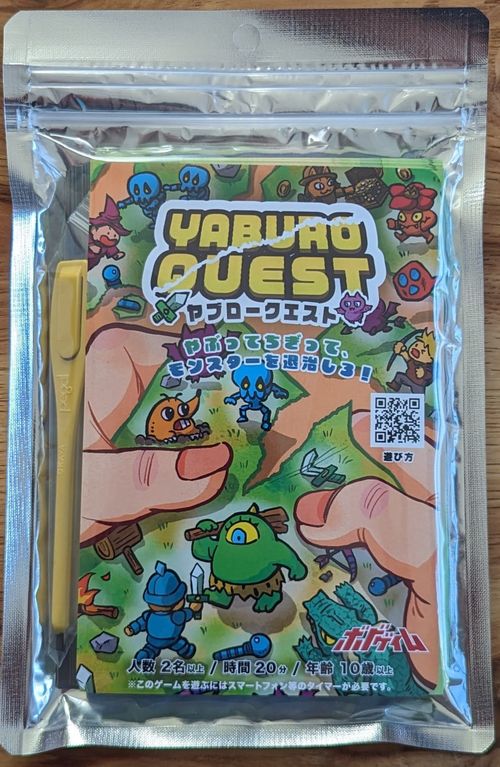
Yaburo Quest
Yaburo Quest Rulebook
Table of Contents
Table of Contents
Setup
-
Choose whether to play Stage 1 or Stage 2 as the first challenge. For a first game, Stage 1 is recommended. Give each player one stage sheet for the chosen stage.
The front of each stage sheet shows the weapon icons and the monster icons. The back shows the treasure icons (coins and treasure chests) and the penalty icon (curse).
-
Take the 4 monster cards common to all stages and add the boss monster card for the chosen stage (the boss cards differ between Stage 1 and Stage 2). This makes a pile of 5 cards. Return any unused boss monster card to the bag.
-
Shuffle the 5 monster cards well. Lay out 4 of them face down in a vertical line as shown in the setup diagram. From the top, these are treated as the monster cards for Rounds 1, 2, 3 and 4.
The remaining card stays face down. Set it aside. It is used in some cases: the source does not say which, beyond the Dual Wielding bonus described under Round 4 (where an unused monster card for the stage is placed).
-
Divide the bonus cards into two groups for Rounds 3 and 4 (3 cards each). Shuffle each group and place one face-down bonus card beside each of the Round 3 and Round 4 monster cards. Return the remaining 4 bonus cards to the bag face down, unused in this game.
-
Each player writes their name in pencil in the top row of their score sheet.
Playing the Game
2. Turn Over the Monster Card
Turn over the monster card for the current round (Round 1 at the start) and have all players check its contents.
Each monster card shows a weapon icon, a monster icon, and the points for that combination of icons. In each round, players score by tearing the stage sheet so that it forms the weapon and monster icon combination shown on the card. Each monster card has its own combination and points.
3. Set the Timer
Set a smartphone or other timer for 2 minutes.
4. Tear the Sheet
Once everyone understands how to tear the sheet as described in this section, start the timer. Each player tears their own stage sheet. A paper piece torn to match the combination specified on that round's monster card is called a "completed piece." Each completed piece you make within the 2 minutes scores points according to its contents. You may make as many completed pieces as you like within the time limit.
Example: In the round where "Mandragora" was turned over, a player who makes 3 completed pieces in 2 minutes as shown in the diagram scores 8 points in total.
Note that including more weapon icons or monster icons than the number specified does not increase the score.
Example: The piece has more weapons than the specified number, or more monsters than the maximum specified.
When making a completed piece, observe the following:
- Tear the piece so that it contains only the combination of icons specified on the monster card.
- The icons specified on the monster card must be fully visible.
- The white border may be separated from the piece without a problem.
- Within the time limit, you may tear the sheet in several separate actions to make completed pieces.
About the back of the sheet
The back of the stage sheet may be looked at at any time during the game. The back shows the treasure icons "coin" and "treasure chest," and the penalty icon "curse." If any of these appear on the back of a completed piece, adjust that piece's score as follows:
- For each "coin" included: +1 point to that completed piece.
- For each "treasure chest" included: +2 points to that completed piece.
- For each "curse" included: -2 points to that completed piece.
A coin or treasure chest scores only if it is fully visible. A curse scores as a penalty if even a small part of it is visible.
Example: In the round where "Mandragora" was turned over, the points were adjusted as shown in the diagram.
Note that a completed piece can, because of a curse, end up with a negative total. In that case, you may choose not to treat it as a completed piece. (In that case, it is not counted in the "number of completed pieces" used for the "Quantity Is Everything" bonus described below.)
If it is hard to decide whether an icon is included, all players should discuss it and agree on a decision.
The boss monsters of each stage require a special way of tearing, so take care:
Stage 1 boss: Degabutsu (デカブツ). Degabutsu requires two sword (weapon) icons. It cannot be scored with only one, so be careful.
Stage 2 boss: Dragon (ドラゴン). The Dragon cannot be defeated with the weapon icons on the front. It is scored by including the "curse" on the back. The Dragon's completed pieces are not reduced by the "curse" on the back. Coins and treasure chests on the back still score.
5. Record the Points
When 2 minutes have passed, all players stop tearing. Anything torn after the time is up is void.
Each player shows their completed pieces to everyone, one player at a time. The scorekeeper writes each player's total points for the round in the matching box on the score sheet.
If the round has a bonus card, also write the bonus points in the same box.
Bonus cards are explained below.
6. Advance the Round
Advance to the next round and repeat steps "2. Turn Over the Monster Card" through "5. Record the Points." Stage sheets torn in the previous round may be in several pieces; all of them may still be treated as that stage sheet.
When Round 4 is finished, go to "8. Determine the Winner."
7. Turn Over the Bonus Card (Rounds 3 and 4 only)
In Rounds 3 and 4, turn over the bonus card beside the monster card at the same time as you turn over the monster card. Each round's bonus card can add points as described on that card. There are 3 bonus cards for each of Rounds 3 and 4, and one of each is used in the game.
Round 3 bonus cards
Quantity Is Everything (数こそ全て). At the end of the round, the player with the most completed pieces gains 3 points in addition to their normal points. If several players are tied for the most, each of them gains 3 points.
Battlefield Economizer (戦場の節約家). At the end of the round, the player with the fewest completed pieces gains 3 points in addition to their normal points. If several players are tied for the fewest, each of them gains 3 points.
Note: This bonus is not gained if the player has zero completed pieces.
Treasure Hunter (トレジャーハンター). At the end of this round, the player with the highest combined total of "coins" and "treasure chests" collected gains 3 points. If several players are tied for the highest, each of them gains 3 points.
Round 4 bonus cards
Weapon Collector (武器コレクター). In addition to normal points, make a completed piece from 3 weapon icons (of any kind). Each such piece scores 2 points. The piece must not include any monsters. You may make as many of these pieces as you like, just like monster card pieces.
The back of each such completed piece is affected in the same way as a completed piece for a monster card: "coin," "treasure chest," and "curse" apply as described above.
Monster Farm (モンスター農場). In addition to normal points, make a completed piece from 5 monster icons (of any kind). Each such piece scores 2 points. The piece must not include any weapons. You may make several of these pieces, just like monster card pieces.
The back of each such completed piece is affected in the same way as a completed piece for a monster card: "coin," "treasure chest," and "curse" apply as described above.
Dual Wielding (二刀流). Place one unused monster card for this stage, face up, beside the Round 4 monster card. In this round, two monster cards count for scoring.
8. Determine the Winner
Add up the total points from Rounds 1 to 4. The player with the highest total is the winner of the game.
If the totals are tied, the winner is the tied player with the higher bonus points (the total of the Round 3 and Round 4 bonus points). If that is also tied, all tied players are winners.