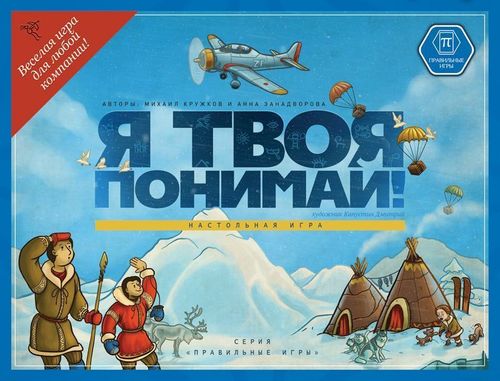
Я твоя понимай
Я твоя понимай Rulebook
Table of Contents
Table of Contents
Object of the Game
Playing in turn as the Ambassador and as the Onkilons, the players strive for mutual understanding using the primitive symbols of the Onkilon language.
Each cycle has as many rounds as there are players. Each player is the Ambassador in one round of the cycle. The other players act as Onkilons. In each round the Ambassador tries to acquaint the Onkilons with one of the "achievements" of the civilised world. The Ambassador must attract the Onkilons' attention to his proposal, but must not overdo it: if all the Onkilons become fully interested in the novelty offered, they may start fighting among themselves and also beat up the Ambassador, who then gets nothing for his educational activity.
You may play a different number of cycles by prior agreement.
Components
- 78 primitive symbol cards
- 48 civilisation achievement cards
- 6 sets of voting tokens numbered 1 to 6 (one set per player)
- 18 resource tokens of three kinds:
- Smoked herring (value I)
- Deer hide (value II)
- Mammoth tusk (value III)
- 50 victory point tokens
Setup
Shuffle the symbol deck and the achievement deck. Place both decks on the table as two stacks. Place the victory point tokens next to them.
Give each player:
- 6 symbol cards,
- 3 achievement cards,
- one set of 6 voting tokens of one colour,
- one resource token of each kind.
When playing with children, remove the achievement cards marked with an asterisk.
Course of the Game
The game lasts several cycles. Recommended number of cycles:
- 3 players: 5 cycles
- 4 players: 4 cycles
- 5 players: 3 cycles
- 6 players: 2 cycles
Example: The Ambassador holds these symbol cards: Unty (traditional fur boots); Bird; Grass; Loud; Sun; Sky. The achievement cards on the table are, in this order: Zoo and Lighthouse; Greenhouse and Clock; Airplane and Camera.
The Ambassador decides to explain CLOCK. He places the token showing "4" face down, and the symbol cards: Sun; Loud; Bird.
Round of the Game: Presenting the Achievement
- The Ambassador lays out three achievement cards in front of himself, one above another, so that all the words are clearly visible to the other players.
- He then places face down a voting token whose number corresponds to the word he has chosen to explain (from 1 to 6, top to bottom). To speed up the game, the players may think about their explanations in advance.
- The Ambassador "explains" to the Onkilons the meaning of one of these six achievements, using the symbol cards he has. He must use either 2 or 3 symbol cards. He lays them on the table in whatever order he considers necessary.
Example: In our example, the Ambassador has chosen to explain CLOCK, so he places the "4" token face down, and lays the symbol cards Sun, Loud and Bird.
Understanding and Bets
The Onkilons try to guess which achievement the Ambassador explained with his set of symbols. Each Onkilon places face down in front of himself:
- a voting token with the number of the achievement he believes is meant, and
- one of his resource tokens as his stake.
When all players have placed their tokens, they are all revealed simultaneously. An Onkilon is considered to have understood the Ambassador if the number on his voting token matches the number on the Ambassador's token.
Example: Two Onkilons decided that it is CLOCK and placed the "4" token in front of themselves. However, one of them staked a mammoth tusk, and the other staked smoked herring. A third player decided that it is AIRPLANE and voted "5"; his stake was deer hide. All players revealed their voting tokens at the same time.
Scoring
One of the following outcomes occurs:
-
No Onkilon understood the Ambassador, or all the Onkilons understood him. The Ambassador leaves with nothing (apart from the bruises and bumps received from the Onkilons). Each Onkilon receives one victory point (having expelled the unneeded Ambassador, they all set off together to catch herring).
Example: If all the players had decided that it is AIRPLANE, or if all had agreed that it is CLOCK, the Ambassador would have remained without points, and each Onkilon would have received one victory point.
-
Some, but not all, of the Onkilons understood the Ambassador. The Onkilons who understood him receive victory points according to their stakes: smoked herring: 1 victory point; deer hide: 2 victory points; mammoth tusk: 3 victory points. The Ambassador receives victory points equal to the highest stake made by one of the Onkilons who understood him.
Example: In our example, the Onkilons who guessed correctly received victory point tokens: one "3" and one "1". The Ambassador receives "3". The player who staked on AIRPLANE gets no points.
Using and Restoring Resource Tokens
All Onkilons who used either smoked herring or a mammoth tusk as their stake in this round must set that token aside. A set-aside resource token is temporarily unavailable to its owner and cannot be used as a stake in the following rounds. Deer hide is never lost and is always available to the player.
When a player has spent both his smoked herring and his mammoth tusk, leaving only deer hide, he immediately takes both of those tokens back, and from then on all three resource tokens are available to him again.
Example: The player who staked deer hide takes it back. The player who staked a mammoth tusk sets it aside; he still has smoked herring and deer hide in hand. The player whose stake was smoked herring takes back the previously set-aside mammoth tusk and smoked herring for himself, because by the end of the round only deer hide is left in his hand.
End of Round
At the end of the round:
- All players take back their voting tokens.
- The Ambassador discards all the achievement cards and symbol cards he played. In addition, if he wishes, he may discard one (but no more than one) symbol card from his hand.
- The Ambassador then draws symbol cards until he has 6 in hand, and takes three new achievement cards.
In the new round, the Ambassador is the player sitting to the left of the previous Ambassador.
End of Game and Victory
The game ends when the agreed number of cycles has been played.
The player with the most victory points is the winner.