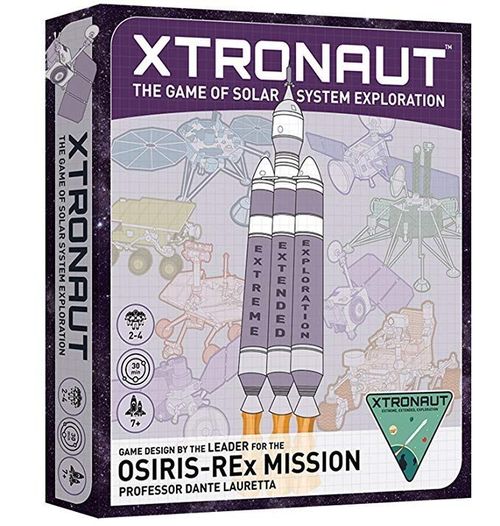
Xtronaut: The Game of Solar System Exploration
Xtronaut: The Game of Solar System Exploration Rulebook
Table of Contents
Table of Contents
Introduction
Xtronaut is an exciting game where players race to complete space missions and earn points. Earn 10 Data Points and you win!
In Xtronaut, you assemble the necessary rocket components and mission enhancements to complete your assigned space mission. The main "currency" of space is ΔV (pronounced "delta-v"), which stands for change in velocity. As applied to space missions and this game, it means the change in velocity necessary for a spacecraft to complete an exploration mission in the Solar System.
Two to four player can compete in Xtronaut, each with their own game board and individual missions.
Contents
- 1 Rulebook
- 108 Playing Cards
- 29 Mission Cards
- 4 Player Boards
- 4 ΔV Cubes
- 4 Score Discs
- 17 Atlas Vehicles
- 15 Delta Vehicles
- 13 Falcon Vehicles
- 5 SLS Vehicles
- 8 Gravity Assists
- 18 Spacecraft
- 32 Action Cards
Setup
-
All players choose a color and place their player boards in front of them.
-
Shuffle the Mission Cards and place the deck in the middle of the table.
-
Deal all players 1 Mission Card. They are placed face-up on the "Active Mission" hexagons on each playerboard.
-
Assemble the Player Card Deck*, shuffle it, and place in the middle of the table. Also designate an area next to the deck to be the Discard Pile.
* Assembling the Player Card Deck: Remove the cards with the following symbols in the upper-right corner when setting up a 2-3 player game: a "3" over a "2" corner symbol is removed for 2 players, and a "3" corner symbol is removed for 3 players. Do not remove any cards in a 4 player game.
-
Deal all players a hand of 5 Player Cards. Keep this hand secret.
-
Place the scoring disk associated with each player on the "Total Data Points" space on the score track of each player board.
-
Place the ΔV cubes associated with each player near the bottom of the ΔV track on each player board.
Gameplay
Objective
The first player to accumulate 10 Data Points from completed missions wins the game!
Players' Turn Order
The player who has last looked into a telescope is the Starting Player to take the first turn. If there is a tie, choose at random. A player's turn is broken into five phases taken in order (may not be taken out of order):
Phase 1 - Draw a Player Card
The current player draws one card from the Player Card Deck. If the deck ever runs out of cards, reshuffle the Discard Pile and make that the new Player Card Deck.
Phase 2 - Play up to 3 Action Cards
A player may play up to three "action" cards from their hand on their turn. If a player does not want to play, or has no action cards, they will skip this phase.
Phase 3 - Trade with other Players
Each player may negotiate trades with other players. Any trades MUST involve the current player. There is no limit to the number of trades that may occur on one turn. Trades may involve cards in a player's hand or on their game board. There MUST always be cards traded, players are not permitted to just "give" cards. Trades may also involve future deals and alliances, such as boycotting trade with another player or for future trades. Future deals are not binding, but immediate trades are.
Phase 4 - Build/Launch a Rocket
The current player may place, replace, or remove any number of vehicles, gravity assists, or spacecraft cards on their player board in the appropriate areas. Cards may be moved from the player's hand and onto the board, and vice versa (see Building a Rocket, page 8). If the player's rocket is complete, they may declare if they are able to have a mission success! (see Completing a Mission, page 10)
Phase 5 - Discard/Draw to 5 Player Cards
If the current player has more than five cards, they discard cards of their choice to the Discard Pile until they have five cards. If the player has fewer than five cards, they draw cards until they have five cards in hand. Cards on the player board do not count towards the number in their hand.
Play continues clockwise to the next player around the table until someone wins the game (see Check for Victory, page 10).
Player Cards
Players can place any number of playing cards from their hand on the player board during their turn. Cards must go on the player board (one per space) in their proper location depending on their type:
Vehicle Cards
There are four different types, and four different product lines, of launch vehicle components:
- First Stage Booster: The primary booster for a rocket. This stage is the first to achieve ignition and begin the lift off of a spacecraft from the surface of the Earth. The First Stage provides ΔV that varies depending on the size of the spacecraft.
- Second Stage Booster: The second stage ignites after the first stage has spent all of its fuel and dropped back to the Earth. For interplanetary spacecraft, the second stage often provides enough thrust for both it and the spacecraft to achieve escape velocity from the Earth.
- Additional Booster: Added to the first stage, these boosters achieve more thrust during lift off. They can be either Solid Rocket Boosters or additional first-stage booster cards. Boosters are optional and are not required for a rocket to be considered complete.
- Left/Right Fairing: Both halves of the protective nose cone in the rocket's third stage that surrounds a spacecraft during the launch through the Earth's atmosphere. To successfully launch a rocket, the player needs both. The Fairings do not provide any ΔV.
Product Lines
To successfully launch a rocket, all of the vehicle components must match one of the four product lines:
- Falcon: Space Exploration Company's (SpaceX) "Falcon 9" rocket has a first stage incorporating 1 or 3 "9-Merlin" engines and its upper-stage powered by a single Merlin vacuum engine. Falcon rockets are designed to use "reusable" boosters.
- Atlas: The United Launch Alliance's Atlas V uses a standard Common Core Booster™, up to 5 strap-on solid rocket boosters, and an upper-stage Centaur Engine configuration.
- Delta: The ULA's Delta IV Launch System is available in multiple configurations: a common booster core with two additional boosters, 2-4 solid rocket boosters, and a cryogenic upper-stage.
- SLS: The Space Launch System (SLS) rocket is under development by NASA as the next-generation launch vehicle for robotic and human missions. The Block 1 SLS configuration consists of four RS-25 engines and 2 five-segment Solid Rocket Boosters, and will use the Interim Cryogenic Propulsion Stage (ICPS) for its upper-stage.
Spacecraft
The correct spacecraft is required to complete a mission. These vehicles have their own rocket engines and fuel tanks and provide additional ΔV for your mission.
Types: There are three types of spacecraft, and each mission requires a specific spacecraft type that is listed on the Mission Card:
- Orbiters
- Landers
- Rovers
Sizes: There are three sizes of spacecraft, whose weight causes different ΔV from the lower-stage boosters when breaking Earth's pull. The larger the spacecraft, the more science and Data Points that can be achieved on a mission.
- Small
- Medium
- Large
Gravity Assists
As the craft moves in space, a fly-by Gravity Assist can provide additional ΔV to a mission.
Players can only play Gravity Assists that are listed on their Mission Card. The ΔV earned from a Gravity Assist is independent of spacecraft size.
A maximum of two Gravity Assists are allowed per mission.
Actions
Up to 3 Action cards can be played during Phase 2 of a player's turn. These represent events in real-life that can either positively or negatively affect a mission. Action cards also can be traded. There are 2 kinds of actions that can be played:
- Enhancers: Actions that give a player an immediate benefit, such as drawing more Player Cards or recycling discarded cards.
- Impeders: Actions that can foil the progress of a mission for your opponents (or yourself if not noted otherwise), such as discarding an Active Mission, stealing Player Cards, or stopping a player from launching a rocket.
The Active Mission
Mission Brief: Before a player reveals the Active Mission side of the card, they first must read the brief on its backside. For the action of "drawing a new mission," the player draws three and ONLY looks at the briefs before choosing (see Drawing New Missions, page 10).
The Active Mission card shows:
- Type of spacecraft required to successfully complete this mission (the Orbiter, Lander, or Rover icon).
- Mission Title, which includes the location of the mission and its purpose (see Glossary for mission descriptions, page 11).
- ΔV required to successfully complete this mission (shown in km/s).
- Gravity Assists that may be implemented to add ΔV.
- Data Points achieved by using a certain size of spacecraft on this mission (the Small, Medium, and Large values).
Building a Rocket
In Phase 4, the current player may place, replace, or remove any number of vehicle, gravity assist, or spacecraft cards on their player board in the appropriate labeled areas. Cards may be moved from the player's hand and onto the board, and vice versa. Only one card may occupy each space. This simulates early development and research into the different rocket types. Players should strive to play vehicle cards of the same product line, however they may play multiple product lines if they wish.
Until a spacecraft has been played onto the board, the ΔV from the boosters cannot be totalled.
Move Cube on ΔV Track: Move the cube on the ΔV track to match the current total ΔV. In this example, after adding the First Stage Booster:
- Medium Rover = 5 km/s
-
- Gravity Assist = 2
-
- Second Stage Booster = 3
- = 10 km/s
-
- First Stage Booster = 11
- Total ΔV 21 km/s
Launching a Rocket
To successfully launch a completed rocket, it must meet the requirements of each step under the LAUNCH MISSION SUCCESS list on the player board.
- All component spaces on the player board with the word "REQUIRED" must be filled and the correct type of spacecraft (Orbiter / Lander / Rover icons) listed on the Mission Card must be used.
- The left fairing and right fairing, second and first stage boosters, and any additional boosters must all be of the same product line. Gravity assists and spacecraft have no product line, and may be added to any rocket in the appropriate position on the player board. Gravity Assists must match with the Mission requirements next to the Gravity Assist (◉) symbol.
- The Mission ΔV must be met or exceeded.
Example 1 - All Required Components Filled: A rocket that has both fairings, a spacecraft, and a second and first stage booster is complete. A rocket missing a right fairing and a second stage booster is not.
Example 2 - Vehicle Parts are the Same Product Line: A rocket whose vehicle parts are all Atlas is valid. A rocket whose parts are a mix of Atlas and Delta is not.
Example 3 - ΔV must be Met or Exceeded: A Large spacecraft is used, so the boosters use the "L" ΔV values: 5 + 2 + 8 = 15. This mission only needs 14 ΔV, so it succeeds. The Deimos Sample Return mission requires 20 ΔV; the same rocket totalling 15 ΔV fails.
Completing a Mission
When a rocket is successfully launched, first discard all cards from the player board (except for "reusable" Falcon cards, they may return to player's hand). Then move the scoring disc up on the player board, adding Data Points achieved based on the size of the spacecraft and its matching value on the Mission Card.
For example, the Small Lander would earn the player 3 Data Points for this Mission Card. The Large Orbiter, however, would earn 6.
Drawing New Missions: After completing a mission, the player places the Mission Card to the side of their player board. They then draw three new Mission Cards from of the deck, HOWEVER they only look at the briefs written on the backsides. From reading those three briefs, the player chooses a new card to reveal and become their new Active Mission. Without revealing, they then place the unchosen cards back into the bottom of the deck.
Check for Victory: If the current player reached 10 Data Points or more, they immediately win!
Advanced Play
Excess ΔV Penalty
If the players feel up to the challenge, this rule variant can be added.
Players will now lose Data Points for exceeding the required Mission ΔV.
For every 5 km/s ΔV a player is over, the Mission's Data Point Value is reduced by 1. Always round down.
- Over by 0-4 km/s = -0 points
- Over by 5-9 km/s = -1 point
- Over by 10-14 km/s = -2 points
- Over by 15-19 km/s = -3 points
Example: Dante needs a ΔV of 14 km/s to launch a Lunar Orbiter. The total ΔV of his rocket is 23 km/s. Because he was over by 9 km/s, he would subtract 1 from his Mission Card's Data Value before adding it to his score.
Quick Reference
Player Turn
- Draw a Player Card
- Play up to 3 Action Cards
- Trade with other Players
- Build/Launch a Rocket
- Draw/Discard to 5 Player Cards
Launching a Rocket
- All REQUIRED components and spacecraft type.
- All vehicle cards must be the same product line.
- ΔV must meet/exceed the requirement.
Completing a Mission
- Discard all cards from player board.
- Collect Data Points equal to the spacecraft's size on the Mission Card.
- Look at the Mission Briefs only on backside of the 3 new Mission Cards. Choose one to be new Active Mission, place the unchosen back on the bottom of the deck.
Game Objective
The first player to achieve 10 Data Points or more wins the game!
Bonus Workbook Material
The following pages are the rulebook's bonus workbook section, "Learn more about the OSIRIS-REx Mission and Delta-V." Diagrams and images are noted in brackets.
Module One: Planning a Mission
When deciding on the target for a space mission there are a lot of questions scientists have to ask themselves including, especially:
- What is the most interesting place for us humans to explore?
We want to go to places we haven't been to before, places we have been but the mystery still remains, or places where other missions have found something exciting that needs to be investigated in more detail. Once the OSIRIS-REx team decided they wanted to look at asteroids, they had to figure out the following:
- Where is our target within the Solar System — where are we headed?
- What kind of spacecraft will we use to achieve our scientific objectives of the mission?
- How are we going to get the spacecraft to the target — how much delta-V is needed to reach the target?
- What type of rocket is needed to reach this delta-V?
- Is gravity assist available to increase delta-V?
The Target: Bennu
[Diagram: the Sun and the inner planets from Mercury to Pluto, with the Asteroid Belt and Asteroid Bennu marked and "Earth (we are here)" labelled.]
Asteroid Bennu is the target of OSIRIS-REx. Asteroids are ancient space rocks that are time capsules from the very beginning of the Solar System. In order to understand how life originated on Earth, we have to take a step back in time to look into how our Solar System formed.
There are millions of asteroids in our Solar System, most of them are in the asteroid belt between Mars and Jupiter. Flying a spacecraft to the asteroid belt and back to Earth requires a lot of energy. Instead, OSIRIS-REx scientists set their sights on Near-Earth asteroids (NEA or NEO).
These are asteroids that have broken away from the asteroid belt and have orbits that bring them close to Earth. OSIRIS-REx will go to NEA Bennu, collect a sample, and return it to the surface of the Earth.
Out of all the NEA's, the following orbit properties made Bennu a desirable target:
- Good orbit properties enables good mission design
- Doesn't get too close to the Sun so we don't worry about spacecraft overheating
- Doesn't get too far away from the Sun so it can use solar panels for electricity
- Low inclination – low re-entry speed for the return capsule that protects the sample collected from the asteroid
- Low delta-V – Easy round-trip
- Bennu approaches Earth every six years - Good launch window and mission length
- Easy to observe with telescopes during close approach – many chances to learn about the asteroid and improve the mission design.
Spacecraft Choices
What type of spacecraft is needed to make it to Bennu? Sometimes the best way to start is to look for examples of other missions that have worked well. That is why OSIRIS-REx is based on two recent successful orbiter spacecraft, Juno and MAVEN.
Juno was launched in August of 2011, with the goal to understand the origin and evolution of Jupiter. MAVEN was launched in November of 2013, with the goal to study atmosphere and climate change on Mars.
These spacecraft were used for the basic design of OSIRIS-REx because they were both proven designs built by experienced teams that were still in place to help with OSIRIS-REx.
Of course, the design team also made many changes to customize the spacecraft for this mission, including adding many different types of scientific equipment and a sample collection/return system.
Even though OSIRIS-REx is an orbiter – it will fly down to the surface of Bennu and collect a sample in five seconds. The small gravity field of Bennu allows the team to make this precision maneuver.
Depending on the objective of a space mission, there are three different types of spacecraft design:
- Orbiters – These craft are sent into space to orbit their target and collect remote data. This can include taking pictures of the surface, monitoring weather patterns, and recording thermal data.
- Landers – These craft actually make contact with their targets and stay in one place during their mission. Landers are used when scientists want to retrieve a sample, take detailed pictures of the surface, or evaluate the climate.
- Rovers – These wheeled-craft can actually drive around on the surface of their target. These craft are great for exploring geographical regions, evaluating terrain, and can collect samples from multiple locations.
Choosing the right size for the spacecraft is also an important factor for the mission. The larger the spacecraft, the more energy is required to launch it out of Earth's gravity. However, with larger spacecraft, more scientific instruments and better computer systems can be installed.
Check Out!
- Where did Asteroid Bennu come from?
- Why go to Bennu?
(A "Scan to learn more" code is printed here.)
Module One Activities!
- Why do different missions need different size rockets?
- What are the three different types of spacecraft?
- If you could go anywhere in the solar system where would you go and why?
- What science experiments would your perform at your destination?
- What types of questions would you want your findings to help answer?
Crossword (puzzle grid not reproduced; clues as printed)
Across
- Where solar panels get their energy from
- Type of spacecraft that makes contact with the surface of a planet and drives around
- Mission to Mars launched in 2013
- Type of spacecraft that orbits a planet
- What OSIRIS-REx will collect from the surface of the asteroid
Down
- Mission to Jupiter launched in 2011
- Ancient space rocks from the early solar system
- Type of spacecraft that makes contact with the surface of a planet and stays in one place
- Change in velocity
- Vehicle that lifts a spacecraft off the surface of the Earth
- Target asteroid of OSIRIS-REx
Module Two: Traveling to Bennu
Once the target and the spacecraft basic design are determined, a critical next step is figuring out how to get the spacecraft from Earth to Bennu.
How much energy is needed to get us to Bennu?
In order to get the spacecraft to Bennu, and choose the best rocket, scientists needed to first determine how much energy is required. The faster the spacecraft is required to fly the more energy is needed.
When a mission is being designed, scientists and engineers have to create a vehicle that can travel fast enough to accomplish the mission – but with using as little energy and fuel as possible. There are no gas stations in space, so unlike when you take a road trip, OSIRIS-REx cannot pull over to the nearest town to get repairs or refuel on its journey to Bennu.
Scientists determine how much energy is needed for a mission by calculating the mission's delta-V.
Delta-V is the change in the spacecraft's velocity. In other words it is the amount of thrust required to launch the rocket into orbit and perform a maneuver such as landing on a surface.
When exploring outer space, most of the energy for delta-V comes from burning rocket fuel. We want to use as little fuel and as small a rocket as possible that will achieve the mission.
When calculating delta-V, scientists use the Greek symbol, Δ and the letter v. The symbol Δ means "change in" and the v stands for "velocity."
Solving for Trajectory
The trajectory must begin at a certain point in space in order to use the least amount of energy feasible. This means we can only launch at certain times, constraining the launch window. The launch window is the time of year and the time of day when the rocket must launch.
For OSIRIS-REx, this is determined not only by Earth's orbit but Bennu's orbit as well. The launch window for OSIRIS-REx is 39 days long with a half hour each day available for a successful launch. This gives the OSIRIS-REx team many chances for lift-off with a low risk of missing Bennu.
If one calculation is off, that could change the entire design of the rocket and the spacecraft.
How do we gain delta-V?
Bigger rockets provide more delta-V but also increase the cost of a mission. To reduce costs and ensure that we make it to the target, scientists and engineers often look for ways to increase the amount of delta-V a spacecraft can harness in addition to what it gets from its rocket engines. One such way is by using a gravity assist.
Gravity assist happens when a spacecraft flies past a planet, and can be used to speed up, slow down, or change direction of a spacecraft without using fuel. OSIRIS-REx will use gravity assist to save fuel.
Check Out! In the game, Xtronaut, look at the delta-V listed on each rocket card. This is the amount each rocket engine provides. Which product lines provide the most and which lines provide the least?
What Type of Rocket Is Needed to Make It to the Target?
Once scientists and engineers understood the trajectory and energy necessary to make it to Bennu, they had to figure out what type of rocket would help them make the journey possible. The OSIRIS-REx team decided to use an Atlas 5 rocket for their launch vehicle. This rocket would provide them with enough delta-V for a comfortable launch window, a proven safety record, and a smooth ride.
The Atlas V is considered to be a very safe vehicle. The Atlas 5 rocket was first launched in August of 2002 and is operated by the United Launch Alliance. Since then it has had more than one hundred launches, with a perfect success rate. This rocket also provides a smooth ride, limiting the amount of shaking of the OSIRIS-REx spacecraft during launch.
The Atlas 5 Rocket
Atlas 5 rockets have two stages of launch. The first stage uses the Common Core Booster. This booster operates for about 4 minutes, and provides between 7 and 14 kilometers per second (km/s) of delta-V, depending on the size of the spacecraft.
The Atlas 5 rocket can have between 1 and 5 Solid Rocket Boosters (SRB), adding between 1 and 11 km/s of delta-V to the mission. They, too, fall into the ocean.
Once the first stage falls away the second stage ignites – adding more delta-V to the spacecraft.
For the Atlas 5 the second stage is called the Centaur. The Centaur can have one or two engines. The Centaur engines are capable of multiple starts and stops in space, making it possible to enter orbit, then coast until the engines fire again and the spacecraft changes orbit.
And finally, the nose of the rocket is known as the "payload fairing." This is used to protect the spacecraft during launch from pressure, heat, and keeps the scientific instruments intact and undisturbed. There are two sizes of payload fairing available on the Atlas V—4-meter and 5-meter.
How does a rocket work? Have you noticed what happens if you let the air out of a balloon? The air goes one way and the balloon moves in the opposite direction. Rockets work in much the same way. Exhaust gases coming out of the engine nozzle at high speed push the rocket forward. Most modern rockets, such as the Atlas 5, are very complicated and weigh hundreds of tons at liftoff.
Rocket Fuel: Most of this weight is fuel, such as liquid hydrogen and liquid oxygen. Rockets need enough fuel to overcome the pull of Earth's gravity. Only when they reach a speed of 17,400 miles per hour (28,000 kilometers per hour) are they travelling fast enough to leave Earth and enter orbit.
Most rockets are made up of at least two stages. When the first stage has used up all of its fuel, that stage separates from the rocket to get rid of the dead weight. It then usually falls back into the ocean and far from populated areas or burns up in the atmosphere. Large launchers often get extra delta-V from booster rockets strapped onto the first stage. Depending on the mission, you might need to increase the amount of delta-V by adding solid rocket boosters (SRBs).
OSIRIS-REx Configuration: OSIRIS-REx uses the "411" configuration of the Atlas 5 with a 4-meter fairing, 1 common core booster first stage, 1 solid rocket booster strapped to the first stage, and a single-engine Centaur second stage.
When OSIRIS-REx launches, the following will happen to each Atlas 5 rocket component:
- After about 3 minutes the single solid rocket booster drops off and falls into the ocean.
- The common core booster first stage falls into the ocean after burning another 4 minutes.
- The Centaur second stage escapes Earth orbit and becomes space junk orbiting the Sun.
- The fairing separates into the left and right halves, which detach and burn up in the atmosphere.
Module Two Activities!
Designing your Own Mission
Now it's time to have some fun, Xtronauts! Let's put all this learning to work and play a game that will help you understand the considerations scientist must take to design a mission. You will be building a rocket and checking the Delta-V of a mission.
Use this worksheet to help you keep track of your mission design. Remember that you need to meet the requirements of your mission in order to claim Mission Success. Use the Xtronaut rocket cards and the player boards to help in making rocket configuration decisions.
Process Steps / Your Mission Design (worksheet, answer lines not reproduced):
- Pick your target – the place in the solar system that you want to go?
- How much Delta-V is required to get to your target?
- Pick the rocket – make sure it provides plenty of energy to reach the target. You can also use gravity assists and spacecraft fuel for more energy?
- Sizing the spacecraft (small, medium, or large) — What size does your mission require? Keep in mind:
- Small use less rocket fuel = less Delta-V
- Medium use more rocket fuel = higher Delta-V
- Large use most rocket fuel = highest Delta-V
- Picking the spacecraft type (orbiter, lander, rover):
- Orbiters fly above a planet or small body and do not operate on the surface.
- Landers operate on the surface of a planet and stay in one place.
- Rovers operate on the surface of a planet and can move around.
- Check for Mission Success: What is your total Delta-V? Do you have enough and the right kind of spacecraft?