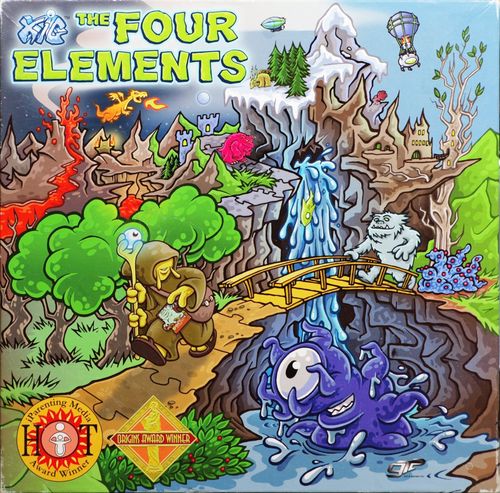
XIG: The Four Elements
XIG: The Four Elements Rulebook
Table of Contents
Table of Contents
Overview
The game can be played by two, three or four players — either all against each other, or in two-person teams. (With more than four players, if a second box is used, every player needs one Pathway.)
Object of the Game
Each player tries to be the first to assemble their own Pathway. Every Pathway is based on one element — Earth, Water, Fire or Air. Each Pathway is made up of 35 tiles: it runs from the two Burrow tiles (inner and outer) to the Ring tile. During play the tiles do not have to connect as they are placed, but the goal is for the complete Pathway to come together in the end.
End of the Game
The player who first assembles their complete Pathway (all 35 tiles) wins.
Contents
- The Earth Pathway: 2 Earth Burrow tiles, 19 Earth creature tiles, 13 XAG corner tiles, 1 Earth Ring tile
- The Fire Pathway: 2 Fire Burrow tiles, 19 Fire creature tiles, 13 XAG corner tiles, 1 Fire Ring tile
- The Water Pathway: 2 Water Burrow tiles, 19 Water creature tiles, 13 XAG corner tiles, 1 Water Ring tile
- The Air Pathway: 2 Air Burrow tiles, 19 Air creature tiles, 13 XAG corner tiles, 1 Air Ring tile
- 60 XAG cards
- 4 XIG cards
- Rulebook
- 4 Pathway boxes
Note: the contents list in the printed rulebook reads "60 XAG cards". The set-up and rules sections refer to the deck as the XAP cards, which is the name used throughout the rules text below; the card count is transcribed as printed.
Set-up
Sort the tiles by element (Earth is marked green, Water blue, Fire red, and Air is marked with a white ring). Each element must have 35 tiles:
- 2 Burrow tiles (inner and outer). Tile 1 is later connected to the outer Burrow tile.
- Creature tiles (for example, the Razorbear), numbered 1 to 33. The tribe symbol shows the tile's tribe. The tile's element is shown, and the number shows its place in the Pathway.
- Ring tile (numbered 33).
- Corner tiles (XAG). These show the corner (XAG) mark. Corner tiles change the direction of the Pathway, and they are not creatures.
Clear a large table or part of the floor — each Pathway is about 46 × 91 cm, and all four Pathways together about 91 × 122 cm.
Each player chooses one element for their Pathway. Any combination works. (If the players have several boxes available, they may choose the same element.)
Decide who will be the starting player (for example, each player draws a tile, and the one with the lowest number starts). Players take turns in clockwise order.
Shuffle the XAP cards and place the deck face down on the table. (In a game with several players, the cards of several boxes may be mixed together into one deck. Cards from several boxes can be combined — they are marked in the bottom-left corner. It is advisable to have 15 × the number of players' cards in use.)
Each player is given one XIG card, which they place in front of them face down. If a player turns their XIG card face up at the end of their turn, they place ALL tiles of their Pathway under protection in the circle of their three opponents. Each player may call on XIG's help only once during the game.
Translator's note on the XIG card: the printed text reads "védelem alá helyezi három ellenfele körében" ("places under protection in the circle of his three opponents"). The printed wording is kept as it stands.
Play of the Game
Players shuffle their tiles, place them face down in front of them, then draw five tiles into hand. At the END OF THEIR TURN every player draws tiles until they have five tiles in hand.
At the START OF THEIR TURN a player places one tile from their hand face up in front of them, in their play area, announcing what is on the tile and which tribe it belongs to. In each player's very first turn only a creature tile may be played, not a corner tile. In later turns a creature tile or a corner tile may be played, whether or not it connects to tiles already played.
A) Creature tiles. If this is a creature tile whose PAIR is already played in front of an opponent, and that pair is UNPROTECTED, it KNOCKS IT OUT: the opponent must take the tile back and place it in their memory deck.
Two creatures are a pair if they belong to the same tribe.
If the played creature has more than one knockable pair, only one is knocked out — the player who plays the creature chooses which.
The Razorbear (Earth) and the Gnasher (Water) are a pair: both belong to the XALVO tribe.
B) Corner tiles. If this is a corner tile, the player may draw an XAG card from the common deck. XAG cards have magical powers, and the player may keep drawn cards in hand until they can and want to play them. Corner tiles cannot be knocked out.
C) Burrow and Ring tiles. If this is a Burrow tile or a Ring tile, it immediately becomes protected and cannot be knocked out.
Important: a Ring tile may only be played after both Burrow tiles have been played.
Unprotected Tiles
UNPROTECTED tiles can be knocked out. A knocked-out tile is placed face down in its owner's memory deck.
Every creature tile is UNPROTECTED if it is not part of a completely finished section.
Example 1, unprotected tiles: Creatures 2, 5, 6 and 7 are all unprotected, because their section is not complete — creature 4 is missing.
Example 2, unprotected tiles: Kaaspe (creature 27) is unprotected and can therefore be knocked out, because its section is not complete — corner tile 26 is missing.
Protected Tiles
PROTECTED tiles cannot be knocked out in any way, not even by XAP cards. Protected tiles are:
- every corner tile;
- every Ring tile;
- every Burrow tile;
- every creature tile that is located in a completely finished section. A section is made of creature tiles connected to one another, with a corner tile at each of its two ends — no tile may be missing.
A section also counts as finished if, at one end of the connected creature tiles, there is a corner tile, and at the other end a Ring tile or an outer Burrow tile.
- If only one section of a player's Pathway remains unfinished, the tiles belonging to that section are also considered protected.
Diagram caption, as printed on the rulebook page for item 5: "Because only one section is still unfinished, all creature tiles are protected." (The caption and item 5 are both kept as printed.)
Example, protected tiles: The creature tiles below are all protected: they are all connected to one another, and at their two ends they reach the two corner tiles.
Memory Deck
- A knocked-out tile is placed face down in its owner's memory deck.
- A tile can only be taken back from the memory deck if:
- a) an effect (for example, an XAP card) directly instructs it;
- b) the player runs out of their normal deck. In this case, at the end of their turn, the player selects tiles from their memory deck to get five tiles in hand.
- Tiles in the memory deck may be freely rearranged, but they must stay face down.
XAP Cards
Whoever plays a corner tile from their hand draws an XAP card. XAP cards can be played in three ways:
-
Completing a section. A player may play a suitable XAP card from their hand when they complete a section of their Pathway. A section is bounded either by two corners, or by a corner and the Ring tile, or by a corner and the outer Burrow tile. If a player completes several sections in their turn, they may play that many XAP cards.
Important: when two corners connect directly to each other, this is not a section, so no XAP card may be played for creating it.
-
Black Magic. If the drawn XAP card is Black Magic, it must be played immediately and carried out. After this, play continues normally.
-
Counter-curse. A player who is the target of an opponent's XAP card may immediately play a Counter-curse from their hand, which cancels the effect of the first XAP card. Play continues normally.
Variants
Four-Player Team Game
There are two teams, each made up of two players. Teammates sit opposite each other. Teammates build the same Pathway and draw from the same deck. Their memory deck is shared as well. When a player finishes their turn, they may — if they wish — pass one XAP card from their hand to their partner.
Entwined Pathways
With two players, if one plays the Water Pathway and the other plays the Earth Pathway, one of the Kojjit tiles (Water 2 / Earth 5) is set aside, and the other is placed face up on the table during set-up. This tile cannot be removed from the table during the game. The tile is part of both Pathways, so the two Pathways become entwined.
Marathon
Only for the brave! Each player builds several Pathways at the same time. By agreement, the winner is either the player who first completes any one of their Pathways, or the player who first completes all of their Pathways. The game takes longer, but there is more strategy in the game.
Shared Memory Deck
All players use a single, common memory deck. Every knocked-out tile goes into this memory deck. If a player draws from it a tile belonging to another player's element, they must hand that tile to its rightful owner, and their turn ends with this.
Quick Game
During set-up, everyone draws one XAP card. In addition, everyone draws 10 tiles and lays them out face up in front of them, in their own play area. Otherwise the game follows the normal rules.
Many other variants can be devised, which is partly why the game is so good. Players are encouraged to invent their own variants, or to look at the versions published on the website www.playxig.com.