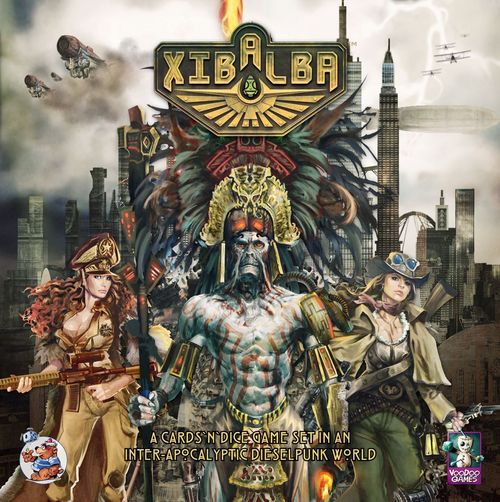
Xibalba
Xibalba Rulebook
Table of Contents
Table of Contents
Game Components
4 Player Boards (Base)
- ACTION POOL: Put rolled DICE SYMBOLS in here to track a player's actions.
- WARHOST: All of a player's purchased SOLDIER cards are put face-up into the WARHOST from where they can be used to attack and block attacks.
- COMMON ACTIONS: Overview of all available ACTIONS that may be used during the ACTION PHASE by spending RESOURCES.
- BASE UPGRADE LEVELS: During the game a player may upgrade its BASE to gain a higher RESISTANCE and generate more RESOURCES.
- PARAGON TRACKER: Use the PARAGON TOKEN to track the current amount of a player's PARAGON.
- RESOURCE TRACKER: Use the RESOURCE TOKEN to track the current amount of a player's RESOURCES.
- ADD-ON FIELDS: All of a player's purchased CIVILIAN and/or STRUCTURE CARDS are put here face-up.
1 Deck Board - Soldier & Civilian Deck
- SOLDIER DECK: Contains all SOLDIER cards in a face-down pile.
- CIVILIAN DECK: Contains all CIVILIAN cards in a face-down pile.
- SOLDIER DISCARD PILE: During the game your SOLDIERS may be destroyed and are then put face-up on the SOLDIER DISCARD PILE.
- CIVILIAN DISCARD PILE: During the game your CIVILIANS may be destroyed and are then put face-up on the CIVILIAN DISCARD PILE.
- SOLDIER & CIVILIAN FIELDS: Always contain 2 face-up cards of each type that are available for purchase.
1 Deck Board - Structure & Event Deck
- STRUCTURE DECK: Contains all STRUCTURE cards in a face-down pile.
- EVENT DECK: Contains all EVENT cards in a face-down pile.
- STRUCTURE DISCARD PILE: During the game your STRUCTURES may be destroyed and are then put face-up on the STRUCTURE DISCARD PILE.
- EVENT DISCARD PILE: During the game EVENTS are used and then put face-up on the EVENT DISCARD PILE.
- STRUCTURES & EVENT FIELDS: Always contain 2 face-up cards of each type that are available for purchase.
1 Ark Board
- ARK FIELD: When a SOLDIER enters the ARK, its card is placed onto the ARK FIELD.
- LIFEPOINTS: Use the LIFEPOINT TOKEN to track the lifepoints of a SOLDIER inside the ARK. Use a maximum of 10 points for 2 player games and a maximum of 20 for 3 or more players.
- CONTROLLING PLAYER: The arrow should always point to the player who controls the ARK with one of their SOLDIERS. It also separates the 2 and 3+ player area.
Tokens, Cards, Dice
- 4 RESOURCE TOKENS (track a player's RESOURCES), 4 PARAGON TOKENS (track a player's PARAGON), 4 BASE TOKENS (track a player's BASE UPGRADE LEVELS), 4 VICTORY TOKENS (track a player's VICTORY CONDITIONS), 1 LIFEPOINT TOKEN (tracks the LIFEPOINTS of the SOLDIER in the ARK).
- 64 SOLDIER CARDS, 48 CIVILIAN CARDS, 32 STRUCTURE CARDS, 32 EVENT CARDS, 8 FACTION CARDS.
- Card layout: faction, card name, resource costs, edition, power value, resistance value, paragon value, card type icon, game phase, card effect.
- 4 RESOURCE DICE (symbols: blank, 1, 2 and 3 resource symbols).
- 2 PARAGON DICE (symbols: blank, 1 paragon symbol, 2 paragon symbols).
- 4 ATTACK DICE (symbols: blank, attack symbol, critical hit symbol).
Game Overview
In XIBALBA players take on the role of a mercenary captain of one of the eight available factions and try to gain control over a contested ARK that contains the precious resource PARAGON. Each player possesses their own BASE and can expand it during each game round by gathering and spending RESOURCES in order to obtain STRUCTURES, CIVILIANS and SOLDIERS. While STRUCTURES and CIVILIANS have specific benefits or disadvantages for a player's course of the game, SOLDIERS are used to fight their way into the ARK in order to loot PARAGON.
The basic game mechanisms - e.g. the gathering of RESOURCES, the looting of PARAGON and the resolving of ATTACKS - are based on a specific dice system with its own SPECIAL DICE. Each round the players roll for RESOURCES, looted PARAGON and the amount of possible ATTACKS that are available to them during their turn.
Besides the dice system, CARDS are essential to determine the course of the game. They can be bought by spending gathered RESOURCES and can be chosen from four different types of DECKS (SOLDIERS, CIVILIANS, STRUCTURES, EVENTS). Purchased CARDS are attached to the BASE owned by the player who obtained the CARDS. From now on those cards' CARD EFFECTS are available and may be used.
The goal of the game is to be the first player reaching a previously determined amount of PARAGON. There are different ways to obtain PARAGON and one of them is to ATTACK and gain control of the ARK.
Game Boards
The game encompasses different GAME BOARDS of which the four PLAYER BOARDS represent the player's BASES, the ARK BOARD the contested ARK in the middle of the table, and the 2 DECK BOARDS are used to store the specific DECKS of card types (SOLDIERS, CIVILIANS, STRUCTURES, EVENTS).
Dice
Dice are used to determine a player's actions during their turn. There are three different kinds of dice:
- RESOURCE DICE
- PARAGON DICE
- ATTACK DICE
Cards
CARDS are the basic element in XIBALBA and fundamentally form a player's base. The base game contains four different types of CARDS:
- SOLDIERS (red cards)
- CIVILIANS (blue cards)
- STRUCTURES (yellow cards)
- EVENTS (green cards)
SOLDIERS are always part of the WARHOST of a player and are also referred to as a player's WARHOST for as long as they are part of it. CIVILIANS and STRUCTURES are placed on the ADD-ON FIELDS of the BASE and are referred to as ADD-ON CARDS. EVENTS are always immediately played and do not belong to a player's BASE.
CARDS contain the following values (POWER, RESISTANCE, and PARAGON only apply to SOLDIER CARDS): card type, power, resistance, paragon, faction, edition, name, card effect, phase, resource cost.
Card Effects
All CARDS have a so called CARD EFFECT. CARD EFFECTS always belong to the CARD on which they are described. CARD EFFECTS are special rules that always alter or expand the regular game rules as stated in their descriptions.
CARD EFFECTS are either resolved in specific GAME PHASES or have a general impact on the whole game. A colored frame around the CARD EFFECT's description as well as an icon will clearly show when to apply it:
- EFFECT PHASE
- DICE PHASE
- ACTION PHASE
- PERMANENT
CARD EFFECTS applying to the EFFECT PHASE, DICE PHASE or ACTION PHASE must be resolved during these respective PHASES. CARD EFFECTS being PERMANENT are always active and do count for the complete game. Such effects always have to be resolved whenever the situation allows it. PERMANENT CARD EFFECTS are not PHASE or turn related.
EXAMPLE: Player 2 owns three CARDS applying to the EFFECT PHASE, the ACTION PHASE, and one being PERMANENT. He can only resolve the CARDS applying to the EFFECT PHASE and ACTION PHASE within the specific PHASES of the game. The CARD being PERMANENT counts for all PHASES of their own turn as well as during the opponents' turns.
Game Preparations
Before Each Game
Place the ARK BOARD at the center of the table and put the top SOLDIER of the SOLDIER DECK on the ARK FIELD. Mark its lifepoints by setting the lifepoint token to the value equal to the SOLDIER's RESISTANCE plus the amount of players. Then place the SOLDIERS & CIVILIANS and the STRUCTURES & EVENTS DECK BOARDS on the sides of the ARK. Shuffle each DECK (SOLDIERS, CIVILIANS, STRUCTURES, EVENTS) and place them face-down on the corresponding field of the DECK BOARDS. The top two CARDS of each DECK are then placed face up on the two fields in front of their DECK BOARDS.
Then players determine their faction by randomly drawing one of the FACTION CARDS. Make sure that only one faction of each board can be drawn.
After each player took their PLAYER BOARDS, each of them receives 1 BASE UPGRADE, 1 RESOURCE, 1 PARAGON and 1 VICTORY TOKEN.
The BASE UPGRADE TOKEN is placed on the first UPGRADE LEVEL of each BASE.
The RESOURCE TOKEN is placed on a value of each player's RESOURCE TRACKER corresponding to the amount of players, e.g. in a 3 player game it would be placed on the number 3.
The PARAGON TOKEN is placed on the 0 of the PARAGON TRACKER.
The ARK is at the center; the DECK BOARDS (STRUCTURES & EVENTS; SOLDIERS & CIVILIANS), the PARAGON DICE, ATTACK DICE and RESOURCE DICE, and the AVAILABLE CARDS lie around it, with the BASES of players 1 to 4 around the table.
Starting a Game
Determine Victory Conditions
After all game preparations have been made, it is time to start a game. First of all it is necessary to agree on the victory conditions. This means that all players agree on a certain amount of PARAGON that has to be gathered in order to win the game.
We recommend the following values:
- 2 Player Game = 30-40 PARAGON
- 3 Player Game = 20-30 PARAGON
- 4 Player Game = 10-20 PARAGON
Basically, the more PARAGON a player has to gather, the longer the game will take, so if you just want to play a fast game, no matter how many players are involved, you can simply choose a lower number and vice versa.
After agreeing on the amount of PARAGON, each player uses a VICTORY TOKEN to mark this amount on the PARAGON TRACKER of their BASE, e.g. in a 4 player game that could be 20 PARAGON.
Starting Player
The next step would be to determine a STARTING PLAYER. For that each player rolls the two PARAGON DICE and the one that scores most becomes the STARTING PLAYER. If this results in a draw, those players have to roll the dice again.
Rounds, Turns & Phases
Rounds & Turns
A game of XIBALBA consists of several game ROUNDS which are separated into one TURN per player.
The STARTING PLAYER begins their first ROUND with their first TURN. When they finish their TURN, the player on their left starts their TURN and so on, until it is the STARTING PLAYER's TURN again, which then ends the first ROUND and starts their second ROUND.
Each player always starts an own ROUND with their TURN and at the same time ends their previous ROUND.
EXAMPLE: In a four player game the ROUND of player 3 ends when players 4, 1 and 2 have finished their TURNS and it is player 3's TURN again. The ROUND of player 2 ends when players 3, 4 and 1 had their TURNS and as soon as player 2 begins its next TURN.
A TURN lasts until the current player voluntarily ends it by resigning to perform any more ACTIONS, or if the player cannot perform any more ACTIONS.
NOTE: So called FORCED ACTIONS (explained later) of a player must always be performed before the TURN of the affected player may be ended.
Phases
A player's TURN is divided into PHASES. The following shows the order in which the PHASES are repeated during each TURN:
- EFFECT PHASE
- DICE PHASE
- ACTION PHASE
If the ACTION PHASE of a player ends, this also ends their TURN and it becomes the TURN of the player to their left. This player now also goes through all the three PHASES and ends their own TURN as soon as they have finished their ACTION PHASE which then starts the TURN of the next player and so on.
Effect Phase
Handling Base Upgrade Effects
The first thing a player does during their EFFECT PHASE is to add as many RESOURCES to their RESOURCE TRACKER as the corresponding value on their current BASE UPGRADE LEVEL shows (e.g. BASE UPGRADE LEVEL 2: +1 RESOURCE).
Handling Card Effects
During the EFFECT PHASE all CARD EFFECTS that apply to the EFFECT PHASE and that belong to the current player are being resolved.
Resolving CARD EFFECTS during the EFFECT PHASE is being done by the current player choosing one of their CARDS applying to the EFFECT PHASE and resolving the described CARD EFFECT.
After completely resolving this CARD EFFECT the player resolves the next one of their CARDS applying to the EFFECT PHASE. This is being done until all of the player's CARDS with the remark EFFECT PHASE have been used once.
The order in which CARD EFFECTS are resolved is up to the controlling player and they may choose a new order of resolving them in each new ROUND.
It is important to know that all CARD EFFECTS that could be used during the EFFECT PHASE have to be applied! It is not allowed to skip a valid CARD EFFECT during the EFFECT PHASE and that is why they are so called FORCED ACTIONS.
EXAMPLE: It is player 2's EFFECT PHASE who has a BASE UPGRADE LEVEL of 2, that adds +1 RESOURCE to their RESOURCE TRACKER. They now have two CIVILIAN CARDS that apply to the EFFECT PHASE and decide to resolve one of them but must also resolve the other one thereafter before it may end their EFFECT PHASE.
As soon as all CARD EFFECTS with the remark EFFECT PHASE have been resolved, the EFFECT PHASE of the current player ends and their DICE PHASE starts.
Dice Phase
Determining Dice Pool
At the beginning of the DICE PHASE a player always determines their DICE POOL. The DICE POOL consists of 6 dice that a player may choose from out of 4 RESOURCE DICE and 4 ATTACK DICE. A player may choose between any combination of these 8 dice but may usually not have more than 6 dice in total and no more than 4 RESOURCE DICE or ATTACK DICE at the same time. Sometimes the total number of dice inside the DICE POOL may be altered by various CARD EFFECTS. In this case it is possible to have more or less than 6 dice, but it is not allowed to have more than 4 dice of the same type.
Handling Card Effects
After determining the DICE POOL, all CARD EFFECTS that apply to the DICE PHASE are being resolved. This is being done exactly as handling CARD EFFECTS during the EFFECT PHASE. These CARD EFFECTS must be used once because they are FORCED ACTIONS and may not be used more than once per ROUND.
Rolling the Dice
When all DICE PHASE CARD EFFECTS of a player are resolved they take all dice from their DICE POOL and roll them once. This is called INITIAL ROLL.
After that the player sorts out any dice that they want to keep and use during their TURN. The sorted out dice now belong to the player's ACTION POOL and are put on the specific field on their BASE without changing the rolled results.
The remaining dice are put back into the DICE POOL and may be rolled a second time. This is referred to as RE-ROLL.
Again, after this second dice roll, the player may sort out any rolled dice into their ACTION POOL, not changing the rolled results. All other dice are put back into the DICE POOL once more.
NOTE: A player may not put any dice back into their DICE POOL that were already sorted out into their ACTION POOL previously!
Another RE-ROLL allows to roll the remaining dice in the DICE POOL a third and last time. After that all dice are automatically being sorted out into the ACTION POOL so that there is no remaining die in the DICE POOL of the player.
EXAMPLE: The DICE POOL consists of 4 RESOURCE DICE and 2 ATTACK DICE.
- INITIAL ROLL RESULTS: The INITIAL ROLL results show a die with one and another die with two RESOURCE SYMBOLS, one die with an ATTACK SYMBOL and three dice with BLANKS. The player keeps the ATTACK SYMBOL and the die with the two RESOURCE SYMBOLS and puts them into their ACTION POOL. The other four dice are put back into the DICE POOL and are re-rolled.
- 1st RE-ROLL RESULTS: The first RE-ROLL shows one RESOURCE SYMBOL, three RESOURCE SYMBOLS, one CRITICAL HIT SYMBOL and a BLANK. The player keeps the three RESOURCE SYMBOLS and the CRITICAL HIT and puts them into their ACTION POOL. The others are put back into the DICE POOL and re-rolled again.
- 2nd RE-ROLL RESULTS: With the last RE-ROLL the player rolls one RESOURCE SYMBOL and a BLANK. Since it is their last RE-ROLL, the player needs to put the dice into their ACTION POOL and may not RE-ROLL them again. The player's ACTION POOL now consists of the following dice: (the ATTACK SYMBOL, the die with two RESOURCE SYMBOLS, the die with three RESOURCE SYMBOLS, the CRITICAL HIT, the RESOURCE SYMBOL and the BLANK).
Altered Re-Rolls
The DICE PHASE of a player encompasses an INITIAL ROLL of their DICE POOL and up to two RE-ROLLS. From time to time it may happen that the amount of RE-ROLLS is being increased or reduced due to specific effects. It is important to note that only the amount of RE-ROLLS may be altered and that the INITIAL ROLL is never affected by such effects and may always be made.
If the amount of RE-ROLLS is changed in any way, the player must sort out all their dice into the ACTION POOL at the latest by the end of their last allowed RE-ROLL.
If at any time a player has sorted out all their dice from their DICE POOL into their ACTION POOL (at the latest after their last RE-ROLL), the DICE PHASE immediately ends, all remaining RE-ROLLS for this TURN expire and the ACTION PHASE starts.
Action Phase
Performing Actions
The ACTION PHASE encompasses the part of the TURN in which a player generates RESOURCES, purchases new CARDS and performs ATTACKS. The order in which these ACTIONS are performed is up to the player and does not follow a specific schedule.
The possible ACTIONS a player may perform during their ACTION PHASE are determined by the dice in their ACTION POOL and partly by CARD EFFECTS that apply to the ACTION PHASE.
When and if a player uses their DICE ACTIONS or a CARD EFFECT is completely up to the player since those are not FORCED ACTIONS. But if a CARD that applies to the ACTION PHASE is used, e.g. to ATTACK, it will always trigger its CARD EFFECT (as long as it applies to the ACTION PHASE) and it must be applied immediately.
Using Dice Symbols
The usage of DICE SYMBOLS is made by simply choosing one or more dice from the ACTION POOL and use them up, which means that the dice are removed from the ACTION POOL and used for a specific ACTION as explained in the next chapter.
Using Card Effects
CARD EFFECTS may be used as long as they apply to the ACTION PHASE. As mentioned before it is not mandatory to use all possible CARD EFFECTS during the ACTION PHASE since they are not FORCED ACTIONS, but every time a CARD is used in any way (e.g. for an ATTACK) you also need to apply its CARD EFFECT if it refers to the ACTION PHASE.
Ending the Action Phase
A player may end their ACTION PHASE at any time and does not need to use up all dice of their ACTION POOL. The ACTION PHASE automatically ends when a player cannot perform any further ACTIONS.
At the end of the ACTION PHASE all remaining dice of the ACTION POOL are removed and the TURN of the next player begins.
Dice Actions
The rolled DICE SYMBOLS of the ACTION POOL allow a player to perform specific ACTIONS. In order to perform an ACTION the corresponding die needs to be removed from the ACTION POOL and cannot be used for further ACTIONS during this TURN anymore. Dice that have been removed from the ACTION POOL are put to the side of the BASE so that it is easily recognizable that they are used up.
A player may decide not to use DICE SYMBOLS and their ACTIONS. In this case, just remove all the dice a player does not intend to use from the ACTION POOL without performing their ACTIONS.
Please remember that all ACTIONS may be used in any order and as often as possible!
At the end of the ACTION PHASE all remaining (not used) dice are removed from the ACTION POOL automatically without using their effects.
NOTE: BLANK dice results have no further relevance and cannot be used for any ACTIONS, except a specific CARD EFFECT allows it. BLANK dice results can be part of the ACTION POOL but cannot be actively used. They will be removed from the ACTION POOL together with all other remaining dice at the end of the ACTION PHASE.
The following listed ACTIONS are all based on the DICE SYMBOLS of the ACTION POOL:
Gather Resources
RESOURCES form the backbone for a solid BASE expansion and a successful game! A player may exchange each RESOURCE SYMBOL in their ACTION POOL for a RESOURCE that can be used to purchase further CARDS during the game or use specific COMMON ACTIONS (page 11).
Each die inside the ACTION POOL that shows at least one RESOURCE SYMBOL may be removed from the ACTION POOL and exchanged for a corresponding amount of RESOURCES. Mark the gained RESOURCES on the RESOURCE TRACKER of the player's BASE by adding the amount of gained RESOURCES to it and placing the RESOURCE TOKEN on the new determined position.
EXAMPLE: One die out of player 1's DICE POOL shows 1 RESOURCE SYMBOL and another one shows 2 RESOURCE SYMBOLS. If the player exchanges these dice for RESOURCES, they will gain 3 RESOURCES and add them to their current RESOURCE TRACKER and place the RESOURCE TOKEN on the specific position. The used dice are removed from the ACTION POOL and put to the side of the BASE. They cannot be exchanged for RESOURCES again in this ROUND.
Gathered RESOURCES remain even after the own TURNS and ROUNDS end. They are only removed when being spent or removed in another way.
No player may gather more than 25 RESOURCES at any time. All RESOURCES that exceed this value immediately expire.
Performing Attacks
ATTACKS are used to let your SOLDIERS enter the contested ARK, to weaken your opponents or to even steal PARAGON from them.
An ATTACK can always be performed when a player has ATTACK SYMBOLS in their ACTION POOL. Each ATTACK SYMBOL in the ACTION POOL allows a player to perform one ATTACK, while they may also combine several ATTACK SYMBOLS for a single stronger ATTACK.
In order to ATTACK, the attacking player must have at least one SOLDIER in their WARHOST or inside the ARK. If a player does not have a SOLDIER CARD in either their WARHOST or the ARK, ATTACK SYMBOLS may not be used, except a specific CARD EFFECT allows it.
There are two different ways of performing ATTACKS:
Attacks from Soldiers in Warhost
If a player only possesses SOLDIERS in their WARHOST, but not inside the ARK, they may only ATTACK enemy SOLDIERS that are currently inside the ARK. Those ATTACKS are always made by the current ACTIVE SOLDIER (the one that is currently the top face-up SOLDIER CARD of a player's WARHOST).
EXAMPLE: Player 2 possesses 3 SOLDIERS in their WARHOST, but only the top face-up SOLDIER of their WARHOST PILE counts as being the ACTIVE SOLDIER.
First of all you need to decide on the POWER of the ATTACK by choosing an amount of dice showing an ATTACK SYMBOL that should be used for the ATTACK. For each ATTACK SYMBOL used for an ATTACK, the POWER of the ATTACK is increased by the current POWER of the attacking SOLDIER.
After that you need to decide on a TARGET for the ATTACK which can only be an enemy SOLDIER in the ARK for as long as you are attacking out of your WARHOST.
The TARGET now suffers DAMAGE equal to the POWER of the ATTACK and will therefore reduce its LIFEPOINTS by the amount of DAMAGE suffered. Place the LIFEPOINT TOKEN on the corresponding value on the LIFEPOINT TRACKER of the ARK.
EXAMPLE: Player 2 has a SOLDIER with POWER 3 in their WARHOST and 3 dice with ATTACK SYMBOLS in their ACTION POOL. Player 2 may use the ATTACK SYMBOLS to ATTACK the SOLDIER currently inside the ARK. Player 2 decides to use two ATTACK SYMBOLS from their ACTION POOL to make one ATTACK with POWER 6 (2x POWER 3 of the SOLDIER). The SOLDIER in the ARK then suffers 6 DAMAGE that are subtracted from its 8 LIFEPOINTS and the LIFEPOINT TOKEN is then placed on the value 2 of the LIFEPOINT TRACKER. Since player 2 still has an ATTACK SYMBOL left in their ACTION POOL, player 2 may still make another ATTACK thereafter. Player 2 could also have used all three ATTACK SYMBOLS for one single ATTACK with a POWER of 9 or three single ATTACKS, each with a POWER of 3.
After DAMAGE and all applicable effects have been applied, an ATTACK counts as being resolved and all dice used for it are removed from the ACTION POOL. If there are still further dice with ATTACK SYMBOLS in the ACTION POOL, they can be used for further ATTACKS until there are no more ATTACK SYMBOLS inside the ACTION POOL.
Attacks from Soldiers inside the Ark
When a player has a SOLDIER inside the ARK they may only perform ATTACKS from the ARK and may not use their WARHOST to attack their own SOLDIER inside the ARK. Attacks performed from the ARK must always target an enemy BASE.
If an ATTACK against an enemy BASE is being made, check the blue value of their BASE UPGRADE LEVEL. This represents the current RESISTANCE of the BASE. If this is higher than the total POWER of the ATTACK, nothing happens. Otherwise, if the POWER of the ATTACK is equal to or higher than the RESISTANCE of the BASE then the ATTACK succeeds and the attacking player may choose to destroy (page 13) one ADD-ON CARD of that BASE.
In addition, the attacking player may loot PARAGON from the attacked player's BASE. Roll an amount of PARAGON dice equal to the PARAGON value of the attacking SOLDIER inside the ARK and subtract the result from the attacked player's PARAGON TRACKER and add the same amount to the attacking player's PARAGON TRACKER.
NOTE: An attacking player may never loot more PARAGON from a BASE than there is available.
Blocking Attacks
If the BASE of a player is being attacked from a SOLDIER inside the ARK, the attacked player has the possibility to BLOCK the ATTACK with the ACTIVE SOLDIER of their WARHOST.
For that the attacked player simply states that they want to BLOCK the ATTACK with their ACTIVE SOLDIER and compares the RESISTANCE of the blocking SOLDIER with the total POWER of the ATTACK. If the RESISTANCE of the blocking SOLDIER is equal to or lower than the POWER of the ATTACK, the blocking SOLDIER is immediately destroyed (page 13). If the RESISTANCE is higher nothing else happens. In both cases the ATTACK counts as being BLOCKED and the attacking player may neither destroy an ADD-ON CARD nor steal PARAGON.
Critical Hits
All ATTACK DICE each have one CRITICAL HIT SYMBOL that is treated like a normal ATTACK SYMBOL except that this ATTACK GAINS +1 to its total POWER for each CRITICAL HIT SYMBOL used in this attack.
EXAMPLE: Player 1 has a SOLDIER with POWER 4 inside the ARK and 2 ATTACK SYMBOLS in their ACTION POOL. Player 1 decides to use one of their ATTACK SYMBOLS to attack the BASE of player 3 that has a RESISTANCE of 4. Player 3 announces that it wants to BLOCK the ATTACK with their current ACTIVE SOLDIER in their WARHOST. The blocking SOLDIER has a RESISTANCE of 3 which means that it will be destroyed by the POWER 4 ATTACK, but the ATTACK itself counts as being BLOCKED and has no further impact on the original attacked BASE. With the second ATTACK SYMBOL player 1 decides to perform another ATTACK against the BASE of player 3. Since player 3 has no more SOLDIERS left in their WARHOST, they cannot BLOCK the ATTACK and the BASE suffers a POWER 4 ATTACK which means player 1 may destroy one of its ADD-ON CARDS and loot PARAGON.
Attack Diagram Example
In this diagram player 1 has a BOMBER inside the ARK and controls it. The player also has a GUNSLINGER in their WARHOST. If player 1 decides to perform an ATTACK they must use their SOLDIER inside the ARK because WARHOSTS (in this case the GUNSLINGER) may only ATTACK the ARK which would be the player's own SOLDIER.
Player 1 therefore has the following ATTACK options:
- ATTACK the BASE of player 2. In this case player 2 could BLOCK the ATTACK with their FLAMERGIRL which would be destroyed when doing so.
- ATTACK the BASE of player 3. Player 3 has no SOLDIER in their WARHOST and could not BLOCK the ATTACK. Player 1 would be able to destroy the SMUGGLER ADD-ON CARD and steal PARAGON from player 3.
- ATTACK the BASE of player 4, but since the BASE has no ADD-ON CARDS that could be destroyed nor possesses any PARAGON that could be looted it makes no sense to attack it.
If it would be player 2's TURN, they could only ATTACK the ARK (the BOMBER) since player 2 may only perform ATTACKS out of their WARHOST.
Player 3 and player 4 do not possess any SOLDIERS in their WARHOSTS and would not be able to ATTACK at all.
Looting Paragon
The goal of the game is to be the first player who looted a specific amount of PARAGON. This can be achieved in different ways, but the looted amount of PARAGON is always determined by rolling one or more PARAGON DICE.
Each die in the ACTION POOL that shows at least one PARAGON SYMBOL may be removed and exchanged for the corresponding amount of PARAGON. The looted PARAGON will then be added to the existing amount of PARAGON on the player's BASE by placing the PARAGON TOKEN on the specific value of the PARAGON TRACKER.
EXAMPLE: Player 3 has one die showing two PARAGON SYMBOLS in their ACTION POOL. If player 3 exchanges this die for PARAGON, they will receive 2 PARAGON and adds it to their current amount of PARAGON by placing the PARAGON TOKEN on the specific value of the PARAGON TRACKER. The used-up die is removed from the ACTION POOL and cannot be exchanged for PARAGON again.
A player's looted PARAGON remains in the game even after a player's own TURNS and ROUNDS end. It may only be removed as a result of enemy ATTACKS or specific CARD EFFECTS.
A player may not gather more than 40 PARAGON at any time and all PARAGON gathered in excess to it will immediately expire.
Common Actions
All Actions described so far are based on DICE SYMBOLS but there are more ACTIONS players may perform during their ACTION PHASE. These additional ACTIONS may always be performed in any order and COST a variable amount of RESOURCES that have to be spent for each ACTION.
Purchase Cards
Gathered RESOURCES may be spent to purchase CARDS. Purchased CARDS are added to a player's BASE and allow new CARD EFFECTS to be used as well as to improve the fighting forces of the WARHOST.
A player may purchase CARDS from four different CARD DECKS:
- SOLDIERS (red cards)
- CIVILIANS (blue cards)
- STRUCTURES (yellow cards)
- EVENTS (green cards)
A DECK is always placed in a face-down pile on the corresponding DECK FIELD of the DECK BOARDS. Place two face-up CARDS of each DECK in the two fields in front of the DECK. Those face-up CARDS form the pool of available CARDS for all players. Only those face-up CARDS may be purchased.
NOTE: If a CARD has been purchased, immediately draw the top CARD of the corresponding CARD DECK and place it face-up on the vacant field of the former purchased CARD.
CARDS are purchased by spending the COSTS mentioned on the CARDS. All COSTS show the necessary amount of RESOURCES that a player has to spend from their RESOURCE TRACKER to purchase CARDS. Therefore simply subtract the RESOURCES spent from the RESOURCE TRACKER and set the RESOURCE TOKEN to the corresponding value so that the RESOURCE TRACKER always shows the current amount of a player's RESOURCES.
A purchased CARD is placed face-up on a valid FIELD of a player's BASE:
- SOLDIERS are always placed on top of a player's WARHOST.
- CIVILIANS and STRUCTURES are placed on one of the BASE's four ADD-ON FIELDS.
- EVENT CARDS are always resolved immediately and afterwards discarded on the EVENT DISCARD PILE of the STRUCTURES & EVENTS DECK BOARD.
As already mentioned before, additional SOLDIERS are placed on top of the existing ones in a player's WARHOST. This means that it may build up a small PILE of SOLDIER CARDS, but only the top CARD is referred to as the ACTIVE SOLDIER CARD. CARDS beneath an ACTIVE CARD can only be used again when they become the top CARD of their PILE. It is the same for ADD-ON CARDS which may also be placed on top of each other and form PILES.
NOTE: CIVILIAN CARDS may not be placed on top of STRUCTURE CARDS and vice versa. If a player has a SOLDIER CARD in the ARK and in its WARHOST, both CARDS count as being ACTIVE!
EXAMPLE: Player 1 has 14 RESOURCES on their RESOURCE TRACKER. Player 1 spends 5 RESOURCES for purchasing a SOLDIER, sets the RESOURCE TOKEN on position 9 of their RESOURCE TRACKER and puts the SOLDIER CARD face-up on top of their WARHOST (ACTIVE SOLDIER). Immediately after that a new SOLDIER CARD is drawn from the SOLDIER DECK and put face-up in front of it. Now player 1 spends 4 more RESOURCES to purchase a CIVILIAN. Again player 1 reduces their RESOURCES on their RESOURCE TRACKER, this time by 4, sets the RESOURCE TOKEN on position 5, and places the CIVILIAN CARD on one of their ADD-ON FIELDS. Since all of the ADD-ON FIELDS are already occupied by either other CIVILIAN or STRUCTURE CARDS, it may only be placed on top of another CIVILIAN but not on top of a STRUCTURE CARD. Fortunately, player 1 has two ADD-ON FIELDS that are occupied by CIVILIAN CARDS and may choose one of them to place the purchased CIVILIAN CARD on top.
Discard Cards
It may happen that a player cannot purchase any beneficial CARDS, that a player wants to prevent another player from purchasing a specific CARD, or simply that a player wants to get rid of some of their own CARDS. That is all possible by a DISCARD ACTION.
To DISCARD a CARD, a player must spend RESOURCES equal to the COSTS of this ACTION listed on their BASE. The player may then put any one face-up CARD of any of the DECKS or one of their own active CARDS from the WARHOST or an ADD-ON FIELD on top of the specific DISCARD PILE. As soon as a CARD of a DECK is discarded, draw a new one from this DECK and place it face-up in front of it.
A player may DISCARD as many CARDS as they want and as they can spend the RESOURCES for.
EXAMPLE: Player 3 wants to DISCARD a SOLDIER in front of the SOLDIER DECK. Player 3 spends the RESOURCES, DISCARDS the SOLDIER and draws a new one that is placed face-up in front of the SOLDIER DECK. They could now purchase the new drawn SOLDIER CARD.
Re-Organize
A player may RE-ORGANIZE their WARHOST and ADD-ON PILES. This means a player may change the order of the CARDS inside each of their PILES and also put CARDS into other PILES of the same CARD TYPE or even place them on free ADD-ON FIELDS.
A RE-ORGANIZATION may be done as often as a player wishes to, for as long as they can pay the COSTS of this ACTION listed on their BASE.
EXAMPLE: Player 2 wants to RE-ORGANIZE their BASE and spends the listed RESOURCES for a RE-ORGANIZE ACTION. They RE-ORGANIZE their WARHOST by changing the order of their SOLDIER cards in any way the player wants to and putting a desired SOLDIER on top of the PILE. Then the player re-organizes one of their CIVILIAN PILES as part of the same action, leaving the top CIVILIAN in place and placing the one underneath on one of their free ADD-ON FIELDS.
NOTE: A player may take a look at their own CARD PILES at any time during the game, but a player may only change the order of the CARDS by using a RE-ORGANIZATION ACTION.
By RE-ORGANIZING a PILE it may happen that a CARD becomes active that allows a SPECIAL EFFECT during the ACTION PHASE or has a PERMANENT EFFECT. Since RE-ORGANIZATION is done during the ACTION PHASE, a player may still make use of any CARD EFFECT of a CARD that has become active due to the RE-ORGANIZATION and that apply to the ACTION PHASE or are PERMANENT.
Pharmaceuticals (+2)
Each time a player spends the listed RESOURCE COSTS for PHARMACEUTICALS, they may immediately increase the LIFEPOINTS of their SOLDIER inside the ARK by +2 up to a maximum of 10 (two player game) or 20 (three or more players).
Weapon Technology
Each time when spending the indicated RESOURCE COSTS for WEAPON TECHNOLOGY, a player may turn one of their ATTACK SYMBOLS inside their ACTION POOL into a CRITICAL ATTACK SYMBOL.
Tactical Assault
By spending the necessary RESOURCE COSTS a player may immediately roll one ATTACK DIE once and add the rolled result to their ACTION POOL.
Harvest
HARVEST is a passive way of gaining PARAGON. Each time a player spends the RESOURCE COSTS for HARVEST, they immediately roll one PARAGON DIE once and add the die result to their ACTION POOL.
Base Upgrades
Each BASE possesses four UPGRADE LEVELS and starts the game on the first UPGRADE LEVEL. This allows a player to use the first of their ADD-ON FIELDS and place CARDS on there. The other three ADD-ON FIELDS are locked and cannot be used to place CARDS on them until they are unlocked. In addition, the first UPGRADE LEVEL marks the initial RESISTANCE and PRODUCTIVITY of the BASE.
To reach the next possible UPGRADE LEVEL, a player needs to spend a specific amount of RESOURCES (orange circle) during their ACTION PHASE:
- LEVEL 2 - 3 or 4 RESOURCES
- LEVEL 3 - 5 or 6 RESOURCES
- LEVEL 4 - 7 or 8 RESOURCES
With each new level, the player unlocks a new ADD-ON FIELD that can be used to place CARDS on it and usually improves the RESISTANCE and/or PRODUCTIVITY of their BASE.
NOTE: You may always only upgrade to the next possible UPGRADE LEVEL and you may not skip one.
EXAMPLE: If player 3 wants to upgrade their BASE from the first to the second UPGRADE LEVEL, it needs to spend 4 RESOURCES. Player 3 may not upgrade their BASE directly from the first to the third LEVEL since it is not possible to skip LEVEL 2.
The RESISTANCE of a BASE is indicated by the shield symbols in the middle row. The PRODUCTIVITY is represented by the wooden crates in the last row and indicates how many additional RESOURCES a player gets automatically at the beginning of their EFFECT PHASE.
Destroying Cards
As mentioned before, CARDS can be destroyed, either by ATTACKS or specific CARD EFFECTS.
A SOLDIER CARD will be destroyed each time it is the TARGET of an ATTACK with an equal or higher POWER than the RESISTANCE of the attacked SOLDIER CARD.
NOTE: Whenever a player destroys a SOLDIER CARD they may immediately roll PARAGON DICE based on the PARAGON VALUE of the CARD that destroyed the SOLDIER CARD and add the results to their PARAGON TRACKER.
CIVILIAN and STRUCTURE CARDS are destroyed when a successful ATTACK against their BASE has been made, or by specific CARD EFFECTS.
Destroyed CARDS are always put on top and face-up of the DISCARD PILE of the specific CARD TYPE, e.g. destroyed SOLDIER CARDS are put on top of the SOLDIER DISCARD PILE.
Paragon Values
SOLDIER CARDS possess a PARAGON VALUE. This value is used to determine the amount of PARAGON DICE a player may roll each time this SOLDIER has successfully attacked a BASE and looted PARAGON or destroyed a SOLDIER CARD. This value is also used when a SOLDIER controls the ARK (page 15).
EXAMPLE: Player 3 has a SOLDIER with a PARAGON VALUE of 1. If they successfully ATTACK a player's BASE, they would be able to loot PARAGON from the attacked player by rolling 1 PARAGON DIE.
Card & Discard Piles
By purchasing and destroying CARDS throughout the game, some DECKS will be emptied and their DISCARD PILES grow. If at any time one of the DECKS runs out of CARDS so that none may be drawn anymore, simply shuffle its DISCARD PILE and use it as a new DECK.
The Ark
The contested ARK is the central PLAYING BOARD in which the precious resource PARAGON is stored. It offers a fast way to increase a player's amount of PARAGON on their PARAGON TRACKER.
Entering the Ark
In order to loot PARAGON from the ARK a player first needs to enter and control it. This can be done with the help of SOLDIERS that are the only CARDS that may enter the ARK. There are two ways how to enter the ARK:
- If the ARK is not controlled by any one, which means no SOLDIER CARDS are inside the ARK, a player may spend one ATTACK SYMBOL to place their ACTIVE SOLDIER inside the ARK. This SOLDIER now counts as controlling the ARK and the ARK is placed so that the arrow for the CONTROLLING PLAYER faces the direction of the player that placed their SOLDIER inside it.
- If the ARK is already controlled by a SOLDIER CARD, this SOLDIER needs to be destroyed before another SOLDIER may enter the ARK. If the SOLDIER inside the ARK is being destroyed by an ATTACK of an enemy player, the attacking SOLDIER must then immediately be placed inside the ARK and counts as controlling it. The destroyed SOLDIER will be put on the SOLDIER DISCARD PILE and the attacking SOLDIER is placed from its WARHOST inside the ARK which is turned so that its arrow faces the new CONTROLLING PLAYER. If possible, it may then still perform additional ATTACKS from within the ARK.
Whenever a SOLDIER of a player enters the ARK, it gains an amount of LIFEPOINTS equal to its RESISTANCE plus one point for each player. Mark the amount of LIFEPOINTS by putting the LIFEPOINT TOKEN on the specific value of the LIFEPOINT TRACKER.
NOTE: A SOLDIER inside the ARK may never have more than 10 LIFEPOINTS for a two player game or 20 LIFEPOINTS for games with three or more players. All exceeding LIFEPOINTS immediately expire.
If a SOLDIER inside the ARK is being attacked, the total POWER of the ATTACK is subtracted from its current LIFEPOINTS of the ARK's LIFEPOINT TRACKER. As soon as the LIFEPOINT TRACKER reaches 0, the SOLDIER is destroyed, removed from the ARK and put into the DISCARD PILE of the SOLDIER DECK.
NOTE: A SOLDIER that destroys a SOLDIER inside the ARK must enter the ARK and cannot voluntarily leave it again! There can only be one SOLDIER entering the ARK and being inside of it at the same time.
EXAMPLE: The ARK is occupied by a random SOLDIER that was put into it at the beginning of the game. It is player 1's TURN and it uses one of its ATTACK SYMBOLS in its ACTION POOL to ATTACK the ARK with a POWER 4 ATTACK of its active SOLDIER in its WARHOST. Since the SOLDIER inside the ARK only has 4 LIFEPOINTS left it will be destroyed and placed on the SOLDIER DISCARD PILE.
Player 1 now immediately places their SOLDIER into the ARK. The SOLDIER gains LIFEPOINTS equal to its RESISTANCE of 4 plus an additional point for each player what makes 4 additional LIFEPOINTS for 4 players. Player 1 places the LIFEPOINT TOKEN on the value 8 of the LIFEPOINT TRACKER on the ARK BOARD.
In player 2's TURN, player 2 uses 2 ATTACK SYMBOLS to attack the SOLDIER of player 1. The ATTACK is made with a total Power of 8 and player 1's SOLDIER is therewith destroyed and immediately removed from the ARK. The SOLDIER of player 2 now enters the ARK and the LIFEPOINTS for this SOLDIER are determined.
Controlling the Ark
To gain control over the ARK and keep it is a good way to earn PARAGON as well as to weaken opponents.
Keep in mind that every time a SOLDIER enters the ARK by destroying a SOLDIER (page 13) in control of it, this player may immediately roll PARAGON DICE equal to the attacking SOLDIER's PARAGON VALUE and add the results to their PARAGON TRACKER.
For as long as a player controls the ARK, they may roll PARAGON DICE equal to their SOLDIER's PARAGON VALUE inside the ARK. This is done at the end of each player's TURN including their own.
Since the CONTROLLING PLAYER of the ARK does not have any ACTION POOL during other player's TURNS, the CONTROLLING PLAYER of the ARK may instead immediately add rolled PARAGON SYMBOLS to its PARAGON TRACKER.
EXAMPLE: In the previous example, both, player 1 and player 2, would have been allowed to roll PARAGON DICE immediately when their SOLDIERS entered the ARK because they destroyed a SOLDIER in order to enter it. The results would have been immediately added to their PARAGON TRACKER.
Since player 1 was still in control of the ARK at the end of their own turn, they were allowed to roll an amount of PARAGON DICE equal to their SOLDIER's PARAGON VALUE inside the ARK and immediately add the results to their PARAGON TRACKER. Player 1 would also have been able to roll the same amount of PARAGON DICE again at the end of each other player's turn in which they still control it, if player 2 would not have already destroyed their SOLDIER and taken control of the ARK.
Victory Conditions
At the beginning of the game the VICTORY CONDITIONS have already been determined by agreeing on a specific amount of PARAGON that has to be reached in order to win the game.
As soon as a player reaches the agreed amount of PARAGON they win the game and the game ends immediately.
Apocalypse Mode
Besides the normal game mode, XIBALBA can also be played in a so called APOCALYPSE MODE.
To play in this mode follow the normal game rules except for these adjustments:
Deck Boards
Use the red back side of the normal DECK BOARDS for your setup. These DECK BOARDS only allow to place one face-up CARD for each CARD TYPE, but all CARDS can be purchased for one less RESOURCE (-1). In addition DISCARD actions may not be used for DISCARDING any CARDS of the DECK BOARDS so the only way to draw new CARDS is to purchase the current ones.
Ark
Just as the DECK BOARDS, the ARK also has a red back side that is used for the APOCALYPSE MODE. This alternate ARK will only allow a maximum of 10 LIFEPOINTS (no matter how many players) but offers additional PARAGON.
Each time a player loots for PARAGON from controlling the ARK, they may add one additional PARAGON to their rolled result as long as the LIFEPOINTS of their SOLDIER controlling the ARK is five or less. If the controlling SOLDIER has six or more LIFEPOINTS they may even add plus two additional PARAGON to their roll.