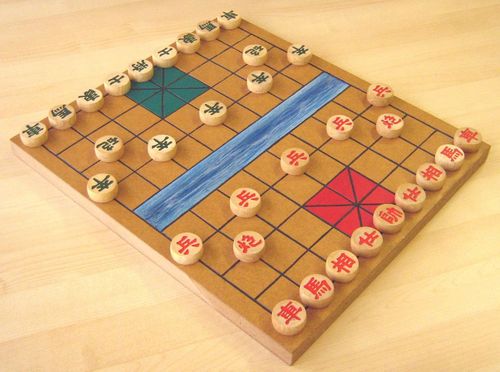
Xiangqi
Xiangqi Rulebook
Table of Contents
Table of Contents
Introduction & History
As in Europe, chess in China underwent changes, and the current game was formed some time after the 13th century. It is now reputedly the most widely played form of chess in the world, a fact partly due to the vast population of its native country.
How to Play
The rules of xiang qi are highly standardised and widely published as given here, with no widespread variations known.
Beginning the Game
- Xiang qi is played on the intersections of a board of 9 lines by 10. A river divides the two halves, and at each end of the board is marked a palace, as shown in Illustration 1.
Illustration 1: the empty xiang qi board.
-
There are two players, one black and one red.
-
Each player has 16 pieces: a general, two counsellors, two elephants, two horses, two chariots, two cannons and five pawns, laid out as in Illustration 2.
Illustration 2: pieces set out for play. From the bottom left the pieces are the chariot, horse, elephant, minister and general; in front of the horses are the cannons, with the soldiers at the front.
Moving the Pieces
-
As red is considered a lucky colour, black is given the first turn. Then red plays, turns alternating thereafter.
-
A player in his turn moves one of his pieces, according to their several rules of movement, described here and shown in Illustration 3.
- The general may move one square horizontally or vertically, but may not leave the palace.
- The counsellors may move one square diagonally, but are similarly confined to the palace.
- The elephant moves two square diagonally, but may not cross the river. Neither may it jump over another piece.
- The horse moves one square horizontally or vertically, then one square diagonally further. It may not jump over other pieces.
- The chariot and cannon move any distance horizontally or vertically. The chariot never jumps over other pieces, and the cannon may not jump unless it is making a capture, as described in rule 7.
- Soldiers move one step forwards. Once over the river, they may move one step forwards or sideways.
Illustration 3: moves of the pieces. Note the jumping capture of the cannon on the left, and the difference in the move of the soldier once across the river.
Capturing Enemies
-
Pieces other than the cannon capture in the same way they move, by landing on the enemy piece and removing it from the board.
-
The cannon captures as it moves, except that it must jump over exactly one piece, of either colour, between its own position and the piece it is capturing.
Threatening the General
-
If the general is threatened with capture, it is in check, and the threat must immediately be averted, by moving the general, interposing a piece between it and its attacker, or capturing its attacker.
-
If the two generals are on the same line, or file, a player may put his opponent in check by moving a piece from between them such that the generals face each other across the otherwise empty file. The opponent must move out of check as in rule 8, and generals may not otherwise face each other on an empty file.
-
A player cannot voluntarily put himself in check; the generals are never captured.
-
Perpetual check is not permitted; if positions are repeated then the aggressor must vary his move.
Ending the Game
-
The game is over when his general is in check, and he can do nothing to rectify this. His opponent is declared the winner.
-
If a player otherwise has no legal move, the game is similarly over and his opponent is the winner.
-
The game is drawn if neither side can engage the enemy.
Further Information
Readers interested in xiang qi may learn more by consulting the following books.
- Bell, R. C. Board and Table Games from Many Civilizations, vol. 1, pp. 66-68.
- Murray, H. J. R. A History of Chess, pp. 121-134. Oxford: Oxford University Press, 1913.
- Parlett, D. The Oxford History of Board Games, pp. 288-290. Oxford: Oxford University Press, 1999.
- Pritchard, D. Brain Games: The Worlds Best Games for Two, pp. 188-196. Harmondsworth: Penguin Books Ltd., 1982.