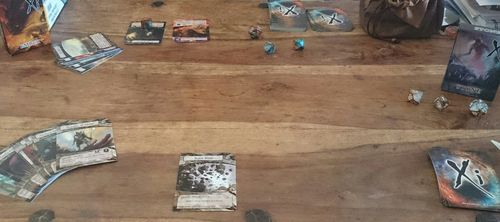
Xi Cards
Xi Cards Rulebook
Table of Contents
Table of Contents
New Players Sheet (Quick Rules)
Turn Structure
You have 10T per turn. (6T on first player's first turn)
You may:
- Draw a card: 3T
- Play a Spell: Spell Cost
- Bank 1 pT: 2T
Skirmishing
Each unit can skirmish once per turn.
A unit chooses which opposing unit to skirmish with.
Each unit deals damage equal to its damage value to the opposing unit's life points.
If there is no opposing unit to skirmish with, a unit may skirmish with a player and deal damage to their life points.
Damage Cycle
Each element does double damage to one other, as shown in the cycle.
- Aqua damage is doubled against Ember.
- Ember damage is doubled against Wind.
- Wind damage is doubled against Stone.
- Stone damage is doubled against Aqua.
- Celestial: no damage taken from anything but Shadow and Celestial. Celestial damage is not doubled against anything.
- Shadow: normal damage on all.
Card anatomy (labels on the sample card "Wind Warrior")
- Card Name
- Spell Cost
- Card Type (for example "WIND - UNIT")
- Damage Value
- Life Points
- Rules/Flavour Text (flavour text is italic)
1 Introduction
Welcome
Welcome, general, to the world of Xi Cards.
Xi Cards is a game for 2 or more players, in which you use units and spells in an attempt to overcome your opponents.
Learning the basics
The objective of Xi Cards is to defeat your opponent(s) by reducing his/her "Life Points" to 0. Each player begins with 40 life points, so you've got a lot of work ahead of you!
Before you read on you'll need to know two terms: "Deck" and "Hand". In Xi Cards, your "deck" is the set of cards you have chosen to use for the game. Your "hand" is any cards you are currently holding. In Xi Cards, you may play cards from your hand, and usually nowhere else.
2 Preparing to Play
You will need...
To play a game of Xi Cards you will need the following:
- A Xi Cards deck for each player, consisting of 30 or more cards, with no more than 3 of each card.
- A flat area to play.
- A good friendly attitude!
It can also be helpful to have:
- Dice (Some 10 sided, one 20-sided & a few 6-sided per player)
- Or a pen and paper
Setting up
Begin by placing your Xi Cards deck in front of you on the table. If you have a some dice, place some by your Xi Cards deck to represent your life points (40).
Leave enough space between your deck and your opponents to fit 2½ cards length ways. You will also need space enough for 1 card to the left of your deck, and 7 to the right (if possible).
Before you start
- Greet your opponent(s) before you start with a friendly handshake.
- If you have never met before, introduce yourself, giving your name. Your opponent(s) should let you know theirs.
- Let your opponent(s) know if you're new to the game, or if you're an expert... If you have played more times than your opponent(s), make sure to help them with the rules if they're unsure, and always be patient.
- Both players start with 40 Life Points. If you are using dice to show this, make sure they are in the correct position.
- Both players draw one card from their deck to their hand.
- Flip a coin or role a die to determine which player has the choice of going 1st or 2nd in the game. There are advantages to both... read on to find out!
- Once all players are comfortable, you may begin!
3 Time
What is time?
Time (often shortened to T) is the main resource used by players in a game of Xi Cards. Each card (or spell) in Xi Cards will have a cost. This cost will usually be a certain quantity of time. This represents the amount of time a general would need to prepare the effect of the given card.
Each turn, a player is allocated 10 units of time (10T) to use as they wish. Once a player's turn is over, their time is set to 0 until their next turn.
For example: "Earth Moth", a unit card, has a cost of 2T. This means that to play the unit, you must lose 2 of your time units. If a player had 10T available before casting the spell, they would have 8T left available afterwards.
On the very first turn of the game a player is only given 6T. This is a drawback for getting to go first!
Note: Time (T) cannot be spent during your opponent's turn.
Prepared time
Some cards cost more than 10T, or cost a certain amount of "prepared time" (pT). Prepared time represents time a general has spent readying him/herself for a certain action. To make 1pT (prepared time) you must use 2T.
For example: Jack has finished playing cards this turn. He still has 5T remaining out of his original 10. He may convert 4T from this 5 to pT. If he does so, he will gain 2pT. His remaining 1T cannot be used, and will disappear.
Prepared time (pT) does not disappear at the end of your turn. This means that if you finish a turn with a certain amount of pT, you will still have that amount during the next turn (unless you spend it!)
Prepared time may be used as normal time. Therefore if you have some pT saved, you can cast spells that cost more than 10T!
For example: Jack saved 2pT during his previous turn. This turn he wishes to play the unit "Drain Fairy", which costs 12T. Using his usual 10T, and his saved 2pT, he may play the unit.
Unlike time, prepared time may be used to play spells in your opponents turn.
Drawing cards
You may use 3T to draw a card from your deck and place it in your hand.
Note that drawing a card costs T, not pT. As you cannot spend T in your opponents turn, you cannot use pT to draw cards in your opponents turn. You can, however, use pT to draw cards in your own turn.
Note also that there is no limit to the number of cards in your hand.
Finally, note that if there are no cards in your deck, paying 3T to draw will have no effect!
4 Units
What is a unit?
In Xi Cards, a player may summon various people, animals and monsters to aid them in their conflict. These are all together known as "units". Units usually make up the main part of a player's Xi Cards deck. A unit will always have certain attributes associated with it – these are outlined below.
Life points and damage
Each unit you own will have a value for its "Life Points" and a value for its "Damage".
Life points represent how healthy the unit is, and how capable it is of sustaining further injury. A unit with a large number of life points is very tough, and may survive some damaging impacts and magic. A unit with low life points may have already been injured, or may have a fragile body.
If a unit's life points reach 0 or less, that unit is destroyed, and must be placed in the discard pile.
Damage represents the unit's capability to injure or disable other units (or a player). A higher value will mean the unit is capable of causing greater damage to a target. A unit's damage can never be reduced below 0. A unit with 0 for its damage will not damage targets (unless a different ability says otherwise).
Typically, units will deal damage during a "skirmish", which will be described in the next section.
Card Types
There are four main card types in Xi Cards: Aqua, Ember, Wind and Stone. A card's type is usually clear from its background, however it will also be written on the card.
Each card type is strong against one of the others (and hence weak against one as well!).
- Aqua damage is doubled against an ember unit.
- Ember damage is doubled against a wind unit.
- Wind damage is doubled against a stone unit.
- Stone damage is doubled against an aqua unit.
To remind you of this cycle, check the back of any Xi Card. Also, see the diagram on the page below:
There are two other special types of card: Celestial and Shadow.
- Celestial type units take no damage from Stone, Aqua, Ember or Wind.
- Celestial and Shadow damage is not doubled against anything.
5 Skirmishing
What is a skirmish?
In Xi Cards, a skirmish happens between two units, or a unit and a player. A skirmish represents a battle, in which the two units use their abilities to try and destroy one another. If a skirmish is between a unit and a player, it represents that unit attacking the opposing general and his/her camp.
How you start a skirmish
To begin a skirmish first choose one of your units that has not already been in a skirmish this turn. Next, choose one of your opponent's units.
If your opponent has no units for you to skirmish with, your unit may skirmish with that player.
When you may skirmish
You may skirmish at any time in your turn.
Note, this means you may play a card, then skirmish, then store some prepared time, then skirmish again, then play another card... etc if you wish.
Damage in a skirmish
After you have declared a skirmish your opponent has a chance to react with pT. After they have/have not reacted you both resolve the skirmish as follows:
- Each unit deals damage equal to its damage value to the other unit's life points. Note that some units will deal double damage to others (see damage types above).
- If a unit is skirmishing against a player, it simply deals its damage value to that player's life points.
Example: Jake chooses to skirmish his "Earth Soldier" (Stone unit, 2 damage, 2 life points) against his opponent's "Snow Beast" (Aqua unit, 4 damage, 16 life points). The "Earth Soldier" takes 4 aqua damage, reducing it below 0 life points. It is destroyed. The "Snow Beast" takes 2 stone damage. This is doubled, as it is stone damage on an aqua unit, and it is reduced to 12 life points. The skirmish is then finished.
6 Spells
What is a spell?
A Xi Cards general has more than just units at his/her disposal to win battles. "Point spell" and "lasting spell" cards are typically the second largest part of a Xi Cards deck, after units. Point and Lasting spells can create a huge range of different effects to benefit a player or hinder his/her opponent.
Note that all cards (including units and statements) are considered a "spell" for rules purposes.
Point Spells
Point spells are brief powers which are used up as soon as their effect is complete.
Example: Jake casts "Flame Lick", a point spell which deals 2 ember damage, on his opponent's "Crocodile of Gree" (a 5 life point aqua unit). The crocodile takes 2 ember damage, and then the spell is placed into Jake's discard pile.
Lasting Spells
Lasting spells are spells which, once set up, will keep their effect going until they are destroyed, or a certain condition is met.
Example: Jake plays "God's Protection", which makes him immune to ember, stone, aqua and wind damage. This will remain true until the condition on the card (he loses life points) is met, or the card is destroyed.
7 Statements
What is a statement?
In Xi Cards, a statement represents a certain event or change in circumstances that has happened where the two generals are battling. This could be anything, from a change in the weather, to news that an uprising has started nearby!
So how are they used?
A statement card will have a sentence in the middle of it. This sentence is the statement. Some other cards may contain rules that require this statement to be in effect.
Statements, like lasting spells, remain in effect until they are destroyed.
Example: Jake plays the statement "Rainfall". This statement has "It's raining" written in the middle of it. Jake then plays the point spell "Rainblast". "Rainblast" says '...If "it's raining" deal an additional 2 points of Aqua damage...' He is able to use this effect as "it's raining".
8 Advanced Rules and FAQ
These rules probably won't come up too often so you might want to try playing a few games before reading!
Advanced Rules & Keywords
- "Prevent" stops a card having any effect. You must "prevent" a card as it is being played. The targeted card goes straight to the discard pile.
- A unit that is "Immune" to a certain type of damage takes 0 damage if it would usually take that damage type.
- "Armour Type" means the same thing as card type. (We're sorry about that, a legacy from the playtesting phase that slipped through!)
- When a player declares that they are playing a spell, their opponent may respond with use of a pT card. The opponent may only make one response, and after this has been made, no more cards or effects may be used by either player until the response effect has finished.
- Life is capped at 99 and prepared time at 20.
- In Xi Cards, always round down. For example half of 3 is 1.5 . You should round this down to 1. 0.5 should round down to 0.
FAQ
-
If both players have run out of cards in their deck, and neither can win, what happens? In this unlikely scenario, the game is a draw.
-
Does my unit ever get its life points back? Some spells will restore life points to a unit. Some units can regenerate their own life points using an ability. Aside from this, units never recover their life points.
-
My Opponent and I both have an effect that happens at the start of the turn. Who's effect happens first? In this situation first resolve the effect of whoever's turn it is. For example, Terry has "Collective Rage". Timmy has "Safety in Numbers". It's the start of Timmy's turn. Firstly, Timmy heals a unit with "Safety in Numbers". Once this has happened, Terry does damage to a unit with "Collective Rage".
-
My "bubble fighter" says it takes 1 less damage each time it is hurt. Does this happen before or after stone damage is doubled? The bubble fighter's effect happens before. So a stone unit which does 3 damage would do (3 – 1) x 2 damage, i.e. 4 damage to it.
-
Does "each turn" include my opponent(s) turns? Yes. A card will say "your turn" otherwise.
-
Can I use pT to play my units and spells in my opponents turn? As stated in the main rules, you can only play cards which have a T cost in your own turn. You may play cards that have a pT cost in your opponent's turn though!
-
Can I play a pT card in response to an opponent ending their turn or drawing a card? You can play a pT card in response to an opponent drawing a card. You could play a pT card after a player has said they're ending their turn... but there are no cards that this would be a good idea with!