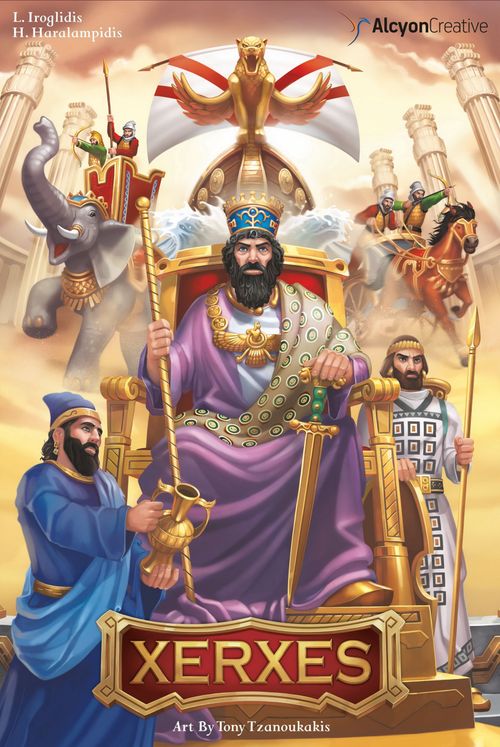
Xerxes
Xerxes Rulebook
Table of Contents
Table of Contents
- Game Contents
- Game Setup for 2 Players
- Playing the Game
- Player Actions
- Player Mats Overview
- Taxation Cards Overview
- Campaign Cards Overview
- Buildings Overview
- Annual Event Cards Overview
- Special Abilities
- Turn Track
- Resource Phase: Gathering Resources and Resolving a Campaign Card
- Build Phase: Constructing Buildings
- Taxation Phase: Resolving a Tax Card
- Winning the Game
- Tie Breakers
- Example of Play
- Solo Mode
Game Contents
- 1 Gameboard (55x36 cm)
- 8 Event cards
- 16 Campaign cards
- 24 Taxation cards
- 4 Player mats
- 4 Satrap pawns
- 8 Worker pawns
- 4 Turn tokens
- 12 Building indicator tokens
- 1 Timeline token
- 24 Resource tokens
- 4 VP tokens
- 4 Special ability tokens
Game Setup for 2 Players
Game Setup
- Shuffle the Annual Event cards and place them face down on their designated space, on the right of the board.
- Each player selects a Satrap and takes their player mat. The player mats indicate the satrapy's name, special ability, and a means of tracking the resources they have gathered.
- Shuffle the Tax cards and deal 6 to each player, keeping 5 and discarding 1. If a player is dealt 5 cards with the same type of reward, shuffle them all together and deal again.
- Shuffle the Campaign cards and deal 4 to each player, keeping 3 and discarding 1.
- Each player receives 6 resource tokens, 1 Satrap pawn, 2 worker pawns, 3 building indicator tokens, 1 turn token, and 1 VP token in their color.
- Each player places the resource tokens on their player mat at 0 resources, their VP token at 0 space and their Satrap pawn at their corresponding area on the board. The Satrap pawns remain on the board for the entire game.
- The youngest player decides the turn order and the players places their turn tokens on the corresponding place on the turn track (at the top right of the board).
- Place the Timeline token on the timeline track on space 1.
Playing the Game
During their turn, each player places their remaining 2 pawn tokens on any area on the map to gain resources, access Military Units or change the turn sequence. They are also able to resolve Campaign cards, Taxation cards or construct Buildings. Lastly, they may use their special ability. All available actions are explained in the section "Player Actions" found below.
Player Actions
Each player controls a governing Satrap pawn, plus 2 pawn tokens to use. Every turn, they may place their pawn tokens on a free area (satrapy) on the map (excluding governing Areas) or the turn changing space to:
- Gather the corresponding resources and add them to their player mat
- Instantly gain access to the Military Units
- Change the player turn sequence.
The players use their pawns according to the turn track and after all have placed their 1st pawns, they continue to the 2nd ones with the same sequence.
If an Annual event applies, the resources or Military Units are adjusted accordingly. (see annual event cards overview below)
If a turn track + or – applies, the resources or Military Units are adjusted accordingly. (see resource phase: gathering resources)
A simple guide of the available actions is as follows:
- Move the Timeline token to the next round
- Resource phase
- Reveal next Annual event
- Campaign phase
- Build phase
- Taxation phase
- Turn change (if a player used the turn changing space)
- End of round
Player Mats Overview
Every player has a mat with the corresponding area of influence (satrapy), a unique special ability, and on the right 6 columns for the game resources. These are in order: gold, iron, stone, wood, wheat and wool. Those resources are the key to fulfill the King's demands, as well as build the available buildings. One can have up to 3 from each resource, counting from top to bottom. Every other resource after 3 accumulated is lost.
Taxation Cards Overview
There are 24 taxation cards in the game (blue back with pouch) featuring various combinations of resources Xerxes demands from the players.
Taxation cards with 4 resources needed have a reward of 1 Military Unit (see campaign cards overview below). Taxation cards with 5 resources needed have a reward of 3VP.
Note: These cards are hidden from other players.
Campaign Cards Overview
The 16 Campaign cards (red back with crossed swords) are expeditions tasked by Xerxes to expand Persian domination. Every such card requires 4 Military Units to be resolved. The 6 Military Units are: elephants, horses, mercenaries, chariots, ships and weapons. The reward for a Campaign card is +5VP for the player, -1VP for a player of their choice.
Note: These cards are hidden from other players.
Buildings Overview
At the bottom of the map, lie 6 buildings for Xerxes' Empire. They need more resources than Taxation cards, but they favor the builder player while sometimes prove the other players weren't worthy of Xerxes' favor. Every building requires 6 resources for it to be built and the reward is noted below the empty space for the flags:
- Grain Silo: Gain 7VP if built in the 1st round, else -1VP per added round. For example, at 5th round: 7-4=3VP
- Road: Gain 4VP, subtract 2VP in total from other player(s)
- Bridge: Gain 4VP, subtract 2VP in total from other player(s)
- Temple: Gain 3VP, subtract 3VP in total from other player(s)
- Palace: Gain 3VP, subtract 3VP in total from other player(s)
- Fortifications: Gain 1VP if built in the 1st round, else +1VP per added round. For example, at 5th round: 1+4=5VP
Annual Event Cards Overview
In the 7 years of Xerxes' influence, certain events may hinder or boost the players' plans. For every round in the Timeline track, a random annual event is drawn after all players have placed all their pawns. Those events count for a single round and are valid for every part of the map, including the areas of influence. There are 8 events in the game:
- Wolves. This year no wool is produced.
- Fire. The wood production stops.
- Bad weather. Stone quarries are not accessible.
- Plunder. The amounts of gold are shortened.
- Locusts. Wheat production stops.
- Flood. Iron mines are inaccessible.
- King's heir. Every player is rewarded with any+3 resources (same resources too).
- Gods' Blessings. Every player is rewarded with +1 Military Unit of their choice.
Special Abilities
There are 4 Satraps in XERXES: Satrap of Babylonia, Satrap of Lydia, Satrap of India and Satrap of Aegyptus. Each Satrap has a unique special ability that enables them to meddle with others or help them have the upper hand. Every special ability is used during that player's turn only once per game. When a player uses their Special Ability, they discard the special ability token.
Satrap of Aegyptus: he changes a Military Unit currently owned, for another.
Example: Satrap of Aegyptus has access to 1 horse, 1 chariot and 1 elephant from his Satrapy pawn and the 2 workers, but also 1 permanent mercenary from a Taxation card. Using his ability, he changes the mercenary for 1 weapon, allowing him to resolve a Campaign card.
Satrap of Babylonia: he negates the Annual event for that round.
Example: The Annual event drawn is Locusts: No grain this year. Fortunately, the Satrap can use his ability to find some amounts in Thracia and Babylonia, adding them to his player mat anyway. Other Satraps are jealous.
Satrap of India: he steals 1 resource from an opponent and adds it to his player mat. (wood for wood, stone for stone etc.)
Example: Satrap of India is desperate for 1 unit of wood to use in a Building. Luckily a fellow Satrap had many units; he decides to lighten a fellow Satrap's warehouse from 1 unit of wood and add it to his own, spending the once in a game ability of his.
Satrap of Lydia: he reduces 2 resources currently owned and increases others by 2. (it applies to negated resources via Annual event too)
Example: Satrap of Lydia Tax duties are demanding 2 units of Wool, but all areas that provide it are occupied. His ability enables him to find "other ways" to make up for it, for an equivalent trade. 1 unit of Stone and 1 unit of Wood will do.
Turn Track
The turn track, apart from player sequence, defines what bonus or malus each player may have. The higher the turn order, the worse the consequence and vice versa. From first to last, the track gives:
- 1st: -1 resource gathered that round, at the end of Resource phase.
- 2nd: -1 Military Unit accessed that round, during Campaign phase.
- 3rd: +1 Military Unit accessed that round, during Campaign phase.
- 4th: +1 resource gathered that round, at the end of Resource phase (does not apply to Annual event negated resources).
Whoever wants to change the turn sequence simply places their pawn on the turn changing space and changes the player order for all players, after the round is finished. This setup is valid when the next round starts.
Example: Satrap of Aegyptus (red) wants to launch a campaign, but his position on the turn track makes him lose a Military Unit. So, he sacrifices a worker and instead of going to a map area, he decides at the 2nd round to go ask Xerxes change in turns. Next round he will have an extra Military Unit to use, while the other Satraps have to play in a different order too.
Resource Phase: Gathering Resources and Resolving a Campaign Card
The 6 resources are important to both Taxation cards and Buildings. They are gathered at the beginning of each round after the Annual event card is drawn. A player may either gather resources or access Military Units to launch a campaign by placing a pawn on a specific area, but not both. If a Military Unit is not used during a campaign, the player then gathers the resources instead.
If a player meets a Campaign card's criteria, they may resolve it to gain its reward.
Please note that Military Units that were accessed at that turn are lost when round changes, whereas the Military Units gained from Taxation cards are valid until the end of the game and are not consumed like regular resources.
To resolve a Campaign card, one must have all the Military Units needed and use them during the Resource phase. The pawns used for Campaign phase are removed from the map, except from the Satrapy pawn which is placed lied down. They then gain the corresponding reward and move the VP cups accordingly. Two Campaigns may be resolved at the same round, provided that each Military Unit is used only once (8 Military Units in total). Anyone may resolve both Tax and Campaign cards at the same round, provided they meet all criteria.
Resource example: Satrap of India goes for the resources. He places his workers on Assyria and Parthia. He plays first, so has to lose 1 resource. The Annual event drawn: Locusts, no grain. In total he adds to his mat 2 Gold, 2 Iron, 1 Wood (the 2nd goes to waste, warehouse is full) and 2 Wool and can't get any Grain. Also, he has to lose 1 resource due to his position on the turn track; he chooses 1 Stone. The 2 workers are then taken from the map.
Campaign example: Our Satrap wants to launch a campaign that needs 2 chariots, 1 mercenary and 1 elephant. From his chosen areas and area of influence he only lacks 1 chariot, but is lucky enough to have a permanent one from a Taxation reward. He can finally go on that expedition, but nevertheless loses 1 resource from the turn track.
Build Phase: Constructing Buildings
To construct a Building, one must have all the resources needed and spend them during the Building phase. They then gain the corresponding reward and place their building indicator token on the empty space next to it, which remains there till the end of the game.
A player may build up to 3 buildings in the entire game, from the available remaining. If a player wishes to build twice in the same round, they have to wait for their 2nd one after all other players pass the build phase.
Build example: It is time to please his highness Xerxes! Constructing a building would do, so spending 3 Grain, 2 Wood and 1 Stone for a Road is not much. It gives him 4VP and allows him to deduct 2VP from Satrap of Lydia (or 1VP from Satrap of Lydia and 1VP from Satrap of Babylonia on a 3 player game).
Taxation Phase: Resolving a Tax Card
If a player meets the Taxation card's criteria, they may subtract the necessary resources from their player mat and resolve it to gain its reward: Victory Points (VP) or Military Units. The Taxation resolve happens after all players have placed their pawns and all annual/turn events have taken place, according to the turn track.
To resolve a Taxation card, one must have all the resources needed and spend them during the Taxation phase. They then gain the corresponding reward and move their VP cup accordingly. There are no restrictions as to how many Taxation cards a player may resolve each round.
Taxation example: Oh, tax duties... This time they ask for 2 Iron, 2 Stone and 1 Gold, removing them from his mat he barely made it in time! His "offer" is rewarded with 3VP.
Winning the Game
The player, who reaches 25 VP first after all players played their turn, wins. Alternatively, after the 7th year of Xerxes' reign, the game is ended and the player with the most VP wins.
Tie Breakers
In case of a tie, players check the tiebreaker conditions found below, in the following order:
- a. Most Campaign cards.
- b. Most Buildings.
- c. Most Taxation cards.
- d. Most resources left.
- e. Unused Special ability.
Example of Play
It is Satrap of Aegyptus turn, Resource phase, on Year 5. The player has gathered sufficient resources to build the 6th building (Wall) but also wants to launch a campaign, so his first move was to place a worker pawn in Thracia and his last move is a worker pawn on Bactria. Then, the Annual event is revealed: +1 Military Unit. The player has access to 1 elephant (Bactria), 1 chariot (his base in Aegyptus), 1 mercenary (Thracia) and a permanent ship from Taxation card. At his turn during Campaign Phase, he declares to complete his 3rd Campaign card that requires 1 chariot, 1 horse, 1 mercenary and 1 ship. Between using his special ability (to change the elephant into a horse) or make use of Xerxes' gift of +1 Military Unit (Annual event), he chooses the latter; thus letting him also gather Bactria's resources (Wheat, Wool and Wood). He gains 5VP and subtracts 1 from the Satrap of India (green). All that is left is the +1 resource from playing 4th in turn track. He gains +1 gold.
Then comes the Build Phase. The player has gathered enough resources to build the Wall so he spends 3 Stones, 2 Wheat and 1 Wood unit to gain 5 VP (as the 5th Year indicates). He can't resolve a Taxation card during Taxation phase, because he has not enough resources.
Editor's note: the example calls the 6th building "Wall", but the Buildings Overview above names the six buildings Grain Silo, Road, Bridge, Temple, Palace and Fortifications. The example is transcribed as printed.
Solo Mode
The Solo mode of the game has a similar setup to the 2-4 player game, but only the remaining player tokens for the map are used (the AI of the game). The 6 Solo tiles come into play. They are drawn randomly at the beginning of each round and set before the player takes action, so they then have 2 consecutive actions to perform. On each Solo tile there are 3 pieces of information: the turn track position of the AI player, some Areas that are occupied by the AI player, and 1 building that they are not allowed to build that round.
The 6 tiles are (each tile lists its areas, a top marker and a crossed-out building artwork):
- Top marker: taxation pouch with -1. Areas: Hyrcania, Assyria, Thracia.
- Top marker: taxation pouch with +1. Areas: Phoenicia, Sogdia, Assyria, Thracia, Persia.
- Top marker: taxation pouch with +1. Areas: Persia, Hyrcania, Parthia, Bactria, Assyria, Phoenicia.
- Top marker: taxation pouch with -1. Areas: Parthia, Sogdia, Persia, Phoenicia.
- Top marker: crossed swords with -1. Areas: Sogdia, Assyria, Bactria, Thracia.
- Top marker: crossed swords with +1. Areas: Hyrcania, Phoenicia, Bactria, Parthia, Persia.
Note: the tile names are transcribed as printed ("YRCANIA" on the printed tile is read as Hyrcania). The top markers are described from the printed icons; the crossed-out building artwork on each tile corresponds to the building the AI may not build that round.
The Campaigns feature 3 scenarios: Easy, Normal and Hard mode. If by the end of the 7th round the conditions are met, the player wins the scenario. When all scenarios have been completed, the Campaign is considered fulfilled. The differences in Solo Campaigns from the 2-4 player mode is that particular Areas are inaccessible (using other players' tokens), the VP track is not used and the player sets their position on the turn track according to Solo tiles.
- Easy: Resolve 4 Tax cards, 2 Campaign cards, and 2 Buildings.
- Normal: Resolve 4 Tax cards, 3 Campaign cards, and 2 Buildings.
- Hard: Resolve 4 Tax cards, 3 Campaign cards, and 3 Buildings.
A simple guide of the available actions in Solo mode is as follows:
- Move the Timeline token to the next round
- Draw Solo tile and resolve it
- Resource phase
- Reveal next Annual Event
- Campaign phase
- Build phase
- Taxation phase
- End of round
When the Solo tiles are depleted in round 6, reshuffle all of them and randomly draw the 7th.