Xanadu: Promo Card – Colección de Arte de Palacio / Palace Art Collection
Xanadu: Promo Card – Colección de Arte de Palacio / Palace Art Collection Rulebook
Table of Contents
Table of Contents
Card
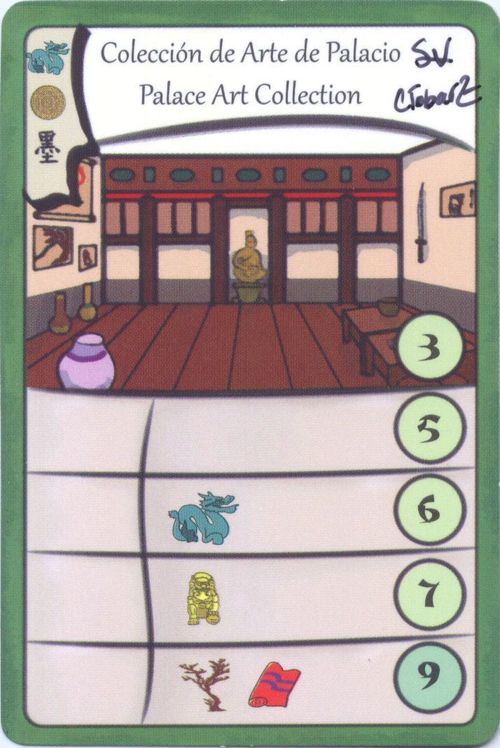
Name: Colección de Arte de Palacio / Palace Art Collection (printed on the banner at the top of the card, Spanish line first).
Colour: green. The card has a green border and frame, the colour the base rulebook describes as the palace cards, with a Jade base cost.
Back: the standard Xanadú card back (a worker with a pickaxe, a stained-glass frame, and the Xanadú name with its sun-and-crescent mark). The back carries no rules text.
Front, printed content:
- Cost: three icons in the top-left banner: a teal dragon-shaped icon (read as Jade), a round gold coin (read as Bronze), and the Chinese character 墨 (read as Ink). The printed cost is therefore 1 Jade, 1 Ink, 1 Bronze.
- Passive resource: no separate passive-resource icon is printed on the card.
- Favors of the Khan: the left-hand sector, the column to the left of the resource squares, is blank. The card prints no Khan favors.
- Illustration: a palace hall interior. The selling price 3 sits over the illustration.
- Selling prices and resource squares: five price levels, printed top to bottom as follows.
| Level (top to bottom) | Selling price | Resource square |
|---|---|---|
| 1 (over the illustration) | 3 | none (illustration) |
| 2 | 5 | blank, no resource icon |
| 3 | 6 | teal dragon icon (read as Jade) |
| 4 | 7 | gold figure, a seated guardian statue (the colour suggests Gold or Bronze; read as printed) |
| 5 (bottom) | 9 | bonsai tree and a rolled scroll with a blue and red wave pattern (read as Wood and Silk) |
- Rule text: none. The only words on the front are the title.
Icon reading caveat: the base rulebook does not include an icon key. The resource names above are read from the icon images and the colour of each icon, not from printed text. The Jade and Ink readings agree with the printed cost, and the base rulebook names Jade as the green cost.
How the card plugs into the base rules
This card has no rules of its own. It is played under the base Xanadú rules, as described below. Only what the base rulebook says is quoted or paraphrased.
Building it (base section "2. Assign Workers and Build a Card"). A player builds this card by collecting the whole cost, 1 Jade, 1 Ink and 1 Bronze, from passive resources, Khan favors and resources gathered by worker placement, in a single turn. Once built, the card is placed horizontally in the player's play area, and no workers can be placed on it. The base rulebook sets a limit of 5 built cards on the table at any time.
Selling price (base "Game Cards", element 3, and section "1. Selling Cards to the Khan"). The Khan pays the first uncovered selling price from bottom to top. On this card that starts at 9, the bottom level. Covering a level with a worker moves the price to the next level up. The base rulebook also says the price "can be raised (upgrade, color green), lowered (sabotage, color red) or remain the same (trade, color yellow)". The card is green, but the printed order puts 9 at the bottom, so covering moves the price down. The base rulebook's wording on which direction green moves the price does not match this, and the base rulebook also refers to a red colour that it does not list among its colours. Neither point can be settled from the card or the base rulebook alone, so the direction of upgrades on this card is left as printed and flagged for review.
Upgrading, sabotaging and trading (base section "3. Upgrade, sabotage, or trade"). Workers may be placed on this card, or on any other card, to change its score or cover its resource squares. The base rulebook does not separate upgrading from sabotaging on a per-card basis beyond the colour wording above.
Forced selling (base section "2", "Forced selling"). When a card has no available squares left, it must be sold at the end of the active player's turn for "the selling price shown over the card's illustration". On this card that is the 3 printed above the illustration. The owner does not get the selling benefits when drawing cards in that case.
Selling and scoring. A built card's score is its current selling price, taken in tong baos when it is sold to the Khan (base section "1. Selling Cards to the Khan"). At the end of the game, every player sells all built cards and counts tong baos (base section "End of Deck and End of Game"). The player with the most tong baos wins.
Variant for 5 or 6 players. The base rulebook gives a bonus for selling green cards in that variant: "Each time a player sells a green card, he take two extra tong baos." This bonus applies only in that variant and applies to this card only because it is green.
Deck placement. Neither the base rulebook nor the card states how a promo card is added to the deck. That is not stated here and is left to the table.