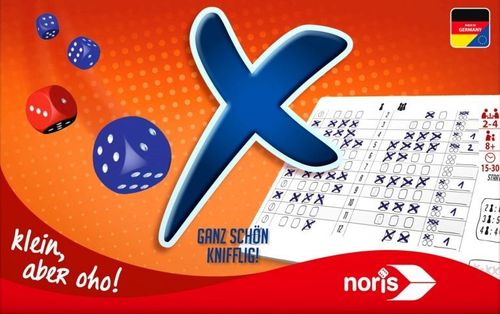
X: Ganz schön knifflig!
X: Ganz schön knifflig! Rulebook
Table of Contents
Table of Contents
Game Materials
- Dice memo pad
- 4 dice
- 1 game instructions
In addition, a pen is needed for each player.
Goal
The dice are rolled and each player is allowed to tick boxes on their playing field. But only fully complete rows can score points. And even a glance at the other player's playing fields can be helpful in making some decisions…
Game Preparation
Each player gets a game sheet from the dice pad and places it in front of them. Next, each player takes a pen (not included). The dice are laid out and ready to go.
If there are four players, each player must tick the two boxes with a "4" in them before the game. If there are two players, both players must tick the nine boxes with a "2" in them.
The youngest player ticks the field for the starting player on his or her game sheet.
And now the fun begins!
The Game Sheet
The game sheet is divided into two halves.
You are only allowed to tick the boxes on the left side of the sheet if you are rolling the dice yourself. Whenever you have filled in all of the boxes in a row on the left half, cross the [!] symbol to the left of it and receive two points at the end of the game.
You are only allowed to tick the boxes on the right side of the sheet if another player is rolling the dice. For every row that you have ticked completely in the right half, you will get one point for each player who has ticked the [!] symbol of this row. So always have a look at what your competition is up to…
How to Play
The youngest player starts. Whoever's turn it is performs the following three phases in the order given. Once you have played a few rounds, you can also do the first two phases simultaneously:
- The active player rolls the dice and is allowed to record two pairs of dice
- The other players are only allowed to record one pair of dice
- If possible, the active player can score a row
After completing these steps, the next player going clockwise has a turn.
1. The active player rolls the dice and is allowed to record two pairs of dice
The player rolls the four dice and then splits them into two pairs. For each of these two pairs, the player sums up the number of pips and is allowed to tick one box in a suitable row on the left half of their game sheet.
Thereby the following applies:
- The colours of the dice are irrelevant to the player whose turn it is.
- If the player cannot record one of the two ticks (because all boxes in this row have already been ticked), the second tick is lost. In rare cases, the player cannot even make a single tick during the turn, then both ticks are lost.
- If the active player ticks the last box of a row on the left half of the game sheet, they must score it in the third phase (see below)
- The player may also choose to let one or both sums lapse, making no tick for them. Sometimes this is necessary when all boxes in a row have already been ticked. [This bullet appears in the German text only; the English printing omits it. It is included here from the German original.]
Example: It's Jana's turn: she rolls 2, 4, 5, 5. She divides the dice into 2+5 and 4+5 and then makes a tick on the left half of her game sheet at 7 and one at 9.
2. The other players are only allowed to record one pair of dice
Now all other players can choose in turn two of the three blue dice. From these two dice, the pips are summed up and a box is ticked in the appropriate row on the right half of the game sheet.
Thereby the following applies:
- The red dice must not be used to form a pair. Only two of the three blue dice may be used!
- Several players can choose the same die or combination of dice. There is no "taking dice away"!
- If the player cannot record a tick (because all boxes a row have already been ticked), then the tick is lost.
Example: The blue dice show a 2, 4 and 5. All other players are allowed to tick either a 6, 7 or 9 on the right half of their game sheets. The 5 on the red dice may not be used, meaning the other players cannot tick a 10! Andrea decides to tick a 7. Markus prefers to tick a 9. Steffi also decides to tick a 7.
3. If possible, the active player can score a row
If the active player has checked the last box in one or two rows on the left half of their game sheet during the first phase, it will result in a quick scoring.
The player ticks the [!] symbol to the left of the row and loudly proclaims that they have completed this row.
Then, all players (including the active player!) must tick one of the four small circles of this row on the right half of their game sheet.
Then it's the next player's turn going clockwise. He or she rolls all four dice and goes through the three phases.
Note: After a few rounds, all players can play and make ticks at the same time. If the order is important, always start with the active player. Then, all players make their ticks one after the other going in a clockwise rotation.
End of the Game
Before the starting player makes his move, everyone checks to see if one of the players has already ticked enough [!] symbols. With 4 players it is 4, with 3 players it is 5 and with 2 players it is 6. If enough have been ticked, the game ends immediately, otherwise another round is played.
When the game is over, the points are counted. Points can be obtained in two ways:
- For each ticked [!], the player receives 2 points. These points are recorded in the [X] field in the bottom left.
- For every completely filled row on the right side, the player gets 1 point for each small circle ticked to the right of it. You also get a point for each player who ticked the [!] in the corresponding number. The sum of these points is recorded in the [XX] field.
Then the sum of [X] + [XX] is determined and the player with the most points wins the game! In case of a tie, the player with the higher [XX] score wins. If there is still a tie, multiple players win.
Example: Jana gets 2 points for every ticked [!], so a total of 10 points. On the right side of her game sheet, she only gets points for completely ticked rows: for the 2 she gets 1 point; for the 4, the 6 and the 10 – 2 points each; and for the 8 she gets no points (nobody had the corresponding [!] ticked). For the right side of her game sheet, she gets 7 points for a total of 17 points.
Symbol key: [!] is the symbol printed to the left of each row on the sheet, used to mark a completed row. [X] and [XX] are the two scoring fields printed at the bottom left and bottom right of the sheet.