Wykersham
Wykersham Rulebook
Table of Contents
Table of Contents
Win Condition
The object is to earn more points than your opponent by "striking off" your stones from the play area. Striking off may be done when you slide a rail to vertically or diagonally align five cups containing your pieces of your colour. Each stone struck off is worth 1 point.
Set Up
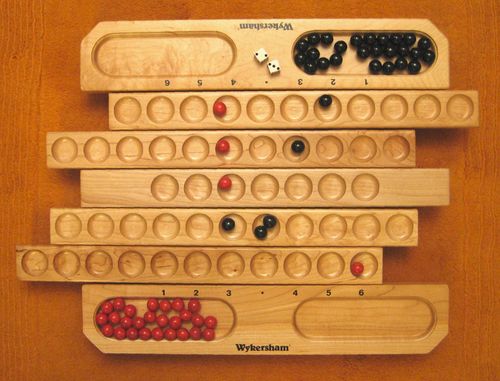
The board is placed so the sliding rails slide sideways. All the rails are flush with the non-moving edges of the board.
The cups in each separate rail are aligned in rows. Columns run "vertically" between the players. The central row, which does not slide, is called the "cross bar". The central column, marked with a square, is the "doubles column". Some columns are numbered. Players refer to the numbers on their side of the board when determining which columns into which to place their stones.
One player plays red, the other black. Exactly 30 stones of the player's colour are placed in his left board pocket. The right pocket will be empty at the start and is used for storing the struck off stones.
Game Play
Either player may start according to the pleasure of their choosing. After this, play will alternate.
Dice Rolling
The player rolls both dice. He will then place two of his stones in the cups according to these rolls. Every turn, a player places exactly two stones. There is no option to skip a turn or play only one stone.
The player must play stones in the cups in the columns that correspond to the results of his dice roll. E.g., if the player rolls a 2 and a 3, he must place one stone in the "2" column and one in the "3" column. The player has free choice of which of the five rows into which to place a stone (subject to their being available cups).
If a player rolls double he chooses one of the following two options:
- Play both stones in the doubles column. Both these stones may be played to the same cup, or they may be played to separate cups.
- Play one stone to the doubles column and one to the column that corresponds to the values shown on the dice. E.g., if a player rolls double 3, he may play one stone to the doubles column and one to the "3" column.
Example: Red rolls double "2" and chooses to put one stone in the "2" column and one in the "doubles" column. Black rolls double "4" and chooses to put both stones in the doubles column and further decides to put both in the same cup. Red putting both in the "2" column or black putting both in the "4" column were not options.
Which Cups May Be Played Into
Empty cups may be played into freely (subject to the dice roll of course).
A cup may hold at most five stones.
Each cup may hold pieces of only one colour, except for cups in the cross bar which are considered neutral and may hold stones of either colour.
If a player slides a rail, that rail is considered "dead" for the rest of that player's turn. No stones may be played into a dead rail. As it does not slide, the cross bar is never dead.
Players can play both stones into the same rail (in which case the rail can slide only after the second stone as the rail would otherwise be dead).
Example: Red rolled 3 and 4. He played a single stone to his nearest rail "3" column and slid it to the left so it is now in the "2" column. His other stone must be played into the white box. His only eligible plays are to the cups indicated by the white rings. He cannot play on the nearest rail because he slid that rail and it is now dead. He cannot play to the next rail because it already has five stones in it. He cannot play to the farthest rail because it contains a black stone. He can play to the cross bar; even though it contains a black stone the cross bar is neutral. The other circled cup is empty.
Rail Sliding
Immediately after each stone is played (e.g., after placing the first stone but before placing the second stone), a player may choose to slide the rail (except for the cross bar which cannot slide) upon which he has just placed a stone. There is no obligation to slide after any move (although at some point a player who wishes to win must slide as players can only score immediately following a slide).
The rail is slid exactly one space to the left or right, e.g., if a player has just placed a stone into the "2" column, after sliding that rail the stone just placed will finish in the "1" or the "3" column. Once a player has started to slide a rail in a certain direction, he must finish the slide in that direction (i.e., he may not test a slide and then change his mind). Rails may only slide at most two spaces away from their median position. A rail currently at this limit may only slide towards the middle; a rail not at this limit may slide either direction. This means each of the seven main columns will always have five cups.
If after sliding a scoring position is formed, a player may choose, but does not have to, strike off stones. A player may strike off after the first stone, the second stone, or both, or neither.
Example: Red rolls 3 and 4. Red plays his first stone to the 2nd rail on in the "3" column and slides it to his right. It ends up in the "doubles" column. This rail is now dead, no more stones to be played here until the next player's turn. His other stone goes to the cross bar column "4".
Scoring and Striking Off
If upon sliding a player makes a diagonal or vertical (but not horizontal) line of five cups which all contain stones of his colour he has created a scoring position. A player chooses either to strike off stones immediately or to leave them in the cups (in which case play continues). If the player chooses not to strike off now he will not be able to strike off those stones until he later performs another slide which creates a scoring position.
A player strikes off by removing some or all his stones from the cups that form the line and placing them in his scoring pocket. A player may strike off as many or as few of his stones from a scoring line as he pleases so long as he takes at least one stone from each cup in the line.
It is possible that a slide may form more than one scoring line at a time. A player may score any or all of these lines as he pleases in any order, though a player must finish striking off all stones from one scoring line before striking off stones from a subsequent scoring line.
As a player strikes off stones from one line he may completely empty cups of his stones and so reduce another line to fewer than five cups. Such a reduced line is no longer eligible to be scored (until restored to five cups).
A player never removes stones belonging to the other player.
Scoring can only be initiated by sliding. Placing a stone into a cup, even if it creates a vertical or diagonal line, does not create a scoring position.
Example: Black has just played and has slid the rail closest to him to make two lines of cups containing black stones. He could score the yellow box line by striking off the five black stones to score 5 points. He could strike off the black stones in the blue box line. He could strike off just five (leaving one stone in the cup where he has two black stones) or all six black stones to score 5 or 6 points. He cannot strike off both the blue and yellow lines because where they cross (white circle) there is only a single black stone. Striking this stone off for one line will break the other line. (If he had two black stones in that central cup, he could strike off both lines, taking one each time.)
Though there are five red cups in a line (grey box), Red cannot strike off these at the start of his turn as striking off can only be done immediately following sliding and Red will not have just slid at the start of his turn.
Nota bene: Three of the rails are now at their slide limit.
End of Game
After each player has taken 15 turns (i.e., played all 30 of their stones) the game is over and the highest scoring player is the winner. There is no tie breaker.
Appendix I – No Legal Move
It is possible, though very unlikely, that a position such as shown could arise where, should Red roll a "1", "2" or "3" (and no doubles) a placement cannot be made (due to all cups in columns "1 – 3" having five stones or black stones outside the cross bar). Any roll containing only "4", "5" or "6" would allow legal moves as would any doubles roll (and doubles would allow Red to score). It is suggested that were a similar situation to arise that a player be compelled to reroll both dice as a pair until two legal moves can be made. This results in a 50% chance of Red winning (there are nine results out of thirty-six when rolling two dice which consist of only 4 or higher, three of which are doubles, and there are the three doubles of less than 4. All twenty-four other results contain a lone 1, 2 or 3 which is unplayable here. Any double, of which there are six out of twelve, will allow playing to the last rail and a win for Red) but this should not be a consideration as this arrangement is vanishingly unlikely and I shouldn't have wasted my time considering it — why are you still reading?
Appendix II – Worst Case
In a worst case scenario, the below could result. Although it will make no difference to the score (which will be zero all) it is suggested that both stones be played to the cross bar doubles column as a trivial ending to the game.