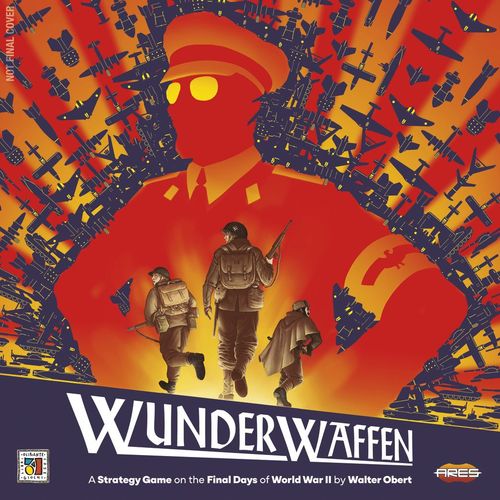
WunderWaffen
WunderWaffen Rulebook
Table of Contents
Table of Contents
- Components
- How to Play
- Initial Setup
- Game Round
- Territories
- Event Tracks
- Shared Territories
- Morale Track
- Politics Track
- Conference Area
- German Research Track
- Research Cards
- End of First Part
- Second Part Setup
- Berlin
- End of the Game
- Final Scoring
- Two-Player Variant
- Historical Setup
- Example of Play
- Allies Strategy
- Germany Strategy
Components
- 1 Rulebook
- 4 Summary sheets
- 1 Game board
- 24 Territory tiles
- 40 Territory control cubes (10 for each player)
- 4 Faction boards: Germany (Germany player), Soviet Union (USSR player), United States (USA player), United Kingdom (UK player)
- 72 double-sided Faction counters: 18 Germany, 18 Soviet Union (USSR), 18 United States (USA), 18 United Kingdom (UK)
- 16 markers: 4 Victory Point (VP) markers, 4 Politics markers, 4 Morale markers, 3 Event markers, 1 Research marker
- 24 Research cards: 8 cards with value 1, 8 cards with value 2, 8 cards with value 3
How to Play
Faction Counters
The four forces in play are called factions; the USA, UK, and USSR players are called the Allies, and are the enemies of the Germany player. Each faction uses 18 counters to make their moves. Each turn, you choose and play three counters: two are used for yourself, and one is given to another player.
These counters have two sides:
- the front side, in the faction's color, with an icon that represents the action that you keep for yourself;
- the back side, in white, displaying an icon with another faction's color, representing an action and to whom it must be given (the only exceptions are the green Event and Morale icons, which can be given to any Allies faction). The back sides have a corner displaying the color of the original faction.
Counter examples:
- Germany Infantry (on the back, Allies Event)
- USSR Faction Flag (on the back, Germany Armor)
- USA Armor (on the back, Germany Faction Flag)
- UK Artillery (on the back, USSR Infantry)
Initial Setup
Players decide or randomly pick the faction they want to play. Then the first player is picked randomly.
- 4 players: each player plays as a faction.
- 2 players: Player A = United Kingdom and Soviet Union; Player B = United States and Germany.
Follow steps 1 to 9 to set up the game.
- Place the four Politics markers on the first square of the Politics track in a pile, in random order.
- Place the four Morale markers on the first square of the Morale track, in reverse order to that of the Politics track.
- Place the four Victory Point markers on the first square (0) of the Victory Point track.
- Shuffle the 24 Territory tiles and randomly place one face down in each Territory, except in Berlin and in the Allies' starting areas. The two remaining tiles will not be used in this game.
- Each player places their 18 Faction counters to the left of their Faction board. Each Allies player chooses three of theirs and, without looking at their backs, secretly places them on the three empty squares of their starting area.
- Each Allies player takes their Event marker and places it on their Faction board, on the first square of the Event track.
- The Germany player takes the Research marker and places it on their Faction board, on the first square of the Research track.
- The Germany player chooses three of their Faction counters and, without looking at their backs, places them on the appropriate squares on their Faction board.
- The Germany player separates the Research cards by value into three 8-card decks, shuffling and placing the decks face down. They then draw four value 1 cards, four value 2 cards, and four value 3 cards. They choose two value 1 cards or one value 2 card and keep the chosen card(s) in front of them, reading their content aloud and immediately applying their effects (if possible). Lastly, they draw cards to replace the chosen one(s) so that they have four visible cards of each value.
At this point, each player reveals their chosen Faction counters. Players should sit at the side of the game board corresponding to their faction, and the playing order follows a clockwise cycle that will be the same for the entire game.
Playing order cycle should always be Germany -> Soviet Union -> United States -> United Kingdom, regardless of who is the first player.
You can now start the game!
Game Round
On your turn, you will use the three counters placed on your starting area (the Germany player takes them from their board instead), then you will choose three new ones to replace them.
The first player takes their three actions, then the player to their left carries out theirs, and so on. When you all have taken your actions, the round is completed and starts again with the first player. Following this order, you take your turns until you run out of counters.
During your turn, you secretly look at the backs of the counters you have chosen earlier, consider their use, and then you:
- use a counter for yourself;
- use a second counter for yourself;
- give a counter, flipped to its back side, to another player, who uses it immediately.
You can take these three actions in any order, and you apply their effects immediately, before using the next counter. Counters that are discarded, or ones that are used but not placed on the map, are placed in your discard area, to the right of your Faction board, and will come back into play later.
Then, you choose three more counters among your available ones (without looking at their backs), place them on your starting area, and end your turn. Once you have chosen all three of your counters, you can look freely at their backs.
As long as it's possible, you must ALWAYS play three counters, but:
- if you have two counters, you must play one for yourself and give the other one to another player;
- if you have one counter, you must play it for yourself;
- if you have no counters, you skip your turn.
You can use counters in different ways. If you play them on the board, you can only place them in Territories (see Territories) bordering either your starting area or a Territory you already control. Alternatively, you can place them in the Conference area, or discard them to advance on the various tracks (Event, Morale, Politics, Research).
Some German Research cards may also instruct you to discard counters.
Note: In some rare occasions, it may happen that you cannot play any counters because there are no available spaces or possible actions. In this case, unusable counters are simply discarded; but if there is even just one valid use, you MUST use a counter.
Example: Counters played during one full game round (Germany player, USSR player, USA player, UK player each play their three counters in turn; illustrated in the rulebook).
Faction Counter Summary
Counters used on Territories have a strength rank. From the strongest to the weakest: Faction Flag -> Artillery -> Aviation -> Armor -> Infantry.
Note: All Allies counters can also eliminate and replace a German counter of the same type (for example, Allies Infantry counters can eliminate and replace German Infantry counters).
Infantry
- Occupies a free, blank Territory space.
Armor
- Eliminates an enemy Infantry counter in a Territory space, taking its place.
- (Allies) Can occupy a space in Berlin.
Aviation
- Eliminates an enemy Infantry or Armor counter in a Territory space, taking its place.
- (Allies) Discard to make the Germany player move back 1 square on the Research track.
Artillery
- Eliminates an enemy Infantry, Armor, or Aviation counter in a Territory space, taking its place.
Faction Flag
- A wildcard that can be used as if it were any other counter of its faction.
- In a Territory space, it eliminates any other enemy counter.
- (Allies) Can occupy a space in Berlin.
Morale
- Discard to gain 1 Morale.
Politics (Allies only)
- Discard to gain 1 Politics.
- Can be placed in the Conference area.
- Can occupy a space in Berlin.
- Can be placed in Territories occupied by another Allies player to share it.
Event (Allies only)
- Discard to advance 1 square on the Event track, ignoring the requirements of that square.
Double Morale (Germany only)
- Discard to gain 2 Morale.
German Research
- Discard to advance 1 square on the Research track.
Double German Research
- Discard to advance 2 squares on the Research track.
Territories
The portion of Europe depicted on the map has been divided into 23 areas called Territories. All Territories, except Berlin, have three spaces that must be entirely occupied by counters to be conquered.
Territories have:
- a control space, to indicate who controls it;
- an area reserved for the Territory tile;
- one or two city indicators;
- three spaces that can be occupied by counters.
At the beginning of the game, the Germany player controls all Territories. At all times, a Territory displaying the German flag in the control space is controlled by the Germany player.
Allies players can place counters in Territory spaces only if that Territory borders either their starting area or another Territory they control. On the other hand, the Germany player can place a counter into any free Territory space (as they control all Territories at the start of the game). A Territory space can be blank, display a counter icon, or be occupied already. You can place any kind of counter on a free blank space.
The playable counters are, from strongest to weakest: Faction Flag -> Artillery -> Aviation -> Armor -> Infantry.
If the space displays an icon, only a counter of the indicated rank or stronger may be placed there. For example, if the displayed icon is an Armor, you must play an Armor counter or a stronger one (e.g. Aviation, Artillery, etc.). Once occupied by counters, the counter icons displayed on the spaces are ignored.
Example: The USSR player wants to conquer the Warsaw Territory, already occupied by two German Armor counters. They place an Aviation counter and eliminate the German Armor on the left; then they place a Faction Flag in the free space in the middle, which calls for an Artillery counter (or stronger), thus occupying all three Territory spaces. The USSR player now has majority, and controls the Warsaw Territory. If the USSR player had played the Faction Flag counter first, the Territory would have been immediately closed off and conquered by the Germany player, the winner by majority.
Conquering Spaces
If a space is not free, but occupied by an enemy counter, it can be attacked (see Comparing Counter Strength). The played counter will replace the eliminated one, which will be placed in its owner's discard area.
Comparing Counter Strength
Counters used on Territory spaces have different strengths, as summarized in the Faction Counter Summary.
Allies counters eliminate German counters when they are equal or stronger, while German counters must be stronger to eliminate Allies counters.
Conquering Territories
When all three spaces of a Territory are occupied, players immediately establish who controls it. This can also happen following an out-of-turn move by a player who has received a counter from another player.
- When all three counters belong to the same faction, the Territory is controlled by that faction.
- When the counters belong to different factions, the Territory is controlled by the faction with the majority of counters, regardless of their strength. If two counters belong to two different Allies and one to the Germany player, the faction with the stronger Allies counter controls the Territory.
- If the Allies counters are equal, the Allies player with the higher Politics score at the time controls the Territory. If the Allies' Politics markers are in the same square, the player with the counter placed on top (see Note on the Morale and Politics Tracks) controls the Territory.
Then, players move all their counters in the Territory to their discard areas, except for the winner, who will use one of their counters to cover the control space. You can also use the back of an opponent's counter, if it shows the winning player's faction color. Then, place a Territory control cube of the faction's color over the counter. By doing so, Allies players show they have conquered the Territory and now control it, while the Germany player strengthens its defenses (see Fortresses (Festungen)).
Example: The USSR player has conquered the Warsaw Territory. They move their Aviation counter onto the control space and the Faction Flag counter into their discard area. The Germany player also places their remaining Armor counter in their discard area. The USSR player gains the Territory tile's bonus plus the Victory Points indicated by their marker's position on the Morale track. The Warsaw Territory now belongs to the USSR player for the remainder of the game and cannot be conquered by any other player.
Conferring With Other Players
WunderWaffen is a game based on territory conquest and confrontation between the forces in field, but it also has a "diplomatic" potential that players should not underestimate. Allies players, in particular, should plan their moves together to optimize the conquest of Territories. For example, a single USSR counter left on a Territory may be useful to the Germany player, who could conquer it with two counters, but at the same time, it could allow the bordering USA player to occupy it in the following turn. Giving counters to other players is the core of this mutual exchange/help dynamics. For example, an Allies could give an Event counter to another Allies, on the condition that they also benefit from it. The Germany player should also try to be an active part of this dynamic.
Territory Points
Note: Once conquered by an Allies player, a Territory cannot be conquered again by any other player. This is not true for Territories conquered by the Germany player (see Fortresses (Festungen)).
When a player conquers a Territory for the first time, they take the Territory tile and place it in front of them. They immediately apply any VPs and bonuses obtained from the tile, in the order they prefer. Finally, they add any potential VPs gained from the conquest of the Territory, as indicated by their marker's position on the Morale track (see Morale Track).
Some Research cards could also give the Germany player additional points when certain Territories are conquered.
A Territory conquered by Allies is recognizable because the German Flag in the control space is covered by an Allies counter. If a Territory is conquered by the Germany player, their counter in the control space will mark it as a Fortress (see below).
A cube with the faction's color is used to quickly identify the faction controlling a Territory.
Fortresses (Festungen)
During the retreat to Berlin, the Germans created a defense system by strengthening their cities, which were called Festungen (fortresses).
Only the Germany player can build a Fortress.
The Germany player can occupy any Territory space that's not under the control of the Allies, with the same rules as the Allies and receiving the Territory tile bonus in case of conquest. When the Germany player obtains majority in a Territory, they place one of their counters in that Territory over the control space, and that Territory becomes a Fortress. From that moment on, the Germany player will not be able to play any more counters on that Territory's spaces.
Allies can permanently conquer a Territory containing a Fortress by occupying all three of its spaces, as they do with other Territories (see Conquering Territories). Once such a Territory is conquered, however, the Allies do not control it yet: the German counter must be defeated using one of the counters used to occupy the Territory. The counter used to occupy the control space must be equal to or stronger than the German one, which will then be removed and placed in the discard area. Otherwise, the Allies counters are discarded, and the Territory remains controlled by the Germany player. With the new conquest, Ally players do not gain bonuses, because there's no longer a Territory tile there, but they still receive VPs based on their position on the Morale Track (see Morale Track).
Example: The Germany player conquers the Poznan Territory, gaining the Territory tile bonuses, and they build a Fortress. Then, they move the Armor counter that the USA player gave them onto the control space, discarding the Faction Flag. They could have used the Faction Flag, making it harder for Allies to conquer the Territory again, but they preferred to discard it to use it again in the second part of the game. Moreover, by keeping the counter on the Territory, they take it away from the USA player. If an Allies player wants to conquer the Poznan Territory again, they will have to occupy all the three spaces, and use an Armor counter, or a stronger one, to defeat the Germany player's.
Bonuses From Territory Tiles
Territory tiles show one of the following bonuses (icons): Victory Points (VPs); Victory Points + Politics; Victory Points + Morale; Victory Points + Event; Victory Points + Research; Morale + Event; Research; Research Card; Politics + Research.
Victory Points, Politics, Morale, Event: The player advances their marker on the appropriate track. The Event bonus is ignored by the Germany player.
Research:
- Germany player advances the Research marker;
- Allies players move it backward.
Research Card:
- Germany player obtains one value 1 card without spending Research points;
- Allies players choose one value 1 card that the Germany player must discard.
Event Tracks
These tracks on the Allies players' Faction boards represent important events and military operations that occurred in the final part of the war and influenced its outcome.
Instead of playing counters on Territory spaces, Allies can discard the counters indicated on their Event track squares to advance their markers on their Faction boards.
Players discard one of the counters indicated on the first square to the right of the marker on their Event track (or a Faction Flag), then advance the Event marker into that space.
The Event marker can also be advanced because of an Event counter received from another player or because of the bonus of a Territory tile that has just been conquered.
Every time the player moves the marker, they decide which of the two effects to apply: the one above the space, or the one below it. In many cases, the effects of this decision will affect other players as well. If an effect icon is green, the player will decide to whom it will be applied. The meaning of the icons is the same as explained above.
Once the track is completed, any further advancement on the Event track will produce the same effect as the last square.
Example: The UK player discards an Armor counter and advances 1 square on the Event track. Then they may decide to:
- Gain 1 Morale and 3 VPs (top option); OR
- Gain 4 VPs and make the Germany player lose 1 Morale (bottom option).
Shared Territories
An Allies player can place a Politics counter in a Territory controlled by another Allies player, outside of its spaces, following the normal placement rules.
This way, the counter's owner gains the right to place their counters in the spaces of bordering Territories as if that Territory were under their control.
Example: The USA player cannot move into the Lodz, Warsaw, or Brest-Litovsk Territories any longer, because they are controlled by the USSR player. The USA player plays a Politics counter on the Warsaw Territory, which is now shared. The USA player can now occupy the spaces of Territories bordering Warsaw, such as Danzig or Poznan.
Morale Track
You advance on this track when you gain Morale by discarding Morale or Faction Flag counters, or as a result of other actions. When you lose Morale, the marker moves back. Every time you gain or lose Morale, update your marker's position.
If your Morale marker is already on the last square of the track, and you gain Morale, all the other players' markers are moved back instead.
In contrast, if your Morale marker is on the first square of the track and you lose Morale, the marker does not move, and you lose 2 VPs.
You do not gain VPs when you advance your Morale marker. The VPs indicated on the track are scored when a Territory is conquered.
Note on the Morale and Politics tracks: When advancing your marker, if you must move it to a square that is already occupied by one or more markers, place yours on top of them.
Morale example: When conquering a Territory, the UK and USA players receive 1 VP, the Germany player 2 VPs, the USSR player 3 VPs.
Politics Track
You advance on this track when you gain Politics by discarding Politics or Faction Flag counters, or as a result of other actions. When you lose Politics, the marker moves back. Every time you gain or lose Politics, update your marker's position.
If your Politics marker is already on the last square of the track, and you gain Politics, all the other players' markers are moved back instead.
In contrast, if your Politics marker is on the first square of the track and you lose Politics, the marker does not move, and you lose 2 VPs.
In case of a tie when assigning control of a conquered Territory, the player with the higher Politics score wins. In the case of a second tie, the player that has their counter on top of the other's wins.
At the end of the game, you will get 10 VPs if you are the highest on the Politics track.
Politics example: It's the end of the game. The Germany player is the highest on the Politics track, so they receive 10 VPs. The other players do not receive any VPs.
Conference Area
Note: The Germany player cannot participate in the Conference!
The player who declares a Conference places a Politics or Faction Flag counter on a square of their choice in the Conference area (at the top center of the game board). They immediately advance on the indicated track or gain 2 VPs, depending on the occupied square.
During their turns, the other Allies players can decide to join the table, playing a Politics or Faction Flag counter on one of the remaining squares and gaining its respective bonus. Each faction can play only one counter. Every time a player starts their turn with their counter in the Conference, they gain the bonus of one of the other free squares. As long as all three squares are not occupied, the Conference participants will keep gaining bonuses as described above.
The last player to place their counter gains the occupied square's bonus and closes off the Conference and its bonuses.
When the first part of the game is over, the allocated counters are recovered by the players. In the second part of the game, it will be possible to declare a Conference a second time.
Example: The USSR player occupies the Morale square with a Politics counter and immediately gains 1 Morale. The following round, they're still the only one in the Conference area, so they can choose to gain 1 Politics or 2 VPs.
German Research Track
In Peenemunde, German scientists were developing super-weapons they hoped could turn the tide of the war.
The Germany player advances on the Research track by discarding a Research counter or as a result of other actions. By advancing on this track, they gain Research points, which are necessary to acquire cards.
Upon moving the Research marker from the first square into the second, nothing happens, but on the third square the player will gain 1 Research point. By the fourth square, they will gain 2, and by the next one 3.
At any time during their turn, the Germany player can spend all collected Research points to acquire one Research card from among the available ones. The acquired card must have a value equal to or less than the number of collected points. This also applies to the last square, which will grant 5 VPs and one card of the player's choice from among the available ones.
The Germany player can only acquire one card per turn in this way.
The Research marker is then reset, moving it back to the first square (identified by a darker square), regardless of the value of the acquired card. If during the game the Research points go back up, it will be possible to acquire another card.
Additionally, the Germany player may gain Research points at any moment during the game because of Allies player actions. Immediately after such a gain, Research points may also be spent.
The Research marker can be moved back thanks to some Allies actions (e.g., Territory tiles, Event track effects, discarding Aviation counters).
Example: The Germany player discards one Research counter and advances one square on the Research track. If they advance again, they will be able to acquire one value 1 Research card by moving the Research marker back to the first square.
Research Cards
Note: Allies players should pay close attention to the effects of Research cards. The more Research cards the Germany player collects, the easier it will be for them to win the game.
Research cards are divided into three decks made up of eight cards each, based on their value (1, 2, or 3). This value is indicated by the number in the top right corner of each card, which indicates the number of Research points that the Germany player must reach to acquire it.
On the left, under the title, a block of text describes the effects that the card introduces once acquired. In the bottom left corner, there are the bonuses that the card grants. All card effects and bonuses can be applied immediately after acquiring it.
There must always be four cards of each value revealed at any time, and these are the only cards that the Germany player can acquire. When a card is acquired (or discarded), a new one is revealed from the same deck.
All players can look at the acquirable Research cards for the entirety of game.
Research Card Anatomy
- Minimum Research points to acquire this card.
- Atom icon indicates cards useful to build the Atomic Bomb.
- Text describes the card's effects once acquired.
- Lightning icon specifies the card is used only once, immediately after acquiring it.
- Bonuses obtainable from card.
- Bomb icon combines with some cards to gain extra VPs.
Example cards shown: Heavy Water (value 1; "A milestone in the realization of the atomic bomb."); Super U-Boots (value 2; "Use a discarded counter to turn an unconquered Territory into a Fortress, choosing between Danzig, Stettin, Peenemunde, Hamburg, or Koln. Gain the Territory tile and VPs normally."); V-3 Cannon (value 3).
Research Cards Shown in the Rulebook (Setup, Step 9)
Value 1
- Flying Wing Bomber: Each time that you use an Aviation or Artillery counter, one Allies player of your choice must discard one Infantry or Armor counter in their starting area.
- Generals Replaced: Choose two counters in your discards and switch them with two counters in your pool.
- Jet Aircraft: When you place an Aviation counter on your Faction board, one Allies player of your choice must discard one Aviation counter in their starting area.
- Scientists: German scientists are persuaded to remain in Germany and serve their homeland.
Value 2
- Counter-Propaganda: Each Allies player must choose and discard one counter from their starting area.
- Organized Research: After you acquire a card, reset the Research track normally; then, you may lose 2 VPs to advance one square.
- Spy Network: Each time that an Allies opponent uses a Politics counter, you may look at the backs of all counters placed on the Allies opponents' starting areas. Then, flip one counter per player, dictating how they will play it.
- V-2 Rocket: Each time that you use an Artillery counter, choose an Allies player: they lose 1 Politics, and you gain 2 VPs.
Value 3
- Advanced Defense: Gain 2 VPs for each Territory you control.
- Enigma 2: Each time that an Allies opponent plays a Faction Flag counter, you may lose 1 Morale to gain 4 VPs.
- V-3 Cannon: Each time that you use an Artillery counter, an Allies player of your choice loses 2 VPs and you gain 2 VPs. At the end of the game, gain 2 VPs for each card with a bomb icon that you have acquired.
- Visit from the Generals: You gain a total of 3 Morale and/or Politics. Then, gain 2 VPs for each German Infantry counter in an unconquered Territory.
End of First Part
After six rounds, all players will have used up their counter pools.
Players gain 1 VP for each Territory they control.
Unconquered Territories are scored by the Germany player. Berlin is considered controlled by the Germany player, and also worth 1 VP, if at least one space is free.
Points are assigned immediately, updating the Victory Point markers' positions on the track that frames the game board.
Second Part Setup
Each player collects their counters in the Conference area and in their discard area and places them in front of them, with the front side visible. Then, without looking at their backs, each player chooses 12 from among them. If they have more than 12 counters, they discard the excess ones again, without looking at their backs. If they have less than 12, they play with the ones they have.
During the second part of the game, you must continue to use three counters per turn, if possible; otherwise:
- If you have two counters, you must play one for yourself and give one to another player;
- If you have one counter, you must play it for yourself;
- If you have no more counters, you skip your turn.
The second part will start with the same player who started the game.
Berlin
The Allies' final objective is to conquer Berlin, and that must be done as quickly as possible.
The Berlin Territory follows rules different from the other Territories:
- To start occupying Berlin's spaces, at least four adjacent Territories must be controlled by the Allies players.
- To place a counter in Berlin, an Allies player must control an adjacent Territory, as with the other Territories. The Germany player, on the other hand, may not place counters in Berlin.
- Only Allies Armor, Faction Flag, and Politics counters can occupy Berlin's spaces.
- When an Allies counter is placed in Berlin, the player can occupy any free space in that Territory. They immediately gain VPs and the bonuses depicted on the space.
- Morale track VPs are not gained when conquering Berlin.
- Players can't play the counter backs they receive from another player in Berlin.
Once the six Berlin spaces are all occupied, the only space that can be occupied again is the sixth (1 VP) space: any number of counters can be placed there, each of them worth 1 VP.
Note: It may happen that, in the last turns, players find themselves unable to play counters in spaces or available actions have run out, both for themselves and their opponent(s). In this case, unusable counters are simply discarded; but if there is even just one valid use, you MUST use a counter.
End of the Game
The game ends when a player occupies the sixth space in Berlin, or at the end of the fourth round of the second part. In either case, the game round is carried out until the end so that every player plays the same number of turns.
Then, players count their scores.
Final Scoring
Players gain 1 VP for each Territory they control. Unconquered territories are scored by the Germany player. Berlin is considered controlled by the Germany player if at least one space is free.
The player in the lead on the Politics track gains 10 VPs (in case of a tie, the counter on top wins).
The player who has most counters in Berlin gains VPs for each of their counters:
- 3 VPs for each Politics counter;
- 2 VPs for each Faction Flag counter;
- 1 VP for each Armor counter.
In case there is a tie for the majority, each tied player gains the above VPs.
The player with the highest VP score wins the game.
Two-Player Variant
If you cannot play WunderWaffen with four players, we recommend the following two-player variant.
In a two-player game, each player controls two factions: United States and Germany; OR United Kingdom and Soviet Union.
The order of play of the four factions is always Germany -> Soviet Union -> United States -> United Kingdom (so that the same player does not play twice in a row), starting with a randomly picked faction.
You will have both factions' boards and counters and will play in turns, alternating the factions and following the above order.
When you play with one of your factions, normal rules apply, with the following exceptions:
- You cannot give a counter back to your other faction; you can only give a counter to one of your opponent's factions. In case it is not possible to do so because you have no opponent faction counters, discard one counter. (In this case, the opponent has the right to ask to see your three counter backs.)
- The Germany player starts the game without any Research cards.
- Research card effects that mention an Allies opponent are not applied to, or activated by, the USA player.
- The player who, at the end of the game, obtains the highest score with their weakest faction wins.
Historical Setup
By arranging Territory tiles following the image in the rulebook you will play with a more realistic and balanced scenario. (The tile arrangement is shown only as a picture in the rulebook.)
Example of Play
In this example, the players' moves in the first two game rounds will be shown, explaining their strategic choices and highlighting the players' relationships with one another. The Territory tiles are arranged following the historical setup. Players all start with their counters on their starting areas. The markers are set up following their respective rules.
First Round
UK player. The UK player starts the game. The player has secretly placed two Infantry counters and a Morale counter on their starting area. After looking at their backs, the player decides to:
- Discard the Morale counter to gain 1 Morale (and avoid giving an Infantry to the Germany player).
- Place an Infantry counter in Koln, in the blank space.
- Give the USA Faction Flag counter to the USA player. The USA player, seeing that in this round none of the other Allies players have any Faction Flag or Politics counters (the only ones that can enter the Conference), places the counter on the Morale square in the Conference area, gaining 1 Morale.
The other Allies players do not like this at all, and the UK player declares that the next counters will be given to the USSR player. The USA player promises to make it right.
Lastly, the UK player picks three new counters and looks at their backs: Armor (back: USA Infantry), Politics (back: German Morale), and Infantry (back: German Research). They are placed in the starting area, and the player starts considering their use. One can easily imagine that the Politics counter will be placed in the Conference area to limit the USA player's advantage.
Germany player. The Germany player has decided to start their game with two value 1 cards, Flying Wing Bomber and V-1 Flying Bomb (V-1 Flying Bomb: Each time that you use an Artillery counter, one Allies player of your choice loses 1 Morale, and you gain 1 Morale), immediately gaining 3 VPs for the second card. Then they secretly placed three counters on their board: an Artillery (to immediately benefit from the two card effects), a Research, and an Infantry. Then they decide to:
- Place the Artillery on the Artillery space in the Stettin Territory, activating the cards' bonuses. First, thanks to the Flying Wing Bomber card, they eliminate the USA Aviation from their starting area (see USA player) and make the UK lose 1 Morale, so they're back at 0. Moreover, as an effect of the V-1 Flying Bomb card, the Germany player gains 1 Morale.
- Advance 1 square on the Research track.
- Choose to give an Event to the USSR player, on the condition that they choose the top "Liberation of Sevastopol" option. The USSR accepts and gains 1 Morale. After these actions, the USSR, Germany, and USA Morale is 1, and the UK Morale is 0.
The Germany player has 3 VPs, and the others have 0.
Lastly, the Germany player picks three new counters and places them on their Faction board, looking at their backs: Armor (back: USA Infantry), Double Research (back: USSR Faction Flag), Infantry (back: Event). Most likely, next round the Germany player will try to advance again on the Research track to acquire a value 1 or 2 card. Alternatively, they could play Armor + Infantry on Stettin, creating a Fortress and gaining 4 VPs + the Morale VPs, if they sacrifice the Double Research (and give a valuable Faction Flag to the USSR player).
USSR player. The USSR player has secretly placed two Infantry and one Armor on their starting area. After looking at the backs, they decide to:
- Discard the Armor to advance to the second square of the Event track, "Operation Bagration," choosing the bottom option, that is 1 Morale + 2 VPs.
- Place an Infantry on one of the two blank spaces in Brest-Litovsk.
- Give the Germany player the Morale.
The USSR player had no choice but to give the Germany player a counter: giving them a Morale point was the "lesser evil," as it was the least powerful of the three available counters. Despite not being mandatory, the USSR player justifies their choice by showing the other counter backs to the other Allies players.
Lastly, the USSR player picks three new counters: Infantry (back: German Armor), another Infantry (back: UK Faction Flag), and Politics (back: USA Infantry). They are placed on the USSR starting area, and the player starts considering their use. The USSR player, too, doesn't want to let the other Allies gain easy points in the Conference area, so they feel inclined to use their Politics counter.
USA player. Before taking any actions, the USA player benefits from their position in the Conference area, deciding to advance on the Politics track instead of getting 2 VPs (at the end of the game, the player with the highest Politics will gain 10 VPs). The USA player had initially placed an Infantry, an Armor, and an Aviation on their starting area. The effect of the Flying Wing Bomber card has removed this last counter, which is now in the discard area.
Having only two counters, they will have to play one for themselves and give the other to another player. After looking at the backs, the USA decides to:
- Place an Infantry in Wien, on the blank space.
- Give the UK an Infantry. The UK must place it in Frankfurt, as it's the only blank space they can reach.
Giving the UK an Infantry counter eased the tension between the Allies: giving the Germany player the Armor counter in order to use the USA player's own Armor would have been an unacceptable provocation toward the other Allies.
Lastly, they pick three new counters: Infantry (German Morale), Armor (German Faction Flag), and Aviation (USSR Infantry). They are placed in the starting area, and the player starts considering their use. With the last two counters, it would be easy to conquer Wien and gain the Territory's bonuses; moreover, the Germany player has no Artillery counters, so there's no risk of losing another counter. If the backs prompted other moves, the player could always advance on the Event track by discarding an Aviation counter.
At the end of the first game round, the players' situation is as follows:
| UK | Germany | USSR | USA | |
|---|---|---|---|---|
| Morale | 0 | 2 | 2 | 1 |
| Politics | 0 | 0 | 0 | 1 |
| Victory Points | 0 | 3 | 2 | 0 |
Conference: Politics -; 2 VPs -; Morale: USA. German Research: 0.
Second Round
UK player. The UK player has an Infantry, an Armor, and a Politics on their starting area. After looking at their backs, the player decides to:
- Give the USA an Infantry, which may currently only be placed on one of the two blank spaces in Munchen.
- Place the Politics on the 2 VPs square of the Conference area, immediately gaining 2 VPs.
- Discard an Infantry to advance to "Operation Overlord" on the Event track and choose the bottom option. Immediately, the UK player gains 2 VPs, and the Germany player loses 1 Morale.
By choosing the top bonus, the UK player would have gained Morale but also given the USA player 3 VPs. Note that this is the only way they could play the Infantry counter, as there are no blank free spaces in Koln or Frankfurt.
The player picks three new counters, placing them on their starting area and starting to consider their backs. Among these, there could be two Armors, which would allow the player to conquer Koln, gain 1 Morale, and advance to "Operation Cobra" on their Event track, plus gain the points deriving from their Morale marker's position. By conquering Koln, they would also have access to the Bremen and Hannover Territories. If in this round the USSR player doesn't occupy the third and last square in the Conference area, at the beginning of their next turn the UK player will gain 1 Politics, the only bonus left there.
Germany player. The Germany player has an Armor (back: USA Infantry), a x2 Research (back: USSR Faction Flag), and an Infantry (back: Event) on their board:
- They discard the Double Research and advance 2 squares on the Research track, then they acquire the value 2 card Super U-Boots and reset the Research marker to the first square of the track. This card has a Lightning icon, so its effect must be applied immediately. It allows the player to conquer a Territory bordering the Baltic Sea. The player chooses Peenemunde, places their previously discarded Infantry counter (the only one!) on its control space, and creates a Fortress. They immediately gain the Territory tile, 2 VPs (plus 1 VP deriving from their Morale marker's position) and advance the Research marker by 1. Then they reveal a new value 2 Research card.
- With their Armor they eliminate the UK Infantry in Frankfurt (the only kind of counter a German Armor can eliminate). The eliminated counter goes into the USA discard area. The player could have also eliminated the UK Infantry in Koln, but Frankfurt's conquest is more interesting.
- They choose to give an Event to the USSR player, so that they can advance to "Liberation of Minsk and Vilnius," but again, the Germany player asks the USSR not to choose the bottom option (which would make them lose Morale).
The USSR gains 1 Morale and 3 VPs thanks to their Event track advancement.
Alternatively, the Germany player could have used the Armor and the Infantry to take the Brest-Litovsk Territory from the USSR player, but would have had to then give them a powerful Faction Flag counter.
Lastly, the Germany player picks three new counters, placing them on their starting area and starting to consider their backs. Among these, there could be the Double Morale, or an Aviation and an Armor to conquer either Frankfurt or Stettin, or an Artillery to keep benefiting from the V-1 Flying Bomb card.
USSR player. The USSR player has two Infantry and one Politics on their starting area. They decide to:
- Place an Infantry in Brest-Litovsk.
- Place an Infantry in Lvov. When they eventually conquer the two Territories, they'll try to do so with more Morale to gain more VPs from their conquest.
- Give the USA an Infantry (which may currently only be placed in Munchen).
Alternatively, they could have used the Politics counter to take the last place in the Conference area (the only remaining free square), but they decided otherwise. The UK and USA players will gain 1 Politics at the beginning of their next turns. The USSR player will still be able to close the Conference in the following round if they use one of their Faction Flags as a wildcard.
Lastly, they pick three new counters, placing them on their starting area and starting to consider their backs.
USA player. The USA player gains 1 Politics, as it is the only free square in the Conference area. They have an Infantry, Armor, and Aviation on their starting area. After looking at the backs, they decide to:
- Discard the Aviation to advance to "Landings in Southern Italy" on their Event track and gain 1 Morale (top bonus).
- Occupy the last space in Munchen with their Armor, conquering it and gaining 1 Politics and 1 VP, plus 2 VPs for their current Morale score (note that they decided to gain the Morale point first to gain more VPs for conquering the Territory). They place the Territory tile in front of them. They place the USA Infantry received from the USSR on Munchen's control space and discard their Armor to use it again in the second part of the game. They place the other Infantry in the UK player's discard area. In the next round, they will be able to move into the Stuttgart, Nurnberg, and Prague Territories.
- Give the Germany player 1 Morale.
Lastly, they pick three new counters, placing them on their starting area and starting to consider their backs. It's now the UK player's turn.
At the end of the second game round, the players' situation is as follows:
| UK | Germany | USSR | USA | |
|---|---|---|---|---|
| Morale | 0 | 2 | 3 | 2 |
| Politics | 0 | 0 | 0 | 3 |
| Victory Points | 4 | 6 | 5 | 3 |
Conference: Politics -; 2 VPs: UK; Morale: USA. German Research: 2.
The players keep playing like this until after the sixth round, when the first scoring will happen. The counter pools will be formed again with 12 counters for each player taken from their discard areas, and then the last four game rounds will be played.
Allies Strategy
Overview
The USA, UK, and USSR players must cooperate to hinder the Germans' scientific research, and at the same time compete with one another to conquer the most German Territories and get to Berlin before the others, earning Victory Points that, at the end, will determine the game's winner. The Allies also aim to participate in the Conference and advance along the Morale, Politics, and Event tracks: each of these choices offers bonuses not to be overlooked. The Allies must also prevent the Germany player from excessively advancing on the Research track, limiting their chances to gain new Research cards: the more cards the Germany player acquires, the harder they will be to defeat. At the end of the game, only one of the Allies will win... if the Germany player has not won already!
Playing Tips
It's important to have 12 counters available during the second part of the game: counters given to Allies are often used to occupy controlled Territories and don't go into the discard area. It is paramount to slow down the Germany player's research, even at the expense of one's objectives: Allies should try to take turns in sacrificing themselves to do so. By discarding an Allies Aviation counter, the German Research marker moves back one position. Keep an eye on the Germany player's active Research cards, so not to facilitate them. It would be best to gain Morale before conquering new Territories, to gain more VPs. Between an Allies and the Germany player, always help the Allies, especially if they have a lower score than you. Use Faction Flag counters wisely. Always try to plan the best way to conquer Territories together with the other Allies, also suggesting exchanging favors. Occupying the first square of the Conference area might be useful to get ahead on the Politics track, especially when the other Allies have no Politics or Faction Flag counters in the current round. You don't have to give Allies any explanation for not helping them with counter backs. Advancing on the Event track is always a good alternative to Territory conquest, and by advancing the obtainable bonuses also increase; play at least 3-4 counters on the tracks or mainly concentrate on Territories. When you are about to conquer the fourth Territory adjacent to Berlin, pay attention to who will most benefit from your action.
Germany Strategy
Overview
The Germany player should push on research. To do this, they must make the most of their Research counters, taking every chance to advance on the Research track and earn Research points that can be spent in return for cards. Each new Research card will bring various advantages during the war. The Germany player should also try to occupy the most convenient Territories, strengthening them through Fortresses (Festungen) to slow down the Allies' advance and gain precious Victory Points, in addition to other advantages. Sometimes they will be forced to help an Allies player, so they should be careful to choose the one with the lowest general score.
Playing Tips
It won't be a problem for you to have 12 counters in the second part of the game: try to pick Faction Flag and Research counters, and the two double counters. Closely examine the Research cards, their possible effects on the game, and the combinations you can create with different cards. Once you acquire a card, remember to make the most of the possibilities it offers: some cards give immediate advantages, while others give advantages that last the whole game. Spend your Research points as soon as you can, even outside of your turn: opponents may make you lose points before you can use them. As an alternative to Research, conquer the most valuable Territories, hindering the Allies' advance by raising Fortresses, guarded by stronger counters, and try to conquer Territories with the Research or the value 1 card icon. When giving counters to an Allies player, try to choose the one with the lowest score. Don't get cut off from the alliance game: suggest exchanging favors with the Allies players, targeting the weakest player and undermining the Allies' trust. Slowing down Berlin's conquest may be useful, but don't forget to conquer other free Territories to gain more VPs.