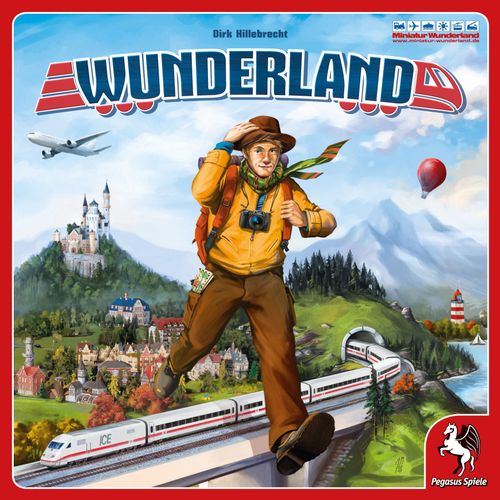
Wunderland
Wunderland Rulebook
Table of Contents
Table of Contents
Idea of the Game
There are many beautiful places and things to discover in Wunderland. That is why the Wunderlanders love to travel around the country and visit its sights. And since Wunderlanders are very sociable people, they rarely travel alone, but usually in a group, if they are going the same way.
The players accompany the Wunderlanders on their journey. In doing so, players must reach the given travel destinations and collect many postcards. Whoever skilfully makes use of the other players' turns and scores the most points wins the game.
Game Setup
-
Place the game board in the middle of the table. The board shows Wunderland with 8 different sections and a large number of different locations. Locations with photographs are destinations. At locations with symbol fields, players can collect their postcards.
-
Sort all the postcards by section (different symbols) and form 7 stacks. Place these stacks face up on the corresponding card spaces on the game board.
-
Shuffle the assignment cards and place them face down in a stack next to the game board. Each player takes 2 assignment cards and places them face down. You may look at your assignment cards at any time.
-
Each player chooses a figure colour and places all 8 figures of that colour on the large start field marked "Knuffingen".
-
Place the small locomotives of your colour on space 0 of the score track.
-
Place the scoring card of your colour next to the game board, near space 0 of the score track.
-
Whoever last travelled with a suitcase receives the large brown locomotive.
Start of the Game
All players take their turns one after another. The player with the brown locomotive starts the game. After their turn they give the locomotive to their neighbour on the left, who then begins their turn. And so on clockwise until the end of the game. The brown locomotive always shows who is taking their turn.
Moving Figures
The player whose turn it is moves one or more figures of their colour from a location of their choice along the lines to a location 1 or 2 steps further. You may freely choose how many figures to move, as long as all the figures start at the same location and have the same destination. The player must make a move; they cannot decline it.
Travelling together in company: All other players now decide, clockwise, whether they want to travel with their figures together with this player. Each player may freely choose whether to travel along and how many of their figures to use. The travellers must be at the same starting point from which the active player made their move, and they must arrive at the same place where the active player's figures stopped.
Both before and after moving figures, the active player may fulfil their assignment cards and collect postcards. After that, the player's turn ends. The next player receives the brown locomotive and now takes their turn.
Example: It is Barbara's (blue) turn. She moves 5 of her 8 figures from the Knuffingen start field 2 spaces forward to destination 9. To her left sits Georg (yellow), who decides to travel with 4 of his figures together with Barbara. Rita (red) sends only 2 figures along. She would very much have liked to move 1 of her figures to destination 8 in order to fulfil an assignment card, but when travelling with other players she cannot "get off" along the way; she can only go to space 9. Then Georg's turn begins.
Fulfilling Assignment Cards
Wunderlanders must plan ahead where they will travel. The player whose turn it is may fulfil any number of assignment cards. For this, at least one of your figures must be at each location shown on the assignment card. The player reveals their assignment card so that everyone can see it. Then the player takes only one of their figures from each depicted location and puts it back on the starting field in Knuffingen.
For each fulfilled assignment card the player receives the number of points indicated in the corner: 15 points for cards with 2 destinations, 20 points for cards with 3 destinations, 25 points for cards with 4 destinations. The player then moves the locomotive of their colour forward on the score track by that number of points.
Fulfilled assignment cards remain lying face up in front of the player. All players can see at any time how many cards a player has fulfilled.
Then, for each fulfilled assignment card, the player draws one new card from the face-down deck and places it face down in front of themselves. Exception: if a player fulfils their fourth assignment card, they no longer draw a new card. The fifth assignment card in the player's hand is their last card in this game.
Example: Barbara (blue) fulfils an assignment card. First she reveals the assignment card to all other players. Then from each of the locations 8, 34 and 41 on her route she moves 1 of her figures back to the start. Barbara receives 20 points and moves her locomotive forward by that many points.
Collecting Postcards
Wunderlanders love postcards! On their turn a player may collect any number of postcards. For this, one or more of the player's figures must be on a field with a symbol. The player then places any number of their figures, of their choice, from any number of symbol fields back on the starting field in Knuffingen. For each figure returned, the player takes one postcard from the corresponding card stack.
If the stack of postcards is already empty, the player is out of luck. The player cannot get any more postcards, but may still return their figures to the starting field if they wish.
The player places the collected postcards face down in front of themselves. The player may look at them at any time. The more postcards from different sections of the game a player collects, the more points they get at the end of the game.
Note: Although Wunderlanders love postcards, they quickly get bored if they look at too many postcards from the same area. So, although a player may collect any number of postcards from each section, at the end of the game they will score points for a maximum of 4 postcards per section!
Example: Barbara (blue) places 2 of her 3 figures from the Switzerland symbol field (gold bars) and 1 figure from the Austria symbol field (mountains) back on the starting field. For this she takes 2 postcards from Switzerland and 1 from Austria.
End of the Game
The game ends when one of the following occurs:
-
A player fulfils their fifth assignment card. In this case the game ends immediately.
-
A player has collected postcards from all 7 sections. (Wunderlanders do not collect postcards in Knuffingen; they feel at home there.) In this case the player may reveal all their postcards face up and thereby end the game at once. But the player may also choose not to reveal their cards and keep playing, in order to fulfil even more assignment cards or collect more postcards. Furthermore, whenever a new turn of that player comes, they may decide to reveal their postcards and thus end the game, or to play on.
After a player ends the game, the other players can no longer move their figures. However, each player may fulfil any number of assignment cards one last time and collect postcards, provided their figures are on the corresponding fields. If there are fewer postcards in a stack than are required, the player who ended the game takes postcards first. The other players take theirs clockwise.
Final Scoring
Now all players score points for the postcards they have collected. To do this, sort your cards by number per section (symbol). In case of a tie, the order of the cards does not matter. For each card of the section in which you have collected the most cards, you get 1 point. For each card of the section in which you have collected the second-most cards, you get 2 points, for each card of the section in which you have collected the third-most cards, 3 points, and so on.
However, a player can score for no more than 4 cards in one section. If a player has collected more than 4 cards of one section, they get no points for the extra cards.
Note: There are small hints on the sides of the game board. Simply place the cards of the section with the most symbols on the leftmost field on your side of the game board, the cards of the section with the second-most on the field to its right, and so on. If a player has more than 4 cards of one symbol, set the extra cards aside. Players can now read off, at the edge of the board, how many points each postcard is worth.
Move the locomotive of your colour on the score track forward by the corresponding number of points. If a player's locomotive reaches 100 points or more, the player takes the scoring card of their colour and places it in front of themselves showing the number 100. In the very rare case that a player reaches 200 points or more, turn the scoring card to the number 200.
Whoever has the most points in total from fulfilled cards and collected postcards wins the game. In case of a tie there are several winners.
Example: At the end of the game Barbara has 15 postcards and sorts them by number per section. In Hamburg she collected 5 cards, but scores only for 4 cards. In total Barbara gets 38 points for her postcards.
Assignment Cards
In choosing the assignment cards, the publishers of the game tried to depict the Miniatur Wunderland as accurately as possible. Nevertheless, for reasons of production technology and game mechanics, the publisher had to introduce a few deviations from the original. All photographs used in this game were, of course, taken in the Miniatur Wunderland.