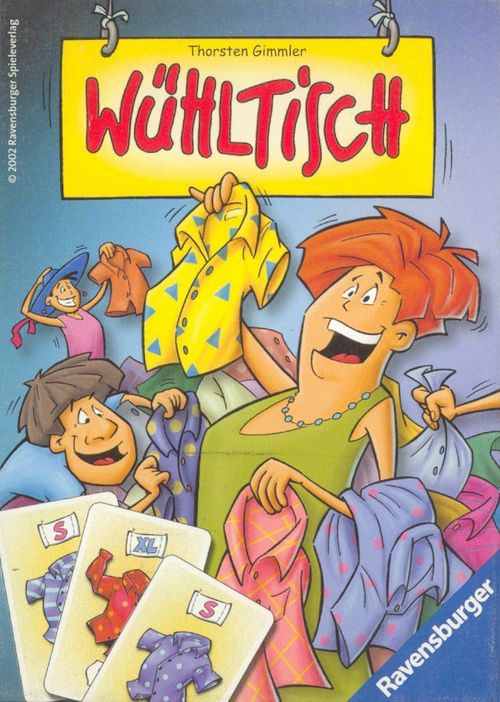
Wühltisch
Wühltisch Rulebook
Table of Contents
Table of Contents
Content
110 cards: 80 Shirts, 16 Purchase Cards, 7 useless and 7 useful Lost Property.
Goal of the Game
Whoever can collect as good as possible from her Purchase Cards and still within the budget, she wins the game.
Game Setup
The preparation of each round is the same: all Shirts and Lost Property are well shuffled together and spread face-down at the center of the table to form a heap. The Purchase Cards are shuffled face-down. Each player receives 3 face-down Purchase Cards, which he places them as a stack in front of him. In addition, a pen and a paper are needed to record the scores of each player.
Game Play
There are 4 rounds of play. Each round starts similarly: the player with the most beautiful shirt in the cabinet calls the start signal, "Let's start shopping!" Now, all players simultaneously turn over their top Purchase Card and search the heap for 3 shirts, which fit their Purchase Card. However, it is not easy to find 3 shirts that exactly matched the Purchase Card in the mega sale. Thus, it is sufficient to find 3 shirts that together match at least 7 of 9 attributes of the Purchase Card (see "The Agreements"). Of course, it is better to fit all 3 shirts accurately!
Player can only search the heap with one hand; i.e. it is not permitted to search through the heap with both hands. In addition, only one card at a time may be picked up from the cloth table and looked at. If you do not want the card, throw it back on the heap face-down and take another card. If you are pleased with the card, put the card into the free hand. Afterwards, you continue to look for the cards from the heap. Besides, the shirts kept in the free hand may be thrown back to the heap any time.
If you find a Lost Property, on which a number is shown, put it down face-up in front of yourself. The value is added to the final scores. A Lost Property, on which no number is shown, is thrown back to the heap face-down.
A player may hold at the most 3 shirts in the free hand. If he would like to take up a fourth card, he must throw one card to the heap face-down before taking another.
If a player collects 3 shirts, with which he is contended, he puts them down together with the Purchase Card as pile in front of himself. Subsequently, he turns over the next Purchase Card and search again from the heap. Once put down, the cards may no longer be exchanged.
A player shall process all 3 Purchase Cards in the same way.
The player, who has firstly collected all 9 shirts, calls "Hands off!" The round then immediately ends. The players, with 3 shirts on the free hand at this moment, shall put them down together with the Purchase Card in front of themselves. Players, who hold fewer than 3 shirts, must throw them back to the heap.
The Agreements
Each shirt has the following 4 attributes:
- Pattern: Strip / Dot;
- Color: Red / Blue;
- Size: S / XL;
- Sleeves: Long / Short
There are 3 of these attributes on each Purchase Card. 3 shirts are needed for each Purchase Card and the card shall be fulfilled optimally: if all 3 shirts agree exactly with the 3 characteristics, there are altogether 3x3 = 9 agreements. However, it is sufficient to match 7 / 8 of the 9 possible attributes. If there are fewer than 7 attributes for the Purchase Card, it scores no points.
Tips: It is easier to keep track the number of mismatches on the Purchase Card. Thus, there may have at the most 2 mismatched attributes for a Purchase Card.
Note: The total price of the 3 shirts may not exceed 80 Euro. Exception: if all 3 shirts are luxurious (each shirts costs 80 Euro) is also permitted.
Example: The player must find 3 dotted shirts with long sleeves of small size.
To fulfill this Purchase Card, a player should collect the specific shirts, for example:
- With this combination, the shirts match 7 out of 9 attributes: 2 dotted shirts, 2 long sleeves, and 3 small size. The total price of the shirts is 80 Euro.
- Here, the shirts match 8 out of 9 attributes: 2 dotted shirts, 3 long sleeves, and 3 small size. Besides, all shirts cost are luxury, costing 80 Euro each.
- With this combination, the shirts match 7 out of 9 attributes: 3 dotted shirts, 2 long sleeves, and 2 small size. However, the total price of the shirts exceeds 80 Euro; it's 120 Euro. As a result, this set will NOT score points.
Scoring
After a player called "Hands Off!", scoring occurs. Each player checks each of his Purchase Cards. Firstly, check whether the total price of the 3 shirts is less or equal to 80 Euro or equal to 240 Euro. If this is not the case, the Purchase Card does not count. If the total price is within budget, the players count how many matches for the 3 shirts. When there are at least 7 matches, the Purchase Card scores. Each match counts ONE point. If a player has 9 matches with a Purchase Card, he receives 5 bonus points - 14 points in total. There are 5 bonus points for all 3 luxurious shirts. In addition, the value of the Lost Property is added to the total score. Scores of all players are recorded on a sheet of paper.
The player, who called "Hands Off!", should be very careful! If he made an error with only one of his 3 Purchase Cards – spending too much or not having at least 7 matches, he scores nothing for the round! However, the value of collected Lost Property still count.
Note: This rule concerns only the player, who called "Hands Off!" For all other players, only the Purchase Card that cannot be fulfilled does not count.
A new round begins (see "Game Setup").
Score of a Purchase Card
= Number of Matches + 5 (if there are exactly 9 matches) + 5 (if all 3 shirts cost 80 Euro) OR = 0 (if fewer than 7 matches)
Score of the Round
= Sum of 3 Purchases Cards + Total value of Lost Property OR = Total value of Lost Property (if Player calling "Hands Off!" can't fulfill one of his 3 Purchase Cards)
Game End
The game ends after the fourth round. The player with most points wins. When there is a tie, the player, with the most cards in front of himself, wins. If there is also tie, all tied players are winners.