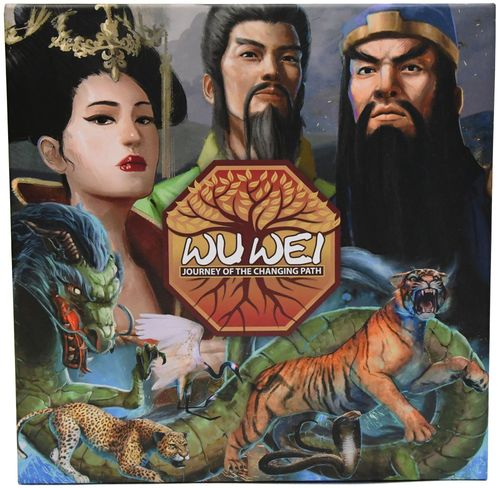
Wu Wei: Journey of the Changing Path
Wu Wei: Journey of the Changing Path Rulebook
Table of Contents
Table of Contents
Game Components
- 2 Yin-Yang Tiles
- 1 First Player Marker
- 3 Center Octagons (Initiate, Master, Emperor)
- 4 Directional Tiles (North, South, East, West)
- 5 Temples
- 3 Status Trackers (Circle, Triangle, Square)
- 1 Gathering Marker
- 5 Palaces
- 1 Temple Tracker Board
- 20 Towns
- 1 Palace Tracker Board
- 1 Town Tracker Board
- 25 Animal Cards (5 each of Leopard, Tiger, Crane, Dragon and Snake, with the Five Cards Earned side)
- 24 Terrain Octagons (Fields, Spring Forests, Summer Mountains, Autumn Marshes, Winter Lakes)
- 1 Game Board
- 6 Aids
- 5 Students (Leopard, Tiger, Crane, Dragon and Snake Student)
- 5 Lineage Markers
- 5 Masters (Leopard, Tiger, Crane, Dragon and Snake Master)
- 4 Emperor Pieces (Emperor or General, Empress or General, General, General)
- 4 Towers
- 8 Walls
- 180 Chi Tokens (36 each of Wood, Fire, Metal, Water and Earth)
Setting Up The Game
Choose A Scenario
For your first game, the Initiate Level is highly recommended. The Master Level adds two challenging complications and is considered the standard level of play. Advanced players may want to try the Emperor Level, which allows for an extra player who takes on the role of the emperor. See the corresponding sections of the rulebook to see how the additional game modes change the rules.
- 2 - 5 Players, Initiate Level, 45 minutes. The Initiate Level is meant for new players. This level focuses on collecting animal cards, harnessing the power of chi, and bidding for first player rights. At this level, you will learn how to move with the seasons, build walls, and cycle through the five elements. This is the beginner level. Do not skip this level if this is your first time playing Wu Wei. (The symbol for this level is the Wu Xing or "Five Elements".)
- 2 - 5 Players, Master Level, 60 minutes. The Master Level is meant for players ready to graduate from being initiates. This level introduces cultivating chi and balancing the dynamic nature of yin and yang. At this level, you also have to weigh the benefits of moving one character versus the other. This is the standard level of play for Wu Wei. (The symbol for this level is the Bagua or "Eight Trigrams".)
- 3 - 6 Players, Emperor Level, 90 minutes. The Emperor Level is for advanced players looking for new challenges. This level introduces a formidable new force: a player-controlled emperor. As the game progresses, the emperor grows more difficult to overcome. The other players must slow the emperor's progress and avoid conscription. This is the advanced level of play for Wu Wei. (The symbol for this level is a stylized version of the Chinese character Lu or "Prosperity".)
Create The Game Board
- Position the game board between the players in the center of the play area.
- Place the north, south, east, and west directional tiles in their indicated locations around the center of the game board.
- Place the 2 yin-yang tiles in their indicated locations: one in the north quadrant, black side up, and the other in the south quadrant, white side up.
- Place 4 towns in the outer corners of the game board, face up: a water town in the north quadrant, a fire town in the south quadrant, a wood town in the east quadrant, and a metal town in the west quadrant.
- Place 5 temples and 5 palaces, face down, at random on the game board. Make sure that no 2 temples or 2 palaces are adjacent to the same terrain octagon.
- Place the remaining 16 towns, face down, at random to fill in the spaces on the game board around the terrain octagons.
- Stack all 3 center octagons face up in the center of the game board, with the INITIATE LEVEL octagon on the top.
- Place a terrain octagon corresponding to each season around the center octagon, face up (i.e., so the fields side is face down), in their marked locations.
- Distribute the 20 remaining terrain octagons at random, face down (i.e., so the fields side is face up), to fill in the empty spaces on the game board.
- Flip all of the terrain octagons face up (i.e., so the fields side is face down), then flip all of the towns, temples, and palaces face up as well.
Position The Characters
- Randomly determine a starting player and give them the starting player marker, placed with the sun side face up. Then give 1 lineage marker (either determined randomly or by choosing in turn order) to each player.
- Place all of the players' students, with their minus side face up, on the center octagon. Place all 5 masters (no matter how many players there are in the game) with their plus side up, on their corresponding temples.
- Put any remaining lineage markers and students back in the box. They will not be used during this game.
Three Kinds of Disciples: A poor disciple utilizes a teacher's influence. A fair disciple admires a teacher's kindness. A good disciple grows strong under a teacher's discipline. — Gasan, Zen Master
Establish The Supply
- Place the 3 tracker boards (town, palace, and temple) along 3 edges of the game board. The player last in turn order chooses where to place the status trackers (circle, square, and triangle) on the tracker boards. Their positions collectively determine the game's starting conditions.
- Put the gathering marker on its marked location on the temple tracker board, with the sun side facing up.
- Place the 180 chi tokens, separated by element, off to one side of the game board.
- Distribute 1 chi token of each element (i.e., 5 total) to every player. Each player in clockwise order after the starting player receives 1 additional chi matching the active element, which is indicated by the town tracker board (i.e., the second player receives +1 chi, the third player receives +2 chi, etc.).
- Separate the animal cards into five decks, by animal type, and place them off to the side of the game board, across from the chi tokens.
- Set aside walls equal to 8 minus the number of players (e.g., 8 walls - 5 players = 3 walls), placing them in the supply. Place the remaining walls back in the box.
Initiate Level Game Objectives
Lead your student on a journey to earn five animal cards and then move your student and master to the center octagon to pass on your martial arts lineage. Each master remains in their temple until their student has earned five animal cards. Once you have all five animal cards, you can move both your student and master to the center octagon. The first player to do so has successfully passed on their martial arts lineage, and wins the game!
Structure Of Play
Wu Wei: Journey of the Changing Path is played in a series of rounds. In each round, players take turns in clockwise order, beginning with the starting player. As the seasons change, a gathering will be triggered every winter (see Gatherings, p. 15), during which turn order is reassigned. The game continues in this way until one player wins.
On your turn, there are four steps that you must take, in order (see below). When your turn is over, the next player in clockwise order takes their turn.
- Meditate
- Move
- Align With Nature
- Develop Discipline
Meditate
Balanced Yin & Yang
The yin-yang tiles never flip. They stay in a state of balance (one showing yin, one showing yang) for the entire game. All characters can move across the yin-yang tiles but yin-yang tiles never produce chi.
Undisciplined Characters
If, at the start of your turn, you do not have at least one character who will be able to move this turn, due to the presence of other characters, walls, or seasonal blockages, you are considered "undisciplined." Of your characters who were free to move this turn, choose one to suffer the associated penalty:
- Undisciplined Student: Your student loses an animal card, chosen by the current starting player. If your student had five animal cards (and had therefore become a student-master), flip your student player piece so that the minus sign is face up, indicating that it is now a student again. Then move your student back to the center octagon; you will begin normal movement from there.
- Undisciplined Master: Your master loses your lineage marker, which is returned to the matching palace. Flip your master player piece so that the minus sign is face up, indicating that you've lost your lineage marker and become a dishonored master. Then move your dishonored master back to the center octagon; you will begin normal movement from there.
While you are dishonored, students must travel to the palace with your lineage marker (or visit your student-master) in order to receive training in that animal type.
When your dishonored master ends movement on the palace with your lineage marker, you recover your lineage marker; take it and then flip your master player piece so the plus sign is face up, indicating that your master is no longer dishonored.
Move
Movement Rules
You can move one, two, or three spaces on your turn. You must move at least one space and you cannot retrace your steps (i.e., move back into spaces you moved through this turn, or the space where you began the turn). If you cannot move at least one space, you are considered "undisciplined" (see Undisciplined Characters, p. 10).
Each step of movement is always to an adjacent space. This means you can move from octagon to octagon, octagon to square, or square to octagon, but never from square to square (i.e., squares are not adjacent to one another).
Directional Tiles: No character may ever move through or occupy the four directional tiles. These are not considered spaces; you must always go around them.
Sharing Spaces: Students may share spaces with masters, but not with other students. Masters may share spaces with students, but not with other masters. (Exception: When a student becomes a master by training with a master and receiving a fifth animal card, the master and student-turned-master will share a space for that turn. This is allowed.)
The Way Is Blocked
Center Octagon: After your student exits the center octagon initially, you cannot move either of your characters back into the center octagon until your student has become a master.
If you ever want to move a student or master out of the center octagon and all four exits are blocked by walls and/or characters, you may destroy an adjacent wall, without spending chi, in order to exit. Otherwise, you cannot move that character this turn.
Blockages: You cannot move a student or master into a terrain octagon matching the current season, which is indicated by the temple tracker board.
You cannot move a student or master into a terrain octagon with a wall, unless you have earned the snake animal card and have the three chi available to activate its power.
Manifesting Chi
During the movement step of your turn, you can spend, or "manifest," chi in order to perform various special actions. You can manifest chi to perform these special actions as many times as you wish to and can afford. However, you can only manifest chi of the active element.
- Move Rapidly: Spend one chi to add one space to your movement.
- Destroy a Wall: Spend three chi to destroy a wall adjacent to your moving character. You may do this at any time during the movement step of your turn.
- Activate an Animal Power: Spend three chi to activate the one-time power of one of your collected animal cards. (See Animal Cards, p. 14 for details.)
You can always use alchemy to transform two chi of the same element into one chi of any other element when spending or sharing chi.
Align With Nature
Chi (also known as qi, ki, or ch'i) is the life force or energy whose existence and properties are the basis of internal martial arts, Chinese philosophy, and traditional Chinese medicine.
If you ended your movement on a terrain octagon, skip this step. But if you ended your movement on a temple, palace, or town, immediately collect one chi of the element matching that tile. If you moved multiple characters this turn, it is possible to collect one chi for each character in this way.
After collecting chi, you must interact with the location tile (i.e., town, palace, or temple) where you ended your movement.
Towns
If you ended your movement on a town, adjust the marker on the town tracker board to match that town's element. This indicates the new active element. You can only manifest chi matching the active element (see Manifesting Chi, p. 11).
Palaces
The palace tracker board indicates which palace is inactive. If you end your movement on this inactive palace, you collect chi as normal but nothing else happens. However, if you end your movement on any other palace, adjust the marker on the palace tracker board to match the palace where you ended your turn.
You may now build a single wall in the active quadrant, which is indicated by the position of the marker on the palace tracker board. You are allowed to build a wall on a terrain octagon that is only partially within the active quadrant, but you cannot build a wall on an occupied terrain octagon. If all available walls are built, you may destroy an existing wall to build a new one.
Temples
The temple tracker board indicates the current season, and therefore which terrain octagons are impassable. When you end your movement on a temple, change the season by moving the marker forward by one.
When the season changes to winter, flip both the starting player marker and the gathering marker to the moon side. Continue taking turns until just before the current starting player takes another turn. At that time, hold a gathering (see Gatherings, p. 15).
Develop Discipline
Students
Whenever a student and a master share a space during this step, the student receives training and collects an animal card matching the master's lineage marker. (Students may also train with other student-masters.)
The player who controls the student chooses a card of their choice from the corresponding animal card stack. Each student can only earn one card from each master.
The moment you collect all five animal cards, your student becomes a student-master; to indicate this, flip your student player piece so the plus side is face up. This new student-master can now train other students, and you can split your movement between both of your masters.
Masters
You cannot move your master until your student has earned five animal cards; only when a student is truly ready to learn will their master journey to the center octagon to pass on their martial arts lineage.
Animal Cards
When your student earns an animal card by training with a master, place the animal card face up (i.e., with the full-color symbol face up) in front of you.
Each animal card has a special power that can be used only once per game. When you activate that animal card to use its power, flip the card over to indicate this.
- Snake (Develops Chi or Energy): During movement, move onto an adjacent wall. This counts as one space of your movement, and you may either stop there or continue moving. (Spent Power: Move Onto One Adjacent Wall.)
- Dragon (Develops Shen or Spirit): In place of your normal movement, move directly to the temple shown on your dragon card. This counts as your entire movement and you cannot continue moving. (Spent Power: Move To The Wood, Fire, Metal, Water or Earth Temple, as shown on the card.)
- Crane (Develops Tendons or Flexibility): During movement, immediately move to either of the yin-yang tiles. This counts as one space of your movement, and you may either stop there or continue moving. (Spent Power: Move To Either Yin-Yang Tile.)
- Tiger (Develops Bones or Structure): In place of normal movement, move directly to the palace shown on your tiger card. This counts as your entire movement and you cannot continue moving. (Spent Power: Move To The Wood, Fire, Metal, Water or Earth Palace, as shown on the card.)
- Leopard (Develops Muscles or Strength): In place of normal movement, move directly to any of the towns shown on your leopard card. This counts as your entire movement and you cannot continue moving. (Spent Power: Move To Any Wood, Fire, Metal, Water or Earth Town, as shown on the card.)
Gatherings
During a gathering, there is a sharing of knowledge in the form of chi redistribution. All players share chi matching the active element (alchemy is allowed), in order to determine the new starting player, in the following manner:
- Each player hides any number of their own chi in a closed fist. This is what they are offering to share, and it is also their bid to choose the next starting player.
- All players simultaneously open their hands to reveal their offered chi. The player who offered the most chi chooses who will be the starting player in the next round, giving them the starting player marker with the sun side facing up. (The current starting player decides the winner, in case of a tie.)
- All players share their offered chi, dividing it among their opponents however they wish.
- The gathering marker is flipped back, so that it is sun side up. Then the new round begins, starting with the newly chosen starting player.
The Five Elements
The ancient Taoists observed a pattern of expression in nature that they called Wu Xing, or Five Elements. These elements, or energies, were described as Wood, Fire, Earth, Metal, and Water and understood to be the primary building blocks from which all material substance is composed.
Each element has its own characteristics and associations with different aspects of nature, such as direction, season, color, shape, and so on.
Master Level
Changes To Setup: Follow the instructions for Initiate Level setup, with the following change: when you stack the 3 center octagons face up in the center of the game board, put the MASTER LEVEL octagon on the top.
Game Objectives: Step into the roles of the dedicated student and elusive master. Changes in the balance of yin and yang influence which characters are free to move each turn. Lead your student on a journey to earn five animal cards, while your master maintains your lineage marker and cultivates chi. Once your student has become a master, you must move both your characters back to the center octagon to pass on your martial arts lineage. The first player to do so wins the game!
Dynamic Yin & Yang
You can move the student and master from the start of the game. The balance of yin and yang determines which characters you are free to move during the Move step of your turn.
- Choose any character to move. If you have two masters, you can split your movement between those two characters.
- Only characters with black in their design can move.
- Only characters with white in their design can move.
The yin-yang tiles are in perfect balance at the start of the game: one tile showing yin (black) and the other tile showing yang (white). The moment a yin-yang tile becomes unoccupied, due to a character moving away from it, the tile immediately flips to the other side. (As long as at least one character remains on a yin-yang tile, the tile cannot be flipped.)
Changes in the balance of yin and yang take effect at the beginning of each character's movement. If you are splitting your movement between two characters, the first character to move may change the balance of yin and yang for the second character.
Cultivate Chi
During the Develop Discipline step, your master cultivates chi. Immediately collect three chi matching your native element (i.e., the element matching your lineage marker). After your student has become a master, you still collect only three chi total.
If you have lost control of your lineage marker, your master will not cultivate chi until you have recovered your lineage marker.
Emperor Level
Game Objectives: Lead your student on a journey to earn five animal cards while your master maintains your lineage marker and cultivates chi. Once you have all five animal cards and your lineage marker, you can move your student and master to the center octagon. The first player to do so has successfully passed on their martial arts lineage, and wins the game!
Meanwhile, one player represents the emperor, working to unify the empire by placing towers in the four corners of the board. As the empire expands, the emperor's forces grow. Recruited generals give the emperor greater power and flexibility but the additional forces require vigilance and careful planning. Generals rely on the emperor or empress to create paths for them across unforgiving terrains. If the emperor places towers in the four corners before one of the other players has passed on their martial arts lineage, the emperor player wins, and only the emperor's lineage will prevail.
Changes To Setup
- One player must play as the emperor. It is recommended that the most experienced player take on this unique role, but it can be assigned randomly. All MASTER LEVEL rules apply.
- When you stack the 3 center octagons face up in the center of the game board, put the EMPEROR LEVEL octagon on the top.
- The emperor player takes all 4 emperor pieces, placing the emperor or empress on the matching yin-yang tile and a positive or negative general on the other yin-yang tile.
- The emperor player also takes 4 towers and 8 walls.
- The player to the left of the emperor is the starting player. Give them the starting player marker, placed with the sun side face up.
- The emperor player chooses 5 terrain octagons, flipping them over to the fields side and placing 5 walls on them. However, a temple may never be completely surrounded by walls during setup.
Emperor Level Rules Changes
1. Undisciplined Characters: If, at the start of a turn, the Emperor player cannot move a character required to move this turn, the penalty for being "undisciplined" is that they must destroy a tower, chosen by the current starting player. Then, move the blocked character to the center octagon and begin movement from there.
2. Emperor Player Movement: Generals can move on walls, towers, square tiles, and octagons flipped to their fields side. However, face-up terrain octagons are off limits to generals. If a general is trapped in the center octagon, you can flip one of the adjacent terrain octagons to the fields side in order to exit.
The emperor and empress can move on walls, towers, square tiles, and all terrain octagons, whether face up or fields side up. However, the emperor and empress are still subject to seasonal blockages.
If you have two black characters, both must be moved at least one space when moving characters with black in their design. The same rule applies to white characters when moving characters with white in their design.
3. Placing Towers: You may place a tower when a general ends movement on a town. Any town that has a tower placed on it no longer provides chi, and neither students nor masters can move into spaces containing towers.
4. Recruiting Characters: As soon as you have placed towers on any two corner towns, you recruit a third character matching the color of your general. As soon as you have placed towers on any three corner towns, you recruit a fourth character. Recruited characters cannot be changed after they have been chosen.
Recruited characters start on the center octagon and are available to move on future turns. Recruited characters remain in play and under your control even if your corner towers are later destroyed.
5. Conscripting Students and Masters: When a positive general ends movement on the same space as a student, the student is "conscripted," and loses an animal card chosen by the current starting player. Then move the conscripted student back to the center octagon; they will begin normal movement from there on their next turn.
When a negative general ends movement on the same space as a student-master, the student-master is "conscripted," and loses an animal card chosen by the current starting player. Then move the conscripted student-master back to the center octagon; they will begin normal movement from there on their next turn.
When a negative general ends movement on the same space as a master, the master is "conscripted" and loses their lineage marker, which is returned to the matching palace. Then move the conscripted master back to the center octagon; they will begin normal movement from there on their next turn.
6. Shifting Terrain: When a character ends their movement on any active palace, that player may flip one terrain octagon in the quadrant indicated by the palace tracker board. (This happens instead of building a wall.) Terrain octagons that are currently occupied by characters or walls cannot be flipped in this way.
You may flip any terrain octagon that the emperor or empress occupied or moved through this turn, so that the fields side is up (see #1 & #2 below). If the emperor or empress end their movement on a terrain octagon, you may flip it so that the fields side is up and build a wall (see #3 below).
7. Pushing and Pulling: During the movement step of their turn, any player can spend chi to push or pull other characters, according to the rules below. (Exception: The emperor and empress cannot push or pull, and cannot be pushed or pulled.)
- Push: Spend three chi to move into an adjacent space with another character of the same sign (i.e., positive or negative), and push that character out into any adjacent space. If there are multiple characters of the same sign, push each of them individually, in any order. If there are no adjacent spaces into which a character can legally be pushed, that character is considered "undisciplined."
- Pull: Spend three chi to pull a character of a different sign from an adjacent space into the same space as your character.
Resist or Yield: Spend three chi to resist an attempted push or pull. (This is the only way to manifest chi on another player's turn!) If you resist an attempted push, you choose an adjacent space to which the initiating character must move. All six chi spent in a resisted push or pull is returned to the supply.
If you yield to a push or pull attempt by another player, you receive the three chi spent by the initiating player. (When multiple players are targeted on the same space, the pushes are resolved in an order of the initiating player's choice.)
Solo Play Mode
Choose A Scenario
In the solo play mode, there are three successive stages: Evolving Traditions, Warring States, and Emerging Empire.
You can attempt any of these as a single session, and there are options for fine-tuning the difficulty level (Beginner, Intermediate, or Advanced) within each stage.
- Stage 1: Evolving Traditions (45 minutes). The old masters are disappearing and you must learn all of their styles before they are lost forever. Preserve the animal forms in order to keep Kung Fu alive. Start here if you are planning to attempt the solo campaign.
- Stage 2: Warring States (60 minutes). The kingdoms of the North, South, East, and West are at war with each other. They conscript the people to build walls on the borders, depleting the land's resources. You must transcend these divisions in order to keep Kung Fu alive.
- Stage 3: Emerging Empire (60 minutes). The Emperor has united the kingdoms and turned his attention to industrialization. Farming, roads, and construction begin to change the landscape, sacrificing natural beauty in the name of progress. You must balance the five elements and combine all five martial arts traditions to continue the eternal evolution of Kung Fu!
Campaign Mode
You can also attempt a solo campaign, in which you must overcome all three stages, in progressive order. There are additional rules in play, including carryover effects between stages, when you attempt the campaign. (Campaign-only rules are marked with a symbol in the rulebook.)
Stage 1: Evolving Traditions
Setup Instructions
Follow the instructions for Initiate Level setup from the standard game, with the following changes and additions:
- When you stack the 3 center octagons face up in the center of the game board, put the Evolving Traditions octagon on the top.
- Choose 1 student, placing it on the center octagon, minus side up. The other 4 students will not be used in the game; return them to the box.
- Place your student's corresponding palace directly west of the west directional tile and corresponding temple directly east of the east directional tile. Place the other palaces and temples as normal.
- Place 4 walls around your student's corresponding palace.
- Place all 5 masters, minus side up, on their corresponding temples.
- Place all 5 lineage markers on their corresponding palaces.
- Randomly select 1 card from each animal deck and set these 5 cards aside, face down.
- Shuffle the other 20 animal cards to form a face-down discipline deck.
- Set the status trackers in any position you wish on the tracker boards.
- Give yourself 1 chi token of each element.
Game Objectives
The old masters are disappearing and you must learn all of their styles before they are lost forever. Preserve the animal forms in order to keep Kung Fu alive.
Winning the Game: In order to win, you must complete both of the following goals:
- Your student must collect all 5 animal cards, then return to the center.
- Your master must retrieve your lineage marker, then return to their temple.
Losing the Game: You lose immediately when either of the following occurs:
- The final card in the discipline deck is revealed during the master phase.
- If 4 animal cards of the same type are revealed from the discipline deck before your student collects the matching animal card and that master retrieves the matching lineage marker, then that style is lost.
Campaign Effects
- To advance to STAGE 2, the minimum requirement is that you must return your promoted student-master to the center and the corresponding master to their temple.
- After completing STAGE 1, for each other master that you did not return to their temple, shuffle the 5 matching animal cards and draw 1 card at random. That card is removed from play for the rest of the campaign. (Put it back in the box.)
How To Play
Use the normal play sequence described in the Initiate Level rules, with the following changes and additions:
During each turn, there will be a student phase and a master phase. There are no gatherings. Instead, when the season changes to winter, flip the gathering marker.
When the gathering marker is sun side up, the student phase occurs first. When the gathering marker is moon side up, the master phase occurs first.
Student Phase: In the student phase of each turn, you must move your student, following the Initiate Level rules. You can, however, move the student and master from the start of the game.
Master Phase: In the master phase of each turn, reveal the top card of the discipline deck. This revealed card will determine (1) which master you can move this turn and (2) which animal effect triggers.
-
Master Movement: The master of the style shown on the card moves now. You may move that master up to 3 spaces. The master will interact with the space they land on, as normal.
If the master lands on a palace with their lineage marker, retrieve it and then immediately collect chi of that type equal to 4 minus the number of matching animal cards that have been revealed from the discipline deck.
If you reveal a card from the discipline deck for an animal style you have already protected, you may choose a different master to move during this phase.
-
Animal Effect: The animal shown on the card indicates which effect triggers. Unless otherwise indicated, the animal effect only occurs at the end of the turn, after both the student phase and master phase have been resolved (regardless of their order).
- Leopard: Change the active element to the type shown.
- Dragon: Advance the season.
- Tiger: Build a wall in (or move a wall into) the inner ring of the quadrant shown (see palace tracker board).
- Snake: Until the start of the next master phase, walls cannot be passed through or destroyed. Note: This effect takes place immediately.
- Crane: Immediately move your student or master to either yin-yang tile. Look at the gathering marker to determine which character to move: if the sun is up, move the master; if the moon is up, you may choose the student or the master. Note: This effect takes place immediately.
Difficulty Levels
The rules of these difficulty levels are cumulative. In other words, if you choose the advanced difficulty, all of the rules and restrictions from all 3 levels are in play.
- Beginner: To protect a style from being lost, you must have collected the matching animal card and retrieved the corresponding lineage marker.
- Intermediate: In order to win, you must also return all 5 masters to their temples.
- Advanced: To protect a style from being lost, the corresponding master must be returned to their temple. Do not collect a chi bonus for retrieving lineage markers.
Stage 2: Warring States
Setup Instructions
Follow the instructions for Initiate Level setup from the standard game, with the following changes and additions:
- When you stack the 3 center octagons face up in the center of the game board, put the Warring States octagon on the top.
- Choose 1 student, placing it on the center octagon, minus side up.
- Set the yin-yang tiles so that they are both white side up.
- Place the 4 towers and 8 walls in the supply.
- Place 1 emperor pawn and the remaining 4 students near the board, covering them with the starting player marker. (These are referred to as "the dice" from here on.)
- Set the status trackers in any position you wish on the tracker boards.
- Give yourself 1 chi token of each element.
Select 2 terrain octagons of each type and remove them from the board. Shuffle all the removed terrain octagons face down, re-place them at random, then flip them face up again.
Game Objectives
The kingdoms of the North, South, East, and West are at war with each other. They conscript the people to build walls on the borders, depleting the land's resources. You must transcend these divisions in order to keep Kung Fu alive.
Winning the Game: In order to win, you must complete all 3 of the following goals:
- Your student must collect all 5 animal cards, then return to the center.
- You must build a tower in each corner of the board.
- You must build 8 walls to form an "X" pattern on the board.
Losing the Game: You lose immediately when either of the following occurs:
- All 20 towns are face down at the same time.
- A master is removed from the game before you have collected that animal card.
Campaign Effects
- You may finish the stage without building all 8 walls normally required. However, failing to build all of the walls will make the final stage more difficult.
- After completing STAGE 2, for each master that you did not return to their temple, shuffle all of the matching animal cards and draw 1 card at random. That card is removed from play for the final stage. (Put it back in the box.)
- Before the next stage, flip all of the remaining towns face down. Collect 2 chi of the matching type for each town you flip this way.
How To Play
Use the normal play sequence described in the Initiate Level rules. Apply the MASTER LEVEL rules with the following changes and additions:
Building Towers: If a master ends movement on a face down corner town, you may immediately build a tower there. If you build a tower, choose 1 of the following bonuses:
- Refresh the powers of an animal card.
- Exchange an animal card for a different card from the same deck.
- Recover an animal card lost during STAGE 1, returning it to the corresponding deck.
Unbalanced Yin & Yang: There are no gatherings. Instead, when the season changes to winter, flip the gathering marker. If this results in the marker being moon side up, flip both yin-yang tiles to black. If this results in the marker being sun side up, flip both yin-yang tiles to white.
Flipping Towns: After each Move step, you must flip 1 town face down. (The starting player marker set on top of the dice serves as a reminder to complete this before moving on to the next step.)
Resolving the Dice: During the Align With Nature step, roll the dice and place them on the starting player marker. Resolve the dice results 1 at a time, in any order you choose. Remove the dice as you resolve them, and replace the starting player marker on top of the dice when finished.
Note: Unlike in the standard rules, masters do not collect chi or perform actions in this step. Adjust the status trackers as normal, however.
Student Dice Results:
- Plus (+): Move the corresponding master to their palace or temple, whichever is closer. If the destination is already occupied by another master, ignore this result.
- Minus (–): Move the corresponding master to the closest matching town that is face up and unoccupied, ignoring walls and seasonal blockages. If the last such town is occupied, return the master to the corresponding temple instead. If there are no such towns at all, remove both the master and student from the game.
- ANIMAL: Gain 1 chi of the active element.
Empire Dice Results:
- Circle (o): Immediately flip 1 town face down.
- Plus (+): Advance the season.
- LION: Lose 1 chi of the active element.
You may spend 3 chi (of the active element) to ignore the effects of any empire die result.
Dice faces are printed as symbols in the rulebook; they are written here in brackets and by name.
Difficulty Levels
The rules of these difficulty levels are cumulative. In other words, if you choose the advanced difficulty, all of the rules and restrictions from all 3 levels are in play.
- Beginner: Payments to ignore empire dice results can be any chi.
- Intermediate: Payments to ignore empire dice results must be chi of the active element.
- Advanced: Payments to ignore empire dice results must be chi of the active element. Roll both the emperor and empress dice every turn.
Stage 3: Emerging Empire
Setup Instructions
Follow the instructions for Initiate Level setup from the standard game, with the following changes and additions:
- When you stack the 3 center octagons face up in the center of the game board, put the Emerging Empire octagon on top.
- Flip all of the towns face down.
- Place the 4 towers on the corner towns, and the 8 walls in an X pattern.
- Choose 1 student, placing it on the center octagon, plus side up.
- Place the remaining 4 students, plus side up, on the 4 corner towns.
- Place all 5 masters, minus side up, on their corresponding temples.
- Place all 5 lineage markers on the corresponding palaces.
- Place the emperor pawn on the white yin-yang tile (in the south) and the empress pawn on the black yin-yang tile (in the north).
- Set the status trackers in any position you wish on the tracker boards.
- Give yourself 1 chi token of each element.
If you didn't build all 8 walls in STAGE 2, remove walls from the board so that only the walls you built in STAGE 2 remain. Remove from the animal decks any animal cards lost due to campaign effects during STAGE 1 and STAGE 2, returning them to the box.
Game Objectives
The Emperor has united the kingdoms and turned his attention to industrialization. Farming, roads, and construction begin to change the landscape, sacrificing natural beauty in the name of progress. You must balance the five elements and combine all five martial arts traditions to continue the eternal evolution of Kung Fu!
Winning the Game: In order to win, you must complete all 3 of the following goals:
- You must retrieve all 5 lineage markers.
- You must return all 5 students and all 5 masters to the center.
- You must flip all 20 towns face up.
Losing the Game: You lose immediately if all 24 terrain octagons are covered with walls and/or fields.
How To Play
Use the normal play sequence described in the Initiate Level rules. Apply the MASTER LEVEL rules with the following changes and additions:
Movement in Pairs: You must discard 1 animal card of your choice at the start of each turn. The animal card you select indicates which pair of characters will move. You can move 3 spaces with that student and 3 spaces with that master, in any order.
However, you cannot move any student (besides the 1 that starts in the center) until you have retrieved the corresponding lineage marker and destroyed the tower in that corner town.
No matter which animal card you discard, if any 1 of your characters is blocking the path of the emperor or empress (i.e., on an adjacent terrain octagon in the direction they are moving), you are required to move that character (discarding a matching animal card in order to move). If multiple characters are blocking the emperor or empress, you can choose which animal pair you want to move (chosen amongst the blocking animals).
None of your students or masters may end their movement on a yin-yang tile.
Using Animal Powers: You can spend 3 chi to use the power of the animal card you selected. Alternatively, you can spend 3 chi to instead use the power of an animal card you did not select, but this exhausts that animal card and removes it from play.
After both a student and master of the same animal style have returned to the center, their animal cards may be used as any other animal card on future turns. You may also continue to use the animal powers on these cards.
Destroying Towers: Whenever the lineage marker for 1 of the students on a corner town is retrieved, the matching tower is destroyed and that student is now free to move. (You can move the student on the same turn they are freed.) This also frees that town and changes the active chi to match the newly freed town. Immediately collect 1 chi matching the new active element.
Building Walls: You can only build walls on unoccupied fields. You cannot build walls on any other terrain type. If there are no fields available when you are building a wall, you may first flip a terrain octagon so that it is fields side up.
Empire Phase: At the end of every turn, the empire pieces (i.e., emperor and empress) get an opportunity to move. Roll the 2 generals to determine the movement patterns for the emperor and empress; there is 1 general that matches each:
- Minus (–): The matching piece moves 0 spaces.
- LION: The matching piece moves 1 space. Flip any terrain octagon that the piece occupied or moved through this turn to the fields side. Build a wall on the space where the piece ends its movement.
- Plus (+): The matching piece moves 2 spaces. Flip any terrain octagon that the piece occupied or moved through this turn to the fields side. Build a wall on the space where the piece ends its movement.
There are no gatherings. Instead, when the season changes to winter, flip the gathering marker. When the sun is up, the empire pieces move clockwise. When the moon comes up, the emperor and empress are returned to the yin-yang tiles and will move counterclockwise. When the sun comes up again, the pieces are returned to the yin-yang tiles again and move clockwise again. The empire pieces always move directly north or south first when they begin movement from the yin-yang tiles.
The emperor moves around the inner ring until it is complete. The empress moves around the outer ring until it is complete.
When the inner ring is complete (i.e., all walls and fields showing on the terrain octagons), the empire pieces move immediately back to the yin-yang tiles and will begin their next movement around the outer ring, until that ring is complete. If the outer ring is complete, the empire pieces both reset to the yin-yang tiles and will move again around the inner ring.
If either empire piece could not move during the Empire Phase due to seasonal blockages, the seasons automatically advance at the end of the phase.
Difficulty Levels
- Beginner: Empire movement is (0/1/2). Payments for animal cards can be any chi.
- Intermediate: Empire movement is (0/1/2). Payments for animal cards must be chi of the active element.
- Advanced: Empire movement is (1/2/3). Payments for animal cards must be chi of the active element.