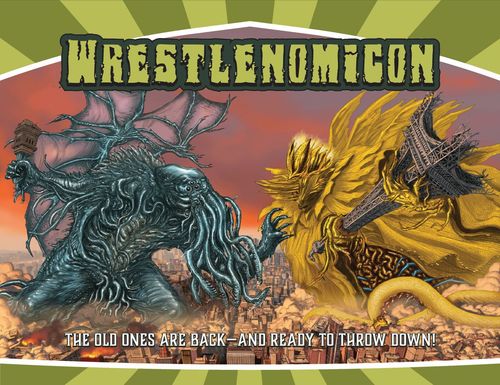
Wrestlenomicon
Wrestlenomicon Rulebook
Table of Contents
Table of Contents
Overview
Wrestlenomicon is a battle between two giant elder gods whose moves are telegraphed across dimensions. You and your opponent take turns preparing your attacks by placing them onto the Attack Track, and eventually carry them out by moving them to Ground Zero. Attacks reduce your opponent's Guts.
Reduce your opponent's Guts from 25 to 0 to win!
Play either as Cthulhu, who can build up to devastating combos across multiple turns, or Hastur, whose affinity for Cultists and rule-breaking Permanent cards gives him an edge in trickery.
Setup
Choose your elder god: Each player takes on the role of an elder god, Cthulhu or Hastur, and takes all the cards belonging to that elder god.
Create the Track: Lay out the Ground Zero card, as well as track cards 1 through 6, in a line between the two players (see picture). Turn the Ground Zero card to the side that says "First attack slams!"
Initial track layout, shown after each player has played their first card (see "Starting the Game").
Setting Up Your Deck and Your Guts: Each player separates out their Cultist cards and sets them aside.
For your first game, also set aside all cards with a starburst icon on the left side. These cards are a better introduction to the game than the rest.
Shuffle the remaining cards and randomly set aside 25 cards, face down, to be your Guts. During the game, you'll track damage to your own elder god by discarding cards from your Guts.
The rest of your cards become your face-down Deck. For your first game, shuffle the starburst-icon cards and place them on top of your deck now.
When you draw cards, you always draw from your Deck.
Leave a space for your Discard Pile. Your discarded and destroyed cards will go here, as will cards from your Guts when you suffer damage.
Starting hand: Draw 7 cards from your deck as your starting hand.
There is no maximum hand size.
Card Basics
Before covering gameplay, let's look at the different types of cards and how they work.
Most cards are attack cards. Each attack card has:
- Two numbers on the left: Position and Momentum.
- An attack type (Bizarre, Dominance, Ranged, or Viscera).
- An attack ability that occurs when the card reaches Ground Zero.
- A Slam ability that enhances the attack under certain conditions.
Playing Attacks: The Game's Most Unexpected Rule
The effect of playing a card in Wrestlenomicon is different than most games. On a typical turn, you play an attack card, but you don't get to use the played card's ability yet! Instead, you place it onto your track at its printed Position, then apply its Momentum to move one of your already placed attacks closer to Ground Zero. When you move an attack card all the way to Ground Zero, the attack lands and you get to use its attack ability.
In addition to attack cards, there are three other types of cards.
Permanent cards can be played from your hand on your turn instead of an attack card. Unlike attack cards, permanent cards always have a small ability the moment they're played and a larger, permanent ability so long as they remain in play. They are placed on the table in front of you, not onto your track.
Combo cards can be played during your own turn if you meet the conditions printed on the card. Playing a Combo does not count as your play for the turn. However, you can only play one Combo card each turn.
Defense cards tell you when they can be played, and you're limited to one Defense card per turn. (It's not likely that you'll want to play a Defense card on your own turn, but you can.) Most Defense cards defend in some way against a single attack card the opponent just used against you, including that card's slam effect. Note that if your opponent follows up with a Combo or Permanent ability, your Defense won't help against that.
Starting the Game
To kick off the game, each player selects an attack card from their hand and reveals it simultaneously. Each player places their attack into the space on their side of the track that matches the card's Position.
These opening cards don't generate Momentum (you don't have a different card on your track to move!). But the player who plays the higher-Momentum card takes the first turn. If it's a tie, the card that's first in alphabetic order breaks the tie.
"No attacks? No attacks!" If you have no attack cards in your starting hand, reveal your hand, shuffle your hand into the deck, and draw seven cards again.
Taking Turns
The rest of the game is played out with players taking alternating turns. You have three options on your turn. Choose one.
- A. Play an attack card.
- Place the card on your track in its initial Position.
- Use its Momentum to move an existing attack card down your track.
- If that brings an attack to Ground Zero, execute that card's ability!
- B. Play a Permanent.
- Place it on the table in front of you.
- Use its "Play" ability.
- If that Zeroes an attack, execute that card's ability!
- C. Pass to draw cards.
Then, it's your opponent's turn.
Option A: Play an Attack Card
Choose an attack card from your hand and show it to your opponent or call out its name.
- Place the new card you're playing into the space matching its printed Position. If that space is already occupied by one of your attack cards, discard the old card (unless you're about to move it in step 2).
- Use the card's Momentum to move one other card that's already on your track down the track towards Ground Zero. Each point of Momentum moves the card one space.
- If you moved a card onto Ground Zero, you get to attack with it (use its ability). See the section on "Attacking and Slamming".
- As a special case, cards that have an exclamation point in their Momentum ("1!") (like Cthulhu's Butt of Wondrous Stench and Hastur's Sometimes Bad Things Happen to Bad Entities) move all your other tracked cards one space each instead of moving a single card. You can still only attack with one card per turn.
Illustrated example (page 7): This card was played in Space 5. It has a Momentum of 2, so the card that was on Space 5 can be moved two spaces.
"Playing an attack card" is not the same as "attacking." It is an important distinction. An attack happens only when you bring an attack card, previously played, to Ground Zero.
Rules of Momentum
When moving cards on your track, you can hop over other cards, but you can't end your movement on a space that already holds one of your cards. Instead, stop moving before entering that space. In extreme circumstances, that might mean you don't move the card at all. Each space on the track can only ever hold one card on your side, and one card on your opponent's side.
Moving from Space 1 to Ground Zero requires at least 1 Momentum, but Ground Zero is not a space on your track. Unlike spaces on your track, Ground Zero can (and will) hold multiple cards. Cards at Ground Zero are not considered on your track and can't be moved.
Option B: Play a Permanent
You can spend your turn playing a single Permanent instead of an attack card. Each Permanent lists its Play effect on top, followed by its Permanent effect as long as it stays in play.
You can only have two Permanents in play. If you want to play another Permanent, discard one of your two Permanents first.
Option C: Pass & Draw
If you have four or fewer cards in your hand, you can pass on your turn instead of playing a card. When you pass, draw two cards. Or you may discard a card of your choice from your hand and draw three cards instead. That's your whole turn.
You can't pass if you have five or more cards in hand.
No Attacks or Permanents? If you have five or more cards in hand but no attack cards and no Permanents, reveal your hand at the start of your turn, shuffle your hand back into your deck, and draw to replace the number of cards you started the turn with. Then take your turn normally.
No Deck? If you run out of cards to draw, shuffle your discard pile to make a new deck.
Attacking & Slamming
Attack cards have powerful abilities, but it's not as simple as playing the card to get the effect. Instead, you must attack by moving the card down your track onto Ground Zero. You may attack with no more than one card each turn.
In addition to its main ability, each Attack card has a Slam ability. If your attack slams the card type the enemy currently has on Ground Zero, you get not just the main ability of the attack but also the slam ability!
Cards that have been placed on Ground Zero stay in your Ground Zero slot. They get covered up by the next card you bring to Ground Zero. Only your top card on Ground Zero is a target for being slammed.
Which Slams Which
- Bizarre slams Dominance
- Dominance slams Ranged
- Ranged slams Viscera
- Viscera slams Bizarre
Each attack card also tells you which type of card it slams at the bottom. (Another way to remember what slams what is that it's alphabetical order: BDRV!)
Examples of Attacking & Slamming
Illustrated example (page 10): an attack card of the Viscera type is shown slamming a Bizarre card, labelled "ATTACK!" and "VISCERA SLAMS BIZARRE!"
The First Attack of the Game Slams!
Remember how you set the Ground Zero card with the "First Attack Slams!" side showing when you set up the game? The first player to attack when the enemy has no card at Ground Zero automatically Slams the attack.
After resolving the attack, flip the Ground Zero card to the side that shows the Slam cycle. Subsequent attacks against an enemy's empty Ground Zero are normal attacks instead of Slams.
Special Card Abilities
Some cards let you steal from your enemy. Others let you boost your own Momentum or bump enemy cards away from Ground Zero.
Additional Momentum
Cultists and some Permanent cards provide Momentum or increase it. Remember that you can only attack with one card each turn. Any movement that would take a second card to Ground Zero can't be fully used. The second card must stop at Space 1.
Bump
Some cards have Bump abilities. Bump lets you move a card on the enemy track backwards, towards Space 6. If you can bump an enemy card past Space 6, it plunges off the track. Discard it!
As with Momentum, you can jump over other cards when you are bumping, but you can't land a bumped card on an occupied space. If the destination space is occupied by another enemy card, you simply can't bump the card that far. Stop at the nearest empty space.
Discard a Card
When not otherwise specified, discarding a card means to put a card from your hand into your discard pile. If you must discard at random, fan your hand out face-down (you can shuffle it if you want) and let your opponent point to one for you to discard.
Steal a Card
When you steal a card from your opponent, take it into your hand. If you discard the card later, it goes to the enemy's discard pile. If you attack with it, it stays in your Ground Zero space. At the end of the game, give it back.
Cultists
Cultist cards are kept separate from the other cards. (Keep separate from your deck and cards in hand.) Neither player starts with any Cultists, but some cards can grant them to you.
When you gain Cultists, stack them on the Cult tile.
When you advance an attack on your track (using Momentum), you can sacrifice one or more Cultists from your Cult tile to move that card an extra space for each cultist sacrificed. (If you move multiple cards due to exclamation point Momentum, each Cultist sacrificed moves a single card.)
There's no limit to the number of Cultists you can accumulate.
Cultist card text: "Sacrifice to add +1 Momentum when moving an attack card."
Damage & Victory
For each point of damage you suffer, take the top card off your face-down Guts stack and flip it face-up into your discard pile. If your opponent runs out of Guts first, you win!
The number of cards left in your Guts stack is public information. If your opponent asks, you must count your remaining Guts and say how many there are. Guts stack comparisons get dramatic at the end of most games!
Victory Levels
For bragging purposes, and when keeping track of comparative success in repeated games, it's worth tracking how many cards the victor has left in their Guts stack at the end.
- 1–3 Guts cards left: Desperate victory
- 4–6 Guts cards left: Squeaky-bum victory
- 7–9 Guts cards left: Somewhat close
- 10–12 Guts cards left: Comfortable win
- 13–15 Guts cards left: Huge win
- 16–18 Guts cards left: Devastating victory
- 19+ Guts cards left: Cosmic victory
Glossary
Attack: Most cards in the game are attack cards. To attack means to use the ability of an attack card (probably because you brought it to Ground Zero). Just playing an attack card is not attacking.
Bizarre: A type of attack card, often associated with gaining Cultists. Slams Dominance.
Bump: Move an enemy card up its track towards or past Space 6. Discard a card bumped past Space 6.
Deck: The stack of cards that you draw from during the game.
Destroy a Permanent: Take an in-play Permanent and put it in its owner's discard pile.
Dominance: A type of attack card, often associated with drawing cards. Slams Ranged.
Draw a card: Put the top card of your deck into your hand.
Exclamation-point Momentum: Cards with 1! Momentum move all your other tracked cards one space instead of moving a single card.
Enemy: Your opponent, or a card or other game piece belonging to your opponent.
Ground Zero: A special space at the end of the track. When Momentum moves an attack card to Ground Zero, it attacks. The topmost Zeroed card for each player is the target for enemy slams.
Guts stack: Cards that represent your life. Each point of damage forces you to discard a card from your Guts. Starts at 25. At zero, you lose.
Play: To play a card means to take it from your hand, put it face up on the table, and perform the appropriate actions for playing that type of card.
Random card on track: If you need to choose a random card on a track and aren't sure how to do it quickly, roll a die until you hit a space that contains a card on the track. Pick that card.
Ranged: A type of attack card, often associated with bumping enemy cards farther up the track. Slams Viscera.
Re-roll: If you choose to re-roll a die, you have to stick with the new result, you can't back up and use the original roll.
Reveal: Show the card to your opponent, but don't do anything else unless the effect says to! The revealed card stays where it is and doesn't need to stay revealed.
Slam: Each type of attack card has a bigger effect if you attack with it when the enemy has a specific type of card showing on Ground Zero.
Roll a d3: To roll a d3, roll a six-sided die and interpret the result like so: 1–2 is 1, 3–4 is 2, 5–6 is 3.
Track: Spaces for attack cards that have been put in play. The track counts down from Space 6 to Space 1. An attack card that moves beyond Space 1 goes to Ground Zero. That launches the attack and it takes effect. Each player puts attack cards on their side of the track and their side of Ground Zero.
Tracked card: A card on the track in Spaces 1 through 6.
Viscera: A type of attack card, often associated with bloody damage! Slams Dominance.