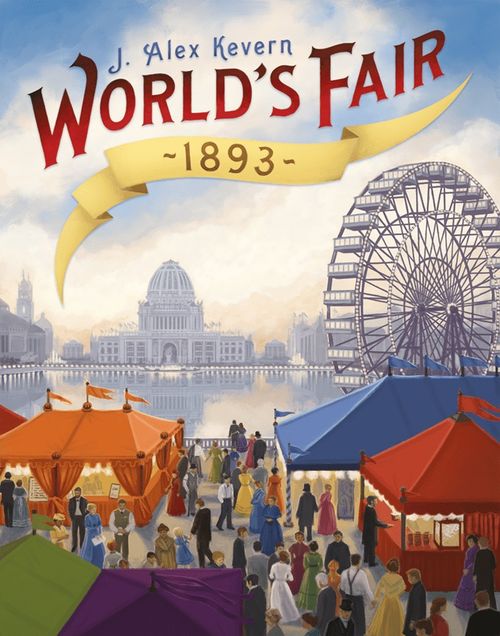
World's Fair 1893
World's Fair 1893 Rulebook
Table of Contents
Table of Contents
Components
- 40 main exhibit cards (5×8)
- 23 influential figure cards
- 1 central board
- 1 top wedge
- 5 area tiles
- 60 exhibit approval tokens (5 × 12)
- 28 midway ticket cards
- 1 Ferris wheel car
- 1 round marker
- 88 supporters (4 × 22)
- 37 leader medals
- 36 midway coins
- 4 start bonus cards
- 4 scoring reference cards
Gameplay Overview
World's Fair 1893 is played over three rounds, each ending with a scoring phase. On each turn, a player sends a supporter to an area of the fair and collects the cards there. In the scoring phases, players gain points if they have the most supporters in an area and if they have collected exhibit cards that match those areas where they lead. The player who has earned the most points by the end of the third round is declared the winner!
Setup
-
Place the central board and the top wedge together in the middle of the play area. Make sure the face-up sides of both pieces match the number of players. The Ferris wheel should have the following number of spaces:
- 4 players – 13 spaces
- 3 players – 11 spaces
- 2 players – 9 spaces
-
Arrange the area tiles randomly around the central board to form a hexagonal shape.
-
Place the Ferris wheel car on the central board covering the start space, which is marked with a star, at the bottom of the Ferris wheel.
-
Place the round marker on the far left space of the round track, at the beginning of Round 1.
The Ferris wheel at the fair, the first of its kind, carried 60 passengers in each car — 2,160 passengers total.
-
Shuffle all 91 main exhibit, midway ticket, and influential figure cards into a single draw deck and place it face down next to the base of the central board.
- For a 2-player game, remove six cards from the deck: one midway ticket and one main exhibit of each category.
- For a 4-player game, remove nine cards from the deck: five midway tickets, two Daniel Burnham cards, one George Davis card, and one Bertha Palmer card.
-
Place two cards from the draw deck face up by each area.
-
Set the exhibit approval tokens, midway coins, and leader medals off to one side.
-
Give each player 22 supporters of one color. Each player places one supporter on each of the five areas.
The fair was open for six months, from May 1 to October 30, 1893, and drew over 27 million visitors.
-
Determine a start player randomly. Give each player the start bonus card corresponding to their position in turn order (i.e., the start player receives the Player 1 card, the next player in clockwise order receives the Player 2 card, and so on). Each player then performs the action(s) listed on their start bonus card.
-
Use two scoring reference cards: the Step by Step card and the Step 2: Score Areas card that matches the number of players in the game. (Return the other two unused scoring reference cards to the box.)
Turn Details
On your turn, you will place one supporter on an area of your choice, play influential figures (if you have any), and then collect all the cards from that area. You will then add three new cards from the draw deck around the board.
Step 1: Place a Supporter
Choose an area and place one of your supporters on that area.
If you ever need a supporter (during Step 1 or Step 2) but do not have any in your supply, you may choose to remove one of your supporters from any area and use that one.
Step 2: Play Influential Figures
If you have any influential figure cards that you collected on your previous turn, you must play (or discard) them each now, in any order you choose. To play an influential figure, perform the action on the card, and then discard it. (See Card Reference for details on the actions.) You cannot save an influential figure for later use.
Step 3: Collect Cards
Take all the cards from the area where you placed your supporter in Step 1, placing them face up in front of you. (Each player's collected cards are always face up, visible for everyone to see.) For each midway ticket you collect, move the Ferris wheel car one space forward on the central board. If it reaches the start space at the bottom of the Ferris wheel, the car immediately stops; it does not skip over the start space. This triggers a scoring phase that will occur at the end of your current turn.
Even though influential figures may allow you to add extra supporters to other areas, you do not collect the cards from those areas. You only collect cards from the area where you placed your supporter in Step 1.
Step 4: Add Three New Cards
First, add one card from the top of the draw deck face up by the area where you placed your supporter in Step 1. Then, add one card by each of the next two available areas, in clockwise order. (Each area has a capacity indicated by the number of arrows on its outer edge, either 3 or 4. If the area is already at full capacity, it is not available; skip over it to the next available area.)
If you run out of cards in the draw deck, reshuffle the cards in the discard pile to form a new draw deck.
Once you've completed all four steps, your turn is over. If the Ferris wheel car stopped at the start space during your turn, the triggered scoring phase occurs after your turn and before the next player in clockwise order takes their turn (see Scoring Phases for details).
Turn Example
Alex begins his turn with no influential figures. He places a supporter on the Manufacturing area (Step 1) and collects the two cards from that area (Step 3). One of the cards he collected is a midway ticket, so he moves the Ferris wheel car forward one space on the central board.
He then adds three new cards to the board (Step 4). He adds the first card by the (currently empty) Manufacturing area. He adds the second card by the next available area, Electricity. The next area, Agriculture, is already at full capacity, so he skips over it; he adds the third card by the Transportation area.
Card Reference
Main Exhibits
These cards represent proposals for the main section of the fair. There are five categories of main exhibits, each matching one of the areas: Agriculture, Electricity, Fine Arts, Manufacturing, and Transportation.
Exhibits are considered "proposed" when you first collect them. Players with the most supporters in an area can have exhibits matching that area "approved" during a scoring phase. (See Scoring Phases for details on approving exhibits.) These exhibit cards are not worth any points on their own; only exhibit cards that have been converted into approval tokens during a scoring phase are worth points.
Players earn more points by having a wider variety of exhibit approval tokens at the end of the game. (A full set of five tokens of different categories is worth 15 points, while five tokens of the same category is worth only 5 points.) See End of Game for more details on scoring exhibits.
The main section of the fair contained over 65,000 exhibits in the beautiful buildings known collectively as the "White City."
Midway Tickets
For each midway ticket that you collect, the Ferris wheel car moves forward one space on the central board. (See Turn Details: Step 3: Collect Cards for more details.) When the Ferris wheel car stops at the start space at the bottom of the Ferris wheel, it triggers a scoring phase that will occur at the end of your current turn.
In each scoring phase, all players redeem their midway tickets for one point each, and the player with the most tickets also gains two bonus points. (See Scoring Phases for details on redeeming tickets.)
The Midway was a mile-long strip of attractions. Ticket sales from these attractions generated much of the profit for the fair.
Influential Figures
These cards represent favors you ask influential people to perform for you. When you collect an influential figure card, you must play (or discard) it on your next turn; you cannot save it for later use. To play an influential figure, perform the action on the card and discard it.
-
Daniel Burnham: Add one additional supporter to the same area where you placed your supporter this turn.
Daniel Burnham, one of the lead organizers, lived on the fairgrounds for over two years before the fair began.
-
George Davis: Add one additional supporter to an area adjacent to the area where you placed your supporter this turn.
The two areas on either side of the base of the central board are not considered adjacent to each other.
-
Bertha Palmer: Move any one supporter (yours or an opponent's) from any area to any other area.
-
Cyrus McCormick, Charles H. Schwab, Augustus Saint-Gaudens, George Westinghouse, and George Pullman: Add one additional supporter to the indicated area.
The Westinghouse Electric Company, owned by George Westinghouse, won the contract to provide electric lighting to the fair.
Scoring Phases
The game has three scoring phases, each occurring immediately after the turn in which the Ferris wheel car stops at the start space on the central board.
The player who triggers the scoring phase may take the Ferris wheel car as a reminder. After the scoring phase, that player returns the car to the start space, and play continues clockwise.
Move the round marker forward one space on the round track, to the end of the current round. Each scoring phase consists of three steps. (The midway coins, leader medals, and approval tokens awarded in the scoring phases are not limited. If any run out, use a pencil and paper to track them.)
1. Redeem Midway Tickets
Leader Bonus: First, the player with the most midway tickets gains two points in midway coins. If there is a tie for the lead, all tied players gain two points.
Redeem Tickets: Next, all players redeem their midway tickets for one point each. Redeemed midway tickets are placed in the discard pile.
2. Score Areas
Score all five areas, one at a time, beginning with the area to the left of the base of the central board and proceeding clockwise. (The number of points gained and the number of matching exhibits that can be approved depends on the number of players. Use the corresponding reference card for details.)
Leader Medals: The player(s) with the most supporters in an area gains a leader medal worth two or four points.
Approve Exhibits: The player(s) with the most supporters can also approve a certain number of their main exhibit cards that match the area. When an exhibit is approved, place the card in the discard pile and take a matching exhibit approval token.
-
1st: The player who alone has the most supporters gains a leader medal and can approve three matching exhibits.
-
2nd (3+ players only): The player who alone has the second-most supporters gains a leader medal and can approve one matching exhibit.
-
Tie – 1st: Multiple players who tie for the most supporters might gain a leader medal and can approve a certain number of matching exhibits.
When there is a tie for first place, no player is awarded second place; the next player is considered to be in (at least) third.
-
Tie – 2nd (4 players only): Multiple players who tie for the second-most supporters may approve one matching exhibit, but do not gain a leader medal.
3. Recall Supporters
Once all five areas have been scored, players recall some of their supporters. For every pair of supporters you have in an area, you must remove one of them.
The orange player has 6 supporters in the Agriculture area, and he recalls 3. The purple player has 5 supporters, and she recalls 2. The white player recalls 1 of his 2 supporters. The blue player has only 1 supporter and recalls none.
At the end of the first and second scoring phases, move the round marker forward one space on the round track, to the beginning of the next round.
End of Game
Once the third scoring phase is complete, the game is over. Each player totals up all the points they have gained from midway coins, leader medals, and approved exhibits.
Scoring Midway Coins
Each midway coin is worth points equal to the number on it (i.e., one or two).
Scoring Leader Medals
Each leader medal is worth points equal to the number on it (i.e., two or four).
Scoring Approved Exhibits
The wider the variety of main exhibits you get approved over the course of the game, the more points they are each worth. Group your exhibit approval tokens into sets, so that each set contains only one token from each category. Each set is worth the number of points shown in the table below.
| Set | Points |
|---|---|
| Full set of 5 | 15 points |
| Set of 4 unique | 10 points |
| Set of 3 unique | 6 points |
| Set of 2 unique | 3 points |
| Individual | 1 point |
(Unapproved exhibit cards are not worth any points. Only exhibit cards that have been converted into approval tokens during the game are worth points.)
The player with the most points is the winner! In case of a tie, the tied player with the most exhibit approval tokens wins. In case of a further tie, the tied player with the fewest unapproved main exhibit cards remaining wins. If there is still a tie, the tied players enjoy their shared victory.
Scoring Example
Beth ends the game with the following 9 exhibit approval tokens. She has a complete set of 5 different tokens, which is worth 15 points. She has another set of 3 (Transportation, Fine Arts, and Manufacturing), worth 6 points. She also has an individual token (Transportation), worth 1 point. Beth scores 22 points for her approved exhibits.
- Set of 5 = 15 points
- Set of 3 = 6 points
- Individual = 1 point
Beth also scores 11 points for her midway coins and 18 points for her leader medals.
Beth's final score is 51 points!
The Fairgrounds
Chicago, Illinois — May 1 to October 30, 1893
Sites & Buildings:
- Ferris Wheel
- Gallery of Fine Arts
- Illinois Building
- Woman's Building
- Transportation Building
- Mines and Mining Building
- Electricity Building
- Manufactures Building
- Administration Building
- Terminal Railway Station
- Machinery Hall
- Agriculture Building