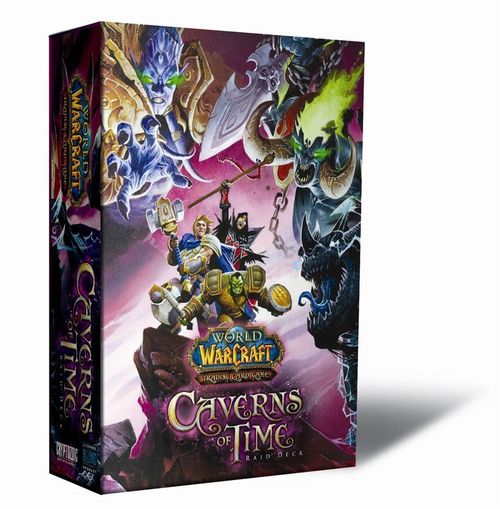
World of Warcraft Trading Card Game: The Caverns of Time Raid Deck
World of Warcraft Trading Card Game: The Caverns of Time Raid Deck Rulebook
Table of Contents
Table of Contents
Raid Rules
The Caverns of Time Raid Deck is an automated deck designed to be played against three players (the Raiders) using Class Starter Decks, Champion Decks, or Constructed Decks. All the Raiders need to do is follow the instructions on the Raid cards and overcome the challenges that await them within the Caverns of Time.
To begin the Raid, select three random Caverns heroes, shuffle them, and set them face down as the hero stack. Reveal the first Caverns hero, but do not resolve any Entrance powers of that hero (if any). Shuffle the Caverns deck and place it face down near the hero stack. During each Caverns turn, you will flip over and play some number of cards from the top of the Caverns deck to represent the abilities, allies, and events that the Raiders must overcome. Each of the Raiders puts out his starting hero, shuffles his deck, and draws a starting hand of seven cards, just like in a normal one-on-one game. Each Raider may choose to take one mulligan by shuffling his hand into his deck, then drawing seven new cards. Then, begin the game, with the Caverns taking the first turn of the game and play proceeding clockwise. If this is your first time raiding, have the Raiders take the first turn instead. (For more information, see Raid Difficulty Modes on page 3.)
The Caverns turn sequence is played as follows, much like a normal turn for a player, but with a few key differences. On each Caverns turn, do the following:
- First, ready all exhausted Caverns cards, including the Caverns hero card and its allies.
- Roll a die to randomly determine which of the Raiding heroes will be the MARKED hero for the turn. In general, Caverns attacks and abilities will be directed at the MARKED hero, its party, and its controller, unless otherwise noted.
- Flip cards from the top of the Caverns deck equal to the Flip value on the Caverns hero card (even on the very first Caverns turn). For example, if the hero has Flip 2, you flip and play the top two cards of the Caverns deck. The flipped cards are played and resolved one at a time.
- When an ally is flipped, it enters play as part of the Caverns hero's party. When an ability or event is flipped, resolve its effect as directed by the card. Raiders may interact with these cards just as though they were any other card of the appropriate type, including attacking, targeting, destroying, and interrupting them.
- After the Caverns cards have been flipped and played for the turn, the Caverns hero and allies attack the MARKED hero. Characters in the Caverns hero's party attack in the order they entered play, starting with the Caverns hero. As in standard play, Caverns allies can't attack the turn they enter play unless they have Ferocity.
- When all the characters in the Caverns party that can attack have done so, the Caverns turn ends.
After the Caverns turn has finished, the Raiders take their turns in clockwise order. If a Caverns hero has fatal damage (equal to or greater than its printed health), it is destroyed. Set the defeated hero on the side, then reveal the next Caverns hero, and resolve any Entrance powers it has. If there are no Caverns heroes remaining, the Raiders have defeated the raid.
If a Raiding hero is dealt fatal damage, all of that Raider's cards leave play. If fatal damage is dealt to all of the Raiding heroes, the Raiders have been defeated.
Special Raid Rules and Card Interactions
Cards that refer to a player's hand function differently when used against the Raid. If a card or effect would put a Caverns card into its owner's hand, it is put on top of the Caverns deck instead. If a card or effect would have the Raid discard cards, put that many cards from the top of the Caverns deck into the graveyard instead.
Some of the Caverns allies have the Boss keyword. While a Boss ally is in play, the Caverns hero can't be attacked. Players may still use abilities targeting the Caverns hero even if a Boss ally is in play. Additionally, when a Boss ally is destroyed by fatal damage, each Raiding player may draw a card.
All Caverns cards are considered to have a cost of 0 for purposes of referencing the cost of cards.
Raid Difficulty Modes
Depending on your relative level of experience with the World of Warcraft® TCG, you may choose an appropriate mode of difficulty when you challenge the Raid. If you find a particular mode too easy or difficult, adjust the starting difficulty as appropriate. It is recommended that you start your first Caverns Raid with the difficulty level at Novice, but ultimately, it is up to you how much of a challenge to are willing to undertake.
- Novice: The Raiders take the first turn, instead of the Caverns. (Brand new to Raiding)
- Experienced: The Caverns takes the first turn. (Experienced Raiders)
- Heroic: Include five to seven heroes in the hero stack, instead of three. (Constructed Decks or very experienced Raiders)
- Legendary: Face off against all eight Caverns heroes. (Glutton for punishment)
WARNING: Legendary difficulty may be hazardous to your hero's health. Symptoms include but are not limited to: despair, hopelessness, denial, anger, fear, doubt, sadness, sorrow, rage, or possibly even death (of your hero). If you experience a Raid that lasts more than four hours, consult a local judge immediately.
Glossary
ABSORB: When an ally you control with Absorb deals combat damage to a hero, it heals that much damage from your hero.
ACTIVATE: Some payment powers have an activate symbol (an icon) as part of their cost. To activate a card, you exhaust it (turn it sideways). An exhausted card can't be activated. An ally's activated powers can be used only if that card has been in its current party since the start of its controller's most recent turn. Only allies have this restriction. Protecting with a character is not the same as using an activated power.
ALLIANCE RACE: The Alliance races in the TCG are Draenei, Dwarf, Gnome, Human, Night Elf, and Worgen.
ASSAULT: A card with Assault X has +X ATK on your turn.
ATK: This is the attack value of a card. A card's ATK is the number in its lower-left corner. A hero or ally's ATK is how much combat damage it deals, and the symbol around the ATK tells you its damage type. If you strike with a weapon, its ATK and damage type are added to your hero that combat.
ATTACH: If an ability tells you to attach it to a card, you put the ability underneath such a card as the ability enters play. As a card leaves play, each of its attachments is destroyed. More than one attachment can be attached to the same card.
ATTACKER: An attacker is a hero or ally that's attacking. A hero or ally becomes an attacker as it exhausts to attack.
BASIC: Some powers have the Basic restriction. You may use a Basic power only during your turn. You may not use a Basic power while in combat, or to respond to other actions.
BLOODRUSH: Bloodrush powers are active only while an opposing hero has more damage on it than your hero.
CARD TYPE: There are six different card types: ability, ally, equipment, hero, location, and quest.
CAVERNS HERO 2+: Powers with Caverns Hero 2+ are active only if one or more Caverns heroes have been defeated.
CHAIN: The chain is the zone where cards and effects go before they resolve. The chain keeps track of the order in which things happen in the game. The order that things resolve off the chain is "last on, first off." The chain is empty while there are no cards or effects waiting to resolve.
CHARACTER: A character is a hero or ally.
COMBAT: During your action phase, you can propose combats with ready heroes and allies in your party.
COMBAT DAMAGE: Combat damage is damage that's dealt by an attacker or defender during the conclusion of a combat. Any other damage is not combat damage, even if it's dealt during a combat step.
CONTROL: You control your hero and all cards you put into play, including any abilities that you attach to a card in play, even if that card is controlled by another player. You also control cards and effects that you add to the chain.
COST: Cards and effects have costs that you must pay to play them. You can't pay only part of a cost, and you can't pay more of something than you have. The number in the upper-left corner of each card is its cost, which is how many resources you must exhaust to play that card.
COUNTER: A card may tell you to put one or more counters on a card in play. It will also tell you what those counters do. You can track counters on a card with beads, dice, or other small objects.
DAMAGE: Damage on a character stays on it until the damage is healed or the character leaves play. Damage greater than or equal to a character's health is called fatal damage. If an ally has fatal damage, it's destroyed. If a hero has fatal damage, its controller loses the game. A character is damaged if it has any amount of damage; otherwise, it's undamaged.
DEF: This is the defense value of an armor card. An armor's DEF (shield icon) is the number in its lower-right corner. The DEF is how much damage the armor prevents as you exhaust it.
DEFENDER: A defender is a character that's defending. A character defends as it enters combat with an attacker.
DESTROY: To destroy a card is to put it into its owner's graveyard from play. If a character has fatal damage or 0 health (drop icon), it's destroyed.
DUAL WIELD: While your hero has Dual Wield, you can control a second one-handed Melee weapon instead of an off-hand equipment. You can also strike with both your Melee weapons in the same combat.
DISCARD: To discard a card is to put it from a player's hand into his graveyard. Cards can be discarded only from a player's hand.
ECHO: When you play an ability with Echo, if you control two or more allies that share a Horde or Alliance race, copy that ability. You may choose new targets for the copy.
EFFECT: An effect is a placeholder on the chain. Using a power, completing a quest, proposing a combat, and striking with a weapon all add effects to the chain. Triggering also creates an effect that is added to the chain. An effect waits on the chain until it resolves or is interrupted.
ELUSIVE: Characters with Elusive can't be attacked. However, they can still attack, and they can still be targeted as usual by powers and abilities.
ENTRANCE: A hero's Entrance power triggers when the hero is first revealed. The starting hero's Entrance power does NOT trigger.
EQUIPMENT: An equipment card is an armor, item, or weapon.
EXHAUST: To exhaust a card in play, turn it sideways; once that's been done, the card is referred to as "exhausted." You can't exhaust a card that's already exhausted to pay a cost. The opposite of exhausted is "ready."
FACE DOWN: Heroes and quests have powers that cause them to flip face down. When either flips face down it remains in play. Heroes still have the characteristic of being a hero. When a quest turns face down, it is no longer a quest, but it is still a resource that can be exhausted to pay costs.
FATAL DAMAGE: Fatal damage is damage on a character that's greater than or equal to its health. If an ally has fatal damage, it's destroyed. If a hero has fatal damage, its controller loses the game.
FEROCITY: An ally with Ferocity can attack on the same turn that it enters play.
FLIP: To flip a face-up hero, you turn it face down, and vice versa. Heroes can be flipped whether they're ready or exhausted.
FRIENDLY: All the characters controlled by you and the players on your team are friendly.
HASTE: A card with Haste X costs X less to play if an ally you control dealt damage to an opposing hero this turn.
HEAL: To heal an amount of damage from a character, remove that much damage from it. You can only heal damage that's already been dealt. Healing can't raise a character's health.
HEALTH: The number in the lower-right corner of a character card is its health (health icon). If a character accumulates damage equal to or greater than its health (fatal damage), it's destroyed. If a hero is destroyed, its controller loses the game.
HORDE RACE: The Horde races in the TCG are Blood Elf, Goblin, Orc, Tauren, Troll, and Undead.
IN COMBAT: An attacker or defender is in combat while there's an opposing attacker or defender.
INSTANT: Some cards have Instant on their type line. You can play an instant any time you have priority, even during your opponent's turn.
INTERRUPT: An interrupted card or effect is removed from the chain and does nothing. If a card is interrupted, it's put into its owner's graveyard. A card can be interrupted only while it's on the chain.
INVINCIBLE: A card with Invincible can't leave play, be targeted, or be dealt damage.
LOCATION: Instead of placing a quest or face-down resource, you may place a Location card. Locations have a map instead of a cost in their upper-left corner. If you ever have more than one location face up in your resource row, you must immediately turn all but one face down. You choose which one stays face up.
LONG-RANGE: Defenders deal no combat damage to an attacking character with Long-Range. This is different from the ranged damage type.
MARKED: The Raid's attacks, cards, and powers will be directed at the MARKED hero, its party, and/or its controller, unless otherwise noted. The MARKED hero is chosen at random at the start of the Caverns turn.
MASTER HERO: A master hero is a special kind of card that a player may include in his deck. When played the player's hero transforms into the master hero, in essence becoming the new character. When a player's hero becomes a master hero, it retains the original hero's attachments, counters, damage, and orientation (ready or exhausted).
MEND: At the start of your turn, a character with Mend X may heal X damage from target hero or ally.
NEUTRAL: A neutral card has no class or faction icon, so it can go into any deck.
ONGOING: Ongoing abilities enter play as they resolve; non-Ongoing abilities enter your graveyard. The text after the word "Ongoing" tells you an ability's powers while it's in play.
OPPOSING: Opponents are opposing players. Opposing zones are owned by opponents. Opposing cards are cards in play or on the chain that are controlled by opponents, cards in opposing zones, or any attachments that were played by an opponent (including ones on your cards).
OWNER: You are the owner of your hero and any card that started the game in your deck. If a card would enter a deck, hand, or graveyard, it enters its owner's deck, hand, or graveyard.
PAYMENT POWER: A payment power can be identified by the arrow symbol in its text (arrow). The text before the arrow is the cost that you must pay to use the power, and the text after the arrow is what happens as that effect resolves. Unless a card says otherwise, you can use payment powers during any phase of any player's turn.
PLACE: Once on each of your turns, you may place a resource. To place a resource, choose a card from your hand and put it into your resource row. Quests and locations may be placed face up; other cards can only be placed face down.
PLAY: To play a card, put it on the chain, choose any targets it describes, and pay its costs. A player can play an instant card any time he or she has priority. Quests and locations can't be played; they can only be placed.
POWER: When a card has text in its text box that has an impact on the game, that text is a power. Powers function only on cards in play unless otherwise specified.
PREVENT: Prevented damage is never dealt. Exhausting an armor to prevent damage that would be dealt to your hero is an example of preventing damage.
PROPOSE: To propose a combat, choose a proposed defender and a ready hero or ally in your party to be the proposed attacker.
PROTECT: Just before a proposed defender enters combat, any player opposed to the attacker may exhaust a character in his or her party that can protect (for example, a character with the Protector keyword). If that happens, the proposed defender stops being the proposed defender, and that exhausted character becomes the proposed defender and starts protecting. Only one character can protect each combat. A proposed defender can't protect itself.
PROTECTOR: A character with Protector can exhaust to become the defender when an opposing hero or ally attacks.
RACE: The Alliance races in the TCG are Draenei, Dwarf, Gnome, Human, Night Elf, and Worgen. The Horde races in the TCG are Blood Elf, Goblin, Orc, Tauren, Troll, and Undead. Other races include Beast, Demon, Dragonkin, Murloc, Naga, and Ogre.
RAIDER: You and your teammates are Raiders. The cards that you and your teammates control are Raiding cards.
RARITY: The color of a card's collector number tells you its rarity: white for common, green for uncommon, blue for rare, purple for epic, and orange for legendary.
READY: A card in play is ready while it isn't exhausted (turned sideways). All cards enter play ready. Only ready cards can be exhausted to attack or pay costs. As your ready step starts, ready all exhausted cards in play that you control. As you ready a card, you change it from the exhausted position to the ready (upright) position.
REMAINING HEALTH: A character's remaining health is the difference between its health (health icon) and the amount of damage that character has.
RESOURCE: You may place one resource on each of your turns. Any type of card can be placed face down as a resource, but only quests and locations can be placed face up. You exhaust resources to pay the resource costs to play cards, use payment powers, complete quests, and strike with weapons. Resources can be exhausted whether they're face up or face down.
REVEAL: To reveal a card is to turn it face up so that all players can see it. Revealing a card doesn't move it out of the zone that it's in. After a card is revealed, it goes back to being unrevealed in the same zone unless otherwise specified.
RIFT: As you play a card with Rift, choose a Horde or Alliance race. You pay 1 less to play that card for each ally you control of the chosen race.
SENTINEL: When an ally with Sentinel exhausts for the first time each turn, ready it.
SMASH: If a character with Smash would deal more than fatal combat damage to an ally, the rest is dealt to that ally's controller's hero.
SPELLSHIELD: A card with Spellshield can't be targeted by opposing cards and effects.
STEALTH: While a character with Stealth is attacking, opposing characters can't protect.
STRIKE: The strike cost of a weapon is the number in its lower-right corner. That number is how many resources you must exhaust to strike with that weapon. While a hero is in combat, its controller may strike with a ready weapon by paying its strike cost and exhausting it. This adds the weapon's ATK and damage type to the hero for the rest of the combat.
TAG: A card may have a tag on the right-hand side of the type line, followed by a number in parentheses. That number is how many cards with that tag you can have in your party at the same time. Any time you control more than that number of cards with that tag, you must immediately destroy all but that number of them. You choose which ones to keep.
TALENT: If you include a Talent Spec card in your deck, you may not include cards of any other Talent Spec in your deck.
TARGET: If a card or effect tells you to target something, you must choose that target as you play it. If there is no legal target, you can't play that card or effect. Once you choose a target, you can't change your choice, even if something happens to the target you chose. If a card or effect tries to resolve and all of its targets have become illegal, it's interrupted. If at least one target is legal, it resolves.
TOKEN: Tokens are used to represent allies in play. You may use anything you like to represent a token ally, like a coin or a die.
TOTEM: A Totem is a Shaman card that counts as both an ability and an ally in all zones. As such, it may be targeted like any other character or Ongoing ability. A Totem can't attack, but it may be attacked like any other character as well.
TRIBE: Tribe powers trigger when a Tauren ally enters play under your control.
UNITY: Unity powers are active only while you control three or more Human allies.
UNLIMITED: Some cards have the Unlimited tag on their type line. You can include any number of unlimited cards in your deck, ignoring the normal four-copy limit.
ZONE: Cards can be in any one of six game zones: chain, deck, graveyard, hand, play, and removed from game (RFG).