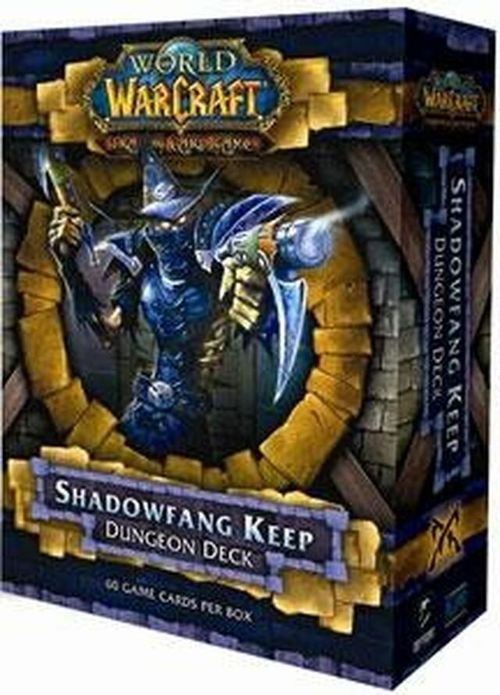
World of Warcraft Trading Card Game: Shadowfang Keep Dungeon Deck
World of Warcraft Trading Card Game: Shadowfang Keep Dungeon Deck Rulebook
Table of Contents
Table of Contents
Dungeon Deck Rules
A Dungeon Deck is an automated deck designed to be played against three players (the Raiders) using Class Starter Decks. All the players need to do is follow the instructions on the dungeon cards and overcome the challenges the dungeon throws at them!
To begin a Dungeon Raid, place the Dungeon hero on the board with its Level 1 version face up. Shuffle the Dungeon Deck and place it face down near the Dungeon hero. During each Dungeon turn, you will flip over and play some number of cards from the top of the Dungeon Deck to represent the abilities, allies, and equipment the Dungeon will present to challenge the Raiders. Each of the Raiding players puts out his starting hero, shuffles his deck, and draws a starting hand of seven cards, just like in a normal one-on-one game. Each player may choose to take one mulligan by shuffling his hand into his deck, then drawing seven new cards. Then, begin the game, with the first Raider taking the first turn of the game and play proceeding clockwise.
The Dungeon Deck's turn sequence is played as follows, much like a normal turn for a player, but with a few exceptions:
- First, ready all exhausted Dungeon cards, including the Dungeon hero and its allies.
- Check to see if the Dungeon hero should level up, as detailed on the card (based on the amount of damage on Raiding heroes). For example, a Dungeon hero with Level Up: 10 will level up if at least one Raiding hero has 10 or more damage on it at the start of the Dungeon's turn. Note that there are two oversized Dungeon hero cards, representing the four levels of difficulty of the Dungeon hero. See Level Up Rules for more information on this.
- Roll a die to randomly determine which of the Raiding heroes will be the MARKED hero for the turn. In general, all attacks and abilities will be directed at the MARKED hero, its party, and its controller, unless otherwise noted.
- Flip cards from the top of the Dungeon Deck equal to the Flip value on the Dungeon hero (even on the very first Dungeon turn). For example, if a Dungeon hero has Flip 2, you flip and play the top two cards of the Dungeon Deck. The flipped cards are played and resolved one at a time. When an ally is flipped, it enters play as part of the Dungeon party. When an ability is flipped, resolve its effect as directed by the card. When an equipment is flipped, it enters play as part of the Dungeon party and can be used by the Dungeon hero, as directed by the equipment. Raiders may interact with these cards just as though they were any other card of the appropriate type, including attacking, targeting, destroying, and interrupting them.
- After the Dungeon has flipped and played its cards for the turn, the Dungeon hero and allies attack the MARKED hero. Dungeon characters attack in the order they entered play, starting with the Dungeon hero. Dungeon allies cannot attack the turn they enter play, unless they have Ferocity.
When all the Dungeon characters that can attack have done so, the Dungeon ends its turn, and the Raiders take their turns in clockwise order. If the Dungeon hero has fatal damage (equal to or greater than its printed health, shown by the blood-drop icon), it is destroyed, and the Raiders have defeated the Dungeon. If the Dungeon deals fatal damage to a Raiding hero, all of that Raider's cards leave play. If the Dungeon deals fatal damage to all of the Raiding heroes, the Dungeon has defeated the Raiders.
Special Dungeon Rules and Card Interactions
Cards that refer to a player's hand function differently when used against the Dungeon. If a card or effect would put a Dungeon card into its owner's hand, it is put on top of the Dungeon deck instead. If a card or effect would have the Dungeon discard cards, put that many cards from the top of the Dungeon deck into the Dungeon graveyard instead.
Some Dungeon allies have the Boss keyword. While a Dungeon Boss ally is in play, Raiders can't attack the Dungeon hero, but must first defeat the Boss before they can attack the Dungeon hero again. Players may still use abilities on the Dungeon hero even if a Boss ally is in play.
All Dungeon cards are considered to have a cost of 0 for purposes of referencing the cost of cards.
Dungeon Difficulty Modes
Depending on your relative level of experience with the World of Warcraft TCG, you may choose an appropriate mode of difficulty when you challenge the Dungeon. If you find a particular mode too easy or difficult, adjust the starting difficulty as appropriate. It is recommended that you start your first Dungeon Raid with the difficulty mode at Novice, but ultimately, it is up to you how much of a challenge to are willing to undertake.
- Novice: The Dungeon hero starts at Level 1. The Raiders take the first turn. (Brand new to Raiding)
- Experienced: The Dungeon hero starts at Level 1. The Dungeon takes the first turn. (Experienced Raiders)
- Heroic: The Dungeon hero starts at Level 2. The Dungeon takes the first turn. (Constructed Decks)
- Legendary: The Dungeon hero starts at Level 3. The Dungeon takes the first turn. (Glutton for punishment)
NOTE: Attempting to defeat the Dungeon on the Legendary mode of difficulty may produce feelings of overwhelming despair and hopelessness, and is a challenge not intended to be undertaken by the faint of heart! Consider yourself warned.
Level Up Rules
Both the Dungeon hero and the Raiding heroes will have the opportunity to level up! The Dungeon hero levels up at the start of its turn depending on how much damage it has dealt to the Raiding heroes, as detailed on the Dungeon hero itself. Each Dungeon hero can level up three times: first, when at least one Raiding hero has 10 or more damage on it; second, when at least one Raiding hero has 20 or more damage on it; and finally, when at least one Raiding hero has been destroyed. If a Dungeon hero can level up multiple times at the start of a turn, it will do so.
All damage, attachments, and orientation (ready or exhausted) of the Dungeon hero remain when it levels up, but sometimes, other powers and attributes of the Dungeon hero (Flip, ATK, health, or other powers) can change. Additionally, some cards may reference the current level of the Dungeon hero. These cards will only trigger their additional powers if the Dungeon hero is at or above the Level listed on the card.
Raiders can level up their heroes by earning experience (XP) from the Dungeon. Experience can be earned on a Dungeon run in a variety of ways, as listed below:
Experience Table
| Experience | Source |
|---|---|
| 5 XP | First attempt at a particular Dungeon run |
| 2 XP | Each subsequent Dungeon run |
| 2 XP | Deal damage to the Dungeon hero equal to at least half its health, but fail the Dungeon |
| 5 XP | Destroy the Dungeon hero |
| 2 XP | Each Boss ally destroyed during a Dungeon run |
NOTE: You can only earn each Achievement once per Dungeon run. Raiders can look at the achievement cards at any time to help determine if/how they wish to complete the Achievements. When either the Dungeon or the Raiders have been defeated, Achievements that were completed during the Dungeon run will grant experience. All Raiders share in the group's accomplishments, earning the same experience for a Dungeon run regardless of the outcome or who actually earned an Achievement (even if they were dead at the time). Players can keep track of the progress made with the included Character Sheets, noting the progress made and Achievements earned during Dungeon runs.
Raider Leveling Guide
For each 10 XP a Raider accumulates, he can level up his deck, customizing it to improve his chances of defeating the Dungeon and subsequently challenging it at higher modes of difficulty. A Raider may level up his deck by adding and/or replacing cards as follows:
- Level 10 (10 XP): Two copies of any Common ability and two copies of any Common ally
- Level 20 (20 XP): Two Rare cards, including Talents
- Level 30 (30 XP): Two copies of any Common or Uncommon equipment, and two copies of any Common or Uncommon ally
- Level 40 (40 XP): Two Rare cards, including Talents
- Level 50 (50 XP): Two copies of any Common or Uncommon ability, and two copies of any Common or Uncommon ally
- Level 60 (60 XP): Two Rare or Epic cards, including Talents
- Level 70 (70 XP): Two copies of any Common or Uncommon equipment, and two copies of any Common or Uncommon ally
- Level 80 (80 XP): Two Rare or Epic cards, including Talents
- Level 85 (85 XP): Your starting and maximum hand sizes are both eight (instead of seven), and your hero has +10 health!
Level Up Example: You choose to raid with Frizlix of Kezan, the Horde Rogue Class Starter Deck. After a couple of Dungeon runs, you earn enough XP to reach Level 10. Now you can add two Common abilities and allies to your deck. The Dungeon Deck Treasure Pack is a great place to start when looking for cards to use when you level up. You have quite a few Rogue allies in your deck, Poison Tipped would be a great addition. Shattered Hand Assassin is also a great choice, not only because he is another Rogue ally, but also because he can help keep Dungeon allies from attacking.
At Level 20, you can add Rare cards to your deck. A weapon like Smite's Reaver would be great, but you can also choose Talents and even respec Frizlix if you don't want to be a Combat Rogue. Enveloping Shadows is a powerful Talent for a Subtlety Rogue and a useful tool to have at your disposal against the Dungeon.
As you continue to level up, you can add more powerful cards to your deck and replace ones that you don't find to be quite as useful. Eventually, you may earn enough XP to challenge the Dungeons at higher modes of difficulty. Ultimately, it is up to you what direction to take with your hero, and as you play against the different Dungeons, you may find that you want to change your focus, depending on what you find most effective for each particular Dungeon. It's up to you to find the best tools available to defeat Cookie, Mograine, and Godfrey, so don't be afraid to try out new cards and strategies with your Raid group.