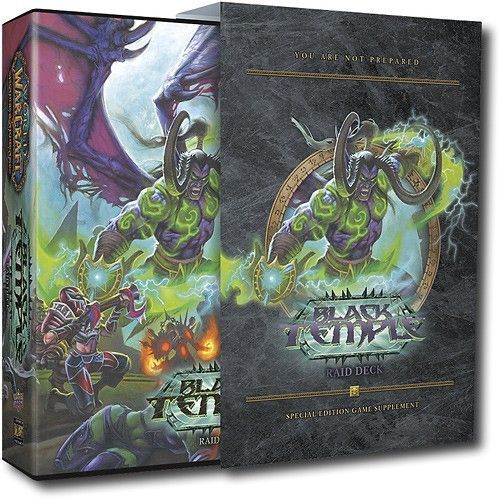
World of Warcraft Trading Card Game: Black Temple Raid Deck
World of Warcraft Trading Card Game: Black Temple Raid Deck Rulebook
Table of Contents
Table of Contents
Overview
In this game, one player will pilot the Black Temple Bosses, and the other players will take on the role of a raiding party, playing their own decks built from the World of Warcraft TCG card pool.
The Black Temple Raid Deck is designed to be played against three raiding players.
For complete World of Warcraft TCG game rules and an interactive demo, please visit www.WoWTCG.com.
What's in this Box?
- 40-card Main deck
- 28-card Minion deck
- 23-card Event deck
- 5-card Betrayer Event deck
- 10 two-sided, oversize hero cards
- 13 two-sided ally tokens
- 12-card treasure pack
Object of the Game
For the Boss player, the object of the game is simple: destroy all those who dare challenge the might of the Betrayer. A raiding player is destroyed if his or her hero takes fatal damage (damage greater than or equal to its health), or if that player has to draw a card from an empty deck.
For the raiding players, the object of the game is to work together to defeat the many Bosses of the Black Temple Raid Deck, starting with High Warlord Naj'entus and ending with the final encounter with The Betrayer. Deal fatal damage to The Betrayer, and the Boss player will be defeated.
Setup
Each raiding player brings a standard 60-card (minimum) deck and hero.
If one or more raiding players are Alliance, then none can be Horde, and vice versa. No other restrictions apply. For example, Traitor heroes can be in a raiding party with non-Traitors, and Demon heroes can be in a raiding party with non-Demons.
The Boss player shuffles the Main deck, the Minion deck, the Event deck, and the Betrayer Event deck. Keep these decks separate. Set aside the 5-card Betrayer Event deck and the ally tokens.
High Warlord Naj'entus is the first Boss. (The "Boss Hero 1" on his type line is a reminder.) He starts the game in play.
Each player (including the Boss player) puts the top seven cards of his or her deck into hand. The Boss player uses the Main deck. All players, including the Boss player, may mulligan as usual.
The raiding player to the Boss player's left goes first, and then play proceeds clockwise. Unlike in a regular game, the first player does not skip drawing a card during the first draw step.
Gameplay
Overview
In many ways, the game plays like a traditional multiplayer game of the World of Warcraft TCG.
- A hero or ally with protector can protect any friendly character. A friendly character is controlled either by you or the players on your team.
- If a raiding player's hero is destroyed, all of his or her cards are removed from the game. This includes abilities attached to other players' cards.
- The Black Temple Bosses, Minions, and ally tokens can attack any opposing hero or ally. Raiding players can attack the current Boss or any of his or her Minions or ally tokens.
- Each raiding player's turn follows the phases and steps of a regular game, as shown by the diagram below:
[Turn diagram: Ready Step, Draw Step, Betrayer Event Step (only while The Betrayer is in play), Combat Step(s) (Play Cards, Use Powers, Make Attacks), Wrap-Up Step.]
While there are many similarities between a regular multiplayer game and a Black Temple Raid game, there are several important differences.
Boss Turn Sequence
The Boss player's turn sequence is as follows:
Start Phase
The Boss player readies all of his or her cards as the ready step starts, including all Event and Betrayer Event cards in play.
As the draw step starts, the Boss player draws one card from the Main deck.
See Betrayer Events for more information about the Betrayer Event step.
Minion Phase
As the Minion phase starts, the Boss player puts the top card of the Minion deck face down into his or her resource row without looking at it.
Action Phase
The Boss player can't place a resource during the action phase. The rest of the Boss player's action phase plays like a regular game.
End Phase
During the wrap-up step, the Boss player discards down to his or her maximum hand size of ten cards. (Each raiding player's maximum hand size is seven cards as usual.)
Resources: Minions and Events
Raiding players can't destroy the Boss player's resources or otherwise remove them from his or her resource row.
The Boss player can't place resources. Instead, there are two ways to put cards into the Boss player's resource row. The Boss player can't look at his or her face-down resources at any time.
Minions
During the Minion phase, the Boss player puts the top card of the Minion deck face down into his or her resource row without looking at it. These cards can be exhausted to pay resource costs as usual.
When a Boss is destroyed, the Boss player removes all face-down Minion resources from play and then puts them into play face up as allies. (Note: Just like regular allies, Minions can't attack or use powers unless they've been under the Boss player's control since the start of his or her most recent turn.)
If a Minion is destroyed, it's put into the Minion graveyard. If a Minion would otherwise leave play during a Raid, it's put into the Minion graveyard instead. Minions can change controllers, unless otherwise specified.
Minions have a resource cost in their top left corner because they can be included in regular decks outside of this Raid. During a Raid game, the Boss player never pays a resource cost to play a Minion; they enter play as described above.
Events
Starting with Boss 2 (Supremus), each Boss enters play with a number of Event cards. This number appears on the right side of the Boss's type line. (Betrayer Events follow different rules, as described in the Betrayer Events section.)
As a Boss enters play, the Boss player puts the specified number of cards from the top of the Event deck face down into his or her resource row without looking at them. These cards can be exhausted to pay resource costs as usual.
When a Boss is destroyed, the Boss player turns over each face-down Event resource, one at a time. As an Event is turned over, it's removed from play and added to the chain. Each player (starting with the Boss player and going clockwise) has a chance to respond before that Event resolves. After each Event resolves, the Boss player turns over the next Event and adds it to the chain, until none remain. Players can't interrupt Event cards.
Once an Event resolves, it's put into the Event graveyard, unless it's ongoing. If it's ongoing, it re-enters play face up, and it is put into the Event graveyard as the next Boss is destroyed. While an Event card is face up in play, it's no longer a resource, and raiding players can't interact with that card in any way.
Boss Destruction
As a Boss is destroyed, do these actions immediately, in the following order:
- Remove that Boss from the game.
- Put all face-up Events into the Event graveyard, and then turn all face-down Event resources face up, one at a time (see Events).
- Remove all face-down Minion resources from the game, and then put them into play face up with the next Boss (see Minions). All Minions and ally tokens already in play remain in play.
The next Boss enters play with the number of Event cards specified on the right side of its type line (see Events). Some Bosses also enter play with a specified number of ally tokens (see Ally Tokens).
A new Boss can use its activated ( ) powers immediately, and when it's the Boss player's turn, it can also attack immediately.
Ally Tokens
Bosses 3 (Shade of Akama), 6 (Shrine of Lost Souls), and 8 (The Illidari Council) each enter play with associated ally tokens. Each token specifies its associated Boss on the right side of its type line, followed by a number. This number tells you how many copies of that token enter play with that Boss. For example, six Ashtongue Channelers enter play with Shade of Akama.
Just like regular allies, ally tokens can't attack or use powers until they've been under the Boss player's control since the start of his or her most recent turn.
Tokens cease to exist outside of the play zone. They can change controllers, unless otherwise specified.
Threat Level
Each Black Temple Raid Boss has a new icon that represents its Threat Level. If a Boss has a Threat Level, it's located on the upper-right corner of its card.
A Boss's Threat Level is the maximum number of resources a raiding player may have at the end of his or her turn. During the wrap-up step of each raiding player's turn, if he or she has more resources than the current Boss's Threat Level, that player must destroy resources until he or she has resources equal to that Threat Level.
Boss 1 (High Warlord Naj'entus) has a Threat Level of 4. This number increases by 1 for each of the next six Bosses. Boss 8 (The Illidari Council) and Boss 9 (The Betrayer) have no Threat Level, allowing raiding players to have any number of resources.
The Bosses
There are nine Bosses in the Black Temple Raid Deck. Each Boss has the words "Boss Hero" followed by a number (1 through 9) on its type line. Bosses enter the game in ascending order.
Four Bosses have special rules associated with them. These rules are explained below.
Boss 4: Teron Gorefiend (Ghost Rules)
This encounter has its own set of rules (the "ghost rules"), which are as follows:
- While Teron is face up, at the end of the Boss player's turn, he or she puts four Shadowy Construct ally tokens into play and chooses a raiding player. That raiding player becomes a ghost until Teron flips or is destroyed.
- All players and characters are non-ghosts by default. Each player chosen by Teron becomes a ghost, which means that characters in that player's party also become ghosts. The Boss player never becomes a ghost.
- In general, non-ghosts can't interact with ghosts, and vice versa. For example:
- Ghosts can't attack or damage non-ghosts, and vice versa. Shadowy Constructs, however, are ghosts that can attack and damage only non-ghosts.
- Only ghost protectors can protect against ghost attackers, and only non-ghost protectors can protect against non-ghost attackers.
- Ghosts can't be targeted by non-ghost players or affected by non-ghost modifiers, and vice versa. For example, let's say that Player A attaches Mark of the Wild to Player B's ally. Later, Player B and his ally become ghosts, while Player A remains a non-ghost. Player B's ally is no longer affected by Mark of the Wild's modifier (but it remains attached), and Player A can no longer target that ally.
- When the last Shadowy Construct leaves the Boss player's party, Teron flips. When Teron is destroyed, all Shadowy Constructs are removed from the game. In both cases, all ghosts revert to being non-ghosts.
Boss 6: Reliquary of Souls
The Reliquary of Souls is the only Boss to appear across the four sides of two different cards. It first enters play with the Shrine of Lost Souls face up. The Shrine is immune until it flips to become the Essence of Suffering (see Special Boss Rules).
If the Essence of Suffering would be destroyed, it is removed from the game and the Essence of Desire enters play in its place undamaged. This is still the same Boss, so no Event or Minion cards are flipped. If the Essence of Desire would be destroyed, remove all damage from it and flip it to its Essence of Anger side. Only after the Essence of Anger is defeated is Boss 6 destroyed.
Any attachments stay attached through each of these transitions (even between the Essence of Suffering and the Essence of Desire), and if the Boss is exhausted, it remains exhausted.
Boss 8: The Illidari Council
The Illidari Council is the penultimate Boss the raiders must face, and it enters play with one copy of each of the following ally tokens: Gathios the Shatterer, High Nethermancer Zerevor, Lady Malande, and Veras Darkshadow. These ally tokens can't leave the Boss player's party until all of them have been dealt fatal damage.
When The Illidari Council flips to its back side, the Boss player issues a final warning and sets the stage for the encounter with The Betrayer. The following actions are performed in order:
- Remove The Illidari Council from the game.
- Put all face-up Events into the Event graveyard, and then turn all face-down Event resources face up, one at a time (see Events).
- Remove all face-down Minion resources from the game, and then put them into play face up with The Betrayer (see Minions). All Minions and ally tokens already in play remain in play.
- The Boss player's hand is discarded into the Main deck graveyard, and then he or she puts seven new cards from the Main deck into hand. (Note: These seven cards can't be mulliganed.)
Boss 9: The Betrayer
The Betrayer enters play with five face-down Events, and while he is in play, the Boss player puts a Minion resource face down each turn as usual. Since The Betrayer is the final Boss, none of these resources will ever turn face up. They are used only to pay resource costs.
Boss Card Text
The following Boss card abilities are printed in the booklet's sample card art and are reproduced as printed:
- Boss Hero 1, High Warlord Naj'entus (Naga Traitor), Threat Level 4: Immune (Can't be attacked, damaged, or targeted.) At the end of your turn, put a spine counter on target opposing hero, and Naj'entus deals 2 melee damage to it. 2 (cost icon), Exhaust a hero or ally in your party with no spine counters: Destroy all spine counters and flip Naj'entus. Only opponents can use this power.
- Boss Hero 2, Supremus (Abyssal Demon Traitor), 1 Event: Supremus has +2 ATK while attacking. When Supremus deals combat damage to a hero or ally, he may also deal that much melee damage to another target hero or ally. At the end of your turn, flip Supremus.
- Boss Hero 4, Teron Gorefiend (Undead Death Knight Traitor), 2 Events: Teron has +4 ATK while attacking. At the end of your turn, put four Shadowy Constructs into play, and a non-ghost opponent becomes a ghost until Teron flips or is destroyed. When the last Shadowy Construct leaves your party, flip Teron. At the start of your turn, you win the game if all opponents are ghosts. (See ghost rules.) Back side: Teron has +2 ATK while attacking. At the end of your turn, choose a random opponent, and Teron deals 1 shadow damage to each hero and ally in that opponent's party for each of your resources.
- Boss Hero 6, Shrine of Lost Souls (Traitor), 3 Events: Immune (Can't be attacked, damaged, or targeted.) When the last Soul Fragment leaves your party, flip Shrine of Lost Souls.
- Boss Hero 6, Essence of Suffering (Traitor): Essence of Suffering has +15 ATK while attacking. Opposing heroes and allies are protectors. If Essence of Suffering would be destroyed, swap it with Essence of Desire instead. (This is not a new hero.)
- Boss Hero 6, Essence of Desire (Traitor): Essence of Desire has +5 ATK while attacking. When Essence of Desire is dealt damage, it deals that much melee damage to its source. If Essence of Desire would be destroyed, remove all damage from it and flip it instead.
- Boss Hero 6, Essence of Anger (Traitor): At the start of your turn, put five anger counters on Essence of Anger. Essence of Anger has +X ATK while attacking, where X is 5 plus the number of anger counters. Remove an anger counter: Essence of Anger deals 1 melee damage to target ally.
Ally token Ashtongue Channeler (Broken Channeler, Shade of Akama: 6): Ashtongue Channeler can't attack. 1 (cost icon), Destroy Ashtongue Channeler: Draw a card.
Note: The booklet shows the card faces of Boss Hero 3 (Shade of Akama), Boss Hero 5 and Boss Hero 7, and the individual Betrayer Event cards, only as card art. Their card-face text is not legible in the booklet's text layer and is not reproduced here; those cards' printed text is on the cards themselves.
Betrayer Events
While The Betrayer is in play, a Betrayer Event step takes place immediately after the Boss player's draw step. During the Betrayer Event step, the Boss player adds the top card of the Betrayer Event deck to the chain. Each player (starting with the Boss player and going clockwise) has a chance to respond before that Betrayer Event resolves. Players can't interrupt Betrayer Event cards.
All Betrayer Events are ongoing, so they enter play face up as they resolve and stay in play for the rest of the game. While a Betrayer Event card is face up in play, it's not a resource, and raiding players can't interact with that card in any way.
If the Betrayer Event deck runs out of cards, the Boss player skips this step.
Special Boss Rules
- Bosses can be destroyed only by fatal damage. Raiding players can't turn any Boss over or remove its powers.
- Raiding players can't destroy the Boss player's resources (Events or Minions) or otherwise remove them from his or her resource row.
- The Boss player has a separate graveyard for each of his or her Main, Minion, and Event decks. Raiding players can't remove cards from any of these graveyards. The Boss player doesn't lose the game if any of these decks runs out of cards. If that happens, the Boss player replenishes that deck by shuffling its graveyard.
- Some Bosses have the immune keyword power. While a Boss has this keyword face up, it can't be attacked, damaged, or targeted. In addition, Black Temple Bosses can't attack while they're immune.
Modes of Play
Standard Mode
The Standard Mode for Black Temple is a "full clear," starting with Boss 1 (Naj'entus) and ending with the defeat of Boss 9 (The Betrayer). Standard Mode is recommended for three raiding players. However, feel free to add one or two more raiding players to adjust the difficulty level.
Raid Decks should be played directly out of the box and not customized in this mode.
Heroic Mode
Once the raiders have defeated the Raid with three players, it's time to move to Heroic Mode. Heroic Mode is recommended for one to three raiding players.
Raid Decks can be customized as follows:
- Main Deck: Up to 4 copies of any Black Temple ability, minimum of 40 cards
- Minion Deck: Up to 4 copies of any Black Temple Minion, minimum of 28 cards
- Event Deck: Up to 2 copies of any Black Temple Event, minimum of 23 cards
- Betrayer Event Deck: No change from Standard Mode
Epic Mode
Epic Mode is the ultimate challenge. It is neither fair nor balanced for raiding players.
- Main Deck: Any number of Black Temple or Traitor* abilities, no minimum deck size
- Minion Deck: Any number of any Traitor* allies (including non-Raid Deck allies such as Lady Vashj and Prince Kael'thas Sunstrider), no minimum deck size
- Event Deck: Any number of Black Temple Events, no minimum deck size
- Betrayer Event Deck: Any number of Betrayer Events, no minimum deck size
* A Traitor card can be identified by the word "Traitor" in its type line.
New Rules for Regular Play
Race and Class
There are currently ten races in the World of Warcraft TCG. They are: Blood Elf, Draenei, Dwarf, Gnome, Human, Night Elf, Orc, Tauren, Troll, and Undead.
There are also currently ten classes in the World of Warcraft TCG. They are: Death Knight, Druid, Hunter, Mage, Paladin, Priest, Rogue, Shaman, Warlock, and Warrior.
If a card refers to a "race" or "class," it's referring to one of the above.
Master Heroes
The Black Temple Raid Deck treasure pack card Illidan Stormrage is the first Master hero. Unlike other heroes, Master heroes start the game in your deck and are played onto the chain like any other card. Illidan Stormrage is a Traitor and can be included only in a Traitor deck.
As a Master hero resolves, it takes the place of the hero currently in your party. It enters play face up with the same damage, attachments, and counters as that hero, and it can never be turned face down. If that hero is exhausted, the Master hero enters play exhausted, and vice versa. Any modifiers affecting that hero continue to affect the Master hero within their durations. Your other cards continue to function normally, regardless of their deckbuilding restrictions.
A Master hero is not an ally, so it can attack and use its powers as soon as it enters your party.
Playable Raid Cards
In addition to the treasure pack cards, the Black Temple Raid Deck includes a number of cards in the Main and Minion decks that are playable in regular decks outside of this Raid.
Minions have a resource cost in their top left corner because they can be included in regular decks. During a Raid, the Boss player never pays a resource cost to play Minions; they enter play as described in the Minions section.
Most Minions require Traitor heroes in regular play. Two of them (Ashtongue Battlelord and Ashtongue Rogue) can be played in both Traitor and Loyal (non-Traitor) decks, and have different powers in each.
Nine of the abilities in the Main deck can be included in regular decks. Each of these nine Traitor abilities can be identified by a class icon in its upper right corner. The Boss player can play these nine abilities regardless of the current Boss.
All other Black Temple abilities, as well as Events, Bosses, and ally tokens, are not playable outside of this Raid.