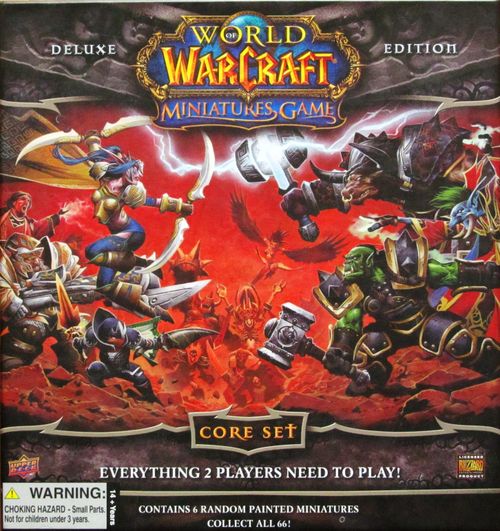
World of Warcraft: Miniatures Game
World of Warcraft: Miniatures Game Rulebook
Table of Contents
Table of Contents
What's in the Starter Box?
- 4 Premium, pre-painted World of Warcraft miniatures (2 Horde and 2 Alliance) — Horde: Lotherin, Gorebelly. Alliance: Ruby Gemsparkle, Vindicator Hodoon.
- 6 Faction-themed, 10-sided dice. (If you use traditional 10-sided dice, the 10 is considered the crit.)
- 6 World of Warcraft miniatures detachable UBases (3 Horde and 3 Alliance). Each UBase carries a health dial and a personal clock.
- 4 Character cards (1 for each miniature).
- 8 Action Bar cards (2 for each miniature).
- 1 Scenario map
- 1 Starter Set rulebook
- 1 Core Set character checklist
Object of the Game and Scoring
Score victory points (VPs) equal to your party's combined honor, and you win.
- You can find each character's honor on the honor symbol on the upper right corner of its card.
- Each party in this Starter Set game has honor 11, so you'll need to score 11 VPs to win.
There are two ways to score VPs:
- You score 4 VPs for each enemy character your characters destroy.
- At the end of ticks 5 and 10 on the master clock, you score 1 VP for each of your characters on or adjacent to the VP location on the game board.
How to Play
Setup
- Each player chooses a party, either Horde or Alliance.
- The Horde party has Gorebelly and Lotherin.
- The Alliance party has Vindicator Hodoon and Ruby Gemsparkle.
- Place the Alliance miniatures in the blue UBases and the Horde miniatures in the red UBases.
- Place the game board on the play area.
- The master clock (located at the side of the game board) starts the game at 1. Put a marker on 1 at the start of the game.
- Find the character cards that go with the miniatures in your party.
- Set each miniature's personal clock (located on its UBase) to 1. Each character's personal clock setting is visible from two sides of its UBase.
- Set each miniature's health dial (located on top of its UBase) to match the health number on its card. A character's starting health is printed next to the health icon on the left side of its card. (Note: When turning the health dial, be sure to turn from the base itself. Do not twist the miniature to turn its health dial.)
- Place each miniature on top of its card.
- Set the Action Bar cards aside for the first game. Once you've played a few games, read the Action Bar Cards section in this rulebook to learn about playing with an Action Bar.
Anatomy of a character card. A character card shows the character's Name, Race/Class, Talent Specialization, honor, Main Attack Ability, further Abilities, and its armor, resist and health values. Example — Vindicator Hodoon, Draenei Paladin — Holy, honor 6:
- Hammer of the Naaru — tick cost 3, range 1, physical attack power 4 (Melee). Crit: Make a magic 4 (Holy) attack against the defender.
- Armor 4, Resist 2, Health 8.
- Devotion Aura: Adjacent allies have armor +1.
Example — Gorebelly, Orc Warrior — Arms, honor 6:
- Drake Talon Cleaver — tick cost 3, range 1, physical attack power 6 (Melee). Crit: Damage +1.
- Armor 3, Resist 1, Health 9.
- Taunt: If an adjacent enemy attacks, it must target an enemy character with taunt if able.
Playing the Game
The master clock starts the game at 1, just like each character's personal clock. Each character gets to take a turn when its clock matches the master clock, so each character will take a turn on game tick 1.
Roll a die. The player who wins the die roll chooses which player goes first. The chosen player then selects a character in their party to take the first turn. That character won't take another turn until the master clock matches its personal clock again.
After that character's turn is over, the other player chooses one of their characters to take the next turn, and so on until all four characters have taken their turns for game tick 1.
A character starts its first turn by entering the board on its faction's spawn point. Your spawn point is the one that's closest to your side of the board.
During each character's turn, it can move up to 2 spaces. See Movement for more information.
In addition, a character must advance its personal clock, usually by taking an action. See Taking Action! for more information.
A character won't take another turn until the master clock matches its personal clock again.
The master clock will often match the personal clocks of more than one character. When this happens, do the following:
- If the characters with the same personal clocks belong to the same player, that player chooses which of those characters takes the next turn.
- If both players control the characters with the same personal clocks, whoever didn't control the last character to take a turn chooses which of their characters with that clock goes next.
The master clock advances by 1 after all characters have taken their turns for the tick. If the master clock advances and none of the characters' personal clocks matches the new game tick, the master clock advances again by 1, until it matches the personal clock of at least one character.
A round ends on tick 10 after all characters with a personal clock of 10 have taken their turns. Then, the master clock wraps around to 1 and a new round begins.
Turn Sequence
Movement
Each character starts its turn with 2 movement points. Each movement point lets a character move 1 space on the board. In other words, when it's a character's turn, it can move up to 2 spaces.
- Movement points don't carry over from turn to turn. If a character spends only 1 movement point on its turn, the remaining movement point is wasted.
- Moving into a forest or hill space takes 2 movement points. Unless a character gets a movement bonus, it must be adjacent to a forest or hill at the start of its turn in order to move into that space. (See Terrain for more information about forest and hill terrain.)
You can move through allied characters (characters in your party), but you can't move through enemy characters.
You can't end a character's movement on a space already occupied by another character.
Movement is optional and can be done either before or after taking an action. For example, a character can't move 1 space, take an action, and then move another space.
Taking Action!
Time is a precious resource. Whenever a character takes an action, it must wait a certain amount of time before it can act again. Characters pay time costs by advancing their personal clocks. When the master clock matches a character's personal clock, that character is ready to take another turn.
Main Attack Ability
Each character has a main attack ability.
The main attack is the first ability listed on a character's card. Here's an example of one from Gorebelly's card:
Drake Talon Cleaver — tick cost 3, range 1, physical attack power 6 (Melee). Crit: Damage +1.
Each attack ability has the following:
Tick Cost: How long it takes the character to recover after making the attack. This cost advances the character's personal clock.
Range: How many spaces away from the character the attack can reach.
- Before you make an attack, find the shortest path from your character to the enemy you want to attack. The number of spaces in this path must be within the attack's range.
- Count spaces starting with the one adjacent to your character and ending with its target's space. (Example: Ruby Gemsparkle is 2 spaces away from Gorebelly, so she's outside of his attack's range.)
- Forests, hills, and enemy characters can block the line of sight between characters, which prevents them from attacking each other. (See Line of Sight and Terrain for more information.)
Attack Type and Power: Attacks are either physical or magic. An attack's power (the number after the type icon) tells you how many 10-sided dice you roll to determine the number of hits the attack creates. The text in parentheses next to the attack's power tells you what type of damage the attack deals.
Crit: If one or more of your attack dice lands on the crit face, this effect happens once. Rolling more than one crit in a single attack counts as only one crit.
See Combat for more information on making attack actions.
Don't Want to Attack?
At the end of a character's turn, if it hasn't advanced its personal clock by taking an action, it must advance its clock by 1. Movement is not an action, and it doesn't cost ticks to move. Whether a character moves or not, if it chooses not to take an action or if it can't take an action (for lack of a target, for instance), then that character's personal clock must advance by 1 tick.
Line of Sight
Enemy characters and certain types of terrain block characters from targeting each other. Your characters can target other characters only if they have unblocked line of sight to their targets.
- You can target or attack through allied characters (characters in your party), but you can't target or attack through enemy characters.
- Enemy characters, forests, and hills block line of sight. If the shortest path between one of your characters and another character crosses a space occupied by an enemy character, a forest, or a hill, your character can't target or attack the other character.
- It doesn't matter if there's a longer path between them that's within the range of your character's action. If the shortest path is blocked, your character can't target or attack the other character.
- If there are two shortest paths of equal length between your character and another character, and one of those paths is free of enemy characters, forests, and hills, your character can target or attack the other character.
Example: Ruby has a magic 3 Arcane Blast attack. She can't target Gorebelly with it, however, because the shortest path between them is blocked by a hill.
Combat
To take an attack action, first advance the attacker's personal clock by the attack's tick cost.
Then, choose an enemy character that's within the range allowed by the attack. There must be unblocked line of sight between the attacker and its target. Once that happens:
- The attacking player rolls dice equal to the attack's power. Each success (a die roll of 4 up through the crit face) is a hit, which creates 1 point of damage. If at least one crit is rolled, the attack is a crit and earns the attack's crit effect.
- If a crit reads, "Damage +1," it's as if the attacker rolled an additional success in the attack.
- If the attack is physical, the defending player rolls dice equal to the defender's armor.
- If the attack is magic, the defending player rolls dice equal to the defender's resist.
- Each success (a die roll of 4 up through the crit face) rolled is a block. Note: A defensive die roll of a crit is treated as an ordinary success.
- If an attack affects more than one defender, make a separate attack roll and defense roll for each defender.
- (Number of Hits) – (Number of Blocks) = Combat damage dealt to the defender.
- Track damage on each miniature's UBase by turning its health dial. The character's health is reduced by the amount of damage dealt. (Note: When turning the health dial, be sure to turn from the base itself. Do not twist the miniature to turn its health dial.)
Example: Gorebelly takes a mighty swing at Ruby Gemsparkle with his Drake Talon Cleaver, paying 3 ticks for his physical 6 attack. His controller rolls six dice, rolling a 1, 3, 4, 9, and two crits, so Gorebelly has gotten four successes in the attack. Despite rolling two crits, the attack's crit effect happens only once, adding an additional point of damage to the attack, for a total of 5. Ruby defends herself with her lowly armor 1, since the attack is physical. Her controller rolls a 7, which is a successful block. One of the 5 damage from the attack is blocked, resulting in 4 damage to Ruby. Her health dial is turned down from 5 health to just 1.
Terrain
This Starter Set comes with two special types of terrain: forest and hill. These types of terrain affect movement, line of sight, and combat.
- Moving into a forest or hill space takes 2 movement points. Unless a character gets a movement bonus, it must be adjacent to a forest or hill at the start of its turn in order to move into that space.
- Forests and hills can block the line of sight between characters, which prevents them from attacking or targeting each other.
- Characters attacking from a hill can choose to reroll one die after the attack roll.
- Characters defending in a forest can choose to reroll one die after the defense roll.
Character Death
- Damage is permanent unless it is healed or the character leaves play.
- If a character takes enough damage to bring its health dial to 0, it is destroyed.
- When a character is destroyed, remove it from the board and return it to its card, then advance its personal clock by 2 ticks.
- A character will respawn on its turn at its faction's spawn point. Characters respawn with full health.
- When a character is destroyed, the opposing party scores 4 VPs.
Special Cases
Three characters in this Starter Set have abilities in addition to their main attacks.
Vindicator Hodoon (Paladin)
Vindicator Hodoon has an ongoing ability that continuously affects the game.
Devotion Aura — Adjacent allies have armor +1.
Devotion Aura is in effect even when it isn't Hodoon's turn.
Gorebelly (Warrior)
Gorebelly also has an ongoing ability that continuously affects the game.
Taunt — If an adjacent enemy attacks, it must target an enemy character with taunt if able.
Enemy characters adjacent to Gorebelly can attack only Gorebelly (since he's the only character with taunt in the Starter Set).
Lotherin (Priest)
Lotherin's second ability is an action that you can choose to take instead of his main attack.
Heal — tick cost 3, range 3, heal power 3. Crit: Heal 1 additional damage.
- Just like an attack, heal abilities have a tick cost, range, and power.
- Lotherin can heal his allies or himself.
- Heal abilities follow the same line of sight rules as attacks. See the Line of Sight section and the Range entry in the Main Attack Ability section for more information.
- Roll three 10-sided dice. Turn the target character's health dial up by 1 for each success (a die roll of 4 up through the crit face).
- Heal actions are not resisted. You do not roll resist dice to block a heal action.
- If at least one crit is rolled, the heal is a crit and earns the heal's crit effect (Lotherin heals 1 additional point of damage from the target).
Action Bar Cards
Once you've played your first few games, try playing with an Action Bar for each character. This opens up a whole new set of options for your characters.
Gather the two Action Bar cards that go with each character and place both of them face down next to the bottom edge of the appropriate character card. These are the Action Bar cards that the character can use during the game.
Characters and their Action Bar cards are listed below:
- Vindicator Hodoon: Hammer of Wrath & Flash of Light
- Ruby Gemsparkle: Ice Barrier & Fire Blast
- Lotherin: Mind Blast & Psychic Scream
- Gorebelly: Execute & Charge
The Basics
- Action Bar cards give your characters access to new attacks or other types of abilities.
- An Action Bar card that grants a character a new attack will also list the range, type, power, and crit abilities of the attack.
- Action Bar cards have costs to use them, just like the attacks and other abilities on character cards. To play a character's Action Bar card, first exhaust that card (turn it sideways), and then advance that character's clock by the number of the Action Bar card's tick cost. An Action Bar card's tick cost is located in the upper left corner.
Anatomy of an Action Bar Card
An Action Bar card shows these elements: Cost (upper left), Card Name, Restrictions, Range, Power and Attack Type, Action Bar Card Type (Damage Type), Talent Tree, Ability, and Flavor Text.
Playing Action Bar Cards
- During a character's turn, it can choose to play a card in its Action Bar.
- Playing a character's Action Bar card counts as that character's action for the turn.
- Instant and react cards follow different rules. See Instant Cards and React Cards for more information.
- To play an Action Bar card, first flip it face up and read the text to your opponent. Then, exhaust the card (turn it sideways).
- After exhausting, pay the costs described on the Action Bar card. An Action Bar card's tick cost is located in the upper left corner.
- Once an Action Bar card is played, it is on cooldown and can't be played again until it is readied (turned upright).
Readying Action Bar Cards
- At the end of each round (end of tick 10), in addition to scoring for the VP location, both players ready their Action Bar cards.
- Cards that were flipped face up remain face up. Cards that are face down remain face down.
- Ready Action Bar cards can be played during the next round. It doesn't matter if they're face up or face down. To play a face-up Action Bar card, just exhaust it.
Instant Cards
Instant cards in this Starter Set: Gorebelly — Charge; Ruby Gemsparkle — Fire Blast.
Charge (Warrior, Arms) — Cost 0. Instant. This character has move +1 this turn. Add physical 1 to the next adjacent enemy this character attacks this turn.
Gorebelly and Ruby Gemsparkle each have an instant card. A character with an instant card has a slightly different turn sequence.
On a character's turn, it can do each of the following things once, in any order:
- Move
- Take an action (either from the character card or from a ready Action Bar card)
- Play a ready instant card
At the end of a character's turn, if it hasn't advanced its personal clock, you must advance its clock by 1. Because instants have 0 tick cost, if a character has played only an instant by the end of its turn, you must advance that character's personal clock by 1.
React Cards
React card in this Starter Set: Ruby Gemsparkle — Ice Barrier.
Ice Barrier (Mage, Frost) — Cost 1. React. Play only when an attack targets this character. Prevent the next 2 damage that would be dealt to this character this attack.
- A react is the only card type that can be used during another character's turn.
- Ice Barrier must be played before any attack or defense dice are rolled.
Customize Your Action Bar
The cards that come with your characters aren't the only ones they can use. When you collect more World of Warcraft miniatures, you'll find a wide variety of different Action Bar cards. The Action Bar offers a chance to customize your characters and spring some surprises on your opponent at the same time.
A character can have a card in its Action Bar only if the Action Bar card's restriction matches that character. Most Action Bar cards are restricted by class, but some are restricted by talent specialization as well, and a few are restricted by race or a specific character. Any character can use a generic card (Action Bar cards without restrictions).
A character can't have two copies of the same card in the same Action Bar.
Party Building
For casual play, you and your opponent can play with any number of characters, but you should play with the same number in each party. There's no limit to how much honor a party can have.
All characters in a party must be from the same faction: Horde, Alliance, or Monster. You cannot mix and match between the factions in the same party. You can have multiples of the same character in the same party.
Players who have collected a wide variety of cards may wish to play with an expanded Action Bar. For fans of dueling, try playing a one-on-one battle in which each character has between four and seven Action Bar cards. Each character should have the same number of cards in its Action Bar.
Each player's party typically has two, three, or five members (not counting pets). Most Organized Play events run by Upper Deck Entertainment will feature three-character parties with two cards in each Action Bar. The combined honor of your party is up to you, unless the tournament scenario says otherwise.
Comprehensive and Tournament Rules
For comprehensive and tournament rules, please visit:
- English language: www.WoWMinis.com/rulebook
- French language: www.WoWMinis.com/rulebook/fr
- German language: www.WoWMinis.com/rulebook/de
- Italian language: www.WoWMinis.com/rulebook/it
- Spanish language: www.WoWMinis.com/rulebook/es
Icon Reference
- Tick Cost: How long it takes the character to recover. This cost advances the character's personal clock.
- Range: How many spaces away from the character the action can reach. The shortest path from a character to its targets must be within the action's range.
- Crit: If one or more dice lands on the crit face, the effect following this icon happens once.
- Health: How much health a character has when it spawns. If a character takes enough damage to bring its health dial to 0, it is destroyed.
- Heal Power: How many 10-sided dice are rolled to determine the number of heals the action creates. Turn the target character's health dial up by 1 for each success.
Attack & Defense Icons
- Physical Attack Power: How many 10-sided dice are rolled to determine the number of hits an attack creates. Deal 1 damage to the target for each unblocked success.
- Magic Attack Power: How many 10-sided dice are rolled to determine the number of hits an attack creates. Deal 1 damage to the target for each unblocked success.
- Armor: If an attack is physical, the defending player rolls 10-sided dice equal to the defender's armor. Block 1 damage for each success.
- Resist: If an attack is magic, the defending player rolls 10-sided dice equal to the defender's resist. Block 1 damage for each success.
Success = 4 up through the crit face.