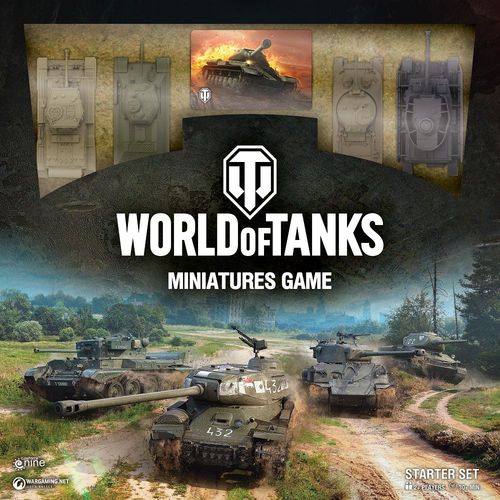
World of Tanks: Miniatures Game
World of Tanks: Miniatures Game Rulebook
Table of Contents
Table of Contents
- Components
- Playing the Game
- Turn Sequence
- Game Setup
- The Movement Phase
- Movement and Terrain
- The Shooting Phase
- Shooting and Terrain
- Roll Attack Dice
- Defence Dice
- Defending: Defense Cancels Hits
- Assess Damage
- The Command Phase
- Common Special Rules
- Tank Types
- Creating a Platoon
- Your First Game
- Battle Modes
- Quick Reference
Components
Tanks and Tank Cards
Tank is the term used for any individual miniature in the game.
These reference cards are used to keep track of your various Tanks' Stats, Special Rules, and record any damage they have taken.
Tank Cards
Each Tank Card shows the following information:
- Nation — This symbol identifies the Nation that fielded this Tank.
- Tank Name — This is the name of the Tank.
- Cost — This is how much the card costs to add to your Platoon.
- Base Stats — These four numbers represent the basic fighting capabilities of the Tank.
- Initiative — This determines the order in which Tanks move and shoot during the turn.
- Firepower — This shows how many Attack dice you roll each turn when shooting.
- Survivability — This helps determine how many Defense dice you roll when shot at.
- Mobility — This shows the maximum number of moves that a Tank can make in each Movement Phase.
- Hit Points — This shows how much damage this Tank can take before being Destroyed.
- Crew Positions — This shows the number and Positions of Crew your Tank can have. You can add one Crew Card to your Tank for each Crew Position.
- Special Rules — Some Tanks have Special Rules. These are referenced on the front of the card, with the full rule detailed on the back.
- Tank Type — There are five types of tank: Light, Medium, Heavy, Tank Destroyer, and SPG (Self-propelled Guns). Each Tank type has a special rule that affects how it plays in the game.
- History — This text provides interesting information about the Tank that is not related to the game.
Crew, Module, and Upgrade Cards
Crew, Module, and Upgrade Cards represent the extraordinary soldiers or additional equipment that separates an individual Tank from the factory standard. They are used to modify a Tank's Base Stats or give them extra abilities.
Hidden Cards. Crew, Module, and Upgrade Cards are usually Hidden at the start of the game by placing them face-down next to their Tank's Card. When you want to use the ability on a card you must Reveal it. When Revealing a card, flip it face-up for the rest of the game. You may Reveal a card at any time.
Hidden cards still have their card types while Hidden. For example, the Critical Card Ammo Explosion requires you to discard all Ammo Cards on your Tank, and this will include face down Ammo Cards.
Crew, Module, and Upgrade Cards with a large Lightbulb icon on the back must start the game Revealed.
Each Crew, Module, and Upgrade Card shows the following information:
- Card Name — This is the name of the Card.
- Card Type — Crew, Module, and Upgrade Cards may be attached to your Tanks. See "Creating a Platoon".
- Nation — This symbol identifies which nation's Tanks can use this card.
- Universal Symbol — Upgrade Cards with this symbol can be added to any Tank, regardless of Nation.
- Card Effect — This details what effect this card gives to the Tank.
- Cost — This is how much the card costs to add it to your Platoon.
- Crew Position — This tells you which Crew Position this upgrade fills.
- Unique Crew Cards — Unique Crew are marked with a symbol after their name. You may not have multiple copies of a Unique Crew Card in your Platoon.
Dice
World of Tanks: Miniatures Game uses six-sided dice. These dice will be used to determine the effectiveness of your shooting and defense, and to resolve other uncertain events.
Each Die has:
- Three Blank faces,
- Two Hit faces, and
- One Critical Hit face.
In general, symbols are good and blank faces are bad, and these will be explained in detail throughout the rulebook.
Tokens
- Movement — These numbered tokens indicate how many moves a Tank made this turn.
- Damage — These tokens can be placed next to Tanks or on their Card to show how many Hit Points they have lost. See "Assess Damage".
- Destroyed — Place these tokens next to your Tank to indicate that it is Destroyed.
- Objectives — These tokens are used during certain Battle Modes. See "Battle Modes".
- Tank ID — These paired tokens can be used in bigger games to keep track of which Tank Card belongs to which Tank Miniature. Place one next to the Miniature and the other on the card.
- Advantage — This token is given to the player who currently has Advantage. The player with Advantage wins all Initiative ties. See "Playing the Game".
Measuring Arrow
The Measuring Arrow is used for many tasks in World of Tanks: Miniatures Game, including Terrain and Battle Mode set up, Movement, and checking for Close Range.
The Tail shows how far a Tank can move. The full Measuring Arrow is used for other measurements.
Critical Cards
These cards are used when a Tank scores a Critical Hit.
Each Critical Card shows the following information:
- Card Name — This is the name of the Critical Card.
- Damage Number — Some Critical Cards do Damage. See "Assess Damage".
- Effect — Some Critical Cards have additional and lasting effects on the target.
- Repairable — Some Critical Cards with lasting effects are Repairable. These can be repaired during the Command Phase.
- Quote — This text has no mechanical effect in the game.
Playing the Game
World of Tanks: Miniatures Game has a simple set of core rules, so it is easy to learn.
If you want to get straight into the action, you can turn to "Your First Game" and start playing with a T-34 versus a Pz.Kpfw. IV Ausf. H.
General Rules
Crew, Module, and Upgrade Cards represent special equipment or unique individuals that may contradict the rules in this book. Where this may happen the rule on the card overrides the rule in this book.
Re-Rolling and Modifying Dice
During the game, some rules will let you Re-roll or Modify a die result. You must complete any Re-rolls before Modifying any dice.
Re-Roll. To Re-roll a die result, pick up the die and roll it again. A die that has been Re-rolled once cannot be Re-rolled again.
Modify. To Modify a die result, pick up the die and change the top face from one result to another face as instructed by the rule. A die that has been Modified may not be Modified again.
Rules References
Throughout the rules you will find boxes that contain additional information, usually pointing you to other sections of the rules that are relevant to the current section.
Rolling for Advantage
During the game, you will need to roll for Advantage. To do this each player rolls three dice.
The player that rolls the most Critical Hits gains Advantage. If this is tied, then the player with the most Hits gains Advantage. If this is still tied, roll again.
Initiative Ties and Advantage
In some cases multiple Tanks may have the same Initiative value. In this case the player who has Advantage counts as having the higher Initiative value in ties.
If you have Initiative ties between Tanks in the same Platoon, the owning player chooses the order in which those Tanks acts.
Destroyed Tanks
If at any point of the game a Tank has lost all of its Hit Points it is immediately Destroyed. Mark it with a Destroyed Token.
Destroyed Tanks cannot move, shoot, use Special Abilities or otherwise act. Destroyed Tanks are both Impassable Terrain and Blocking Terrain.
Turn Sequence
During a game, players will play through a number of turns until one player achieves victory. Each turn consists of three Phases:
- Movement Phase. In this Phase players will move each of their Tanks in Initiative order, from lowest to highest.
- Shooting Phase. In this Phase players have a chance to shoot with each of their Tanks in Initiative order, this time starting with the highest and moving on to the lowest.
- Command Phase. In this Phase players will mark destroyed Tanks, repair Critical Cards, check for victory conditions, shuffle the Critical Card deck, and clear all Movement tokens from the table.
Game Setup
Battlefield Setup
World of Tanks: Miniatures Game is played on a 3' x 3' Battlefield.
Both players start the game by rolling for Advantage. Starting with the player that wins the roll, players alternate placing terrain until all terrain pieces have been placed. The two Woods or Hills must be placed first, then the four Buildings, and then finally the Walls.
Woods, Hills, and Buildings may not be placed within a Measuring Arrow of each other, or the table edge. Walls must be placed with a short edge touching a Building or another Wall.
Attacker or Defender
After the terrain is set up, roll for Advantage again. The player that wins the roll may choose whether to be the Attacker or Defender.
The Attacker starts with Advantage while the Defender chooses which side of the table they want to deploy on.
Deployment
The Defender now chooses a table edge to deploy on. The Attacker will deploy on the opposite table edge.
The players place their Tanks on the table in Initiative order. The Tank with the lowest Initiative is placed first, before moving up through higher Initiative values.
To deploy a Tank, place the Measuring Arrow so that it is touching your edge of the table. Place the Tank square against the tail of the Measuring Arrow.
Trading Advantage
It is unlikely that the Attacker will retain Advantage for the entire game. During the Command Phase, there is a chance it will change sides. See "The Command Phase".
The Movement Phase
In the Movement Phase both players have a chance to move all of their Tanks, maneuvering for cover or lining up shots.
Initiative
In the Movement Phase players move Tanks with the lowest Initiative first and proceed up through the Initiative order to the Tank with the highest Initiative.
Stationary
A Tank does not have to move. If a player does not move a Tank, it does not gain a Movement token. Instead, its shooting becomes more effective (see "Roll Attack Dice"). Any Tank that does not have a Movement token is considered to be Stationary.
Movement
Most Tanks can make multiple moves per turn, with a maximum number of moves limited by their Mobility.
Moving a Tank
To move a Tank, place the Measuring Arrow touching any part of the Tank and pointing in any direction.
Then pick up the Tank and place it anywhere along the Measuring Arrow, so that the hull is square against the Tail.
This completes one move and can be repeated a number of times up to the Tank's Mobility. Tanks cannot move past the Tail of the Measuring Arrow, and Tanks can rotate using the Measuring Arrow.
Place Movement Token
After you complete all of a Tank's moves, place a Movement token next to it to show how many times it moved. The faster your speed, the harder you will be to hit, but the harder it will be for you to hit the enemy.
Defensive Measures
Instead of moving a Tank, you may add Movement tokens up to its maximum Mobility even if you don't change its physical placement. This is to indicate taking evasive action or generally focusing on avoiding enemy fire.
Movement and Terrain
The World of Tanks: Miniatures Game has four main types of terrain: Woods, Hills, Buildings, and Walls.
Woods and Hills
Tanks can move into Woods and onto Hills with no penalty.
Buildings and Walls
Impassable Terrain. Terrain that is Impassable may not be entered and Tanks cannot end their move on that piece of terrain. When moving a Tank you cannot place the Measuring Arrow in such a way that it would make the Tank move through Impassable Terrain.
Tanks cannot move through Buildings as they are Impassable Terrain. Movement Arrows may be placed over Impassable Terrain, but Tanks must stop where the Measuring Arrow crosses Impassable Terrain.
Tanks can move over Walls with no penalty. If a Tank moves over a Wall, the Wall is destroyed and removed from the game.
The Shooting Phase
In the Shooting Phase, both players have a chance to shoot with all of their Tanks.
Initiative
The Shooting Phase starts with the Tank with the highest Initiative and proceeds down through the Initiative order to the Tank with the lowest Initiative. The player with Advantage gets to act first in the case of Ties.
The first thing to do when shooting with a Tank is pick a target. There are no range limits, so your choice of target is only limited by Line of Sight, and in the case of an Assault Gun, its inability to fire to the side or rear.
Line of Sight
A Tank has Line of Sight to its target if you can draw a straight line from the center of the Tank's turret to any part of a target Tank without passing through another Tank or any Blocking Terrain.
Assault Guns.
Restricted Line of Sight: Tanks with the Assault Gun Special Rule have a more restricted Line of Sight. They draw Line of Sight from the center of the front of their hull rather than from the turret.
Fixed Field of Fire: Tanks with the Assault Gun Special Rule can only shoot at another Tank if either:
- the target's entire hull (excluding protruding gun barrels) is in front of the Tank, or
- any part of the target's hull (again excluding protruding gun barrels) is directly in front of the Tank.
For example, a Tank with the Assault Gun Special Rule (like the StuG III Ausf. G) cannot shoot targets unless they are completely in front of it, or any part of the target is directly ahead of it. An M4A1 Sherman that would usually not be a viable target because it is partially behind the front of the StuG III Ausf. G can still be shot at if part of it is directly in front of the attacking Tank's hull.
Blocked Line of Sight. Draw a line from the center of the Tank's turret to check if it has Line of Sight to a target. A Tank's Line of Sight is stopped by other Tanks and Blocking Terrain. For example, a Tank can have Line of Sight to a target past another friendly Tank in front of it, but a Tank directly blocking the path stops Line of Sight to a Tank behind it.
Cover
Tanks are In Cover if the shooting Tank cannot draw Line of Sight to three of its four corners without passing through Cover.
In some cases it may be possible to see a Tank, but not be able to draw Line of Sight to any of its corners. You can still shoot Tanks concealed this way.
Tanks ignore any Terrain directly underneath their own model when determining whether a target is In Cover.
Sticking to Cover will let your Tanks roll extra Defense Dice any time they come under fire. See "Roll Attack Dice".
Hull Down
Taking Cover on a Hill or behind a Wall is better than just being in Cover as Hills and Walls block incoming Hits.
If a Tank is In Cover on a Hill or behind a Wall, it is Hull Down and will take less Hits when shot at (see "Assess Damage"). A Wall is destroyed and removed from the game when a target that is Hull Down behind it is shot at.
Shooting and Terrain
Each terrain type has its own rules for Line of Sight and Cover.
Woods
Woods are Concealing Terrain and give Cover to Tanks in them or seen through them.
Buildings
Buildings are Blocking Terrain, so they block Line of Sight to Tanks behind them.
Hills
Hills are Concealing Terrain and give Cover to Tanks that are both on the Hill, and more than a Measuring Arrow from the edge. Tanks that are on a Hill but less than a Measuring Arrow from the edge do not get Cover from the Hill.
Hills are also Blocking Terrain, so they block Line of Sight to Tanks behind them.
Walls
Walls are Concealing Terrain and give Cover to Tanks behind them, but are destroyed when shot through.
Roll Attack Dice
Once a Tank has determined a valid target, it can attempt to Shoot it by rolling its Attack dice. The number of dice you roll is your Tank's Firepower number, plus any cards that add to your Firepower.
Each result of Hit scores a Hit, each Critical Hit scores a Critical Hit, and each other result is a Miss.
Some Special Rules, Crew, Modules, and Upgrades allow you to Modify or Re-roll dice (see "Re-Rolling and Modifying Dice"). Remember to check cards attached to your tank!
Shooting While Stationary
Stationary Tanks may Re-roll any Misses.
Stationary Tanks. If a Tank has no Movement token, it is Stationary.
Defence Dice
After the shooting player has made their Attack roll (including Re-rolling or Modifying any dice), the target player assembles a pool of Defense dice.
The Defence Dice Pool
- Create the Pool. The starting number of dice in the pool is a Tank's Base Survivability number.
- Shooting Tank's Movement. Add one Defense die for each move that the shooting Tank made (as shown by the Movement token beside it).
- Target Tank's Movement. Add one Defense die for each move that the target Tank made (as shown by the Movement token beside it).
- In Cover. Add one Defense die if the target Tank is In Cover.
- Close Range. Subtract one Defense die if the shooting Tank is within one Measuring Arrow (including the head) of the target Tank, measured from any part of the Tank's hull.
- Side Shot. Subtract one Defense die if any part of the shooting Tank's hull (excluding protruding gun barrels) is behind the front of the target Tank. Some special rules change the number of dice removed for a Side Shot (see "Common Special Rules" for an example).
- Six-Dice Maximum. A Tank can never roll more than six Defense dice. If the dice pool exceeds this number, reduce it to six before rolling.
Defending: Defense Cancels Hits
Roll Defense Dice. After creating their Defense dice pool, the target player rolls those dice to try and cancel the attacker's successes.
The target player starts by canceling one of the shooting player's Hits or Critical Hits for each Critical result that they rolled in their Defense dice pool.
Then the shooting player picks one of their own Hits or Critical Hits to cancel for each Hit result rolled by the target player.
Any remaining Hits or Critical Hits will now be resolved. See "Assess Damage".
Hull Down
If a Tank is Hull Down (In Cover on a Hill or behind a Wall, see "Hull Down" under "The Shooting Phase"), the shooting player must discard a Hit, if there are any. If there are no Hits, they do not need to discard a Critical Hit.
If the Tank was Hull Down behind a Wall, the Wall is destroyed and removed from the game, regardless of whether dice were removed (even if all of the dice were canceled by the target player's Defense dice or there were no Hits remaining).
Assess Damage
After comparing the Attack and Defense rolls, any uncanceled Hits or Critical Hits are applied to the target Tank.
Hits
Each Hit that is not canceled after the Defense roll causes the target Tank to lose a Hit Point. Place a Damage token next to the Tank or on the Tank's card to show the Damage.
Critical Hits
The target player draws a Critical Card for each Critical Hit that is not canceled after the Defense roll.
If the card has a Damage Number, immediately add that much Damage (in some cases, no damage) just as you would for a Hit. Then apply any special effect listed on the card.
If the card is Repairable, place the Critical Card on the Tank's card to remind the players of its effect. Critical Cards that aren't Repairable are placed on the discard pile once they have been resolved.
In-the-red
The Hit Points bar is divided into coloured segments. Some Upgrade Cards reference 'In-the-red'. Tanks are In-the-red if they only have red Hit Points remaining.
Destroyed Tanks
If at any point during a game a Tank loses all of its Hit Points it is immediately Destroyed. Mark it with a Destroyed Token.
Destroyed Tanks cannot move, shoot, use Special Abilities or otherwise act. Destroyed Tanks are both Impassable Terrain and Blocking Terrain.
The Command Phase
The Command Phase has four steps that clean up the battlefield, preparing it for the next turn.
- Check For Victory. If a Battle Mode has unique victory conditions, check whether they have been met now. Regardless of any other victory conditions, if at this step your opponent has no Tanks in play (they are all Destroyed or removed from the game), you win. If at this step you and your opponent both have no Tanks in play (they are all Destroyed), you end the game in a draw.
- Repair. Each Tank may attempt to repair one Critical Card with the Repairable keyword. Roll one die. On a roll of Hit or Critical Hit, discard the Critical Card. When you repair a Critical Card you only remove the card and its special effect. Any Damage taken from a Critical Card remains.
- Roll for Advantage. Both sides roll for Advantage, the side that wins will have Advantage and will win all Initiative ties for the next turn.
- Reset the field. Remove all Movement Tokens and shuffle discarded Critical Cards back into the Critical deck, ready for the next turn.
Common Special Rules
Each Tank Card in the game will have a list that indicates what, if any, Special Rules that Tank has. The following is a list of common Special Rules:
- Arrow Shot. When attacking you must Modify a Miss to a Hit.
- Assault Gun. This tank has a Restricted Line of Sight and Fixed Field of Fire (see "Line of Sight").
- Big Gun. When Attacking you may Modify a Hit to a Critical Hit.
- Fortress. When this tank is the target of a Side Shot, do not subtract a Defense die.
- High Explosive. Discard all Hits before Assessing Damage.
- Light Flank. When this tank is the target of a Side Shot, subtract an additional Defense die.
Tank Types
There are five Tank types: Light, Medium, Heavy, Tank Destroyer, and SPG (Self-propelled Gun). Each Tank type has a special rule that reflects its role on the battlefield.
- Light Tank. Friendly Tanks shooting at a Tank within Close Range of this Tank gain +1 Firepower.
- Medium Tank. When Shooting, this Tank may Re-roll a Miss Attack dice.
- Heavy Tank. When Defending, this Tank may Re-roll a Miss Defence die.
- Tank Destroyer. This Tank gains +1 Survivability while in Cover.
- Self-propelled Guns. Other Tanks do not block this Tank's Line of Sight.
Creating a Platoon
Tank Platoons are created from four different card types: Tank Cards, Crew Cards, Module Cards, and Upgrade Cards. Each of these cards has a Cost that will be added together to create your Platoon. The Tank Cards in your Platoon can be from any mix of Nations.
Cost Limit
Before a game, players create a Platoon to a certain Cost limit. This limit may be agreed upon by the players playing the game, or set by a Tournament Organizer. Try playing your first few games at 50 Cost and then move up to 200 Cost. 200 Cost is the standard Cost limit, but you can change this limit to suit the games you and your friends want to play. Each card you add to your Platoon will have a Cost, and the total must be equal to or under the agreed Cost limit.
Tank Cards
Tanks come from particular Nations, indicated by the flag symbol on their card (Germany, U.K., U.S.A., and U.S.S.R.). You can take any mix of Tanks in your Platoon, even if they are not from the same Nation.
You and your friends may want to create Platoons of Tanks from just one Nation. If you do, you are only allowed to add Tank Cards from one particular Nation to your Platoon. Other than this restriction, you build your forces in the same way you would build a normal Platoon.
Tanks may only be given Upgrades, Modules and Crew that match that Tank's Nation. However, some cards are marked with the Universal symbol. These represent more universal cards that are available to all Tanks regardless of Nation.
Upgrade Cards
There are three subtypes of Upgrade cards; Ammo, Consumable, and Equipment.
You may attach up to three of each subtype of Upgrade card on a single Tank.
Module Cards
There are five subtypes of Module cards; Gun, Turret, Engine, Suspension, and Radio.
You may attach up to one of each subtype of Module card on a single Tank.
Crew Cards and Crew Positions
Crew Cards are marked with the Position that the Crew fills. The Crew Positions on Tank cards indicate how many of each position of Crew they can have attached to it.
Some Tanks may let you take multiple of the same position of Crew while others may not give you an option to attach some positions of Crew cards.
In some cases Tanks may have Crew Positions covering multiple roles, for example Commander/Gunner. In this case you may attach either a Commander or Gunner Crew Card in this position.
Crew with the same Card Effect do not stack. For example, if you have Driver and Gunner each with the Concealment Crew Card then your Tank only gains +1 while In Cover, not +2 while In Cover.
Some Crew may have multiple Card Effects. For example if a Driver had both Repair and Clutch Braking, the Tank would be able to Repair an additional Critical Card each turn and attempt to rotate its facing at the end of the Movement Phase. Adding another Crew with Repair would not allow the Tank to Repair a third Critical Card each turn.
Unique Crew Cards
Unique Crew Cards are marked with a symbol. Players may have as many Unique Crew Cards in their Platoon as they want, but can only have one of each particular Unique Crew Card in their Platoon. Unique Crew still count as Crew Cards, so any effects that affect Crew Cards affect Unique Crew Cards as well.
Equipping a Tank
In summary, you may attach to each Tank Card:
- 0-1 Crew Card per Crew Position
- 0-1 Module Card per Subtype
- 0-3 Equipment Cards
- 0-3 Ammo Cards
- 0-3 Consumable Cards
Your First Game
1. What You Need
You will need the following components to play your first game:
- Pz.Kpfw IV Ausf. H Tank and Card
- T-34 Tank and Card
- Critical Deck
- Dice, Tokens and Measuring Arrow
- A space to play (ideally a 3' x 3')
2. Setup
Set up the terrain and Tanks as shown on the scenario map, using the Measuring Arrow. Deploy the T-34 in the Red area and the Pz.Kpfw IV Ausf. H in the Green area, with Woods and Houses placed around the table.
3. Play the Game
Players move through three Phases each turn.
A. Movement Phase. The Pz.Kpfw IV Ausf. H has the lowest Initiative so it will move first. To move a Tank, place the Measuring Arrow touching the hull and facing in any direction. Then place the tank square against the Tail of the Measuring Arrow. The Pz.Kpfw IV Ausf. H has a Mobility of 2 so can move up to two times each turn. Place a Movement token showing how many times the Tank moved.
After the Pz.Kpfw IV Ausf. H has moved it is now the T-34's turn to move. The T-34 has a Mobility of 3 so can move up to three times each turn.
Once both Tanks have moved (or chosen to stay Stationary) it is time to start shooting.
B. Shooting Phase. Since the T-34 has the highest Initiative it gets to shoot first. To shoot, the T-34 must have Line of Sight to the Pz.Kpfw IV Ausf. H. If you can draw a line from the T-34 turret to the Pz.Kpfw IV Ausf. H without going completely through a Building then it is in Line of Sight.
After determining if you can see the Pz.Kpfw IV Ausf. H you create an Attack dice Pool. Grab a number of dice equal to the Firepower number on your Tank card, in the case of the T-34 that is 4.
Roll the dice. Each result of Hit scores a Hit, and each Critical Hit scores a Critical Hit. If your T-34 has no Movement token next to it, it is considered to be Stationary and you may Re-roll any of its Attack dice that failed to Hit. Otherwise, because it is a Medium Tank, it can Re-roll one die.
The Pz.Kpfw IV Ausf. H now gets a chance to stop the T-34 attack. Create a pool of Defense dice. The Pz.Kpfw IV Ausf. H has a Survivability of 1, so starts with 1 die.
Add another die for each time the T-34 and Pz.Kpfw IV Ausf. H moved this turn.
Add an additional die if the Pz.Kpfw IV Ausf. H is In Cover. The Pz.Kpfw IV Ausf. H will gain Cover if the T-34 can see it but cannot draw Line of Sight to three of its four corners without passing through a Forest or Building.
Remove one Defense die if the T-34 is within Close Range of the Pz.Kpfw IV Ausf. H. To be in Close Range, the Tanks need to be within one Measuring Arrow of each other.
Remove one Defense die if any part of the T-34 hull is behind the front of the Pz.Kpfw IV Ausf. H tank's hull.
A Tank can never roll more than six Defense dice.
Roll the Defense dice. Each Hit result cancels a Hit or Critical Hit chosen by the shooting player, and each Critical Hit result cancels a Hit or a Critical Hit chosen by the target player.
Each uncancelled Hit causes the Tank to lose a Hit Point. For each uncancelled Critical Hit draw a Critical Card and apply all effects to the Tank. This may include the loss of Hit Points and/or other Effects.
After the T-34 has shot it is then the turn of the Pz.Kpfw IV Ausf. H to return fire following the same steps.
Once both Tanks have shot, it is time to move on to the Command Phase.
C. Command Phase. If either Tank has lost all of its Hit Points then the Tank is Destroyed and their opponent wins the game. If both Tanks are destroyed the game ends in a draw.
If neither tank is destroyed you may attempt to repair Critical Cards assigned to your tank. Choose one card with the Repairable keyword and roll a die, on a result of Hit or Critical Hit remove the chosen Critical Card from your tank.
Remove all Movement tokens from the Tanks and shuffle discarded Critical Cards back into the Critical Card deck. Then start a new turn beginning with the Movement Phase.
Congratulations, you have now completed the first part of your World of Tanks: Miniatures Game Boot Camp. Now try playing the same game again, this time using Crew and Upgrade Cards to upgrade your Tanks to a total Cost of 50 (see below for a suggested list). You will need to add in the Advantage rules from "Rolling for Advantage".
A suggested Pz.Kpfw. IV Ausf. H list with Camouflage Net, Binocular Telescope, and 105-octane Gasoline; and a suggested T-34 list with Spall Liner, Recon, Safe Stowage, and Snap Shot.
Once you have played a game with the Pz.Kpfw. IV Ausf. H and T-34 using Crew and Upgrade Cards, try a pair of larger 100 Cost Platoons. Add a Cromwell to the Pz.Kpfw. IV Ausf. H, and a M4A1 Sherman to the T-34.
A suggested Cromwell list with Pudding and Tea, and Large Repair Kit; and a suggested M4A1 Sherman list with Gun Rammer, Enhanced Gun Laying Drive, Repair, and Smooth Ride.
Battle Modes
There are a number of ways to play World of Tanks: Miniatures Game beyond the basics. This section describes four different Battle Modes you can play.
Assault
The attacker wins this Battle Mode by defeating the defender on their home ground.
Table Set Up. After placing the terrain, the Attacker places two Objective tokens within a Measuring Arrow of the Defender's side of the board.
Check for Victory. When checking for victory in the Command Phase, the Attacker gains one Victory Point if they have a Tank within a Measuring Arrow of the center of an Objective token and the Defender does not.
The game ends after eight turns. If the Attacker scores two Victory Points before this point, they win the game. Otherwise, the Defender wins the game.
Encounter
You win this Battle Mode either by destroying all of the enemy Tanks, or by holding the center of the battlefield against all comers.
Table Set Up. After placing the terrain, place an Objective token in the center of the board.
Check for Victory. When checking for victory in the Command Phase, you gain one Victory Point if you have a Tank within a Measuring Arrow of the center of the Objective token and your opponent does not. You cannot claim a Victory Point in the first turn.
When you score three Victory Points, you win the game.
If you run out of time, the player that has the most Victory Points at that time wins the game. In the case of a tie, the player that Destroyed the most points worth of Tanks wins. Include the Cost of any Crew, Module and Upgrade Cards that Destroyed Tanks started the game with.
Capture the Base
You win this Battle Mode by penetrating your opponent's lines to take your objective, or by just wiping them out.
Table Set Up. After placing the terrain, each player (starting with the Attacker) places an Objective token within a Measuring Arrow of the opponent's side of the board.
Check for Victory. When checking for victory in the Command Phase, you gain one Victory Point if you have a Tank within a Measuring Arrow of the center of the Objective token that you placed and your opponent does not. You cannot claim a Victory Point in the first turn.
When you score at least two Victory Points and have more Victory Points than your opponent, you win the game.
If you run out of time, the player that has the most Victory Points at that time wins the game. In the case of a tie, the player that Destroyed the most points worth of Tanks wins. Include the Cost of any Crew, Module and Upgrade Cards that Destroyed Tanks started the game with.
Free-for-All
This is the basic game as described in the rules. You win by being the last player with an operational Tank, or Tanks on the battlefield. If you run out of time (or play to a set time limit, say 30 minutes or an hour), the player that Destroyed the most points worth of Tanks at that time wins the game. Include the Cost of any Crew, Module and Upgrade Cards that Destroyed Tanks started the game with.
Multiplayer Games
Add more excitement to your game by forming teams of players. Multiplayer games follow the default rules for World of Tanks: Miniatures Game, with the following additions and clarifications.
- This Platoon. Tanks controlled by the player directly.
- Friendly. Tanks controlled by another player on the same team as the player. These Tanks are neither in "this Platoon" nor "enemy Tanks".
- Enemy. Tanks controlled by a player's opponents.
Quick Reference
Turn Sequence
- Movement Phase: Players move their Tanks, in ascending Initiative order.
- Shooting Phase: Players shoot with their Tanks, in descending Initiative order.
- Command Phase: Players resolve a number of effects and prepare for the next turn.
Movement Phase
- Start with the Tank with the lowest Initiative and proceed up through the Initiative order to the Tank with the highest Initiative.
- To move a Tank, place the Measuring Arrow touching the hull and facing in any direction. Then place the Tank square against the Tail of the Measuring Arrow.
- Tanks can move a number of times each turn, up to their Mobility number.
- Place a Movement token showing how many times your Tank moved.
- If you decide not to move a Tank it is Stationary. Do not place a Movement token for that Tank.
Shooting Phase
- Start with the Tank with the highest Initiative and proceed down through the Initiative order to the Tank with the lowest Initiative.
- Choose a target and determine Line of Sight.
- Create a pool of Attack dice, based on the Firepower number of the shooting Tank and any relevant Crew, Module, and Upgrade Cards.
- Each result of Hit scores a Hit, each Critical Hit scores a Critical Hit, and each other result is a Miss.
- Stationary Tanks may re-roll any of their failed attack dice.
- Create a pool of Defense dice, based on the Survivability number of the target Tank with an additional die for each of the following that apply:
- Each time the shooting Tank moved this turn.
- Each time the defending Tank moved this turn.
- Defending Tank is In Cover.
- Reduce the pool of Defense dice once for each of the following that apply:
- The shooting Tank is within one Measuring Arrow of its target.
- Any part of the shooting Tank's hull is behind the front of the target Tank.
- A Tank can never roll more than six Defence dice.
- Each Hit result cancels a Hit or Critical Hit chosen by the shooting player, and each Critical Hit result cancels a Hit or a Critical Hit chosen by the target player.
- Each uncancelled Hit causes the target to lose one Hit Point.
- For each uncancelled Critical Hit draw a Critical card and apply all effects to the Tank. This may include the loss of Hit Points.
Command Phase
- Check for Victory. If all of your opponent's Tanks are Destroyed, you have won.
- Each Tank may attempt to repair the Effect of one Critical Card with the Repairable keyword. On a roll of Hit or Critical Hit, discard the Critical Card.
- Roll to determine who has Advantage for the next turn.
- Remove all Movement tokens and shuffle discarded Critical Cards back into the Critical deck.