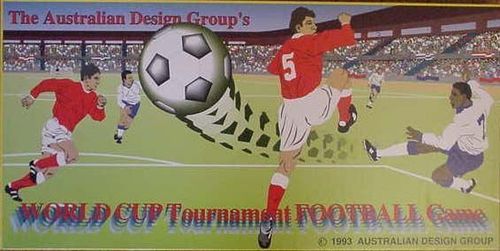
World Cup Tournament Football
World Cup Tournament Football Rulebook
Table of Contents
Table of Contents
Contents of the Game
The game consists of:
- One 820mm x 580mm full-colour playing board of the World Cup Football Final series.
- One 820mm x 580mm full-colour playing board of the Olympic Games Football Final series. The Final of this board is marked "OLYMPIC FINAL" and the board is on the back of the World Cup board.
- 84 National Football team tokens. Each token is a cardboard goalkeeper in stylised National team colours. Each national team is rated in terms of goals and penalties head-start, based on their World Cup performance through history.
- 84 National flags. Each National team token has an equivalent cardboard national flag.
- 192 playing cards. Each card is rated in terms of goals and penalties, and represents the score for each game or part of a game.
- 24 plastic feet. These are placed under the goalkeepers that will be competing in the current World Cup campaign, so that the goalkeepers can stand tall.
- This rulebook.
Object of the Game
The object of the WORLD CUP Tournament FOOTBALL Game is to play cards on the different football fields in the preliminary round and half-fields in the later rounds in order to promote your team(s) through the rounds of the World Cup and win the coveted trophy in The Final.
An Olympic final tournament takes about 20-30 minutes to play, while the World Cup Finals takes 50-70 minutes.
Setting-Up
First, unfold the board provided, setting it up on one side if you are playing a World Cup series (consisting of 24 finalists) or on the other if playing the Olympic football final (consisting of 16 finalists).
Next, press out the team flags and goalkeeper tokens from their cardboard stems. Use a sharp knife if you desire a smoother edge to your tokens.
Now you must decide which teams (out of the 84 provided) will be included, and how many of these each player will manage.
If you wish to play a historical World Cup series, decide which. To help you in this decision we have included a list of all 61 teams that have ever competed in a World Cup finals series throughout history (1930-90), and in what position they ended each campaign.
Having decided which teams will be included, pick out the team flags and goalkeeper tokens that will be required for your chosen finals series. Press the chosen goalkeepers into the plastic feet provided, so that the goalkeepers are standing upright.
(Illustration: a goalkeeper token showing its Goals and Penalties values, standing in the plastic feet.)
Now place the chosen goalkeepers onto the group preliminaries part of the playing board, one per football field. Each Goalie should be placed in the goal square provided for each pitch.
There are 6 Groups (A - F) of 4 teams (1 - 4) in the World Cup for a total of 24 football pitches in the World Cup Group Preliminaries.
There are 4 Groups (A - D) of 4 teams (1 - 4) in the Olympics for a total of 16 football pitches in the Olympics Group Preliminaries.
You should set up each goalie in rating order where the best rated team (in terms of goals, then penalties) is placed in the A1 spot, the second best in the B1 spot, and so on, down to the lowest rated team which is placed in the F4 spot (or D4 if playing the Olympic Final series). If 2 or more teams are equally rated, then choose randomly from between them as to which will occupy the higher position.
Example: You have decided to include Germany, Brazil, Argentina and Italy amongst the 24 teams playing in the World Cup finals. Brazil and Germany are the highest rated teams (2 goals and 2 penalties each), and Germany is randomly chosen to occupy the top spot (A1), with Brazil occupying the A2 spot. Argentina and Italy are the next highest rated and Argentina is randomly chosen to occupy the A3 position with Italy occupying the 4th highest position (A4). The remaining 20 teams are placed down in a similar fashion in the remaining positions.
You then place the goalie's team flags into a cup, shake them up and, in order, offer each player to randomly choose flags from the cup, up to the number decided upon. Each player must end up with the same number of flags in their possession, and their identity should be kept hidden from the other players.
(Illustration: a team flag/goalkeeper showing Goals and Penalties.)
All remaining flags are kept to one side as "bank teams". These are kept hidden from all players until the end of the game.
Example: You have decided to play the World Cup Football final which consists of 24 finalists. There are 5 people playing and you have decided to manage 4 teams each. Each person would randomly pick out 4 teams from a cup, leaving the remaining 4 teams as "bank teams".
Next, shuffle the cards and place some face-down on the space marked "CARD DECK 1" and the remainder face-down on the space marked "CARD DECK 2". Note that there is no difference between these card decks. 2 decks have been provided as 192 cards in one stack is very unwieldy. All future references will just be to "the card deck" which will incorporate both "CARD DECK 1" and "CARD DECK 2" and refers to either.
Finally, the dealer deals out 5 cards face-down to each player. These are kept hidden from all other players.
(Illustration: a playing card, e.g. "HAT TRICK", showing its Goals and Penalties values.)
Playing the Game
After looking at your own cards, the player to the left of the dealer now begins the game by playing two cards; one must be played on a team in the group preliminaries, and a second must be played on one half of a football field in any later round of the final series.
You play a card on a team in the Group Preliminaries by placing it face-up in any football field adjacent to a Goalie.
You play a card on a team in any later round by placing it face-down in any half of a football field there.
After playing 2 cards, you may now replenish your hand by picking up 2 cards in total from either card deck, provided there are cards remaining in either card deck. You may never have more than 5 cards in your possession at any one time.
It is now the next player's turn (going clock-wise) to play cards, just as the first player did, followed by the next player and so on.
No more than 3 cards in total may be placed on any one field of the Group Preliminaries.
No more than 3 cards in total may be placed on any one half-field in any later round.
Each player continues in turn to play cards until all fields in the group preliminaries have 3 cards placed on them.
Players then resolve each preliminary group (A - F in World Cup, A - D in the Olympics) by adding up the goals and penalties on each card to the goals and penalties of that team's goalkeeper. The team with the highest number of goals in each Group is that Group's winner. If two or more teams have an equal total of goals, then penalties are used to decide the winner. If these are tied, the higher rated team (position 1 is higher than 2 which is higher than 3 which is higher than 4) is the group winner.
Using the above procedure, the second best team is decided. These 2 teams from each group automatically go through to the next round and are placed in their goalie's spot in the appropriate half of the field.
Example: You are playing the 1990 World Cup and you are determining who will succeed from Group B. Cameroon (B4) got 3 goals from her 3 cards added to her goalie's 1, to total 4 and come first. Argentina (B1) only received a total of 1 goal from cards added to her goalie's 2 to total 3 which equaled Romania's (B3) total (2 from cards and 1 from the goalie). The USSR (B2) got a total of 2 goals to come in 4th in the group.
To find out who was 2nd and 3rd, we now look at the number of total penalties scored by Argentina and Romania. Argentina got 2 penalties from cards added to 1 from her goalie for a total of 3. Romania got 4 from cards, and thus is second. If she had only totaled 3, then Argentina would have been second as she is the highest rated (B1 to Romania's B3).
The Cameroon goalkeeper is placed in the goals of the final sixteen marked "Winner Group B". The Rumanian goalie is placed in the goals marked "Second Group B".
If playing a World Cup game, you must now decide which were the 4 best 3rd placed teams, using the same procedure above of totaling the card and goalie's scores for each of the 6 group's 3rd best teams. If the goals and penalties are equal, the higher rated team (A is higher than B is higher than C and so on) goes through.
These 4 best 3rd placed teams are now placed in order in the positions marked "X1" (best 3rd placed team) to "X4" (4th best 3rd placed team). From now on, each game is a head-to-head knockout.
Players must now reveal which of their teams failed to make it past the Group Preliminaries. Players who have no teams left to manage are out of the game!
If playing a World Cup game:
(a) All cards played on the teams in the Group preliminaries are now shuffled and then returned face-down to the bottom of the card deck.
(b) Players with less than 5 cards in their possession may now replenish their hand from the returned cards (the player with the least remaining cards receiving the first, the player to their left the second and so on, until there are no cards remaining in the deck or each player has 5 cards).
(c) The remaining players then keep playing cards in turn until each half-field has 3 cards (face-down) on it. However, in their turn, a player may only place 1 card in any half-field and may only replenish their hand by picking up 1 card in total from the card deck.
After all half-fields have 3 cards on them, the remaining players resolve the winner of each remaining knock-out game.
Starting with the final sixteen if playing the World Cup game or quarter-final in the Olympics, players reveal control of the remaining teams as each game is resolved.
Each game is resolved by the players controlling the two goalies (or anyone, if it is a bank team), turning over each of their 3 cards in turn, adding the cards' goals and penalties to that of their goalkeeper's.
The team with the higher total of goals is the winner. If both teams have an equal total of goals, then penalties are used to decide the winner. If these are tied, the higher rated team (A1 is higher than B1 which is higher than C1 and so on down to X4 which is the lowest rated) is the winner.
The winner of each game follows the brown path to the next half-field position, and that team's goalkeeper moves into that half-field's goals. The losing goalkeepers stay where they are to dream of glory next time.
(Illustration: the Quarter-Finals area of the board. The winner of one quarter-final is placed in one half of the semi-final field and the winner of the other quarter-final is placed in the other half.)
After all games in the round have been resolved, the next round is resolved in the same manner until the semi-finals are reached. The loser of each semi-final follows the brown path to the 3rd vs 4th play-off, while the winner follows the red carpet into The Final.
The players controlling the 2 teams in the 3rd vs 4th play-off now resolve their game as above.
Finally the players controlling the 2 finalists resolve The Final as above.
The winner is declared the new World Champion and is free to boast and gloat about what a wonderful player they are!
Of course the losers are allowed to plot their revenge in the next tournament!
Optional Rules
Team Scoring
If you wish, you can also award the best Manager title to the player whose teams overall did the best.
To evaluate how well each manager did, simply add the points together that each team under your control achieved. These points are given out for each round your team managed to get through and is specified next to the round name.
Example: You have just completed the World Cup Football final. The manager of the team that won The Final receives 10 points, the runner up 8 points, 3rd place - 6 points, 4th place - 4 points, the quarter-finals - 2 points and the final sixteen - 1 point.
Each manager then subtracts the total number of their goalkeepers' goals from this total. The manager with the highest modified total becomes the manager of the series.
Example: You have just completed the 1990 World Cup Football final. The teams under your control are Italy and Argentina (2 goals each), and Cameroon and the USSR (1 goal each) for a total of 6 goals. Argentina ended up 2nd (8 points), Italy 3rd (6 points), Cameroon in the quarter final (2 points) and the USSR got knocked out in the Group Preliminaries (0 points) for a total of 16 points. Subtracting the 6 goalkeeper goals from this total gives a modified total of 10 points. This is higher than any other manager and so you win the title of manager of the series even though you did not win the World Cup.
Hidden Play
All cards in the Group preliminaries are played face-down.
Open Play
All cards in the later rounds are played face-up.
Wild Play
The first card in the later rounds are played face-up.
Longer Version (takes about 20 minutes longer)
No more than 4 cards may be placed on each field in the group preliminaries or half-field in a later round.
If playing the World Cup game, in order that there are enough cards, players resolve each group as soon as 4 cards have been played on every team in that group. Replenish the card deck from those teams that were 1st, 2nd and 4th (leaving the 3rd placed team's cards with its goalkeeper until all 6 groups have been resolved). The returned cards are shuffled and then placed face-down on the bottom of the card deck.
Players with less than 5 cards in their possession may now replenish their hand from the returned cards (the player with the least remaining cards receiving the first, the player to their left the second and so on, until there are no cards remaining in the card deck or each player has 5 cards).
Player's Notes
The World Cup Tournament Football game, like many great games is simple to learn but difficult to master. You might think there is little skill in just placing down the better cards on your own teams while dumping bad ones on your opponents'. However, the game is far more subtle than that.
At the start of the game, check your team flags to see if you have more than 1 team in any one preliminary group. If so, you have an enormous advantage as you can basically leave that group alone, assuming that at least one of your teams in that group will go through to a later round. This allows you to concentrate on other groups, hopefully ruining your opponents' plans.
The real trick of the game is to support your own teams while not signalling to your opponents which are your teams. To do this in the preliminary round (where the cards are face up) is to not support your own teams but to place lousy cards on other teams in the same group. You should only support your own team after your opponents have already placed 2 (presumably 0 goal) cards on it, and then slam down your best card (preferably a hat-trick) on it.
One good tactic is, as your first card, to place a good card on a team that is not your own. This will immediately signal to your opponents that this team is yours and they may dump some "0" cards on it, thus destroying it's chances immediately. You should look around you to ascertain the face of it's real manager, as their team hits the wall virtually at the start of the game.
It is often better not to win a particular group, but instead to position yourself to come second. Attempting to come first will signal which is yours to your opponents, allowing them to destroy your team in the later rounds. Coming second will confuse them more, allowing you to support the second place team in the later rounds without arousing your opponent's suspicions.
In later rounds, you must obviously support the positions which you think your team can get to. If two of your teams are likely to be playing against each other, you do not need to place 1 card in that game, as one of your teams is guaranteed to win through to the next round. This allows you to concentrate on later rounds, keeping 1 jump ahead of your opponents.
Finally, you could lose all by trying to support all your teams. Especially in the later rounds, it is better just to support 1 or 2 teams through to the final rather than taking a broad brush approach. For example, if you have decided that your team with the best chance is the one that will most likely come second in preliminary group B, then support B2's path right through to the final, ignoring all your other teams. If you have placed most cards down in the final, then your team will win provided you get that far.
Good luck and good gaming!
Designer's Notes
The World Cup Tournament Football game was designed because of my love of football, and my love of watching nation battle against nation in the sporting arena.
The game allows you in just one hour to be in charge of one (or several) football nation and to guide its destiny in a world tournament. The board is double-sided to allow simulation of both sixteen and twenty-four team events like in the Olympics and the World Cup. The colourful board, players, cards and flags, and a choice of eighty-four countries add to the excitement.
I decided to design the game to be simple enough for young children to play, to be fun and able to be played socially or seriously, and to have plenty of scope for clever play with skill a deciding factor.
The game is based on a simple yet tactically rich concept of players trying to provide a series of winning matches on their team's path from the preliminary rounds through to the final. Skill and strategy are required as players simultaneously need to ensure their team wins at the expense of others, thus ensuring that opponents teams hopes of glory end in defeat.
A feature of the game is that it can be played by just two players or by as many as twenty-four. It can be played as a highly skillful cut and thrust, mindbending game, or as a social, chat and laugh while you play party game.
The conclusion of the game is a high-light with suspense building as cards are turned over to determine who has been able to get their country to be the winner in each match and lastly the winner of the final is decided.
Developer's Notes
The great thing about developing a game like the World Cup Tournament Football game was how little development was required. Peter had designed such an excellent game that there was only a couple of areas needing polishing to make it even better.
The first time I played the game, Western Samoa won. Being a keen football enthusiast, I knew that only 6 teams have ever won the World Cup, and I can assure you that Western Samoa was not one of them. The simple solution was to rate the teams based on their World Cup performances over history.
The second concern was the cards. The original design only had '0' and '1' goal cards leaving little difference between scores. The solution was to provide '2' and '3' goal cards (the infamous hat-tricks) allowing more latitude for the scores. Admittedly this allows for higher scoring games (a sore point with Peter) but my view is that we should not be strait-jacketed by the defensive nature of modern football. Thus this game represents the free-flowing style of football in the past (and hopefully of the future) more than the defensive game of the present (where 0-0 is an exciting result!?!).
Hidden play was another development that adds to the "fog of campaign". You must now use your powers of deduction to work out who owns which teams and how you can thwart their road to success.
The final change was purely cosmetic. In the original design, flags were placed flat in the goals. To get a three-dimensional game, plastic feet were included, and who else should be in the goals except the goalkeepers who now stand proud in their national colours, as they head towards victory and glory.
I hope you find that the final result is as fun to play as it was to produce. Enjoy!
World Cup History Chart
The following are the teams that have competed in the finals of the World Cup in the order they finished (with a bit of poetic licence by me). The name in brackets is the host and the number is the number of countries that competed in the qualifyings rounds.
1930 - Uruguay, Argentina, Yugoslavia, USA, Chile, Brazil, Romania, Paraguay, France, Peru, Belgium, Mexico, Bolivia (Uruguay, 13)
1934 - Italy, Czechoslovakia, Germany, Austria, Spain, Switzerland, Sweden, Hungary, Romania, France, Holland, Argentina, Brazil, Belgium, Egypt (Italy, 32)
1938 - Italy, Hungary, Brazil, Sweden, France, Czechoslovakia, Switzerland, Cuba, Norway, Poland, Germany, Belgium, Holland, Romania, Indonesia as Dutch East Indies (France, 36)
1950 - Uruguay, Brazil, Sweden, Spain, Yugoslavia, Switzerland, Italy, England, Chile, Paraguay, USA, Bolivia, Mexico (Brazil, 32)
1954 - West Germany, Hungary, Uruguay, Austria, Yugoslavia, Brazil, England, Switzerland, Turkey, Italy, France, Belgium, Mexico, Czechoslovakia, Scotland, South Korea (West Germany, 38)
1958 - Brazil, Sweden, France, West Germany, Wales, USSR, Yugoslavia, Northern Ireland, Czechoslovakia, Hungary, England, Paraguay, Argentina, Scotland, Austria, Mexico (Sweden, 53)
1962 - Brazil, Czechoslovakia, Chile, Austria, Hungary, England, USSR, West Germany, Italy, Argentina, Mexico, Spain, Uruguay, Colombia, Bulgaria, Switzerland (Chile, 56)
1966 - England, West Germany, Portugal, USSR, Argentina, Hungary, Uruguay, North Korea, Italy, Spain, Brazil, Mexico, France, Chile, Bulgaria, Switzerland (England, 71)
1970 - Brazil, Italy, West Germany, Uruguay, Peru, England, USSR, Mexico, Sweden, Romania, Belgium, Israel, Bulgaria, Morocco, Czechoslovakia, El Salvador (Mexico, 70)
1974 - West Germany, Holland, Poland, Brazil, Sweden, East Germany, Argentina, Yugoslavia, Scotland, Italy, Chile, Bulgaria, Uruguay, Australia, Haiti, Zaire (West Germany, 99)
1978 - Argentina, Holland, Brazil, Italy, West Germany, Poland, Austria, Peru, Tunisia, Spain, Scotland, France, Sweden, Iran, Hungary, Mexico (Argentina, 106)
1982 - Italy, West Germany, Poland, France, USSR, Brazil, England, Austria, Spain, Nth. Ireland, Argentina, Belgium, Algeria, Hungary, Scotland, Yugoslavia, Cameroon, Honduras, Czechoslovakia, Peru, Kuwait, Chile, New Zealand, El Salvador (Spain, 108)
1986 - Argentina, West Germany, France, Belgium, Mexico, England, Brazil, Spain, Uruguay, Morocco, USSR, Italy, Denmark, Paraguay, Poland, Bulgaria, Portugal, Hungary, Scotland, South Korea, Nth. Ireland, Algeria, Iraq, Canada (Mexico, 121)
1990 - West Germany, Argentina, Italy, England, Yugoslavia, Czechoslovakia, Rep. of Ireland, Cameroon, Brazil, Spain, Belgium, Costa Rica, Romania, Colombia, Holland, Uruguay, USSR as CIS, Austria, Scotland, Egypt, Sweden, Sth Korea, USA, UAE (Italy, 111)
1994 - likely line-up - Germany, Italy, Brazil, Switzerland, Sweden, Republic of Ireland, Russia, Norway, Denmark, France, Colombia, Holland, Argentina, Mexico, Nigeria, Belgium, Greece, Romania, Bolivia, Cameroon, Morocco, USA, South Korea, Iran (USA, 143)