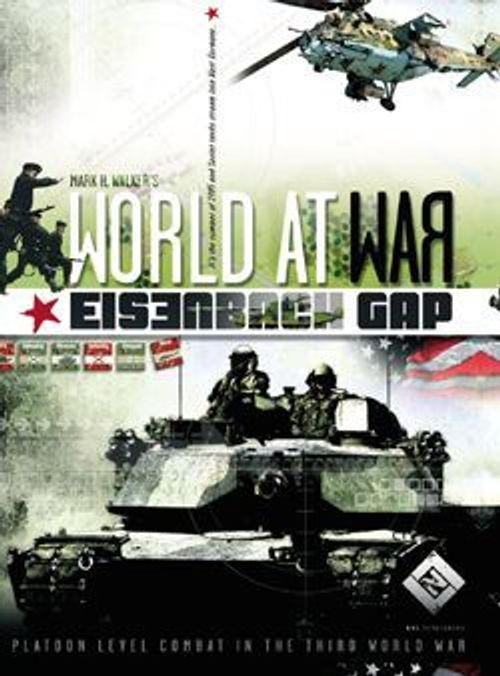
World at War: Eisenbach Gap
World at War: Eisenbach Gap Rulebook
Table of Contents
Table of Contents
- 1.0 General Concepts
- 2.0 Setting Up the Game
- 3.0 Outline of Play
- 4.0 Formation Impulse
- 5.0 Movement
- 6.0 Combat
- 7.0 Line of Sight
- 8.0 Artillery
- 9.0 Helicopters
- 10.0 Scenarios
- Terrain Effect Chart
- Helicopter Line of Sight Table
- Moving Fire Table
1.0 General Concepts
The map for this module depicts a small area of West Germany bordering East Germany. Counters represent infantry platoons (40-60 men), armor platoons (Armored Fighting Vehicle - AFV) (3-5 tanks), armored personnel carriers (APC), infantry fighting vehicles (IFV), and others. A turn represents 5-15 minutes of real time. A hex is approximately 150 meters across.
1.1 Dice
Several six-sided dice (d6) are used to determine the results of combat, Assault, Armor Save, and other game functions.
1.2 Counter Definitions
There are two types of counters in the game:
- Units, which represent combat formations that directly take part in the fighting — for example, Abrams tanks, Soviet infantry, and so on, and
- Administrative markers that assist play. These include Ops Complete markers, Disrupted markers, formation activation markers, and so on.
Units / Markers
1.2.1 Unit Nomenclature Definitions
Don't try to memorize these definitions. They are here for reference. You'll learn them easily as you play.
Full Strength: The full-strength side of a counter is a unit at full manpower and armament. It is set off by a colored bar behind the vehicle symbol or NATO symbol.
Reduced-strength: The reduced-strength side of a counter is a unit with reduced manpower or armament. It is set off by a white bar behind the vehicle symbol or NATO symbol.
AP Firepower (Armor Piercing): The red number indicates how many d6 are rolled when attacking an armored target.
HE Firepower (High Explosive): The yellow number indicates how many d6 are rolled when attacking an unarmored or thin-skinned target, helicopters, and in other cases described in the rules.
AA Firepower (Anti-Aircraft): The blue number indicates how many d6 are rolled when attacking helicopters and aircraft.
To Hit: You must roll a value on a d6 greater than or equal to this number in order to hit the target.
Range: The normal firing range. Most weapons can fire at double the listed range, at the cost of effectiveness (see 6.1.1). Units whose range value is underlined cannot fire beyond the listed range.
Armor: The armor level of armored vehicles. This is the number of d6 rolled to determine how many Hits are ignored.
Save Number: The value that must be equalled or exceeded on a d6 to ignore a single Hit.
Movement Factor/Type: The number of Movement Points a unit has and/or its movement type (tracked, wheeled, helicopter, foot). A circled number means the unit can transport infantry and Support Weapons (SW) (see 5.2).
Assault Factor: The number of d6 rolled when conducting an Assault.
1.3 Unit Types
1.3.1 Infantry
Troops that move by transport (e.g., M-113, BTR-60, M3, BMP) or on foot, and that use rifles, machine guns, and light anti-tank weapons. These include American, West German, and Soviet infantry, marked with the appropriate NATO symbols on their counters. Infantry is a soft target. All infantry units may use an SW in combat (see 1.3.5). Infantry units may use only one SW.
Mark says: Other modules introduce new types of infantry, such as motorcycle troops or militia. Tanks also gain SW in later modules. But for simplicity's sake, we're leaving that for other modules.
1.3.2 Helicopters
Helicopters do not count against the stacking limit. Helicopters may be attacked with either AP or HE Firepower (see 9.3). Helicopters have a single strength level; they are destroyed outright when they would become Reduced. Helicopters have two movement modes, shown on the two sides of the counter, and have different Firepower in each. See 9.0 for details.
1.3.3 Headquarters
The game includes formation headquarters units (HQ). These represent 3-10 men and/or, depending on the platoon type, 1-2 combat vehicles. HQ do not count against the stacking limit, but no more than one HQ may occupy a hex. To act effectively, a formation must be within the Command range of its own HQ (see 1.5 and 4.0).
1.3.3.1 HQ Movement
An HQ must always remain in a hex with a unit or units of its own type; it can move only when accompanied by a unit or units of its type, and if all units in the HQ's hex are destroyed, the HQ is destroyed as well.
An HQ not marked with an Ops Complete marker may move normally with the units it is stacked with.
1.3.3.2 HQ Combat
An HQ cannot be directly attacked under the combat rules (see 6.0). If units attacked while stacked with an HQ become Disrupted or Reduced, roll 1d6. On a 1, the HQ is flipped to its Reduced side; if it is already Reduced, the HQ is destroyed. Results of 2-6 have no effect. Subtract 2 from the 1d6 result if a unit stacked with the HQ is destroyed outright. If all units in the stack are destroyed, the HQ is destroyed as well. If only the HQ is destroyed, the surviving units continue their impulse without penalty, since command status is checked before combat. If the HQ is destroyed before the start of an impulse, or during the first impulse, the formation's units check command for their own impulse as normal, but whether the HQ itself is restored is determined only at the end of the turn. If there is no Wreck marker in the hex, one is placed when the HQ is destroyed. An HQ cannot be Disrupted.
An HQ cannot attack on its own, but it adds the value of its Leadership to the Firepower (or to the Assault Factor, if an Assault is underway) of ONE of the attacking units in its hex.
Exception: if an infantry unit attacks with both its own weapon and an SW, the Leadership bonus applies to both.
1.3.3.3 HQ Replacement
Restore a destroyed HQ with its Reduced side up during the Marker Removal Phase, in any hex containing a friendly unit(s) of the appropriate type and formation. If no units of the appropriate type remain, the HQ CANNOT be restored. In that case, every unit of the formation whose HQ was destroyed must thereafter check for activation as Out of Command (see 4.0).
Example: If the HQ of the Soviet 87th Motorized Rifle is destroyed, it is placed Reduced-side up during the Marker Removal Phase in any hex containing a T-55 platoon of the 87th. If no such platoons remain on the map, the HQ of the 87th Motorized Rifle is NOT placed.
1.3.3.4 HQ Leadership
An HQ subtracts the value of its Leadership from the 2d6 roll of ALL units attempting to Rally in its hex.
1.3.4 Vehicles
Wheeled or tracked vehicles are shown on the counter with the corresponding image.
1.3.4.1 Armored Fighting Vehicles (AFV)
Any vehicle with an Armor Value and Save Number on its counter is an Armored Fighting Vehicle. Armored vehicles are treated as hard targets.
Armored Fighting Vehicle
1.3.4.2 Thin-Skinned and Unarmored Vehicles
Armored vehicles with an Armor Factor of 1 and a Save Number of 5 or 6 are considered thin-skinned. Such vehicles may be attacked by any armored vehicle using either AP or HE Firepower. Attack results are calculated normally using HE Firepower and the Hit Number. After the number of Hits is determined, the target vehicle determines which Hit is ignored, per 6.1.
Unarmored vehicles have NO Armor Factor or Save Number on their counter and may be attacked by any armored vehicle using AP or HE Firepower, with each Hit Reducing them (see 6.1.7). Because such a vehicle has no Armor Factor, it instead rolls a d6 for terrain protection as a soft target does (see 6.1).
Thin-Skinned Combat Vehicle
Example 1: A TOW Jeep in a woods hex rolls 1d6; on a 5 or 6 it ignores one Hit. So if a T-72 (AP Firepower 4, Hit 5+) fires on the TOW Jeep in the woods and rolls 3, 3, 4, 5, it scores one Hit. The TOW Jeep then rolls 1d6. On a 5 or 6, the Hit is ignored and the jeep survives; otherwise it is Disrupted.
Infantry may also fire HE Firepower at unarmored vehicles as if at soft targets. Hits are calculated as normal (i.e., one Hit Disrupts, two Hits Disrupt and Reduce).
Example 2: Soviet infantry fires HE Firepower at a jeep in a clear-terrain hex at a range of two hexes. The Soviets roll a 5 and a 6, scoring two Hits. Since the jeep is in open terrain, it cannot ignore any Hits and takes both.
A Wreck marker MUST be placed after a thin-skinned or unarmored vehicle is destroyed.
Mark says: Why would an armored vehicle attack another armored vehicle with HE Firepower? For the most part, there's no reason to. A T-72 has no trouble destroying an M113 (Armor Factor 1, Save Number 6) with AP Firepower. On the other hand, a BTR-70 or a Shilka would rather attack that same M113 with HE Firepower. That holds true for large-caliber machine guns (14.5mm on the BTR-70) and small-caliber cannon (23mm on the Shilka), which are capable of penetrating the thin armor of a thin-skinned vehicle.
1.3.4.3 Mortars
A unit marked with a mortar symbol is a mortar crew. Both man-packed mortars (the Soviet 81mm mortar in the 2nd Airborne Division) and self-propelled mortars (the M-106 in Alfa Troop) can fire, including Opportunity Fire (see 6.2), directly at hexes within their LOS (Line of Sight). Note that if the range value on the counter is underlined, extended-range fire is not possible, and reduced-range fire does not increase accuracy (see 6.1.2). Mortars may also fire outside their own LOS, at targets within the LOS of an HQ or reconnaissance unit. Fire of this type is organized the same way as off-map artillery fire, using the parameters (Firepower and Hit Number) printed on the counter (see 8.1). The firing player must roll a d6 to determine whether the mortar fire scored Hits IF the target hex is not within the mortar's own LOS. After firing, the mortar is marked with an Ops Complete marker. The unit that called for the fire continues to act normally.
1.3.4.4 Reconnaissance Units
Reconnaissance units (recon) are marked with an ® symbol. Reconnaissance units have three important traits that distinguish them from other units.
Independent: Recon platoons act independently. Accordingly, recon units remain in command at a range twice the Command range (see 4.0) shown on the HQ counter.
Highly Trained: Recon platoons may call for artillery fire just as an HQ can.
Observant: Units within the LOS of a recon unit CANNOT be Concealed (6.1.5).
1.3.4.5 Anti-Aircraft Units
In Eisenbach Gap, anti-aircraft units are represented by the American Chaparral and the Soviet ZSU-23-4 (Shilka), which are treated as thin-skinned vehicles, and by the SW Stinger and SA-7, marked with a blue anti-aircraft firepower number in the upper-left corner of the counter. Their Firepower may only be directed against helicopters. The combat range of AA units CANNOT be halved when firing at helicopters. Note that units such as the Shilka can also fire HE Firepower and Assault, as shown on their counters.
Chaparral and Shilka units represent 1-2 vehicles and have a single strength level, like helicopters. When an attack Reduces an AA unit (see Reduction, 6.1.7), its counter is replaced with a Wreck marker.
Mark says: In other modules, such as Blood and Bridges, there are aircraft, but with the original Eisenbach Gap game we're trying to keep things as simple as possible.
1.3.5 Support Weapons
Sagger, SA-7, Dragon, and Stinger counters, marked "Support Weapon" beneath the colored bar, are Support Weapons (SW). SW are special weapons that grant extra capability to an infantry unit. If the platoon is destroyed, remove the SW from the map along with the infantry platoon. Infantry platoons must fire their SW and their primary armament (whose Firepower is printed on the counter) in the same attack. Fire may be directed at a single target or at different targets.
Place SW counters on the map the first time they open fire; they then stay with the platoon for the rest of the scenario. If, however, any friendly platoon is destroyed BEFORE all of its SW have been placed, the owner of the destroyed unit rolls 1d6. On a 1, the opponent may destroy any not-yet-placed SW. Subtract 1 from the d6 result for each infantry platoon destroyed previously (after the first). SW are ranged weapons and are not used in an Assault.
1.3.6 Unit Color
American units are green. Soviet units are red. West German units are gray.
1.4 Stacking
Up to two units may occupy a hex. This limit always applies. It does not apply to markers, helicopters, Wrecks, SW, or HQ. An APC and the passengers it is carrying count as a single unit.
1.5 Formations
Each formation consists of an HQ and several units. These are usually companies for NATO and battalions for the Soviets. All units of a formation share the same name.
1.6 Morale
Morale is a measure of psychological state, readiness, and training. Units always use the Morale value of their HQ when making Morale checks.
Units can be in Good Order (GO) or Disrupted state. Units in GO state are ready to fight. Disrupted units are units worn down by enemy fire and, to put it plainly, just tired of war. Their combat ability is somewhat reduced.
Helicopters have no Morale. They automatically Rally out of Disrupted when their formation activates, and they are never Out of Command.
Example: All units of the American Yankee Company have Morale 7. Whenever a Morale check is required during play, the player rolls 2d6: if the result is less than or equal to the formation's Morale value, the unit passes the check.
1.7 Marker Types
1.7.1 Formation Markers
Formation markers are placed in an opaque container as directed by the scenario. We find a coffee cup works best for this, but only as long as you keep the cup holding the formation markers at least three feet (or a meter, if you prefer the metric system) away from your cup of coffee. When a player draws a formation marker, that formation is activated.
1.7.2 End Turn Markers
These are placed in the same opaque container as the formation markers (i.e., the recently-washed cup mentioned above), as directed by the scenario. When the second End Turn marker is drawn, the turn ends.
2.0 Setting Up the Game
Read the scenario and set aside the forces it uses. Deploy them per the scenario. Place the formation markers and End Turn markers in an opaque container as directed by the scenario.
3.0 Outline of Play
3.1 Operations Phase
Players alternate drawing markers from the opaque container (from here on, we'll call it the cup). It doesn't matter who draws first, but please be civilized about it. If an End Turn marker is drawn from the cup, set it aside. If a second End Turn marker is drawn (or if there are no more formation markers left in the cup), the Operations Phase ends and the Marker Removal Phase begins. When a player's formation marker is drawn from the cup, he or she MUST activate that formation for movement and combat. This activation is called a formation impulse, and the formation is called the activated formation.
3.2 Marker Removal Phase
Remove all Ops Complete markers from the map, adjust Smoke and Ammo Depleted markers, restore destroyed HQ, and return all formation markers and End Turn markers to the cup, except as described in 3.2.1.
3.2.1 Hey! None of My Formations Were Activated!
If a formation was not activated during the turn, its owner keeps that formation's End Turn marker until that formation is drawn, at which point the End Turn marker is returned to the cup. He returns the End Turn marker he is holding to the cup on the very next turn, as soon as the formation is activated. This means that if you have two, or even three, formations that were not activated, you hold on to an End Turn marker until all three formations have been activated. If both sides have un-activated formations, both sides withhold their End Turn markers from the cup until the following turn.
4.0 Formation Impulse
The player, strictly observing the order given below, carries out the following actions with activated formations. Note that some formations have two formation markers and can therefore be activated TWICE in a turn. All actions must be carried out in sequence, as described below.
Mark says: This is important. If a formation has two markers, each of its units has the opportunity to act twice — and three times, counting Opportunity Fire. This doesn't mean the player gets to choose when the unit is activated — it means both activations must occur. Having two formation markers essentially doubles the actions a formation can take.
4.1 Housekeeping
Remove all Ops Complete and Out of Command markers from the formation.
4.2 Command
Check the command status of all units in the formation. Units within the Command range of their HQ are considered In Command. Units that are OOC of their HQ (including units whose HQ has been permanently destroyed, 1.3.3.3) must check Morale by rolling 2d6 (for example, a unit of the 33rd Motorized Rifle must roll 6 or less). Check Morale hex by hex, not unit by unit. If the check succeeds (the roll is equal to or less than the value shown on the formation's HQ counter, or the calculated conditional Morale value), all units in the hex are considered In Command. If the check fails, that hex is considered OOC and is marked with an OOC (Out of Command) marker. OOC units cannot move or fire during a formation impulse, but they may make Opportunity Fire during the enemy's formation impulse (see 6.2). All units of a formation entering play are considered In Command during their first activation.
Example: A BMP-1 and a dismounted infantry unit of the 33rd Motorized Rifle share a hex. The player rolls a 7 and fails the Morale check, placing an Out of Command marker on the stack.
4.3 Rally
Attempt to Rally the formation's Disrupted units. Units that are In Command Rally on a roll of 2d6. OOC units add 1 to the Morale roll. All units sharing a hex with their HQ may subtract the HQ's Leadership value from the roll. Remove the Disrupted marker from any unit that passes the check.
4.4 Operations
Carry out operations (movement, fire, Assault, and other actions defined by the rules) with the formation's units that are In Command.
5.0 Movement
The Movement Factor (MF) is a unit's abstract speed. In each formation impulse, units may move up to their MF. Movement is voluntary. Mark a unit that has moved with an Ops Complete marker. A unit that has moved may not fire, except for units capable of Moving Fire (6.1.3).
5.1 Stacked Units
Units that begin an action stacked together may move as a group and split apart at any time. Units moving into an adjacent hex spend Movement Factor to enter the hex according to the Terrain Effect Chart (TEC). Units may enter hexes occupied by the enemy, but doing so requires initiating an Assault or an Overrun. Moving units may draw Opportunity Fire (6.2).
5.2 Transporting Units
Units with a circled Movement Factor (e.g., M113, BMP, BTR-60, Marder, and Bradley) may transport infantry and SW (even while Reduced). Place the embarking infantry and SW units beneath the transport counter.
5.2.1 Loading
If a transport and unloaded infantry begin movement in the same hex, they may load and then move up to half the transport's MF during the formation impulse.
If the transport and the infantry begin movement in different hexes, they may move up to half the transport's MF and up to 1 MF for the infantry to reach a common hex and load. They may not move further for the rest of the turn.
Disrupted infantry cannot load into a transport.
5.2.2 Unloading
The transport and its embarked infantry may move up to half the transport's MF, after which the infantry may unload, with the infantry counter placed on top of the transport counter. The infantry may then move an additional 1 hex. Alternatively, if the transport and its embarked infantry begin movement in the same hex, the infantry may unload as its first action and move into an adjacent hex, after which the transport may move up to half its MF.
As stated above, Disrupted infantry cannot load. Nor may it violate the movement rules for Disrupted units (6.1.7).
5.2.3 Infantry Fire From Transport (Combat Fire)
Infantry may not fire from a transport. The transport itself, however, may fire normally.
Mark says: Even though many transports have firing ports for the infantry to shoot from, it isn't effective.
5.2.4 Transport as a Target (Combat Results)
If the transport is Disrupted, the infantry it carries is Disrupted as well. If the transport Rallies, the embarked infantry Rallies as well. If the transport takes a loss, roll 1d6: on an even result, the embarked infantry also takes the loss. If the transport is destroyed, roll 1d6: on an even result, the embarked infantry is also destroyed; on an odd result, the infantry becomes Disrupted and Reduced.
6.0 Combat
World at War has four types of combat: ranged, Opportunity Fire (a form of ranged combat), Assault, and Overrun.
6.1 Ranged Combat
During its formation impulse, every GO unit not marked with an Ops Complete marker that has an enemy within LOS and range may attack it (except as noted below). During the enemy's formation impulse, when enemy units move within the LOS and range of a GO friendly unit NOT marked with an Ops Complete marker, that unit may fire on them; this is called Opportunity Fire, and it is covered in detail in its own section (see 6.2).
Units may attack once per formation impulse with either AP or HE Firepower, and a single enemy unit may be attacked by several units at once. Two units in a stack may fire at the same target, but defense is rolled separately against each attacker. Mark a unit that has made a ranged attack with an Ops Complete marker. Units attack individually, except for SW. A motor rifle platoon must fire its SW when it fires its primary weapon (the Firepower shown on its counter), or it loses the ability to use that SW later. A motor rifle platoon may fire its primary weapon and its SW at the same target or at different targets. A unit is never required to fire.
You may always fire at an adjacent unit, but you may not fire at a unit if LOS is blocked (see 7.0); for helicopters, see the Player Aid Card.
There are two types of targets: hard (mostly armored vehicles, see 1.3.4.1) and soft (in World at War, infantry and unarmored vehicles).
Armored targets have an Armor Factor and a Save Number printed on their counters. Unarmored targets do not have these values.
Attackers normally use AP Firepower against armored targets and HE Firepower against unarmored targets, helicopters, and thin-skinned or unarmored vehicles (see 1.3.4.2).
To attack an enemy unit, the attacker must: a) have the target within LOS (7.0); b) be within range of the target.
Determine range by counting hexes between the attacker and the target. Do not count the attacker's own hex. The target's hex is counted.
The attacker rolls a number of d6 equal to its Firepower (AP against an armored target, HE against a thin-skinned target or a helicopter). Each die result equal to or greater than the Hit Number scores one Hit on the target.
If the target is armored, its owner rolls a number of d6 equal to its Armor Factor plus any terrain Defensive Bonus (see TEC). Each die result equal to or greater than the Save Number allows one Hit to be ignored. Armored targets can never receive a Defensive Bonus of more than 2d6, regardless of terrain or Concealed status (6.1.5).
If the target is thin-skinned or unarmored, its owner rolls a number of d6 equal to the terrain Defensive Bonus. On a result of 5 or greater, one Hit is ignored. Unarmored targets have no limit on Defensive Bonus.
Example: A platoon of Abrams tanks attacks a platoon of T-72s holed up in a woods hex. Since the T-72s are an armored target, the Abrams use their AP Firepower of 4 and a Hit Number of 4. The Americans roll 4d6, getting 4, 5, 6, and 3 — three Hits. The T-72s are in a woods hex, which grants a Defensive Bonus of 1d6.
The T-72s have an Armor Factor of 4 and a Save Number of 6; the Soviet player rolls 5d6 (4d6 for the T-72's Armor Factor and 1d6 for the Defensive Bonus) and gets 1, 3, 2, 4, and 6 — so one American Hit is ignored, leaving the Americans with 2 Hits on the T-72 platoon, which becomes Disrupted and Reduced.
6.1.1 Extended Range
Units may fire at up to twice the range printed on their counter. Any fire beyond the printed range is considered extended-range fire. When firing at extended range, the Hit Number is increased by 1 on the d6.
Example: When firing AP Firepower at a target 1-10 hexes away, the Abrams' Hit Number is 4. When firing AP Firepower at a target 11-20 hexes away, the Hit Number increases to 5.
Weapons whose range is underlined on the counter cannot fire at extended range. The range printed on the counter is their maximum.
6.1.2 Reduced Range
Weapons whose range value is NOT underlined fire more accurately at short range. When firing at half range or less, the Hit Number is reduced by 1 on the d6.
Example: For T-72 tanks firing AP Firepower at a range of 3 hexes or less, the Hit Number is reduced from 5 to 4.
6.1.3 Moving Fire
Units whose Firepower is underlined may move up to half their Movement Points and then make Moving Fire, applying the penalty shown on the Player Aid Card. The Abrams, Bradley, T-72, Leopard II, Leopard I, Cobra, and Hind are the only seven units in Eisenbach Gap Deluxe that can make Moving Fire.
If the combined effects of 6.1.1 and/or 6.1.3 would push the Hit Number above 6, instead reduce Firepower by 1 for each point of increase beyond 6, holding the Hit Number at 6.
Example: If extended range would raise a unit's Hit Number from 5 to 6, and it then also fires Moving Fire, the further penalty is applied as a reduction to Firepower instead of the Hit Number.
Units making Moving Fire may not take part in an Assault or Overrun against enemy units.
6.1.3.1 Helicopter Moving Fire
Helicopters may fire after moving up to 12 hexes. They may not fire in the same turn if they moved more than 12 hexes. Helicopters can only move in Flying Mode (9.0), so their Moving Fire penalty is already factored into the values on the Flying side of the counter.
6.1.4 Missile-Armed Units and Missile Depletion
Missile-firing units are any units with an underlined AP or AA (9.3) range value on their counter (BMP-1, Bradley, ITV, Dragon, Sagger, Cobra, PAH, Marder, Milan, Redeye, Stinger, SA-7, and Hind). When a missile-armed unit rolls "No Hit" on its firing dice (for example, an ITV rolls 1, 3, 3, 2, or a Redeye rolls 3, 4, 4, or a BMP-1 with Firepower 3 at a range of 14 hexes rolls 1, 2, 3), it temporarily runs out of ammunition. Place a Depleted Ammo 2 marker on the unit. During the Marker Removal Phase, flip the Depleted Ammo 2 marker to its Depleted Ammo 1 side. During the following Marker Removal Phase, remove the Depleted Ammo 1 marker. A unit or SW with an underlined AP Firepower value on its counter cannot use that Firepower while under a Depleted Ammo marker (1 or 2).
These rules do NOT apply to mortars.
6.1.5 Concealed
If the attacked unit is in a hex with a Wreck marker, or in a woods, city, rough terrain, or cultivated (infantry only) hex, and
a) it is NOT marked with an Ops Complete marker, b) it did not move, c) it is not adjacent to a GO enemy unit, or d) it is not within the LOS of a GO enemy reconnaissance unit (see 1.3.4.4),
then it is Concealed. Add 1d6 to the terrain Defensive Bonus for a Concealed unit. For example, an infantry unit in a city hex gets a Defensive Bonus of 2d6 from the city; if it is also Concealed, its Defensive Bonus becomes 3d6. Remember that heavily-armored targets can receive a maximum Defensive Bonus of 2, regardless of hex conditions.
6.1.6 Maximum Defensive Bonus
Heavily-armored targets receive a maximum Defensive Bonus of 2, regardless of the terrain and conditions of the hex they occupy (see 6.1.5). This is a maximum Defensive Bonus, not a default one. For example, a heavily-armored vehicle in a woods hex gets a Defensive Bonus of 1d6. If that heavily-armored vehicle is also Concealed, it gets 2d6 — and if the hex also contains a Wreck, the vehicle still only gets a total Defensive Bonus of 2d6.
Soft targets have no limit on Defensive Bonus.
6.1.7 Combat Results
Disrupted: The first Hit on a unit Disrupts it. Disrupted units cannot fire, but they may move; however, they may not move closer to an enemy unit (or into a hex adjacent to the enemy) while within its LOS. If a unit is already in a hex adjacent to the enemy, it may retreat away from the enemy until it leaves that unit's LOS. It may unload infantry (5.2.2). Disrupted units may counterattack in Assault Combat, but their Assault Factor Hit Number drops to 6. Disrupted units may return to normal status by passing a Morale check during their own formation impulse.
Reduction: Each Hit against a Disrupted unit reduces it by one level (it remains Disrupted). A full-strength counter is flipped to its Reduced side, and an already-Reduced unit is destroyed. If there is not already a Wreck marker in the hex, place one after the FIRST vehicle is destroyed in that hex — use only one Wreck marker per hex.
6.2 Opportunity Fire
Opportunity Fire is a form of combat carried out while an enemy unit is moving. If an enemy unit moves within the LOS and range of a GO unit not marked with an Ops Complete marker, that unit may attack the moving unit after it enters its new hex, following the rules above. A moving unit may be attacked only once per hex it enters — meaning it can be attacked by a different enemy unit in each successive hex of its move. A unit that becomes Disrupted or Reduced must stop moving. Mark units that make Opportunity Fire with an Ops Complete marker. Opportunity Fire occurs before Moving Fire (6.1.3).
6.3 Assault Combat
Units Assault enemy units by moving into their hex. Assault Combat begins the moment attacking units enter the defenders' hex. Each side may exceed the stacking limit given in section 1.2 for this combat. Units entering the hex are called the attackers; units occupying the hex are called the defenders.
The attacking units roll a number of d6 equal to their Assault Factor. Each die result equal to or greater than the Assault Hit Number counts as a Hit. Don't apply them yet. Now the defender counterattacks the attacking unit, rolling d6 equal to its own Assault Factor. Each die result equal to or greater than the Assault Hit Number counts as a Hit. Note that if the defenders are Disrupted at the moment the attackers enter their hex, their Assault Hit Number for the counterattack is 6.
Now both sides tally Hits. Every unit belonging to a player in the hex must take one Hit before any of them takes a second, and all must take two Hits before any is destroyed. If a player's units take an odd number of Hits (e.g., 1 or 3), randomly determine which unit takes the extra Hit. Otherwise, Hits have the same effect as in Ranged Combat (6.1). If the defender is destroyed, the attacking player remains in the hex. If the defender took more Hits than the attacker, the defender retreats one hex and the attacker remains in the hex. If the defender is not destroyed and took fewer Hits than (or the same number as) the attacker, the attacker must retreat to the hex it entered from. If either side has an HQ in the hex, damage to it is resolved per 1.3.3.2.
Example: If a unit stacked with an HQ takes a Hit, roll a d6 — on a 1, the HQ is Reduced, or destroyed if it was already Reduced.
When retreating, the defender must attempt to retreat in the direction exactly opposite the direction from which the attackers entered the hex. A defender may not retreat
a) into a hex occupied by the enemy, or b) into a hex adjacent to an enemy unit (other than the ones that just attacked it), or c) into a hex where doing so would violate the stacking limit.
If the defender cannot retreat, it is destroyed.
If an HQ takes part in Assault Combat (whether on the attacking or defending side), one of the units adds the HQ's Leadership to its Assault Factor. The HQ itself does not attack.
Example: A BTR-80 platoon of the 87th Motorized Rifle, with a non-Reduced HQ of the 87th Motorized Rifle's T-55, rolls 3d6 (1d6 for its own Assault Factor plus 2d6 for the 87th Motorized Rifle HQ's Leadership).
After the Assault result is determined, both the attacking and defending sides are marked with an Ops Complete marker.
Units without an Assault Factor cannot attack or counterattack in Assault Combat.
6.3.1 Infantry Assault Bonus vs. Vehicles
If infantry attacks a hex where ALL the defending units are vehicles, or Undisrupted infantry defends against an Assault where ALL the attacking units are vehicles, reduce the infantry's Assault Hit Number by 1 (e.g., from 4 to 3).
If infantry attacks a hex where ALL the defending units are vehicles, or Undisrupted infantry defends against an Assault where ALL the attacking units are vehicles, AND the combat takes place in a city, reduce the infantry's Assault Hit Number by 1 (e.g., from 4 to 3) AND increase its Assault Factor by 1 (e.g., from 3 to 4). This means infantry attacking a stack of vehicles in a city (or defending against one, while Undisrupted) both increases its Assault Factor and lowers its Assault Hit Number by 1. In short: it is not a great idea to Assault GO infantry in a city with vehicles unsupported by your own infantry.
Note: Disrupted infantry does NOT reduce its Assault Hit Number — it remains 6 — and gets no bonus against vehicles in a city.
6.4 Overrun Combat
Combat vehicles may attempt to Overrun enemy infantry in open or hilly terrain. To do so, the player must declare the intention and move the combat vehicles into the hex, paying one additional Movement Point beyond the normal cost of entering that terrain. After paying for the Overrun, the combat vehicles must have enough Movement Points remaining to enter an adjacent hex. That hex must not contain any other enemy units.
Each combat vehicle unit (or stack of such units) making an Overrun triples its Assault Factor and rolls that many d6. Each die result equal to or greater than the attacker's Assault Hit Number hits the target. Don't apply them yet. Infantry in the hex counterattacks the Overrunning combat vehicle unit with its unmodified Assault Factor. Defending units that were already Disrupted BEFORE the Overrun use an Assault Hit Number of 6.
Then both sides tally Hits. All defending units in the Overrun hex must take one Hit before any takes a second. Hits are resolved as in Ranged Combat (6.1). If the attacking combat vehicles became Disrupted or Reduced during the Overrun, they may not pass through the hex, and instead return to the hex from which they attempted to enter. A combat vehicle in normal status may make as many Overruns as its Movement Points allow, but it cannot Overrun the same hex twice in the same turn — that's just silly.
7.0 Line of Sight
To attack units at range, the attacker must have clear LOS to its target. An attacker can always attack an adjacent unit. Ground units in World at War exist at two elevation levels: ground level (Level 0) and hill level (Level 1). A unit is at hill level if it occupies a hill, and at ground level otherwise. This affects how LOS is determined.
7.1 Ground Level LOS
An attacker at ground level cannot fire if blocking terrain lies between it and the enemy-occupied hex. Blocking terrain is:
a) a woods, city, or hill hex, or b) 2 or more rough-terrain hexes, Wreck hexes, or a combination thereof.
Terrain in the hexes occupied by the attacker and its target does not affect LOS.
Note: Blocking terrain types are listed on the Player Aid Card.
7.2 Hill Level LOS
If the attacker is on a hill or a wooded hill, it cannot fire at an enemy if a hill crest line crosses its LOS. Crest lines are the thin white lines that mark the boundaries of a hill. The effect of a crest line can be ignored if:
- the target is also on a hill or wooded hill, or
- the attacker or the target is in a hex adjacent to the crest line.
Blocking terrain may also obstruct an attacker on a hill from seeing a target that is also on a hill. LOS is blocked by:
a) a single wooded-hill hex, or b) two or more rough-terrain hexes or Wreck hexes, or a combination thereof.
If the attacker is on a hill or wooded hill, it cannot fire at an enemy at ground level if that enemy is directly behind a woods, or one or two hexes behind a city. A target is considered "behind" a woods or city if the LOS crosses the woods or city hex before reaching the target hex.
If the attacker is on a hill or wooded hill, it cannot fire at an enemy unit at ground level if a hill, wooded hill, or city lies between the attacker and the target.
7.3 LOS Determination
Whether fire into a hex is blocked or not can be determined by stretching a string from the center of the attacker's hex to the center of the defender's hex. If the string passes through one or more blocking hexes, fire is blocked. The string does NOT need to touch the silhouette of the woods, city, or other terrain feature.
If the string passes only along the edge of a blocking hex, fire is not blocked; but if the string runs along a boundary shared by two blocking hexes (i.e., between them), LOS IS blocked. Note that in this situation, a second rough-terrain hex, or a combination of rough terrain and a Wreck marker, also blocks LOS. For example, LOS from X13 to Z9 is blocked.
8.0 Artillery
Artillery support is specified in the scenario's conditions using a formula such as 1 x 4/5, where 1 is the number of fire missions, 4 is the Firepower, and 5 is the Hit Number of the artillery mission. This module has five types of artillery fire: HE (High Explosive), Smoke, FASCAM (Field Artillery Scatterable Munitions), Chemical, and DPICM (Dual-Purpose Improved Conventional Munitions).
An HQ may call up to two artillery missions as its FIRST action when its formation is activated, targeting any hex within the HQ's LOS. To do so, designate the target hex and roll 1d6: on a 1-5, the mission lands on the target hex; on a 6, your opponent designates an adjacent hex for the strike to land in instead. An artillery strike affects ALL units in the target hex. The result of the mission depends on the type of artillery fire used.
An HQ that calls for artillery is not marked with an Ops Complete marker. It may still move, engage in Ranged Combat, or Assault during its impulse, but calling for artillery must be its FIRST action.
8.1 High Explosive Fire Missions
To resolve an HE mission, roll a number of d6 equal to the Firepower. Each result equal to or greater than the Hit Number scores a Hit on the target.
The owner of the targeted unit rolls a number of d6 equal to the infantry Defensive Bonus of the terrain, without counting Concealed; in a city, both vehicles and infantry defending roll 2d6. For each result of 5 or greater, one Hit is ignored. It does not matter whether the target is armored or not. An infantry unit and a vehicle sharing a hex both use the infantry Defensive Bonus.
Now tally the Hits. If a hex with two units receives a single Hit, randomly determine which unit takes it. Every target unit in the hex must take one Hit before any takes a second. Combat vehicles (even thin-skinned ones) cannot be Reduced by HE fire. The first Hit Disrupts them; subsequent Hits have no further effect. Subsequent Hits, however, do Reduce soft targets and UNARMORED vehicles sharing a hex with a heavily-armored vehicle.
Even though an HQ cannot be attacked directly by artillery, if any other unit in the hex takes a Hit, the HQ rolls a d6 under the rules described in 1.3.3.2. This applies here as well.
It is reasonable to house-rule that each unit is attacked separately by the artillery mission.
8.2 Smoke
To lay down smoke, place a Smoke 2 marker in the chosen hex per 8.0. This marker blocks LOS at any elevation, into and through that hex and its six neighboring hexes, for all units not adjacent to it, EXCEPT for the units listed in the Advanced Imaging column of the Moving Fire Table on the Player Aid Card — the American Abrams, Bradley, ITV, Milan, TOW, Leopard I, and Leopard II.
For units with thermal imaging sights, the AP and HE Hit Numbers increase by 1; the ITV, however, cannot use its HE Firepower to fire through Smoke hexes, but may fire through them with its AP Firepower, with its Hit Number increased from 4 to 5.
*Any adjacent unit may fire into a Smoke hex. Doing so increases the Hit Number by 1.
During the Marker Removal Phase, flip the Smoke 2 marker to its Smoke 1 side. During the next Marker Removal Phase, remove the Smoke 1 marker from the map.
8.3 FASCAM (Field Artillery Scatterable Munitions)
Only the Americans may use the FASCAM system. To resolve it, place a Mines! marker in the chosen hex as described in 8.0. All units entering that hex or its six neighboring hexes suffer damage from the mines. The Americans roll 1d6: on an even result, the unit is Disrupted; on an odd result, the strike has no effect. If the 1d6 result is a 6, the Mines! marker is removed.
8.4 Chemical
Only the Soviets have access to this type of artillery fire, representing a barrage using a non-persistent nerve agent. To resolve a chemical strike, place a Chemical Strike marker in the chosen hex per 8.0. This barrage immediately affects all units in that hex and its six neighboring hexes. To resolve the attack, every affected unit must check Morale. Combat vehicles that fail their Morale check become Disrupted; if they are already Disrupted, they suffer no further penalty. Infantry transported in combat vehicles (e.g., in an M-113) does not check Morale separately — it uses the same result as the vehicle transporting it. Infantry not transported in a combat vehicle (i.e., dismounted) that fails its Morale check becomes Disrupted AND Reduced.
Units must pay an additional 2 MP to enter a hex with a Chemical Strike marker, or one of its six neighboring hexes, but suffer no further penalty for doing so. Remove the Chemical Strike marker during the Marker Removal Phase.
8.5 DPICM (Dual-Purpose Improved Conventional Munitions)
A DPICM bombardment only damages combat vehicles. To resolve a DPICM bombardment, follow 8.0 for the chosen hex, then roll a number of d6 equal to the Firepower value. A result equal to or greater than the Hit Number damages the target.
The owner of the targeted unit rolls a number of d6 equal to the terrain's Defensive Bonus, without counting Concealed. For each d6 result of 5 or greater, one Hit is ignored. Now tally the Hits. Every target unit must take one Hit before any takes a second. Unlike HE fire, a DPICM bombardment can Reduce combat vehicles (6.1.6).
It is reasonable to house-rule that each unit is attacked separately by the artillery mission.
9.0 Helicopters
Helicopters are organized into formations and have formation markers, but no HQ. When a helicopter formation marker is drawn from the cup, all helicopters of that formation (usually two counters) are activated; they are considered In Command and are automatically Undisrupted.
9.1 Helicopters on the Move
Helicopters have two modes: Flying and Hovering. The default mode is Flying (helicopters enter play in Flying mode). When a helicopter is Hovering, flip the counter to its Hovering side. Helicopters use the values that correspond to their current mode. A helicopter may change modes ONCE per activation, and this must be its FIRST action after the formation is activated.
Helicopters move hex by hex, ignoring the cost of entering a hex; their Movement Factor is effectively unlimited, but they may move no more than 12 hexes if they intend to use Moving Fire (6.1.3). They must move hex by hex so that the opposing side has the opportunity to make Opportunity Fire against them.
Helicopters cannot Assault, but they may enter a hex occupied by the enemy, as long as there is no enemy helicopter already there. Both units may then coexist in the same hex and may fire at each other as if they were in adjacent hexes. They may also be fired on by other units outside the hex.
9.2 Helicopters on the Attack
Helicopters use the values corresponding to their current mode (the side of the counter showing). Helicopters use their HE Firepower against both thin-skinned and heavily-armored vehicles. For example, when a Hovering Hind (Mi-24) fires at an armored vehicle using its HE Firepower, it rolls 4d6, and every result of 5 or greater scores a Hit.
The Soviet Hind and the American Cobra may fire after moving up to 12 hexes. They cannot fire in the same turn if they moved more than 12 hexes. Helicopters can only move in Flying Mode, so their Moving Fire penalty is already factored into the values on the Flying side of the counter.
Designer's note: Helicopters in Flying Mode have no AP Firepower, because employing anti-tank guided missiles (ATGMs) — represented by AP Firepower — is difficult, since the ATGM cannot be effectively guided while the helicopter is moving at speeds over a hundred miles an hour. Note also that a helicopter's HE Firepower represents the cannon and machine guns that most helicopters carry. That cannon can be effective against the thin top armor of tanks and combat vehicles, which is why a helicopter is able to attack heavily-armored vehicles using HE Firepower.
9.3 Helicopters as Targets
Helicopters may be attacked with either AP or HE weaponry, after which they roll a d6 using their Armor Value and Save Number. Units without anti-aircraft weaponry (without a blue Firepower Factor) attack helicopters at half their normal range, but can always attack a helicopter in an adjacent hex. For example, a unit with a range of 5 attacking a helicopter has an effective range of 2. Units without anti-aircraft weaponry cannot fire at extended range against a helicopter and get NO bonus for reduced range (6.1.2).
Units with anti-aircraft weaponry can be identified by their blue Firepower Factor. They do not halve their range when attacking a helicopter. Extended- and reduced-range modifiers apply in full to anti-aircraft weaponry. Note that AA units such as the Chaparral, which use missiles with an underlined range value, do not apply extended- or reduced-range modifiers.
Any unit with AP Firepower and an underlined range — in other words, units that fire AP guided missiles (e.g., Dragon, Marder, TOW Jeeps, ITV, M3, BMP-1s, Sagger, and BRDM AT) — cannot attack Flying helicopters with AP Firepower. When attacking Hovering helicopters, their range is halved.
The first Hit on a helicopter Disrupts it; a Hit on an already-Disrupted helicopter destroys it. Place a Wreck marker in the hex where the helicopter was destroyed (yes, a single marker covers all destroyed helicopters). If the hex is occupied, roll 1d6: on a 1, one randomly-determined unit in the hex takes damage (6.1.6). Disrupted helicopters AUTOMATICALLY Rally when their formation is activated.
Mark says: Why do helicopters have such large Armor Factor and Save Number values? Although helicopters have relatively little actual armor plating, a Flying helicopter's Armor Factor represents the difficulty of hitting a helicopter flying fast and low over the terrain.
9.4 Helicopters and LOS
Helicopters — whether Flying or Hovering — are considered to be one elevation level above the terrain they are over. Accordingly, the LOS effects based on elevation are shown in the Helicopter Line of Sight table on the Player Aid Card.
10.0 Scenarios
Overview: The situation, date and time, and the forces involved.
Control: To control a city, or any other hex for that matter, a player must have a unit in the hex, or have been the last to pass through every hex of the city. A player automatically begins the game in control of every hex where he could theoretically place a unit. Eisenbach lies on both sides of the river.
Scenario Order of Battle: When a formation is listed in a scenario — for example, 1st Tank — the entire formation plays, including any Support Weapons listed in the Order of Battle. For example, if all units of the 33rd Motor Rifle (in The Defense of Klappenbruck) are in play, they receive the two Saggers listed for that formation in the Order of Battle. If the scenario lists specific "elements" of a formation, only the listed units play. Always check the scenario's Special Scenario Rules (SSR) for additional units, such as a BRDM AT or a Chaparral, that may be attached to a formation. Each formation (or element of a formation) listed in the Order of Battle receives its own formation markers, unless the scenario states otherwise. For example, the Soviet 1st Tank normally receives one formation marker, while the American Team Yankee receives two.
Playable Area: The area of the map where the battle takes place.
Turns: How long the battle lasts, and any special information about End Turn markers.
Victory Conditions: The specific objectives each player must achieve to win the battle.
Special Scenario Rules: Rules that apply specifically to that scenario. Players should read these rules carefully, or they risk missing events such as reinforcements, withdrawals, and other important developments.
Terrain Effect Chart
| Terrain | Defensive Bonus | Movement Cost | Concealment | Blocks Visibility | Comment | Example |
|---|---|---|---|---|---|---|
| Clear | None | 1 | No | No | — | O16 |
| Hill | 1 – if attacked from ground level | +1 if entering from ground level; otherwise 1 | No | Yes (see 7.0) | — | K17 |
| Woods | 1 | 1 for Infantry, 2 for Vehicles | Yes | Yes | — | Z16 |
| Wooded Hill | 1; 2 – if attacked from ground level |
Helicopter Line of Sight Table
| Helicopter's Location | Helicopter's Height | LOS Effect |
|---|---|---|
| Over clear terrain | Level 1 | Cannot fire at an enemy unit on a hill if the LOS between attacker and target passes through (a) a wooded-hill hex, or (b) more than one Wreck marker on a hill. Cannot fire at an enemy unit at ground level that is directly behind a woods, or 1-2 hexes behind a city. Cannot fire at an enemy unit at ground level if a hill lies between attacker and target. |
| Over a hill, over a woods, or over a city | Level 2 | Cannot fire at an enemy unit at ground level that is directly behind a woods, or behind a hill that is not part of the hill the helicopter is flying over, or 1-2 hexes behind a city. Cannot fire at an enemy unit at ground level or hill level if a wooded hill lies between attacker and target. |
| Over a wooded hill | Level 3 | Cannot fire at an enemy unit at ground level that is directly behind a woods, or behind a hill that is not part of the hill the helicopter is flying over, or 1-2 hexes behind a city. Cannot fire at an enemy unit at ground level or hill level if a wooded hill lies between attacker and target. Cannot fire at an enemy unit at hill level that is directly behind a wooded hill, or on a hill that is not part of the hill the helicopter is flying over. |
Moving Fire Table
| Country | Moving Fire Level 1 (L1) | Moving Fire Level 2 (L2) | Advanced Imaging (thermal sights) |
|---|---|---|---|
| United States | Bradley (HE) | Abrams | Abrams, Bradley, ITV, TOW |
| West Germany | Leopard 1 | Leopard 2 | Leopard 2, Jaguar, Luchs |
| Soviet Union | T-72 | — | — |
L2 modifier: +1 to Hit, -1 Firepower. L1 modifier: +1 to Hit.
Units with Advanced Imaging may fire into and through Smoke hexes, but doing so lowers the Hit Number by -1 (applied once, not per hex), and they cannot fire at extended range while doing so.