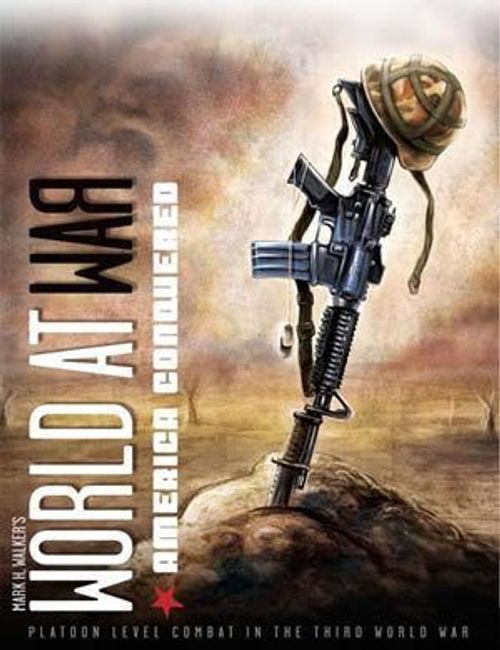
World at War: America Conquered
World at War: America Conquered Rulebook
Table of Contents
Table of Contents
- 1.0 General Concepts
- 2.0 Setting Up the Game
- 3.0 Outline of Play
- 4.0 Formation Impulse
- 5.0 Movement
- 6.0 Combat
- 7.0 Line of Sight
- 8.0 Artillery
- 9.0 Air Support
- 10.0 Jamming (Electronic Warfare)
- 11.0 Battlefield Chaos
- 12.0 Fortifications and Terrain Improvements
- 13.0 Scenarios
- Terrain Effect Chart
- Helicopter Line of Sight Table
- Moving Fire Table
- Battlefield Chaos Table (America Conquered)
- Volley Fire
- Targeting Table
- Counter Illustrations
1.0 General Concepts
The four maps of this module depict typical terrain of Florida and Texas. You may notice elevations on maps "I" and "H" and wonder what kind of mountains these are. Do not be surprised. The hills do not represent the Smoky Mountains (Great Smoky Mountains National Park in the central part of the Appalachian Mountains – translator's note); they are rather gradually rising dunes, as found in Florida. Counters represent infantry platoons (40-60 men), platoons of Armored Fighting Vehicles (AFV) (3-5 tanks), armored personnel carriers (APC), infantry fighting vehicles (IFV), helicopters, aircraft and SW. A turn lasts 5-15 minutes of real time. A hex is about 150 meters across.
1.1 Dice
Several six-sided dice (d6) are used to determine the results of combat, Assault, armor saves (Armor Save) and other game functions.
1.2 Counter Definitions
There are two types of counters in the game:
- Units, which are combat formations that directly take part in the fighting, for example Abrams tanks, Soviet infantry, etc., and
- Administrative markers to help play. They include: Ops Complete markers, Disrupted markers, formation activation markers, and so on.
1.2.1 Unit Nomenclature Definitions
Do not try to memorize these definitions. They are here for reference. You will learn them easily in the course of play.
Full Strength: the full-strength side of a counter – a unit completely manned and equipped. It is identified by a colored bar behind the vehicle image or NATO symbol.
Reduced-strength: the reduced-strength side of a counter – a unit with fewer men or weapons. It is identified by a white bar behind the vehicle image or NATO symbol.
AP Firepower (Armor Piercing): the red number indicates the number of d6 rolled when attacking an armored target.
HE Firepower (High Explosive): the yellow number indicates the number of d6 rolled when attacking an unarmored or thin-skinned target, helicopters, and in other cases described in the rules.
AA Firepower (Anti-Aircraft): the blue number indicates the number of d6 rolled when attacking helicopters and aircraft.
To Hit: you must roll on a d6 a value greater than or equal to this number in order to hit the target.
Range: the normal firing range. Most weapons can fire at double the listed range, but at a cost in effectiveness (see 6.1.1). Units whose Range value is underlined cannot fire beyond the listed range.
Armor: the armor level of an armored vehicle. This is the number of d6 rolled to determine how many Hits are ignored.
Save Number: the value that must be equaled or exceeded on a d6 to ignore a single Hit.
Movement Factor/Type: the number of Movement Points the unit has and/or the movement type (tracked, wheeled, helicopter, foot). A circled number means the unit can transport infantry and support weapons (SW) (see 5.2).
Assault Factor: the number of d6 rolled when conducting an Assault.
1.3 Unit Types
1.3.1 Infantry
Troops that move by transport (for example M-113, BTR-70, M3, M2, AAV (amphibious vehicles), LAV25, trucks, BMP) or on foot, and that use rifles, machine guns and light anti-tank weapons. They include Mortar crews (non-self-propelled mortars), paratroopers, SEALs, Spetsnaz, SpecFor (US Army Special Forces), airborne, commandos, militia, armed civilians, civilians, SWAT (police assault teams), mob – and are marked with the appropriate NATO symbol on the counter. We have also included special crews and units in the game, such as RCL (recoilless rifle team) and Militia Cav (militia cavalry), which are also infantry units. Infantry is a soft target. All infantry units may use a Support Weapon (SW) in combat (see 1.3.5). Infantry units may use only one SW. With the exception of Militia Cav, all infantry units may be transported (see 5.2).
(Illustrations: Infantry; SWAT; Mortar crew.)
Note: Yes, this means an SW can be attached to a mortar crew and to Militia Cav.
1.3.1.1 Special Infantry Units
Militia Cav (militia cavalry): represents a platoon of militia on horseback. They follow all the movement and combat rules for infantry units.
RCL (a recoilless rifle team): represents an infantry squad serving a recoilless gun. They follow all the movement and combat rules for infantry units.
1.3.2 Helicopters
Helicopters do not count against the stack limit and must attack separately from other units in a hex. Helicopters may be attacked with either AP or HE Firepower (see 9.3). Helicopters have one strength level. They are immediately destroyed when they take a Reduced result. Helicopters have two movement modes, shown on the different sides of the counter, and accordingly have different Firepower. See 9.0 for details.
1.3.3 Headquarters
The game includes formation headquarters units (HQ). They represent 3-10 men and/or – depending on the platoon type – 1-2 combat vehicles. HQ do not count against the stack limit, but there may be no more than one HQ in a hex. To act effectively a formation must be within Command range of its HQ (of the same formation) (see 1.5 and 4.0).
1.3.3.1 HQ Movement
An HQ must always remain in a hex with a unit or units of its type, may move only when accompanied by a unit or units of its type, and if all units in the same hex as the HQ are destroyed, the HQ is destroyed too.
HQs NOT marked with an Ops Complete marker may move as usual with the units with which they are stacked.
1.3.3.2 HQ Combat
An HQ cannot be directly attacked using the combat rules (see 6.0). If attacked units stacked with an HQ are Disrupted or Reduced, roll 1d6. On a 1 the HQ is flipped to its Reduced side. If it is already Reduced, the HQ is destroyed. Rolls of 2-6 on the d6 have no effect. Subtract 2 from the d6 roll if a unit in the stack with the HQ is destroyed. If all units in the stack are destroyed, the HQ is also destroyed. If only the HQ is destroyed, the surviving units continue their impulse without penalties, since Command is checked before combat. If the HQ is destroyed before the start of the impulse or during the first impulse, then the formation's units still make their Command check for their own impulse, but whether the HQ itself is replaced is determined only at the end of the turn. If there is no Wreck marker in the hex, then if an HQ is destroyed such a marker is placed. An HQ cannot be Disrupted.
An HQ cannot attack by itself, but it adds its Leadership value to the Firepower (or to the Assault Factor, if an Assault is taking place) of ONE of the attacking units in the same hex.
Exception: if infantry attacks with its own weapons and an SW, Leadership applies to both.
1.3.3.3 HQ Replacement
Restore a destroyed HQ with its Reduced side up in the Marker Removal Phase in any hex with a friendly unit(s) of the appropriate type and formation. If no units of the appropriate type remain, the HQ CANNOT be restored. In that case every unit of the formation whose HQ was destroyed must in future take an activation check as Out of Command (see 4.0).
Example: If the HQ of the American 2-17 National Guard Mech is destroyed, it is set up Reduced side up in the Marker Removal Phase in any hex in which there is an M60A3 platoon of the 2-17 National Guard Mech. If there are no such platoons on the game board, the 2-17 National Guard Mech HQ is NOT set up.
1.3.3.4 HQ Leadership
HQs subtract their Leadership value from the 2d6 roll of ALL units making a Rally attempt in the same hex as the HQ.
1.3.4 Vehicles
Wheeled or tracked vehicles are shown on the counter with the corresponding image.
1.3.4.1 Armored Fighting Vehicles (AFV)
In America Conquered all vehicles with an armor and save value on the counter are Armored Fighting Vehicles (AFV). AFVs are considered protected targets.
(Illustration: Armored fighting vehicle.)
1.3.4.2 Thin-Skinned and Unarmored Vehicles
Armored vehicles with an Armor Factor of 1 and a Save Number of 5 or 6 are considered thin-skinned. Such vehicles may be attacked by any armored vehicle using AP or HE Firepower. The result of the attack is calculated as usual using HE Firepower and the Hit Number. After counting the number of Hits scored, for the target vehicle it is determined which Hits are ignored, in accordance with 6.1.
Designer's note: why is it possible to attack combat vehicles with HE Firepower? For a T-72, for example, destroying an M113 (Armor Factor 1, Save Number 6) with AP Firepower is not a problem. On the other hand, a BTR-70 or a Shilka can attack the same M113 with HE Firepower. This is true of heavy machine guns (14.5 mm on the BTR-70) and small-caliber cannon (23 mm on the Shilka), which are able to penetrate the thin armor of thin-skinned vehicles.
Unarmored vehicles do NOT have an Armor Factor and Save Number on the counter and may be attacked by any armored vehicle using AP Firepower, and each Hit Reduces them (see 6.1.7) (one Hit Reduces and Disrupts, and the second destroys the unit). Since this vehicle has no Armor Factor, a d6 is rolled for it for the protective properties of terrain, as for soft targets (see 6.1).
(Illustration: Unarmored vehicle.)
Example 1: Police located in woods roll 1d6; on a 5 or 6 they ignore one Hit. Thus if a T-72 (AP Firepower 4, Hit on 5) fires at the Police in woods and rolls 3, 3, 4, 5, it scores one Hit. Now 1d6 is rolled for the Police. If a 5 or 6 comes up, the Hit is ignored and the Police survive; otherwise – Disrupted.
Vehicles and infantry may also fire HE Firepower at unarmored vehicles as at soft targets. Hits are calculated as usual (i.e. one Hit Disrupts, two Hits Disrupt and Reduce).
Example 2: Soviet infantry fires HE Firepower at a truck located in a clear terrain hex from a range of two hexes. The Soviets roll 5 and 6, scoring two Hits. Since the truck is in open terrain it cannot ignore Hits and takes two Hits.
After thin-skinned and unarmored vehicles are destroyed, Wreck markers MUST be placed.
1.3.4.3 Mortars
A unit designated by a mortar symbol is a mortar crew. Both carried (the American 81 mm Mortar) and self-propelled (MTLB-120) mortars may fire, including Opportunity Fire (see 6.2), by direct fire at hexes in their LOS (Line of Sight). Note that if the range value on the counter is underlined, firing at extended range is impossible, and firing at reduced range does not increase accuracy (see 6.1.2). Mortars may also fire outside their own LOS at targets in the LOS of an HQ or reconnaissance units. Fire of this type is organized in the same way as off-board artillery fire according to the parameters (Firepower and Hit Number) shown on the counter (see 8.1). The player must roll a d6 to determine whether the mortar fire scored Hits IF the target hex is not in LOS. After firing is finished the mortar is marked with an Ops Complete marker. The unit that called the fire continues to act as usual.
1.3.4.4 Reconnaissance Units
Reconnaissance units (recon) are marked with the ® symbol. Reconnaissance units have three important features that distinguish them from other units.
Independent: reconnaissance platoons act independently. Accordingly, reconnaissance units are In Command at a distance twice the Command range value (see 4.0) shown on the HQ counter.
Highly Trained: reconnaissance platoons may call artillery fire in the same way as an HQ.
Observant: units lying in the LOS of reconnaissance units may NOT be Concealed (6.1.5).
1.3.4.5 Anti-Aircraft Units
Anti-aircraft units have their AA Firepower shown as a blue number in the upper left corner of the counter. All of them are thin-skinned vehicles. Firepower shown by the blue number can be directed only against air targets. The firing range when firing at aircraft and helicopters is not halved. The M163 and ZSU-23-4 Tunguska may also fire HE Firepower and Assault as shown on their counters.
Anti-aircraft units are represented by 1-2 vehicles and have one strength level, like helicopters. When an attack on an anti-aircraft unit results in its Reduced (see Reduction, 6.1.7), its counter is replaced with a Wreck marker.
1.3.4.6 Bridging Units
A bridging unit (MTU-55) may move into a river hex or is placed according to special scenario conditions. Moving into a river hex costs 2 MP, and laying or folding up a bridge costs 2 MP. Movement across a laid bridge requires 2 MP. If the bridge is Disrupted, movement across it costs 3 MP. A deployed bridge may be attacked or Assaulted. One Hit Disrupts it, and the second destroys it (the bridge is removed from the map). Armor is evaluated as indicated on the counter.
As a vehicle (Undisrupted), the bridging unit is also Disrupted by one Hit and destroyed after a second Hit. A deployed bridge does not affect the limit on the number of units in a stack; a deployed bridge also does not affect LOS.
Note: there are no bridging units in America Conquered.
1.3.5 Support Weapons
A counter marked Support Weapon under the colored bar is a support weapon (SW). SWs are special weapons that give an infantry unit additional capabilities. An SW with a small infantry icon is attached to infantry; with a tank icon, to tanks. Tank SWs are not included in America Conquered, but exist in earlier modules and may be included in expansions to America Conquered.
If a platoon is destroyed, remove the SW from the map together with the platoon. Infantry platoons must use the SW in the Operations Phase and their main weapon (the Firepower of which is shown on the counter) simultaneously. Fire may be directed at the same or at different targets.
Place SW counters on the board when you first fire them; they remain with the platoon until the end of the scenario. If, however, any friendly platoon is destroyed BEFORE all SWs have been placed, the owner of the destroyed unit rolls 1d6. On a 1, the enemy may destroy any unplaced SW. Subtract 1 from the 1d6 result for each destroyed infantry platoon (after the first). Long-range SW weapons are not used in Assault.
Example: The Cubans have one unplaced Sagger. The American player destroys the second Cuban infantry platoon in the scenario. The Cubans roll 1d6, subtracting 1 from the result for the additional (after the first) destroyed infantry platoon. The Cubans roll a 2 and the Americans destroy the unplaced Sagger.
Designer's note: essentially this is a simple mechanism that allows units carrying an SW to be destroyed before it is placed. Thus a delay in placing an SW raises the risk of losing it, and the longer a player delays placing an SW, the higher that risk. This lets us drop the annoying hidden-placement rules that force a player to write down assignments for his SW on "Legendary Beer-Stained Napkins".
1.3.5.1 Tank Support Weapons
Tank support weapons are not included in America Conquered, but are included in earlier modules and may be included in expansions to America Conquered.
Use the SW rules (1.3.5) when using tank ATGMs. This applies both to placing the SW marker when it is first used and to removing the marker from the game if a unit able to use an SW is destroyed before it is placed.
To fire an ATGM, tanks must be stationary and not fire Moving Fire during the activation. They also must not be Disrupted or marked Ops Complete.
When firing an ATGM, tanks, unlike infantry, cannot fire their main weapon. Firing guided weapons requires the participation of the whole crew.
If the ATGM fire results in no Hit, the counter is removed from the board (leaves the game). This means that the ATGMs in the ammunition load have run out.
1.3.6 Leaders
Leaders in America Conquered are unique counters. They represent men of action, men who lead others. The following rules model these Leaders.
They must be attached to one platoon and always remain with it. The platoon takes on the Leader's Morale.
A Leader is always In Command, as is the platoon to which he is attached. A Leader attached to a platoon loaded in transport moves with the platoon, and the transport carrying them is In Command until the platoon is unloaded.
A Leader may use his Leadership to modify ANY of the values on the platoon's counter and at any moment when the platoon must roll a d6 or move. He must declare in advance which counter value he will modify. For example, Hood, attached to an M48A5 platoon, may increase the platoon's movement range to 5. If the platoon is fired on, Hood may on the one hand reduce the Save Number to 5 (a clever move), or on the other increase the Armor Value to 5. When the platoon fires, Hood may increase the range by 1, OR increase Firepower, or reduce the Hit Number. However, the platoon may not add more than 2d6 per roll to an attack.
Leaders may not subtract their Leadership from Rally d6 rolls.
Leaders may call artillery support, just like an HQ.
Leaders are not Disrupted. If the platoon is destroyed, the Leader is killed. If the platoon is Reduced, roll 1d6: on a 1 the Leader is killed. Flip the Leader counter to its Hallowed Ground side.
1.3.6.1 Hallowed Ground
When a Leader is killed, flip his counter to the Hallowed Ground side and leave it in the hex where the Leader died. The counter remains there until the end of the scenario. The hex becomes a rallying point for his brothers in arms. To use this feature, units of the Leader's nationality may reroll 1d6 whenever they need to, if they are in a Hallowed Ground hex.
Example: An American M48A5 fires, using its AP Firepower, while in a Hallowed Ground hex. The American player rolls 3d6. He may reroll 1d6.
1.3.7 Heroes
The unit to which a Hero is attached is always In Command, ignores the first Hit against it when attacked, and automatically scores Hits – 1 more than the number of Hits – when conducting an Assault. Heroes may be attached only to infantry platoons.
Heroes cannot be directly targeted, nor can they be Disrupted. If the platoon is destroyed, the Hero is killed. If the platoon is Reduced, roll 1d6: on a 1 the Hero is killed. Flip the Hero counter to the side showing Hallowed Ground.
1.3.8 Sniper
A sniper has an image of a sniper rifle on the counter. On the reverse side is the inscription Ops Complete, meaning that the sniper has fired. A sniper may move at any moment, even during the enemy's turn, to any hex that provides a Defensive Bonus for infantry (for example a city, woods or crops). After being placed the sniper cannot move. The stacking limit (see 1.4) does not apply to a sniper. A sniper must always be no more than 2 hexes from the unit to which he is attached.
A sniper may hit only infantry units (1.3.1), including special infantry units (1.3.1.1), mortar crews (1.3.4.3) and towed guns (1.3.9). The sniper counts the range to the target, including the target hex but not counting the sniper's hex. Add 1 to the range if the target is in a hex with a city and subtract 1 from the range if the target is in open terrain. The sniper's player rolls 1d6. If the value is equal to or greater than the range, place a Disrupted marker on the target unit. If the unit is already Disrupted, the attack has no effect. After the shot, flip the sniper counter to the side reading Ops Complete.
After the shot, the sniper's target's player rolls 1d6. If the result is 1, remove the sniper. Subtract 1 from the roll if the target was not Disrupted; subtract 1 from the roll if this is not the sniper's first shot. Modifiers are cumulative.
If an enemy enters the sniper's hex and there is no other friendly unit in that hex, the sniper is eliminated. If a friendly unit in the sniper's hex is forced to retreat as a result of an Assault, the sniper is destroyed.
A sniper is not considered a unit to which 1.3.3.2 applies; neither an HQ nor a Leader has any influence on a sniper's attack. A Hero adds no bonuses to a sniper.
1.3.9 Towed Guns
Counters that have the letter "T" in place of the movement value are towed guns. Towed guns are thin-skinned targets and have special transport rules. See 5.2.5 for more complete information.
1.4 Stacking
Up to two units may be placed in a hex. The limit always applies. It does not apply to markers, helicopters, Wrecks, SW and HQ. An APC and the passengers it carries are considered one unit.
1.5 Formations
Each formation consists of an HQ and several units. Usually these are companies for NATO and battalions for the Soviets. All units of a formation have the same name.
1.6 Morale
Morale is a measure of psychological state, readiness and training. Units always use the Morale value of the HQ when making Morale checks.
Units may be in GO (Good Order) and Disrupted states. Units in the GO state are ready for combat. Disrupted units are units worn down by enemy fire and, to use a hackneyed expression, simply tired of war. Their ability to conduct combat operations is somewhat reduced.
Helicopters have no Morale. They automatically Rally from Disrupted when their formation is activated, and they are never Out of Command.
Example: All Havana Rifles units have Morale 7. When during play a Morale check is required, the player rolls 2d6: if the result is less than or equal to the formation's Morale value, the unit passes the check.
1.6.1 Conditional Morale
Some Alliance formations and NATO reservists have unstable Morale. Neither side minded fighting while things were going well, but when losses began to rise the Morale of both tended to "evaporate". To model this situation these formations were given Conditional Morale. Such Morale is marked with a number, for example 2, with a "+".
The number is the base Morale. When making a Morale check for a unit, either to determine whether it is Out of Command or to Rally, take the base Morale and add 1 for each unit of the formation other than the HQ that is within 2 hexes of the given unit. A unit stacked with an HQ may subtract the HQ's Leadership value from the 2d6 roll. Do not count itself or a Leader.
Platoons that have a Leader in their composition take on that Leader's Morale. They do not need to calculate their Morale as described above.
The maximum value of a unit's Conditional Morale is 8. It does not matter how many units are within a radius of two hexes.
Example: A Disrupted platoon of Cuban Reserve T-34 tanks is in the same hex as another T-34 platoon. Within a radius of 2 hexes there are 3 T-34 platoons of their formation. The Morale of the first platoon will be: 2 (base Morale for Cuban Reserve) + 4 (for each of the 4 units within a radius of 2 hexes) = 6.
1.7 Marker Types
1.7.1 Formation Markers
Formation markers are placed in an opaque container as prescribed by the scenario. We consider that a coffee cup suits this best, but only as long as you keep the cup with formation markers at least three feet (or a meter, if you prefer the metric system) from your own coffee cup. When a player draws a formation marker, he activates that formation.
1.7.2 End Turn Markers
They are placed in the same opaque container as the formation markers (i.e. the freshly washed cup as above), as prescribed by the scenario. When the second End Turn marker is drawn, the turn ends.
1.7.3 Miscellaneous Markers
Other markers, such as Ford, Landed, Ammo Depleted and others, will be explained in the corresponding sections or in the Special Scenario Rules.
2.0 Setting Up the Game
Study the scenario and set aside the forces used in it. Set them up according to the scenario. Place the formation markers, Air Support, Chaos and End Turn markers in an opaque container as directed by the scenario.
3.0 Outline of Play
3.1 Operations Phase
Players take turns drawing markers from the opaque container (hereafter called the cup). It does not matter who draws first, but please be civilized. If an End Turn marker is drawn from the cup, set it aside. If a second End Turn marker is drawn (or if there are no more formation markers left in the cup), the Operations Phase ends and the Marker Removal Phase begins. When a player's formation marker is drawn from the cup, the player may put it back, skipping (setting aside) the formation's actions, or activate the formation for movement and combat. This activation is called a formation impulse, and the formation is called the activated formation.
3.2 Marker Removal Phase
Remove all Ops Complete markers from the board, adjust the Smoke, Ammo Depleted and Jammed markers, restore destroyed HQs, and return all formation markers and End Turn markers to the cup, except in the cases described in 3.2.1.
3.2.1 Hey! None of My Formations Was Activated!
If a formation was not activated during the turn, its owner keeps an End Turn marker until he draws his formation; then the End Turn marker is returned to the cup. He returns the End Turn marker he holds to the cup in the next turn as soon as the formation is activated. This means that if you have two or even three formations that were not activated, you keep the End Turn marker until all three formations have been activated. If both sides have unactivated formations, both sides take End Turn markers out of the cup until the next turn.
4.0 Formation Impulse
The player, strictly observing the order, performs the actions described below with the activated formations. Note that some formations have two formation markers and therefore have the ability to activate TWICE per turn. All actions must be carried out in sequence as described below.
Note: This is fundamental. If a formation has two markers, each of its units has the opportunity to act twice, and three times counting Opportunity Fire. This, however, does not mean that the player must decide when a unit is to be activated; it means that both activations must be carried out. Having two formation markers essentially doubles the actions the formation can carry out.
4.1 Housekeeping
Remove all Ops Complete and Out of Command markers from the formation.
4.2 Command
Check Command status for all units of the formation. Units within the Command range of their HQ, or having a Leader or Hero attached to them, are considered In Command. Units OOC of their HQ (including units whose HQ has been permanently destroyed (1.3.3.3)) must check Morale by rolling 2d6 (for example, a 62nd Motorized Rifle unit must roll 6 or less). Check Morale for each hex, not for each unit in that hex. If the Morale check is passed (a roll equal to or less than the value shown on the formation's HQ counter, or the calculated Conditional Morale value), all units in the hex are considered In Command. If the Morale check is failed, that hex is considered OOC and is marked with an OOC – Out of Command marker. OOC units cannot move or fire during the formation's impulse, but may fire Opportunity Fire during the enemy formations' impulses (see 6.2). All units of a formation brought into the game are considered In Command during their first activation.
Example: A VAB and a (dismounted) infantry unit of the 33eme Regiment d'Infanterie de Marine are in one hex. The player rolled a 7 and failed the Morale check and places an Out of Command marker on the stack.
4.3 Rally
An attempt to Rally Disrupted units of the formation. Units that are In Command Rally with a 2d6 roll. OOC units add 1 to the Morale roll made on 2d6 for the Morale check. All units in the same hex as an HQ may subtract the HQ's Leadership value from the Morale roll made on the dice. Remove the Disrupted marker from a unit that passes the Morale check.
4.4 Operations
Carry out operations (movement, fire, Assault and other actions defined by the rules) with the units of the formation that are In Command.
5.0 Movement
The Movement Factor (MF) is the abstract speed of a unit. In each formation impulse units may move without exceeding their MF value. Movement is voluntary. Mark a unit that has moved with an Ops Complete marker. A unit that has moved cannot fire, except for units that can use Moving Fire (6.1.3).
5.1 Stacked Units
Units that begin their actions in one stack may move together and may separate at any moment. Units moving into an adjacent hex spend Movement Factor on entering the hex according to the Terrain Effect Chart (TEC). Units may enter hexes occupied by the enemy, but in doing so they must initiate an Assault or Overrun. Moving units may provoke Opportunity Fire (6.2).
5.2 Transporting Units
Units with a circled Movement Factor (for example BTR-70 or M113) may carry infantry and SW (even if the transport is Reduced). Place the loaded infantry units and SW under the transport counter.
5.2.1 Loading
If a transport and unloaded infantry begin movement in the same hex, they may load and move half of the transport's MF in the formation impulse.
If the transport and the infantry begin moving in different hexes, they may move half of the transport's MF and 1 MF of the infantry until they reach one hex, and load. They cannot move until the end of the turn.
Disrupted infantry cannot load into transport.
5.2.2 Unloading
The transport and the infantry it carries may move half of the transport's MF, and then the infantry may unload, with the infantry counter placed on top of the transport counter. The infantry may then move an additional 1 hex. In addition, if the transport and the infantry loaded in it begin movement in the same hex, the infantry may unload as its first action and move to an adjacent hex, after which the transport is able to move half of its MF.
As stated above, Disrupted infantry cannot load. In addition, it cannot violate the movement rules for Disrupted units (6.1.7).
5.2.3 Combat Fire
Infantry cannot fire from transport. The transport, however, may fire as usual.
Designer's note: even though many transports have firing ports for infantry fire, it is ineffective.
5.2.4 Transport as a Target (Combat Results)
If the transport is Disrupted, the infantry loaded in it is also Disrupted. If the transport is Rallied, the loaded infantry also Rallies. If the transport takes losses, roll 1d6: if an even value comes up, the loaded infantry also takes losses. If the transport is destroyed, roll 1d6: if an even value comes up, the loaded infantry is also destroyed; if an odd value comes up, the infantry becomes Disrupted and Reduced.
5.2.5 "T" Units and Transport
Some units, such as the Nicaraguan D-30, have the letter "T" instead of MF. This indicates that the unit cannot move. However, they may be redeployed with the help of transport. Loading and unloading such units requires the transport to spend half of its MP. The "T" unit remains in the hex where it was unloaded and is marked with an Ops Complete marker. If the transport has MP left, it may leave the hex. "T" units follow the rules described in 5.2.4, "Transport as a Target", in the part describing an attack on the transport.
5.3 Amphibious Movement
Units with green MP are able to cross river and lake hexes. Doing so, they spend all their MP. In other words, a unit must begin the formation impulse by entering the water and leaving it.
Designer's note: yes, most units in World at War have some ability to cross water obstacles, but only those with green MP can use their abilities with little or no preparation.
6.0 Combat
World at War implements 4 types of combat: ranged, Opportunity Fire (a form of ranged combat), Assault and Overrun.
6.1 Ranged Combat
In their formation impulse all GO units not marked with an Ops Complete marker, and having enemies in LOS and range, may attack them (except in cases specified below). During the enemy's formation impulse, when his units move into the LOS and range of GO friendly units NOT marked with an Ops Complete marker, they may be fired upon; this action is called Opportunity Fire, and it is described in detail in the corresponding section (see 6.2).
Units may attack once per formation impulse with either AP or HE Firepower, and an enemy may be attacked by several units at once. Two units from a stack may fire at one unit, but defense is calculated for each enemy. Mark with an Ops Complete marker a unit that has made a ranged attack. Units attack independently, except for SW. Motorized rifle platoons must fire their SW when they use their main weapon (the Firepower shown on their counters), otherwise they lose the ability to use the SW. A motorized rifle platoon may open fire with its main weapon and SW at one target or at different targets. A unit is not obliged to open fire.
You may always fire at adjacent units, but you cannot fire at units if LOS is blocked (see 7.0); for helicopters see the Player Aid Card.
There are two types of targets: hard (mostly armored vehicles, see 1.3.4.1) and soft; in World at War these are infantry, recoilless guns, anti-tank artillery batteries and mortars.
Armored targets have Armor Factors (armor values) and Save Numbers (save values) on their counters. Unarmored targets do not have these values.
Usually attackers use the AP Firepower value when attacking armored targets and HE Firepower against unarmored targets, helicopters, and thin-skinned and unarmored vehicles (see 1.3.4.2).
Consult the Targeting Table at the end of this booklet.
To attack an enemy unit, the attacker: a) the target must be in LOS (7.0); b) must be within range of the target.
Determine range by counting hexes between the attacker and the target. Do not count the hex where the attacker is located. The target's hex is counted.
The attacker rolls the number of d6 given in the Firepower (AP when attacking an armored target and HE when attacking a thin-skinned target or helicopters). Each d6 result greater than or equal to the Hit value (To Hit) means one hit on the target.
If the target is armored, its owner rolls d6 according to its Armor Factor and the Defensive Bonus from terrain (see TEC). Each d6 result greater than or equal to the Save Number allows one Hit to be ignored. Armored targets cannot get a Defensive Bonus of more than 2d6, regardless of the terrain where they are or of their Concealed status (6.1.5).
If the target is thin-skinned or unarmored, its owner rolls d6 according to the terrain's Defensive Bonus. On values greater than or equal to 5, one Hit is ignored. For unarmored targets there is no limit on the size of the Defensive Bonus.
Example: a platoon of Leopard D1 tanks attacks a T-72 platoon sheltered in woods. Since the T-72 is an armored target, the Leopard D1s use an AP Firepower value of 4 and a Hit value of 4. The Canadians roll 4d6 and get 4, 1, 5 and 4, which means three Hits. The T-72s, Concealed in a woods hex, have a Defensive Bonus of 1d6 for the ruins [as printed in the Russian text] and a bonus for Concealed, but for armored targets the maximum bonus cannot exceed 2d6. An unarmored target in a similar situation would receive 3d6.
So, the T-72 has Armor Factor 4 and Save Number 6; the Soviet player rolls 6d6 (4d6 for the T-72's Armor Factor and 2d6 for the Defensive Bonus) and gets: 1, 3, 4, 4, 5 and 6; therefore 1 Hit from the Canadians is ignored, giving the Canadians 2 Hits on the platoon [the Russian text says "T-64"], Disrupted and Reduced.
6.1.1 Extended Range
Units may fire at a distance 2 times the range shown on the counter. Any fire at a range greater than shown on the counter is considered extended-range fire. When firing at extended range, the Hit Number on the d6 is increased by 1.
Example: when firing AP Firepower at a target at a distance of 1-8 hexes, the Centurion's Hit value is 5. When firing AP Firepower at a target at a distance of 9-16 hexes, the Hit Number rises to 6.
A weapon whose range is underlined cannot fire at extended range. The range shown on the counter is the maximum.
6.1.2 Reduced Range
A weapon whose range value is NOT underlined fires more accurately at shorter range. When firing at half range the Hit Number on the d6 is reduced by 1.
Example: for T-Black Eagle tanks, when firing AP Firepower at a range of 4 hexes or less the Hit Number is reduced from 4 to 3.
6.1.3 Moving Fire
Units whose Firepower is underlined may move half their Movement Points and open Moving Fire with the penalty shown on the Player Aid Card.
If the combined effects of (6.1.1) and/or (6.1.3) make the Hit Number exceed 6, reduce Firepower by 1 for each point of Hit Number increase, leaving the Hit Number equal to 6.
Example: If as a result of increased range a unit's Hit Number rises from 5 to 6, subsequent penalties are applied by reducing Firepower.
Units making Moving Fire cannot take part in an Assault or Overrun against enemy units. Consult the Player Aid Card to determine the appropriate bonuses and penalties depending on unit type.
6.1.3.1 Helicopter Moving Fire
Helicopters may fire after moving 12 hexes. They cannot fire in the same turn if they have moved more than 12 hexes. Helicopters may move only in Flying Mode (9.0), so their Moving Fire penalty is already accounted for on the counter, on the Flying side.
6.1.4 ATGM and Missile Depletion
Missile-firing units are any units with an underlined range value on the counter, unless it is a mortar. When a missile-armed unit rolls "No Hit" on the d6 while firing (for example a BMP-2 rolled 1, 3, 3, 2), it temporarily runs out of ammunition. Place a Depleted Ammo 2 marker on that unit. In the Marker Removal Phase flip the Depleted Ammo 2 marker to its Depleted Ammo 1 side. In the next Marker Removal Phase remove the Depleted Ammo 1 marker. A unit or SW with an underlined AP Firepower value on the counter cannot use its Firepower while under a Depleted Ammo marker (1 or 2).
6.1.5 Concealed
If the attacked unit is in a hex with the Concealed property (as shown on the Player Aid Card), and
a) is NOT marked with an Ops Complete marker, b) is not moving, c) is not adjacent to a GO enemy unit, or d) is not in the LOS of a GO enemy reconnaissance unit (see 1.3.4.4),
it is Concealed. A Concealed unit makes maximum use of the advantages of terrain and does not give away its position by fire. Add 1d6 as Defensive Bonus from terrain for a Concealed unit. For example, an infantry unit in a hex with a city gets a Defensive Bonus from the city of 2d6; if the unit is Concealed, its Defensive Bonus becomes 3. Remember, however, that heavily armored targets may receive a maximum Defensive Bonus of 2, regardless of the conditions in the hex.
6.1.6 Maximum Defensive Bonus
Heavily armored targets receive a maximum Defensive Bonus of 2, regardless of the terrain and the conditions in the hex where they are located (see 6.1.5). This is the maximum Defensive Bonus, not a default bonus. For example, a heavily armored vehicle in woods receives a Defensive Bonus of 1d6. If the heavily armored vehicle is also Concealed, it receives 2d6, and if there are also Wrecks in the hex, the vehicle still receives only an additional 2d6.
For soft targets there is no limit on Defensive Bonus.
6.1.7 Combat Results
Disrupted: the first Hit on a unit Disrupts it. Disrupted units cannot fire but may move; however, they cannot close with enemy units (or enter a hex adjacent to the enemy) while in its LOS. If a unit is already in a hex adjacent to the enemy, it may retreat away from the enemy until it leaves his LOS. They may unload infantry (5.2.2).
Disrupted units may counterattack in Assault Combat, but their Hit Number for the Assault Factor is lowered [sic: i.e. worsened] to 6. Disrupted units may return to normal on a Morale check in their formation impulse.
Reduction: each Hit on a Disrupted unit reduces it by one level (it remains Disrupted). The unit counter is flipped from its full-strength side to the Reduced side, and a unit that is already Reduced is destroyed. If there was previously no Wreck marker in the hex, place such a marker after the FIRST vehicle destroyed in the hex – use one Wreck marker per hex.
6.2 Opportunity Fire
Opportunity Fire is a type of combat carried out during the movement of an enemy unit. If an enemy unit moves into the LOS and range of a GO unit not marked with an Ops Complete marker, the latter may attack the moving unit after it enters a new hex, in accordance with the rules set out above. A moving unit may be attacked only once in each hex it enters. That is, in each subsequent hex of movement the unit may be attacked by a new enemy unit. A unit that becomes Disrupted or Reduced must stop. Mark units that have opened Opportunity Fire with Ops Complete markers. Opportunity Fire takes place before Moving Fire (6.1.3). Fire at a hex in which there are units of both sides is not possible.
6.3 Assault Combat
Units assault enemy units by moving into their hex. Assault Combat begins at the moment the attacking units enter the defenders' hex. Each side may exceed the stack limit on the number of units given in section 1.2 [as printed; the stacking limit is in 1.4]. Units entering the hex are called attackers; units occupying the hex are defenders.
The attacking units roll as many d6 as shown in the Assault Factor (assault parameter). Each d6 value greater than or equal to the Assault Hit Number counts as a Hit. Do not count them yet. Now the defender counterattacks the attacking unit, rolling d6 according to his own Assault Factor. Each d6 value greater than or equal to the Assault Hit Number counts as a hit. Note that if the defenders are Disrupted at the time the attackers enter their hex, their Assault Hit Number when counterattacking is 6.
Now both sides count Hits. All of each player's units in the hex must receive one Hit before any receives a second, and all receive two Hits before any is destroyed. If a player's units receive an odd number of Hits (for example 1 or 3), it is determined randomly which unit receives the additional Hit. Otherwise Hits have the same effect as if Ranged Combat were taking place (6.1). If the defender is destroyed, the attacking player remains in the hex. If the defender received more Hits than the attacker, the defender retreats one hex and the attacker remains in the hex. If the defender is not destroyed and received fewer Hits (or the same number) than the attacker, the attacker must retreat to the hex from which he entered this hex. If one of the sides has an HQ in the hex, its damage is evaluated in accordance with 1.3.3.2 "HQ Combat".
Example: If a unit with an HQ in the stack receives a Hit, it rolls d6; on a 1 the HQ becomes Reduced – or is destroyed if it was already Reduced.
When retreating, the defender must try to withdraw in the direction directly opposite to that from which the attackers entered the hex. The defender cannot retreat
a) into a hex occupied by the enemy, or b) into a hex adjacent to an enemy unit (not the units that have just attacked it), or c) into a hex where doing so would violate the stacking limit.
If the defenders cannot retreat, they are destroyed.
If an HQ takes part in Assault Combat (it does not matter whether for the attackers or the defenders), one of the units increases its Assault Factor by the HQ's Leadership. The HQ itself does not attack.
Example: An M-113 platoon of Santiago with a non-Reduced Santiago HQ must roll 3d6 (1d6 for the Assault Factor + 2d6 for the Leadership of the Santiago HQ).
After the result of the Assault is determined, both sides, attacking and defending, are marked with an Ops Complete marker.
Units that have no Assault Factor (for example SA-9) cannot attack or counterattack in Assault Combat.
6.3.1 Infantry Assault Bonus Versus Vehicles
If infantry attacks a hex where ALL defending units are vehicles, or Undisrupted infantry defends against assaulters where ALL attacking units are vehicles, reduce the infantry's Assault Hit Number by 1 (for example from 4 to 3).
If infantry attacks a hex where ALL defending units are vehicles, or Undisrupted infantry defends against assaulters where ALL attacking units are vehicles, AND the fight takes place in a city or ruins, reduce the infantry's Assault Hit Number by 1 (for example from 4 to 3) AND increase the Assault Factor by 1 (for example from 3 to 4). This means that infantry attacking a stack of vehicles in a city/ruins (or defending, Undisrupted) increases its Assault Factor and reduces its Assault Hit Number by 1. To summarize: it is not a very good idea to attack GO infantry in a city with vehicles without the support of your own infantry.
Note: Disrupted infantry does NOT reduce its Assault Hit Number, which remains 6, and gets no Assault bonuses against vehicles in a city.
6.3.2 Augmented Firepower
Some units have an augmented Assault or Firepower Factor. Such units are marked with a "+" next to the corresponding value. These units roll an additional 1d6 for the augmented attack. The unit's owner may choose which d6 values to count, but cannot inflict more Hits than the value of its unaugmented Firepower.
Example: A SEAL platoon rolls 3d6 in a normal Assault. The unit's owner may choose the best 2 results of the 3.
6.4 Overrun Combat
Combat vehicles may attempt to Overrun enemy infantry in open or hilly terrain. To do so the player must declare his intention and move his combat vehicle into the hex, spending an additional Movement Point over the normal cost of movement across that terrain. After paying for the Overrun the combat vehicle must have enough Movement Points to enter an adjacent hex. That hex must not contain other enemy units.
Each combat vehicle unit (or stack of such units) carrying out an Overrun triples its Assault Factor, rolling a number of d6 equal to the resulting value. Each value rolled on a d6 greater than or equal to the attacker's Assault Hit Number hits the target. Do not count them yet. The infantry in the hex attacks the Overrunning combat vehicle unit with an unmodified Assault Factor. Defending units that were Disrupted BEFORE the combat vehicle's Overrun use an Assault Hit Number of 6.
Then both sides count Hits. All defending units in the hex through which the Overrun is carried out must receive one Hit before anyone receives a second. Hits are calculated as in Ranged Combat (6.1). If the attacking combat vehicles were Disrupted or Reduced during the Overrun, they cannot pass through that hex, but return to the one from which they tried to enter. A combat vehicle in normal condition may carry out as many Overruns as its Movement Points allow, but you cannot Overrun the same hex twice in one turn – it simply looks silly.
7.0 Line of Sight
To attack units in Ranged Combat, the attacker must have a clear LOS to his target. The attacker may always attack an adjacent unit. For ground units in World at War there are two height levels: ground level (Level 0) and hill level (Level 1). If a unit occupies a hill, it is at hill level; if not, it is at ground level. This affects determination of LOS.
7.1 Ground Level LOS
An attacker at ground level cannot fire if blocking terrain lies between him and the hex occupied by an enemy unit. Blocking terrain types are shown on the Player Aid Card. The terrain in the hexes in which the attacker and his target are located does not affect LOS.
7.2 Hill Level LOS
If the attacker is on a hill or wooded hill, he cannot fire at the enemy if a ridge line passes through his LOS. Ridge lines are thin white lines that outline the boundaries of a hill. The effect of the ridge line may be ignored if:
- the target is also on a hill or wooded hill, or
- the attacker or the target is in a hex adjacent to the ridge line.
Blocking terrain may also block the view of an attacker on a hill to a target that is also on a hill. LOS is blocked by:
a) one wooded hill hex, or b) two or more hexes of broken terrain or Wrecks (or a combination of them).
Note:
If the attacker is on a hill or wooded hill, he cannot open fire at an enemy at ground level if the enemy is directly behind woods, or one or two hexes behind a city. The target is considered to be behind woods or a city if the LOS crosses the woods or city before it reaches the target hex.
If the attacker is on a hill or wooded hill, he cannot fire at an enemy unit at ground level if between the attacker and the target there is a hill, or a wooded hill, or skyscrapers.
7.3 LOS Determination
Whether fire at a hex is blocked can be determined by means of a string stretched from the center of the attacker's hex to the center of the defender's hex. If the string passes through one or several blocking hexes, the fire is blocked. It is NOT NECESSARY for the string to touch the silhouette of the woods, city or anything else.
If the string runs only along the side of a blocking hex, the fire is not blocked; but if the string runs along a common side of blocking hexes (i.e. between them), LOS is blocked. Note that in this case a second hex of broken terrain or a combination of broken terrain with a Wreck marker blocks LOS. For example, LOS from KH3 to KK5 is blocked.
8.0 Artillery
Artillery support is given in the scenario conditions in the form of a formula such as 1 x 45, where 1 is the number of fire missions, 4 is the Firepower and 5 is the Hit Number of the artillery strike. There are six types of artillery fire: HE (High Explosive), Smoke, Field Artillery Scatterable Munitions (FASCAM), Chemical, Dual-Purpose Improved Conventional Munitions (DPICM) and Multiple Launch Rocket System (MLRS). Not all types of artillery support are available in all World at War modules.
An HQ may call up to two artillery missions as the FIRST action upon activation of the formation against any hex in the HQ's LOS. To do so, designate the target hex and roll 1d6: on 1-5 the mission lands on the target hex; on a 6 your opponent chooses a hex adjacent to the target hex where the artillery strike lands. An artillery strike covers ALL units in the hex. The result of the artillery mission is determined by the type of artillery fire.
HQs that call artillery are not marked with an Ops Complete marker. They may move, conduct ranged combat or Assault in their impulse, but calling artillery must be the FIRST action.
8.1 High Explosive Fire Missions
To carry out an HE Fire mission, roll a number of d6 equal to the Firepower. Each result equal to or greater than the Hit Number counts as a Hit on the target.
The owner of the attacked unit rolls a number of d6 equal to the infantry Defensive Bonus value of the terrain, not counting Concealed; in a city both vehicles and infantry defend with 2d6. For each value greater than or equal to 5, one Hit is ignored. It does not matter whether the target is armored or not. An infantry unit and a vehicle in the same stack use the infantry Defensive Bonus.
Now count Hits. If a hex with two units receives one Hit, randomly determine which unit receives the Hit. All target units in the hex must receive one Hit before any receives a second. Combat vehicles (even thin-skinned vehicles) cannot be Reduced as a result of HE Fire. The first Hit Disrupts them; repeated Hits do no further harm to them. Repeated Hits, however, Reduce soft targets and UNARMORED vehicles in the same hex as a heavily armored one.
Even though HQs cannot be attacked by artillery, if any other units in the hex take a Hit, the HQ rolls d6 under the rules described in 1.3.3.2. And that is fair.
[Sentence as printed in the Russian text:] It would be logical to play with special rules where each unit is attacked separately by the artillery mission.
8.2 Smoke
To carry out a smoke screen, place a Smoke 2 marker in the chosen hex in accordance with 8.0. This marker blocks LOS from any height into and through that hex and the six adjacent hexes, for all units not in adjacent hexes, EXCEPT for the units listed in the Advanced Imaging column of the Moving Fire Table, which is on the Player Aid Card.
For units with infrared thermal imagers the AP and HE Hit Numbers are increased by 1; an ITV, however, cannot use its HE Firepower to fire through hexes with Smoke, but may fire through these hexes with its AP Firepower. In that case the Hit Number is increased from 4 to 5.
*Any adjacent unit may open fire at a hex with Smoke. In that case the Hit Number must be increased by 1.
In the Marker Removal Phase flip the Smoke 2 marker to its Smoke 1 side. In the next Marker Removal Phase remove the Smoke 1 marker from the board.
8.3 FASCAM (Field Artillery Scatterable Munitions)
To carry out FASCAM, place a Mines! marker in the chosen hex, following 8.0. Detonation on mines is carried out in accordance with 12.2.
8.4 Chemical
Only the Soviets possess this type of artillery fire, which is a barrage using non-persistent nerve gas. To carry out chemical munitions, place a Chemical Strike marker in the chosen hex in accordance with 8.0. This barrage immediately affects all units in that hex and the six adjacent hexes. To carry out an attack with this weapon, each affected unit must check Morale. Combat vehicles that fail the Morale check are Disrupted. If they are already Disrupted, they receive no additional penalties. Infantry riding in combat vehicles (for example in an M-113) does not take a Morale check; it uses the same results as the combat vehicles on which it is transported. Infantry not transported in combat vehicles (dismounted, in other words) that fails the Morale check is Disrupted AND Reduced.
Units must additionally pay 2 MP to enter a hex with a Chemical Strike marker, or the adjacent six hexes, but do not receive additional penalties. Remove the Chemical Strike marker in the Marker Removal Phase.
8.5 Cluster Munitions (DPICM – Dual-Purpose Improved Conventional Munitions)
A cluster-munitions bombardment inflicts damage only on combat vehicles. To carry out a cluster-munitions bombardment, follow 8.0 for the chosen hex, and then roll a number of d6 equal to the Firepower value. A value equal to or greater than the Hit Number damages the target.
The owner of the target unit rolls a number of d6 equal to the Defensive Bonus from terrain, not counting Concealed. For each d6 with a value of 5 or more, one Hit is ignored. Now count Hits. All target units must receive one Hit before any receives a second. Unlike HE Fire, a cluster-munitions bombardment can strike combat vehicles (6.1.6).
[Sentence as printed in the Russian text:] It would be logical to play with special rules where each unit is attacked separately by the artillery mission.
8.6 MLRS Strike
MLRS strikes cover a large area. Soviet MLRS strikes with HE Firepower "34" cover the target hex and the six adjacent hexes. NATO MLRS DPICM "23" strikes cover the target hex and the six adjacent hexes. To carry out a strike, place an MLRS strike marker in the hex as described in (8.0) and calculate as indicated above.
8.7 On-Map Artillery Units
Some scenarios use units such as the 2S1, M198 or BM-21, which represent batteries of self-propelled or towed artillery. Such units have 2 uses of HE Firepower: a fixed one, for example 4 or 10, and an unlimited one, shown under the fixed one. These units may fire in three different ways.
These units may fire direct fire at a specific target in their LOS at fixed range.
They may also fire at a range exceeding the fixed range at a target in their LOS, according to 8.1.
Finally, they may fire at units outside their LOS if the enemy is in the LOS of an HQ, Leader or reconnaissance units of the same formation. In this case fire is conducted according to the procedure described in 8.0. After firing, the artillery unit is marked with an Ops Complete marker.
9.0 Air Support
Air support on the World at War playing field includes attack helicopters, airstrikes and air cover. Briefly, the main points are below.
Helicopters are organized into formations and have formation markers, but have no HQ. When a helicopter formation marker is drawn from the cup, all helicopters of the formation (usually two counters) are activated, they are considered In Command and they are automatically Undisrupted.
The AirStrikes counter is placed in the cup. It is resolved when the counter is drawn from the cup.
The Air Cover marker is also placed in the cup. The ability to intercept enemy helicopters and airstrikes depends on whether it has been drawn from the cup.
9.1 Helicopters on the Move
Helicopters have two modes: Flying and Hovering. The default mode is Flying (helicopters enter the game in Flying mode). When a helicopter is Hovering, flip the counter to the Hovering side. Helicopters use the parameters corresponding to the current mode. A helicopter may change mode ONCE per activation; this must be their FIRST action after the formation is activated.
Helicopters move hex by hex, ignoring the cost of entering a hex; their Movement Factor is unlimited, but they may move no more than 12 hexes if they intend to use Moving Fire (6.1.3). They must move hex by hex to give the other side the opportunity to conduct Opportunity Fire at them.
Helicopters cannot Assault, but may enter a hex with the enemy, unless there is an enemy helicopter there. Both units may coexist in one hex and may fire as if they were in adjacent hexes. They may also be fired on by other units from outside the hex.
9.2 Helicopters on the Attack
Helicopters use the parameters according to their current mode (counter side). Helicopters use their HE Firepower against thin-skinned and heavily armored vehicles. For example, when a Hovering Cobra fires at armored vehicles using its HE Firepower, it rolls 3d6 and each value of 4 and higher scores a Hit.
The Soviet Hind and the American Cobra may fire after moving up to 12 hexes. They cannot fire in the same turn if they have moved more than 12 hexes. Helicopters may move only in Flying Mode, therefore their Moving Fire penalty is already accounted for in the parameters on the Flying side of the counter.
Designer's note: helicopters in Flying Mode have no AP Firepower, because use of anti-tank guided missiles (ATGM), represented by AP Firepower, is difficult, since it is impossible to control an ATGM while the helicopter is moving at more than a hundred miles per hour. Note also that the HE Firepower of a helicopter represents the cannon and machine guns with which most helicopters are armed. This cannon may be effective against the light armor on the roofs of tanks and combat vehicles; therefore the ability of a helicopter to attack heavily armored vehicles with HE Firepower is implemented.
9.2.1 Pop-Up Attacks
Helicopters may conduct Pop-Up attacks. To do so the player declares his intention. A Pop-Up raises the helicopter one level higher (from "2" to "3", for example); see the Player Aid Card. Then the helicopter conducts the attack. Any ONE unit within the helicopter's reach and able to fire Opportunity Fire may open Opportunity Fire at the helicopter, after which the helicopter conducts its attack, but before damage is evaluated. Both units (the attacking helicopter and the unit firing Opportunity Fire) count the damage received, which allows them to destroy each other simultaneously, just like in a Hollywood action movie.
9.3 Helicopters as Targets
Helicopters may be attacked with either AP or HE weapons, after which they roll d6 applying their Armor Value and Save Number. Units without anti-aircraft weaponry (without a blue Firepower Factor) attack helicopters at half their firing range, but can always attack a helicopter in an adjacent hex. For example, a unit with a firing range of 5 will have a range of 2 when attacking a helicopter. Units without anti-aircraft weaponry cannot fire at extended range when attacking a helicopter and do NOT get bonuses for reduced range (6.1.2).
Units without anti-aircraft weaponry with an underlined range value CANNOT be used to attack a Flying helicopter. When attacking a Hovering helicopter their range is halved.
Units with anti-aircraft weaponry can be identified by a blue Firepower Factor. They do not halve their firing range when attacking a helicopter. Modifiers for extended and reduced range apply to anti-aircraft weaponry in full. Note that anti-aircraft units such as the Chaparral, which use missiles with an underlined range value, do not apply modifiers for extended and reduced range.
Any unit with AP Firepower with an underlined range, in other words those units that fire AP guided missiles (for example Dragon, Marder, TOW Jeeps, ITV, M3, BMP-1s, Sagger, and BRDM AT) cannot attack Flying helicopters with AP Firepower. When attacking Hovering helicopters their range is halved.
The first Hit on a helicopter Disrupts it; a Hit on a Disrupted helicopter destroys it. Place a Wreck marker in the hex where the helicopter was destroyed (yes, one marker for all vehicles). If the hex is occupied, roll 1d6: on a 1, one randomly chosen unit in the hex takes damage (6.1.6) [as printed]. Disrupted helicopters AUTOMATICALLY Rally when their formation is activated.
Designer's note: why does a helicopter have high Armor Factor and Save Number values? Although helicopters have little armor, the Armor Factor of a Flying helicopter symbolizes the difficulty of hitting a helicopter flying fast and low over the ground.
9.4 Helicopters and LOS
Helicopters – in Flying and in Hovering – are considered to be one level above the terrain level. Accordingly, the LOS effects depending on height are shown on the Player Aid Card in the Helicopter Line Of Sight table.
9.5 Airstrikes
During a scenario a player may call an airstrike. The airstrike is delivered when the AirStrikes counter, in the form of the corresponding aircraft, is drawn from the cup. When it is drawn, the corresponding player plays out the airstrike. Follow these instructions.
- The player places the AirStrikes counter in the target hex.
- The defender may attack the aircraft with anti-aircraft units, without Ops Complete markers, in whose range the airstrike takes place. LOS does not matter. Attacks are made individually, but Hits are added together. Units that have fired are marked Ops Complete. For the airstrike's defense a d6 is rolled according to the aircraft's Armor Value and Save Number (6.1). One Hit Disrupts/damages the aircraft and interrupts the airstrike. The player delivering the airstrike rolls 1d6: on 1-3 the aircraft returns to base (leaves the game), on 4-6 it goes into the cup until the next turn (the pilot makes a second pass). Two Hits shoot the aircraft down, and it leaves the game.
- If the aircraft received no Hit, it attacks the target hex. If there are armored targets in the hex, the aircraft uses AP Firepower; if unarmored, HE Firepower is used.
- The player delivering the airstrike rolls d6 according to the power of the aircraft's weapons (6.1). The defending player also rolls d6 according to the Defensive Bonus, but not counting Concealed. For each roll greater than or equal to "5" one Hit is removed. It makes no difference whether the target is armored or not. All units receive one Hit before any receives two, etc.
- If there are both armored and unarmored targets in the hex, the attacker must choose which type of target he is attacking, and then only they will take damage.
- The attacking player rolls 1d6 to determine the condition of the aircraft. If the result is greater than the number of Hits (received before the defender's defensive roll), the counter returns to the cup. If the result is less than or equal to the number of Hits, the aircraft has run out of ammunition and leaves the game.
9.6 Air Cover
Air cover represents the actions of jet fighters that stop attacks by enemy attack aircraft and helicopters. When a player receives cover in accordance with the special scenario rules he places the marker in the cup.
Air cover is used at the moment the enemy delivers an airstrike, before the anti-aircraft units fire.
During the turn, if the marker has been drawn, it remains in its owner's hand and may be used during that turn if the enemy conducts an airstrike according to the rules of 9.5, or uses helicopters, according to 9.3. If the marker was not drawn, the cover cannot be used.
If the air cover marker has not been drawn by the end of the turn, or a drawn marker was not used, it returns to the cup in the Marker Removal Phase.
Air cover strikes using the AA Fire shown on the counter. The aircraft carrying out the airstrike rolls d6 to determine the number of Hits ignored, as if they were attacked with AP Firepower. Hits are calculated according to 9.5. After the air cover is carried out, the marker is removed from the game.
Air cover may also be used to attack enemy helicopters. The owner simply places the air cover counter on the helicopter counter to show that he is attacking helicopters using AP Firepower. Then the helicopters determine how many Hits they ignore. Use all Hits as usual, and then remove the Air Cover counter from the game.
10.0 Jamming (Electronic Warfare)
Electronic warfare means may also be used to disrupt the actions of enemy formations. This is represented by placing a Jammed counter in the cup with the counters.
When the Jammed counter is drawn from the cup, the player places it, in accordance with the scenario's instructions, on an enemy HQ of his choice. That formation and its units suffer the following effects:
a) When the marker of this formation is drawn from the cup, roll 1d6 for each hex in which units of its formation are located to determine whether they are In Command. b) Units in a hex with an HQ, and units stacked with a Leader or Hero, are automatically within Command. c) Disrupted units in the jammed formation get a +1 penalty to the Morale value on the Rally check. d) During each Marker Removal Phase the player who has the jammed formation rolls 1d6. If the result is even, flip the Jammed marker to its Solving side; if the marker is already flipped, remove it from the game.
11.0 Battlefield Chaos
The game mechanics represent the chaos of the battlefield. If the scenario so specifies, a Chaos! marker is added to the cup (usually at the beginning of the scenario). When the marker is drawn from the cup, roll 2d6 (it does not matter who rolls the dice) and check the result against the Battlefield Chaos Table on the Player Aid Card. Some events may be positive and some not so much; some results apply to the Alliance forces, others to the NATO allies.
Unless instructed to remove the Chaos! marker, return it to the cup in the Marker Removal Phase.
In some cases the effect of the marker applies to the formation whose marker is drawn next (if the turn ends before a formation marker is drawn, the effect is ignored and the Chaos! marker is put back in the cup).
12.0 Fortifications and Terrain Improvements
If the defending side has time, using bulldozers, explosives and simply shovels, it will create fortifications against enemy attacks. The following rules describe artificial fortifications and improvements.
12.1 Improved Positions (IP)
Improved Positions are specified in the scenario. Improved Positions may be placed in any hex, and negate the first Hit from any attack, including Assault. Improved Positions remain on the map throughout the scenario.
Example: a T-72 platoon rolls two Hits against an infantry platoon located in Improved Positions in woods. The Improved Positions allow the first Hit to be ignored; after that the infantry rolls 1d6, since the woods bonus described in the Terrain Effect Chart allows the second Hit to be ignored. In another example, an infantry platoon in Improved Positions is Assaulted by an enemy platoon. The enemy rolls 2 Hits. The first of them is ignored.
12.2 Mines
Mines! counters may be placed on the board according to the scenario or by means of FASCAM artillery support. Once placed, mines are triggered instantly when any unit (or helicopter, if it lands) enters the hex or the six adjacent to it. The unit rolls 1d6; if an odd number comes up, the unit is Disrupted; if even, the mines have no effect. If a 6 is rolled, the Mines! marker is removed from the board.
13.0 Scenarios
Overview: You may play these scenarios in whatever order you like best. However, I believe it is most interesting if they are played in order. The first eight scenarios tell the story of the Cuban invasion of Florida. Scenarios nine through thirteen describe the Texan-American Army and its struggle against the invasion of the South American countries.
Control: To control a city, or any other hex for that matter, a player must have a unit in the hex or be the last to have passed through each hex of the city. A player automatically begins the game controlling all hexes where he could theoretically place his unit.
Playable Area: The zone on the map where the battle takes place.
Turns: How long the battle will last and any special information about the End of Turn markers.
Victory Conditions: To win the battle each player must achieve certain objectives.
Special Scenario Rules: These are special rules that apply to a particular scenario. Players should familiarize themselves with these rules, otherwise they may miss events such as reinforcements, retreats and other important events.
I note that some of these rules, such as the rules for helicopter Assaults, are quite extensive. At first glance it may seem it would be better to put them in the main rules of the game. But I do not think so, because it seems to me that these rules are not an integral part of World at War and are best separated from the core rules. Consequently, if you do not want to play a given scenario, you do not need to read many additional rules. I do not like rules.
Terrain Effect Chart
Chart note: the Russian source file preserved this chart only as plain text without table borders; the cell assignment below follows the reading order of that text. Blank cells were blank in the source.
| Terrain | Defensive Bonus | Movement Cost | Concealment | Blocking | Comment |
|---|---|---|---|---|---|
| Clear | None | 1 | None | None | |
| Rough | 1 | 1 for infantry; 2 for vehicles | Yes | 2 or more [hexes] | |
| Craters | 1 for infantry; none for vehicles | 1 for infantry; 2 for vehicles | Yes, infantry only | None | |
| Texas Scrub | 2 for infantry; 1 for vehicles | 2 for infantry; for vehicles it does not matter, except when moving along a trail | Yes | Yes |
Helicopter Line of Sight Table
Over clear terrain – Height of flight: First level.
- Cannot fire at an enemy unit that is on a hill if on the straight line between the attacker and the target there is: (a) a wooded hill hex, or (b) more than one Wreck marker on a hill.
- Cannot fire at an enemy unit at ground level that is: directly behind woods, or 1 or 2 hexes behind a city.
- Cannot fire at an enemy unit at ground level if there is a hill between the attacker and the target.
Over a hill, over woods or over a city – Height of flight: Second level.
- Cannot fire at an enemy unit at ground level that is: directly behind woods, or [behind] a hill that is not part of the hill over which the helicopter is flying, or 1 or 2 hexes behind a city.
- Cannot fire at an enemy unit at ground level or hill level if there is a wooded hill between the attacker and the target.
Over a wooded hill – Height of flight: Third level.
- Cannot fire at an enemy unit at ground level that is: directly behind woods, or [behind] a hill that is not part of the hill over which the helicopter is flying, or 1 or 2 hexes behind a city.
- Cannot fire at an enemy unit at ground level or hill level if there is a wooded hill between the attacker and the target.
- Cannot fire at an enemy unit at hill level that is: directly behind a wooded hill, or [behind a] hill that is not part of the hill over which the helicopter is flying.
(Illustration in the source: an example of LOS from Black Eagle, BMP-2, T-72, Centurion, M60-A3 and BRDM-2 counters, with lines marked CLEAR and BLOCKED.)
Moving Fire Table
Chart note: cell boundaries were not preserved in the source text; the columns below follow its reading order, and where a country's units were printed across several lines they are grouped as printed.
| Country | Moving Fire Level 1 (L1) | Moving Fire Level 2 (L2) | Advanced Imaging (infrared thermal imagers) |
|---|---|---|---|
| America – United States | M2/M3 Bradley (HE only), M60A3, Marines, SEALs, Airborne, Abrams M1 | TOW, TOW Jeep, Bradley, M901-ITV, M60A3, Abrams M1, AH-1 Cobra, AH-64 Apache | |
| West Germany | Gepard (only as AA), Leopard 1 | Leopard 2 | Luchs, Jaguar, Leopard 2, BO105 |
| England – Great Britain | Chieftain, Centurion | Challenger 1 | Milan, Rapier, Chieftain, Challenger 1, Lynx |
| France | 2e REI Infantry | Milan, Roland, AMX30-B2 | |
| Canada | Centurion, Leopard C1 | TOW, M150, Leopard C1 | |
| Sweden | STRV-103, Centurion |
Effects (bottom row of the table):
- Moving Fire Level 1: +1 to Hit.
- Moving Fire Level 2: -1 Firepower; +1 to Hit.
- Advanced Imaging: May fire at and through hexes with Smoke, but with a Hit Number -1 (in total, not per hex) and cannot fire at extended range.
Battlefield Chaos Table (America Conquered)
Roll the dice (see 11.0) and consult the table.
2 – I'm not dead yet! Each side may remove an Ops Complete marker from one unit.
3 – Miscommunication. The Alliance player may immediately move any one enemy unit. The unit may even be marked with an Ops Complete marker, and all movement rules apply, including triggering Opportunity Fire.
4 – NATO Close Air Support. Immediately place the NATO Airstrike counter (9.5) corresponding to a NATO country in the cup. NATO close air support may make only one attack and is then removed from the game. If a NATO airstrike is already in the game or is scheduled for one of the following turns, the NATO forces instead of an airstrike receive one 3-4 HE artillery support (8.1), which may be used when the NATO player has the opportunity to call artillery support.
5 – Comms Breakdown. The next formation drawn from the cup rolls d6 for each hex where units of that formation are located, except for hexes where an HQ, Leader or Hero is located.
6 – Berserk. A randomly chosen (see below) Disrupted or Reduced Alliance unit, under the stress of war, goes berserk. If it was Disrupted, remove the Disrupted marker; if Reduced, flip the counter to its Full Strength side. If both, restore it fully to combat condition. Mark the unit with a Berserk marker. The unit is immediately activated and heads for the nearest enemy unit in LOS. If there are no enemy units in LOS, head for the nearest enemy unit. The Alliance unit remains Berserk until it completes an Assault on an enemy unit. Its Hit Number is lowered by 1 for this Assault. If the unit is fired upon, the first Hit flips the Berserk marker to the Insane side (no effect other than to mark this first Hit), the second Reduces the unit, the third destroys it. The same applies to the results of Assault combat. The marker is removed after the Assault combat is resolved. For random selection, roll a d6 if there are <= 6 Disrupted/Reduced units. If there are <= 10 units, roll a d10. I doubt that a situation could arise where there would be more than 10.
7 – Expand your horizon! Roll the dice again, but this time 3d6.
8 – Wear and tear. The NATO player places a Breakdown 2 marker on one enemy vehicle platoon. Units under a Breakdown marker cannot move or fire, but may defend in Assault. In the Marker Removal Phase flip the Breakdown 2 marker to its Breakdown 1 side. In the next Marker Removal Phase remove the Breakdown 1 marker from the board. Transport under a Breakdown marker may unload infantry. Dismounted infantry may move 1 hex.
9 – Armed Insurrection. The NATO player places a Mob counter in any hex with a city or skyscrapers not occupied by the enemy (subject to the stacking limit – 1.4). Place the Mob formation marker in the cup.
10 – Friendly Fire. Confusion among poorly trained troops and new allies has led to friendly fire. The Alliance player chooses the NATO unit that provoked the friendly fire. The NATO player chooses who is to be fired upon. The unit must open fire on another NATO unit. Calculate the result of combat as usual. Mark the unit that fired with an Ops Complete marker.
11 – Alliance Leader. Place a Leader counter on one of the platoons. Ignore (and roll the d6 again) if there is already a Leader in the game.
12 – Volley Fire. The Alliance player receives a Volley Fire marker. He may use this marker during the action of any Alliance formation. For the rules on using Volley Fire see the Volley Fire section below.
13 – NATO Leader. Place a NATO Leader counter of the corresponding nationality on one of the platoons. Ignore (and roll the d6 again) if there is already a Leader in the game.
14 – Thor's Hammer. A strong electromagnetic storm covers the battlefield. The Command ranges of all HQs are reduced to 3 hexes. Maximum range of ranged combat: 3 hexes. Fire at extended range is impossible, reduced-range bonuses do not apply, but you may move and fire within these limits. Roll 1d6 in the Marker Removal Phase. On a 5-6 the storm ends. Add 1 to the die roll for each Marker Removal Phase after the first in which dice were rolled to end the storm.
15 – Battle Drill! The Alliance player receives a Battle Drill marker. Use it when you activate one of the Alliance formations, in order to activate a second formation. Units in both formations may only move and fire Moving Fire (if they are able to), or do nothing, although HQs and reconnaissance units may set priority for artillery for movement. Remove the marker from the game after use.
16 – Battlefield Repairs. The NATO player may return to Full Strength one GO Reduced vehicle platoon, or remove the Disrupted marker from a Disrupted vehicle platoon.
17 – Fortune Favors the Boid. The Alliance player receives 1d6. He may use this 1d6 once when conducting combat (6.0), either to replace (remove 1 unsuccessful 1d6 roll or replace the value on a rolled die) or to add (if the combat calls for a 3d6 roll, it may be increased to 4d6) it. His intention must be declared before the dice are rolled.
18 – Sniper! The NATO player receives a sniper (any available sniper is used). Place the sniper no further than 2 hexes from a friendly unit. The sniper is immediately ready to open fire. Thereafter the sniper is activated once per turn, whenever the friendly unit nearest to the sniper is activated.
Volley Fire
During the game a Volley Fire marker allows its owner to carry out Volley Fire during a formation impulse. To fire Volley Fire, the player declares the target of his volley with three units of one formation that meet the firing conditions prescribed in 6.1. Nominally one of the units is considered the leader, the other two units are considered support. Each support unit adds 1d6 to the Firepower of the leading unit. HQs or Leaders may also be stacked with any of the three units, adding their Leadership value to the attack, but the total amount of additional leadership bonuses may not be greater than 2. Modifications for extended and reduced firing range apply only to the leading unit; the support units are only required to satisfy the conditions of 6.1. In other words they receive no benefits from reduced range or penalties from extended range. Support units may be either Full Strength or Reduced. For example: a Full Strength T-72 tank platoon, an infantry platoon and a T-55 tank platoon attack an armored target. For all units the target lies within range and in LOS. The T-72 platoon is the leading unit, the infantry and the T-55 are support. The attacking player rolls 6d6 (4+1+1) and scores a Hit on a roll of 5 (the prescribed AT Hit Number for T-72 tanks) and higher.
Targeting Table
Chart note: the source preserved this table only as run-together text; columns follow its order. Hard targets: AFV, Thin-Skinned AFV. Soft targets: Truck, Jeep, Airboats, Cutler Bay Police (unarmored vehicles); Infantry; Helicopter; Airstrike. Superscript numbers refer to the Notes below.
| Firepower Type | AFV | Thin-Skinned AFV | Truck, Jeep, Airboats, Cutler Bay Police | Infantry | Helicopter | Airstrike | Notes |
|---|---|---|---|---|---|---|---|
| AP | Yes | Yes | Yes | No | Yes (1) | No | |
| Vehicle HE | No | Yes | Yes | Yes | Yes (1) | No | |
| Infantry HE | No | No | Yes | Yes | Yes (1) | No |
Notes
1 = At half range; a unit with underlined Firepower cannot fire at a Flying helicopter.
2 = Can affect with its fire only Disrupted. NATO DPICM can inflict Reduced (8.5).
3 = Only a landed helicopter can be the target.
4 = The target of field artillery may be an individual unit within range and in LOS. If the fired-upon unit is at a distance greater than the normal range, or the unit is not in LOS, fire is conducted under the rules of 8.1.
5 = When infantry attacks, lower the Hit Number of the Assault Factor by 1 if the attacked hex contains only heavily armored vehicles. Also add 1 to the Assault Factor if the Assault takes place in a hex with a city or skyscrapers. Airboats cannot Assault; Cutler Bay Police receive no bonuses in Assault (see 6.3.1).
Counter Illustrations
(Illustrations in the source show an annotated counter, full-strength side and Reduced side, with labeled elements: Range, AP Firepower, To Hit, Armor, Save Number, Type, Formation, Assault, Movement. The scenarios announced in section 13.0 are not part of the source document.)