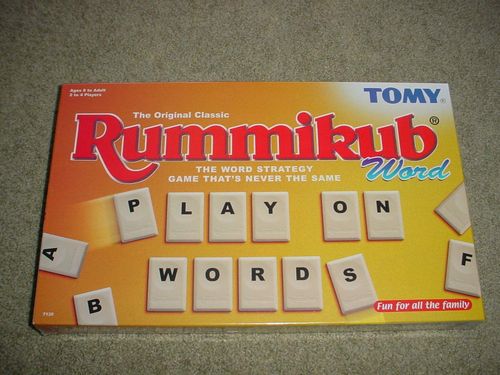
Word Rummikub
Word Rummikub Rulebook
Table of Contents
Table of Contents
- Game Contents
- The SABRA Manner
- Preparation
- Scoring
- The Rules of Play
- Permitted and Forbidden Words (General Advice)
- The INTERNATIONALE Manner
- Preparation (The INTERNATIONALE Manner)
- Scoring (The INTERNATIONALE Manner)
- The Beginning of the Game
- Further Course of the Game
- Empty Rack (During the Game)
- End of the Game (The INTERNATIONALE Manner)
- Permitted and Forbidden Words (The INTERNATIONALE Manner)
- Time Limit (The INTERNATIONALE Manner)
- Tips (The INTERNATIONALE Manner)
- Solitaire (The INTERNATIONALE Manner)
Game Contents
- Rules
- 4 rack boards (opzetplankjes)
- 110 letter tiles
- 2 joker tiles
Letter distribution: A-7; B-3; C-2; D-5; E-18; F-2; G-4; H-4; I-7; J-2; K-2; L-3; M-3; N-10; O-7; P-3; Q-1; R-6; S-3; T-6; U-3; V-2; W-2; X-1; Y-2; Z-2.
The SABRA Manner
For 1-4 players from age 7.
Object of the game: Each turn, form as many words as possible on the table in order to finally achieve the highest score.
Important note for beginners: We advise you to follow the examples below to learn the game's possibilities by laying the letter tiles face up on the table and "playing" the examples.
- Example 1: On the table lies the word HUT. On your rack are the letters O, E and N. From the word HUT already laid and the letters on your rack you can form a new word: HOUTEN. You score 6 points.
- Example 2: On the table lie POES and LEER. On your rack you have an E. From LEER you leave EER lying; with this L and with the E from your rack you form together with the word POES a new word: SOEPEL. You score 6 points, 1 point per letter of this new word.
- Example 3: On the table lies the word DOOR. On your rack you have the letters K, L, E, E. You can take the D from the word DOOR; OOR remains lying. Together with this D and the letters on your rack you form: KLEED. Your score is 5 points.
- Example 4: On the table lie the words MENEER and MAAR. On your rack are the letters L, E and N. From MENEER you leave EN lying; from MAAR you leave AR lying. From the remaining letters together with the L, E and N on your rack you form the new word MEERMALEN. Your score is 9 points.
- Example 5: On the table lie the words ROOD, TIK, RUN, GIET and TIEN. On your rack is the letter C. By arranging the letters of these words in a different order and also using the C from your rack, you can form the word INTRODUCTIEKORTING, and score no less than 18 points!
- Example 6: On the table lie the words LUCHT, WARM, VIN and TEER. On your rack (among others) are the letters H, G and E. If you place the letters of these words in a different order and add the H, G and E from your rack, you can score 19 points by forming the word HETELUCHTVERWARMING.
- Example 7: On the table lie the words BEK and EN. You have a D on your rack. You can join the words and add the D so that a new word arises: BEKEND. Score: 6 points.
- Example 8: On the table lie the words STER, SCHOEN and VETE. On your rack you have the P. You exchange this P with the R from STER, and the R goes together with SCHOEN and VETE to form a new word: SCHOENVETER. As you can see, the P from your rack is used in a 4-letter word, but you score 11 points for the longest new word: SCHOENVETER.
Note: After finishing your turn, no loose letters may remain lying on the table. Also, no letters may be taken from the playing area and placed on your rack.
The Use of the Joker, with Examples
The joker may be placed for any letter. During the game each player is allowed, if possible, to exchange the joker for the corresponding letter. An exchanged joker must immediately be put back into play again. The joker may therefore never be taken from the playing area onto a rack. A joker that comes directly from the pot onto a rack may of course be kept on your rack until you want to use it.
Below are some examples of ways to use the joker, and how to free it up for re-use. The joker is marked with @.
- Example 1: On the table lies the word ZON, and you have the joker on your rack. You can now form the word @ZON (= OZON) by placing your joker before the word ZON. You score 4 points.
- Example 2: The joker lies on the table in the word RIN@ (= RING). On your rack you have (among others) the letters E and L. From this you can compose a new word: RELIN@ (= RELING). You score 6 points for this.
- Example 3: The joker lies on the table in the word KORAA@ (= KORAAL). The joker here stands for an L. You have the letters D and I on your rack. From this word and these letters you can form two new words: RADIO and KA@ (= KAT). Now the joker no longer stands for an L but for a T. You always score for the longest of the newly formed words, here 5 points for the word RADIO.
- Example 4: The words RINGSLA@G (= RINGSLANG) and OP lie on the table, and you have a T on your rack. In the following way you can free the joker for your own use (on the table): you split the word RINGSLA@G into RING and SLA@G, then you remove the joker from SLA@G so that the word SLAG remains and you have the joker available to form a new word. Together with the T from your rack you add the joker to OP and thus form a new word: @TOP (= STOP). Score: 4 points, for STOP or for SLAG.
- Example 5: The words PIA@O (= PIANO) and TIN lie on the table, and you have the T on your rack. By adding the T to TIN to make the word TINT you could score 4 points. However, by placing the letters of both words in a new order and also using the T from your rack, you can form a new word: PATIOT@IN (= PATIOTUIN). Instead of 4 points you now score 9 points!
- Example 6: The words KOFFER and DEE@ (= DEEG) lie on the table. You have the letters O and I on your rack. By combining these letters and words you can form the word @OEDERKOFFIE (= POEDERKOFFIE) and you score 12 points. Note that the joker first stood for a G, then for a P.
Preparation
- All tiles are placed letter-side down in the pot.
- Each player blindly takes 7 tiles from the pot and places them on his rack (opzetplankje).
- A player is designated to begin. For example, the oldest, the youngest, or each player takes a tile from the pot, and whoever's letter is closest to A in the alphabetical order may begin.
- One player is designated to keep the score. He notes the names of the players in the order of play, in connection with the last round.
Scoring
Per turn a player may form several words on the table, but scoring is only for the longest word that he formed during that turn. For each letter of this word he scores one point. Note the score after each turn.
Each letter is worth 1 point.
The Rules of Play
Each player has taken 7 tiles from the pot. Each player must, on his turn, form from his own rack a starting word (beginwoord) of at least 3 letters and lay it on the table. Whoever cannot, takes 1 tile from the pot and his turn is over.
During the turn in which a player lays his starting word, he may not yet add to other words on the table. Also, each player must, immediately after finishing his turn, top up his rack from the pot to 7 tiles.
The main rule of this game is this: ALL WORDS ON THE TABLE may be broken, split, rearranged and even "given up" in order to form new words on the table TOGETHER WITH AT LEAST 1 LETTER FROM YOUR OWN RACK. The order of the letters of the words already laid on the table is therefore not fixed. (This differs from the INTERNATIONALE manner of Word-Rummikub, in which, when a word is already formed, a correct remaining word of at least 3 letters must always be left lying.)
During a turn a player may therefore form several words on the table, but only the longest new word formed during that turn is scored, at 1 point per letter. Forming 2-letter words is therefore also permitted! Only the starting word must consist of at least 3 letters.
Permitted and Forbidden Words (General Advice)
Players may agree on rules beforehand. Making up your own rules is of course never "forbidden", but it should always be creative. We give a general recommendation not to allow the following: proper names, geographical names, abbreviations, diminutives, all verbs and verb forms, and all plural forms. If doubt arises as to whether a certain word is permitted, consult a dictionary as "referee". Also note that with 3-letter words, Y counts as 1 letter and IJ (= I and J) counts as 2 letters.
Note: No points can be scored for a remaining word that stays UNCHANGED on the table. For clarity, here are some examples:
- Example 1: On the table lie the words TEKENTAFEL and MAN. On your rack is the letter D. You add the D to MAN to make the word MAND. From TEKENTAFEL you leave TAFEL lying as an (unchanged) remaining word. You rearrange TEKEN into a new word: KETEN. You score here (5 points) for this new word KETEN, because it is the longest of the newly created words.
- Example 2: On the table lie the words REGENDRUPPEL and MAN. On your rack is the letter K. You add the K to MAN to make the word MANK. From REGENDRUPPEL you leave DRUPPEL lying as an (unchanged) remaining word. You rearrange REGEN into a new word: NEGER, and you score for this word, because NEGER is the longest word of the newly created words in this turn. That the letter from your rack is used in another word does not matter. For DRUPPEL you cannot score, because the letter order in this remaining word has not changed!
- Example 3: The word KOKSMAAT lies on the table, and the letters O and P are on your rack. From KOKSMAAT you take away the S, so that actually two (unchanged) remaining words stay lying: KOK and MAAT. The S you want to use to form the word SOP with the O and the P from your rack. You score for SOP, and not for MAAT or KOK, because the letter order there has remained unchanged.
If during the game a word has already been formed earlier on the table, no points are scored for that word! Also no points are scored if a word ends up lying twice on the table.
End of the game: If a player takes the last tiles from the pot, this means that after this round the FINAL ROUND (SLOTRONDE) begins. In it each player again tries to form as long a word as possible, but each player also uses this last turn to try to play all the letters from his rack. Each player has had the same number of turns. All players deduct 1 point from their own total score for each tile still on their rack. For a joker on the rack, 10 points must be deducted! The winner is the player who has ultimately achieved the highest total score.
General notes: If one wants to shorten the playing time, or if the game is played by just two players, one can use, for example, 50 points as the final score in the score count. If one of the players reaches 50 points, the round is played out so that every player has had an equal number of turns (!), and whoever has the highest total score after this round is the winner.
Time limit: It is recommended to set a thinking time, for example 3 minutes per player per turn. In this (SABRA) manner of play it appears that a somewhat longer thinking time must be kept, especially as the game progresses. The use of a Rummikub sand timer or the electronic Rummikub timer is then also recommended. Extra tension is brought by a penalty when the time limit is exceeded: for this turn no score is obtained!
Tip: As a game variation the game can be played with an "open" pot instead of a "closed" pot. Divide the pot into four stacks, so that players, when they take from the pot, always have a choice from 4 letters.
Solitaire: You follow the same rules, and you are of course always the player on turn. When ALL tiles are played, the round is finished. In the next round you try to improve your record by trying to lay an even longer word. For example: if your longest word in the previous round consisted of 16 letters, then try this time to form a word of more than 16 letters.
The INTERNATIONALE Manner
For 1-4 players from age 10.
Object of the game: Each turn, form as long a word as possible in order to finally achieve the highest score.
Important note for beginners: Place all tiles face up on the table and then follow the game possibilities by means of the various examples given here.
Several examples of combining and scoring:
- Example 1: On the table lies the word BEST. On your rack are the letters A, N and D. From this you can form a new word: BESTAND. You score 7 points: one point for each letter of the (longest) newly formed word.
- Example 2: On the table lies the word ROOD. On your rack is the letter B. You can form the word BROOD as a new word, and you score 5 points for this.
- Example 3: On the table lies the word KANTOOR. On your rack are the letters D and M. You can split KANTOOR into KANT and OOR. Your letters D and M, added to O-O-R, can form a new word: DROOM. Note: you do not score for the word KANT, because you only score for the longest of the new words; in this case therefore for the word DROOM. You score 5 points.
- Example 4: On the table lies the word PELOTON. On your rack is the letter S. From PELOTON you leave the word LOT as the remainder. From the remaining letters P-E-O-N, combined with the S from your rack, you form SNOEP. Score 5 points.
- Example 5: On the table lie the words KOETS and HEN. On your rack you have the letter G. From the word KOETS you leave KOE as the remaining word. The word HEN you combine with the G from your rack and with the S and the T that you took away from KOETS, to form a new word: HENGST. You score 6 points.
- Example 6: You may use more than one word from the table, together with at least one tile from your rack, to form a new word together, provided any remaining parts are still correct words. On the table lie the words VOORBEELD and UITVOER. On your rack you have the letters of the word GANG. You can of course simply lay GANG and score 4 points, but by combining you can now score more points: from VOORBEELD you take VOOR away, from UITVOER you take UIT away, and together with GANG from your rack you form a new word: VOORUITGANG. You score 11 points for this (instead of 4 points for GANG). No score for BEELD and VOER, only for the longest new word.
- Example 7: On the table lies the word LIEVELING. On your rack you have the R, T and N. From the word LIEVELING you leave VEL lying as a correct word; together with the other letters of this word and the R from your rack you form a new word: LERING. You still have an I left over, of which you can form the word TIN together with the T and N of your rack. You score for the longest new word, thus for LERING: 6 points.
The use of the joker and examples thereof: The joker may be laid for any letter and is not bound to one. During the game each player is allowed, if possible, to exchange the joker for the corresponding letter. An exchanged joker must immediately be put back into play again. Once laid on the table, the joker must stay on the table. Below are some examples of ways to use the joker and to free it for use again. The joker is marked with @.
- Example 1: On the table lies OOR. A player has received the joker on his rack (from the pot). Now he can lay the joker next to OOR: OOR@ (= OORD). Score 4 points.
- Example 2: A player has on his rack: KEER@UNT (= KEERPUNT). He can lay this on the table and scores 8 points with it.
- Example 3: On the table lies PA@. The joker can represent various letters here, such as N, K or D. If a player has an N, an A and an L on his rack, he can exchange the joker for the N here, and afterwards, with the joker, the A and the L, form a new word, e.g. @AL (= DAL or GAL, etc.). If a joker is exchanged for a letter, the joker is therefore free to be used again for any arbitrary letter.
- Example 4: On the table lies PLAAT@. Here the joker stands for an S. A player can simply take the joker away here, and PLAAT then remains lying on the table. The joker must stay on the table, but is now free to be used again.
- Example 5: On the table lies @A@IO (= RADIO) and TUIN. If a player joins these words into @A@IOTUIN (= PATIOTUIN), he scores 9 points. Note: this player must during his turn still lay at least 1 tile from his own rack on the table! He scores for the longest word that he formed during his turn.
- Example 6: On the table lie the words VEL@ (= VELD), ARBEID and OVEREENKOMST. On your rack you have the letter G. The joker in VEL@ (= VELD) can be exchanged for the G from your rack, for a new word: VELG. The joker now represents an S as a link between the words ARBEID and OVEREENKOMST, so that you can score 19 points for the longest new word: ARBEID@OVEREENKOMST (= ARBEIDSOVEREENKOMST).
- Example 7: On the table lies a joker in the word TA@ELKLEED (= TAFELKLEED), and on your rack you have the letters K, U, N and D. From the word you leave KLEED lying. From the letter tiles TA@EL, together with the letters K, U, N and D from your rack, you form a new word: TA@LKUNDE (= TAALKUNDE). For this you score 9 points. The joker first represented an F; in the new word it represents an A.
Preparation (The INTERNATIONALE Manner)
- All tiles are placed letter-side down in the pot.
- Each player blindly takes 7 tiles from the pot and places them on his rack (opzetplankje).
- A player is designated to begin. For example, the oldest, the youngest, or each player takes a tile from the pot, and whoever's letter is closest to A in the alphabetical order may begin.
- One player is designated to keep the score. He notes the names of the players in the order of play, in connection with the last round.
Scoring (The INTERNATIONALE Manner)
Per turn a player may form several words, but scores only for the longest word formed during that turn. For each letter of this word he scores one point. After each turn the score is noted by the person designated for this.
Each letter is worth 1 point.
The Beginning of the Game
First, each player must form, from his own rack, with letter tiles, a word of at least 3 letters, and lay it face up on the common playing area on the table. This first-laid word is called the BEGINWOORD (starting word), and each player must first bring such a starting word onto the table before he can further take part in the game. If a player cannot lay this starting word, he must take a tile from the pot, and his turn is over. As long as a player cannot yet lay his starting word, he must, each time he is on turn, take a tile from the pot until he is finally able to bring a starting word from his own rack onto the table. When a player lays his starting word, he may not, during this turn, lay additional letters to words already lying on the table, or combine with letters of the words lying on the table.
Word not formed? Take a tile from the pot!
Note: On all subsequent turns in which new words are formed, these words must consist of at least 3 letters, and AT LEAST ONE LETTER MUST COME FROM OWN RACK! Throughout the whole game applies: whoever cannot lay a tile on the table must take a tile from the pot, and his turn is then over.
Further Course of the Game
During the further course of the game there are the following 2 possibilities for forming words on the table:
- A. By laying out ("UITLEGGEN"), i.e. laying out a word on the table using exclusively letters from your own rack.
- Example: On your rack you have the letters B-U-I-T-E-N. You may lay this on the playing area, and you score 6 points.
- B. By combining ("COMBINEREN"), i.e. forming a word by combining one or more letters from your own rack together with letters and/or words from the common playing area on the table.
- Example: On the playing area lies the word SOEP. You have on your rack an E and an L. You can now form the word SOEPEL, and you score 6 points.
A player who has already laid his starting word may therefore, in his following turns, form new words of at least 3 letters either by laying out or by combining. When combining, the player may use the words lying on the table by splitting and changing them, but always so that from a "broken" word on the table at least 3 LETTERS IN THE SAME ORDER AS THE REMAINING WORD MUST STAY LYING!!! Of course these letters must also form a correct word.
- Example: On the table lies the word OPENBAAR. On your rack you have the letter T. From OPENBAAR you leave OPEN lying as a correct remaining word. You combine BAAR with the T from your rack into a new word: RABAT. You score 5 points.
Note: A word from the playing area may never be given up entirely, but it is permitted for a word from the playing area to be added in its entirety to another word. Moreover, the letters of this added word must also remain in the same order in the new word.
- Example: On the table lie the words GANG and UIT. These may be combined into the word UITGANG. But since on each turn at least 1 tile from your own rack must always be used, during this turn you must find another new or already formed word where a tile from your own rack can be added. If this word has fewer than 7 letters, you score for the word UITGANG (7 points), because it is then the longest new word! If a player cannot form a word on his turn, he takes a tile from the pot, and the turn is over.
Example of what is not allowed: On the table lies the word VER, and you have on your rack the letter E. You want to insert the E into the word VER so that the word VEER would arise. This is however not permitted, because in this way no remaining word would remain lying from the existing word!
Empty Rack (During the Game)
If a player has used all the letter tiles from his rack, he then immediately takes 7 tiles from the pot again and places them on his rack. After taking from the pot, the turn is over. If there are fewer than 7 tiles in the pot, the player simply takes the number of tiles that are still in the pot.
End of the Game (The INTERNATIONALE Manner)
If one of the players has reached 50 points, this is "the bell for the last round", i.e.: whoever still has a turn coming may now play his last turn. Each player has then had equally many turns. The WINNER is the player who, after the last round, has the highest total score. All players deduct 1 point from their own total score for each tile still on their rack, while a joker on the rack gives 10 minus points.
You can of course also play until the tiles in the pot are finished. If the last tile is taken from the pot, this means that this is the penultimate round. In the last round each player has the chance to try to lay all the tiles from his rack on the table, and each has had equally many turns.
Permitted and Forbidden Words (The INTERNATIONALE Manner)
Note: the original rulebook prints this section a second time, in the INTERNATIONALE part, with essentially the same wording (same examples, same advice on permitted words, remaining words and repeated words). It is transcribed once, above, under "Permitted and Forbidden Words (General Advice)", and not repeated here.
Time Limit (The INTERNATIONALE Manner)
It is recommended to set the thinking time, for example 2 or 3 minutes per player per turn. This can be done, among other ways, with the Rummikub sand timer or the electronic Rummikub timer.
Tips (The INTERNATIONALE Manner)
- Tip 1: As a game variation, the game can be played with an "open" pot instead of a "closed" pot. Divide the pot into four stacks, so that players, when they take from the pot, always have a choice from 4 letters.
- Tip 2: It is recommended, when the game is played by children, also to allow 2-letter words, such as DE, IN, OP, LA, etc. Instead of remaining words of at least 3 letters, remaining words of at least 2 letters may then stay lying. The forming of verbs may also then be allowed.
Solitaire (The INTERNATIONALE Manner)
You follow the same rules, and you are of course always the player on turn. When ALL tiles are played, the game is over. In the next game you try to improve your record by trying to lay an even longer word. For example: if your longest word in the previous round consisted of 16 letters, then try in the following round to form a word of more than 16 letters.