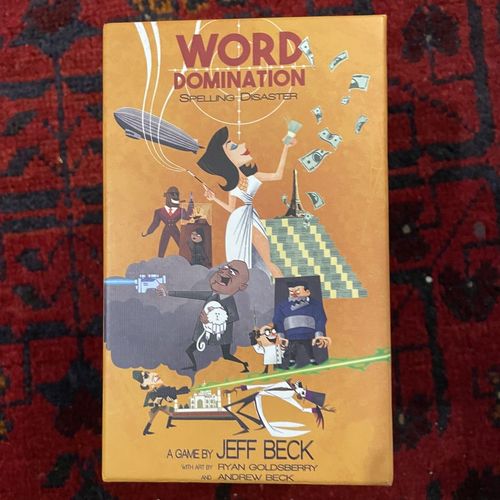
Word Domination
Word Domination Rulebook
Table of Contents
Table of Contents
Components
- 110 cards:
- 102 blue cards, each showing one letter and a picture of a landmark, artifact, or object to steal
- 8 black cards, each showing one letter (with a Polish diacritic) and a special action
- 120 player markers (30 markers each in 4 colors)
- 1 starting player token
- 4 cheat sheets (1 per player), each showing a character portrait and a reminder of what that player may do on their turn
- 1 round tracker board (spaces numbered 1–6)
- 1 round marker
A sticker is included so you can personalize your copy of the game.
Objective
You take on the role of a villain fighting for dominance over the world. The winner is whoever gains control of the greatest number of objects shown on the cards. You do this by spelling words using the matching letters. For example, to claim the card showing the Colosseum (marked, in this Polish edition, with the letter K for "Koloseum"), you must form words containing the letter K. On the English edition the same principle applies, but each card's letter matches the English name of what it shows.
It won't be easy! You'll fight fierce battles over individual objects — they'll change hands again and again. This is when you'll learn the true power of the word. Good luck!
Setup
A. Shuffle all the cards (blue and black) together and form them into a deck, letters facing down.
B. Take the following number of cards from the top of the deck and lay them out in the middle of the table, letters facing up:
| Number of players | 2 | 3 | 4 |
|---|---|---|---|
| Cards taken from the top of the deck | 16 | 25 | 30 |
| Layout on the table | 4×4 | 5×5 | 6×5 |
C. Each player takes 1 cheat sheet and places it in front of themselves, portrait side up.
D. Each player takes 1 card from the top of the deck and places it (letter side up) on their cheat sheet.
E. Each player takes 30 markers in the color of their cheat sheet and places them in front of themselves.
F. Place the round tracker board to the side of the table.
G. Place the round marker on the round tracker board, on space number 1.
H. Whoever has the most rascally-looking face takes the starting player token (or the oldest player, if you can't decide).
Setup for a Three-Player Game
The layout diagram above shows a worked example for a three-player game: the deck (A) is shuffled, 25 cards are dealt into a 5×5 grid on the table (B), and each of the three players (here: Artur, Ewa, and Jagoda) takes a cheat sheet (C) with a starting card on it (D) and a pile of 30 markers in their color (E). The round tracker board (F) is placed beside the table with its marker on space 1 (G), and the starting player token (H) goes to whoever is dealt in first.
Playing the Game
The game lasts 6 rounds (tracked on the round tracker board). The player with the starting player token goes first. Play then proceeds clockwise. On their turn, a player performs 3 actions, in this order:
- Add a card.
- Spell a word.
- Draw a card.
1. Add a Card
Play your card onto the cards lying in the middle of the table. This card must be adjacent, on at least 1 side, to another card.
Example: Jagoda added her card with the letter T.
2. Spell a Word
Spell any word made up only of letters visible on the cards in the middle of the table, or letters on cards you have already claimed during the game (claiming cards is covered further on). The word must include the letter on the card you just added.
For each letter you use (on a card in the middle of the table), place one of your markers on it.
Note: If a player cannot spell a word — and does not use help from another player (covered further on) — they set aside the card they just added (to the bottom of the deck), take a new one from the top of the deck, and add that instead.
Black cards are treated the same as blue cards in the base game. Special actions are only used in the variant described at the end of this rulebook.
Rules for Spelling Words
- The player does not change the layout of the cards on the table. They say the word out loud and, for each letter used (on a card in the middle of the table), place one of their markers on it.
- Each card may be used only once in a word. For example, if spelling ATTACK, a player cannot use the same T card twice — they must use two different cards showing the letter T.
- Letters used in a word do not need to lie next to each other.
- A player may not spell a word that has already been used during the game, or a related word. For example, if the word HOME has already been spelled, neither HOME nor a word like HOMELY or HOMESTEAD may be spelled again. It's a good idea to keep track of the words that have already been used.
- During play, players will claim cards (see Claiming Cards, below). When spelling a word, a player may use letters from cards they have personally claimed. They do not place a marker on those cards. A player may not use cards claimed by another player.
- If there is any doubt about whether a word is valid, it can be checked in a dictionary.
Claiming Cards
The point of spelling words is to bring about a situation where 2 markers belonging to the same player are on a card. When that happens, that player claims it. Fierce battles are fought over the cards this way: players place their markers on them and remove their rivals' markers.
After spelling a word and placing markers on the matching cards, a player checks the situation on each of those cards:
- If a card has 1 marker on it, nothing happens (the marker stays on the card).
- If a card has 2 different markers on it, the player removes their rival's marker (and returns it to them), leaving their own marker on the card.
- If a card has 2 identical markers on it, the player claims that card.
- Both markers are returned to that player's supply.
- The claimed card is placed next to that player's cheat sheet, letter side up.
- The empty space left by the claimed card is filled with a card taken from the top of the deck, placed crime-scene-tape side up. The player places their marker on it, so everyone can see who claimed the card that occupied that space.
A player may claim several cards in a single turn.
Claimed cards make the rest of the game easier — a player may use letters from cards they've claimed when spelling future words.
3. Draw a Card
At the end of their turn, a player takes 1 card from the top of the deck and places it (letter side up) on their cheat sheet. The turn then passes to the player seated to their left.
End of Round
A round ends once every player has taken their turn. The round marker is then moved forward 1 space on the round tracker board, and the next round begins.
Help from Another Player
Any player may (but doesn't have to) offer help to the player whose turn it is. Of course, not for free! A player who wants to help thinks of a word in their head, then states:
- how many letters their word contains,
- how many cards the active player could claim thanks to that word,
- what they want in payment for their help — naming the card or cards (among those the word uses) on which they'd like to place their marker.
The active player decides whether they want to accept the help, and whether they agree to the proposed payment. Players may negotiate it (both the number of cards and which letters are involved).
Example: It's Artur's turn, and he's trying to decide what word to spell. Jagoda offers to help. She has thought of a seven-letter word that would let Artur claim 4 cards. As payment, Jagoda would like to place her marker on the cards with the letters S and N. Artur offers to let her place a marker only on the card with the letter S. Jagoda agrees.
If several players offer help, the active player decides whether to use any of it. If they do, they must pick 1 helping player.
If the active player agrees to use the help:
- the helping player states the word they thought of, then places their markers on the letters that make up their payment,
- the active player places their own markers on the remaining letters of that word,
- then all players check the situation on those cards:
- If a card has 2 markers belonging to the same player, that player claims it.
- If a card has 2 different markers on it, whichever marker was placed second stays on the card, and the other returns to its owner.
If you want to speed up play, you can introduce a time limit for taking a turn.
End of Game
The game ends after the sixth round. Players count their points. Whoever has the most points wins. In case of a tie, whoever has claimed the most cards wins. If it's still a tie, the tied players share the victory.
A player scores points for the following:
- 1 point for each card they've claimed.
- 1 point for each crime-scene-tape space in a zone they control (see below).
Zone Control
A zone controlled by a player is at least 3 crime-scene-tape cards that are adjacent to each other side-by-side, all bearing that same player's marker.
A zone controlled by a player can also be made up of at least 3 crime-scene-tape cards, all bearing that player's marker, that are linked together by unclaimed cards.
Example: 3 crime-scene-tape cards bear red markers, but the cards don't sit side-by-side. They're linked by an unclaimed card with the letter O — which also has a red marker on it. Thanks to that card, the 3 crime-scene-tape cards form a zone controlled by the red player.
Note: Unclaimed cards that bear player markers do not score points at the end of the game.
Example Scoring
- Jagoda scored 13 points in total:
- 2 zones controlled by Jagoda: zone I — 3 cards = 3 points; zone II — 3 cards = 3 points.
- 7 claimed cards = 7 points.
- Artur scored 11 points in total:
- 1 zone controlled by Artur: 5 cards = 5 points.
- 6 claimed cards = 6 points.
- Ewa scored 12 points in total:
- 1 zone controlled by Ewa: 5 cards = 5 points.
- 7 claimed cards = 7 points.
Game Variant: Special Card Actions
This variant makes use of the black cards' special actions. Setup is the same as in the base game.
After spelling a word that includes letters from black cards, a player may (but doesn't have to) use the special action of each black card they used. All other rules remain unchanged.
Note: this edition's black cards use letters unique to the Polish alphabet, so its 8 special-action names below are translated from those letters (Ą, Ć, Ę, Ń, Ó, Ś, Ź, Ż) rather than the English edition's own black-card letters.
- Power Core — Take 1 card from the top of the deck and hand it to any player. On that player's next turn, they must spell a word that includes a letter from the card you handed them.
- Training Zeppelin — At the end of your turn, draw 2 cards: keep 1 for yourself (place it on your cheat sheet) and set the other aside, to the bottom of the deck.
- Bulging Blaster — You may place your marker on any card you did not use while spelling your word. If this is your second marker on that card, you claim it.
- Shadow of Doom — You may move 1 crime-scene-tape card to a different spot on the table (it must be adjacent, on at least 1 side, to another card in the middle of the table). This lets you build a zone you control, or break up a zone controlled by another player.
- Resistance of Matter — You may remove any 1 marker from any letter card in the middle of the table. The removed marker returns to its owner.
- Whoosh of Energy — While spelling a word, you may use 1 card that another player has claimed. You do not place your marker on it. If it's a black card, you may also use its special action.
- Piercing Eyes — While spelling a word, you may use any card twice. At the end of your turn there will then be 2 of your markers on it (you claim that card).
- Gel of Forgetting — At the end of your turn, choose 1 card among those in the middle of the table and rotate it 90 degrees. No one may use it in their word until after that player's next turn.