Word Colony
Word Colony Rulebook
Table of Contents
Table of Contents
Game Components
Base Game Components
- 420x Letter Cards
- 22x Black Cards
- 42x Special Cards
- 16x ABCD Answer Cards (4 sets of 4)
- 4x Pawns
- 1x Scoreboard
- 1x Guide
- 1x Box (with card holder)
- Extra: Certificate of Authenticity signed by the creator (for the first 3,000 games)
Note: the counts above are printed as in the guide. The letter lists in the guide add up to 416 Letter Cards and the Black Card lists add up to 26 cards.
Letter Cards
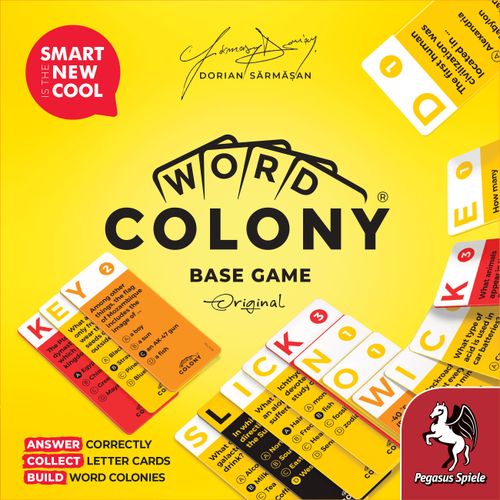
Letter Cards (or Question Cards) are used by each player when it is their turn to read a question and then to build words on the table.
Each Letter Card contains:
- A letter and a score of 1, 2 or 3 points;
- A general knowledge question and 4 answer options, A-B-C, or D, where only one option is correct.
1 point letters:
- E (46 cards)
- A (44 cards)
- I (38 cards)
- O (38 cards)
- T (28 cards)
- N (28 cards)
- S (20 cards)
- R (20 cards)
- H (16 cards)
- D (16 cards)
- L (14 cards)
- C (14 cards)
2 point letters:
- U (12 cards)
- G (12 cards)
- M (10 cards)
- F (10 cards)
- P (10 cards)
- W (8 cards)
- B (8 cards)
- Y (6 cards)
- V (6 cards)
3 point letters:
- K (3 cards)
- J (3 cards)
- X (2 cards)
- Q (2 cards)
- Z (2 cards)
Side Note: the scores 1, 2 and 3 represent, respectively:
- the number of cards players will collect from the box if they answer the question read that round correctly;
- the number of places on the scoreboard players will advance with, if they used Letter Cards in creating new words.
Remember! Letter Cards can be used in creating new words, whether the card was previously played by reading the question on it in a previous round or not. The cards already used in creating a word cannot be picked up or changed once placed on the table. Cards in hand that have not yet been used to build a word will not count towards the score.
Black Cards
Black Cards work just like a Letter Card, the same rules apply. The only difference is that they have a negative score.
-1 point letters:
- E (1 card)
- A (1 card)
- I (1 card)
- O (1 card)
- T (1 card)
- N (1 card)
- S (1 card)
- R (1 card)
- H (1 card)
- D (1 card)
- L (1 card)
- C (1 card)
-2 point letters:
- U (1 card)
- G (1 card)
- M (1 card)
- F (1 card)
- P (1 card)
- W (1 card)
- B (1 card)
- Y (1 card)
- V (1 card)
-3 point letters:
- K (1 card)
- J (1 card)
- X (1 card)
- Q (1 card)
- Z (1 card)
Good to know! Black Cards can be used to create new words, especially if a specific letter is needed, but their negative scores (-1, -2 or -3 points) will be subtracted from the word's total score. If you come into possession of a Black Card, even though at first it might be a disadvantage for you, you can use it to make other players lose points in the question rounds.
Black Cards can also be used to read questions. In this case, no player will collect new cards that round. All players who answer incorrectly will lose -1 point, -2 points or -3 points, depending on the value of the Black Card, and must move their pawns backward on the scoreboard. Players who answer correctly will not lose any points that round.
Remember! If players reach the FINISH line with one or more Black Cards in hand, their negative score will reduce their total score on the scoreboard. They must move their pawn back on the scoreboard according to the total negative score from the Black Cards and continue the game.
e.g. In the case of a 40-point Quick Game, the player who reaches 40 points, but still holds a -2-point Black Card, must build words on the table totaling 42 points to win if unable to discard or use the Black Card.
Special Cards
There are 42 Special Cards:
- 1x Immunity
- 1x Guardian
- 1x Total War
- 2x Conquest
- 2x Exchange 1 Black Card
- 2x Exchange 1 Vowel
- 3x Exchange 1 Consonant
- 2x Dumpster Dive
- 2x Mirror
- 3x Wild Card
- 2x Magic Word
- 2x Fist Bump
- 2x Go Fish
- 2x New Hand
- 4x Lucky Draw (2 or 3 extra cards)
- 2x New Chance
- 3x Swap a Card
- 2x Lose 2 cards
- 2x Lose the Doubles
- 2x Lose Half
Special Cards can be used anytime during a player's turn, if they draw such a card. Each Special Card contains its own instructions for use.
ABCD Answer Cards and Pawns
In the base game there are 4 sets of A-B-C-D Answer Cards and 4 pawns, for four players. The game can be expanded to a larger number of players using one or more expansions.
Side Note: each player will choose a set of 4 ABCD Answer Cards and a pawn at the beginning of the game. Players will use these cards to give the answer they think is correct in each round of questions. Unused sets will be removed from the game.
Scoreboard
Each player will navigate with their own pawn on the board. The pawn will be moved each time the player collects new points (forward) or loses points (backward).
Side Note, e.g.: if a player builds a word with a total letter value of 5 points, they will move their pawn 5 positions forward on the scoreboard.
Remember! Two or more players can occupy the same position on the board. In this case, pawns will overlap in the same position.
Guide
Each game comes with an easy to follow brochure with full game instructions.
Box with card holder
The Word Colony Original base set comes in a special premium box, featuring an elegant black card holder with internal dividers to support the cards vertically, also acting as a "Mother Box", in which all the cards from the 5 available extensions can be added.
See the next section for the first steps to prepare the game.
Game Setup
1. Choose the game type
At the start of a new game, players will choose the type of game they want to play. The difference among the 3 options lies in the score that players must collect to win. Game duration will vary based on the chosen game.
- Quick Game
- Master Game
- Epic Game
* Playing for the first time? We recommend starting with a Quick Game.
** Game time is only an estimate and may vary depending on the number of players and their general knowledge level and game experience.
Good to know! If a Master Game or Epic Game is chosen, each player will collect 2 new cards from the deck when they reach or pass the checkpoints, Quick Game (at 40 points) or Master Game (at 70 points) and continue the game.
If a player forgets to collect their 2 cards after passing the checkpoint, they will be able to do so the next time on their turn.
If during the game, the player loses points and has to move the pawn back before a checkpoint (Quick Game or Master Game), the 2 cards originally drawn will be kept by the player. The next time the same checkpoint is passed, the player will not collect any more cards.
Source note: the guide's text does not state the finish-line point total for the Epic Game; only the Quick Game (40) and Master Game (70) checkpoints are printed in the text.
2. Choose the pawn and the A-B-C-D Answer Cards
Each player will choose a pawn and a set of 4 A-B-C-D Answer Cards, from the 4 available sets (for 4 players). Players will use these cards to give the answer they each think is correct in the question rounds, and the pawns will be used on the scoreboard when they collect (or lose) points.
Remember! If fewer than 4 players are playing, any unused sets will be removed from the game.
3. Shuffle the cards and deal 5 to each player
Before the first round begins, players will shuffle all Letter Cards, Black Cards, and Special Cards together on the table. They will then randomly insert them into the box holders and deal 5 cards to each player.
Good to know! Players will randomly place cards in all the dividers in the box and all must be positioned with their backs facing outward to prevent their contents from being seen. If face-up cards are discovered during the game, they will be removed from the box and set aside in a separate trash pile. These cards will not be used in the game.
4. Who starts the game?
To determine who starts the game, each player will draw a new Letter Card from the box. The player with the letter closest to the letter "A" will start the first round. Once the starting player has been determined, these cards will be placed separately in the trash pile. These cards will not be used in the game.
Special cases when deciding who starts the game:
- If 2 or more players draw the same deciding letter and it cannot be determined who will start, it will be a tie. These cards will be placed in the trash pile and players will each draw a new card from the box.
- If a player draws a Special Card, they will place it in the trash pile and draw a new card from the box until they manage to draw a letter card.
- If a player draws a Black Card, it will be counted after standard Letter Cards. e.g. A player who draws an A 1 Letter Card will be ranked ahead of a player who draws an A -1 Black Card (negative score).
Remember! Once it has been determined who starts, these cards will be placed separately in the trash pile. They may not be reused in this game.
After the completion of the first round, the order of players will be clockwise.
Gameplay
The guide's gameplay chapters are: 1. Drawing a card; 2. Reading a question; 3. Choosing the right answer; 4. Collecting the cards; 5. Word-Building & Scoring (Building Words, Expanding Words, Building Words Using Black Cards, Conquering Words, Building Word Colonies, Developing Supercolonies, Decolonizations); 6. End of Round; 7. End of Game.
1. Drawing a card
At the beginning of each new round, before reading a question, the player will draw a new card from the box. The newly drawn card will be added to their hand and can be used freely along with the other cards.
2. Reading a question and the ABCD answer options
Without revealing their hand to others, the player will choose one of the Letter Cards or Black Cards in their hand to read aloud the question and the four possible A-B-C-D answers, without disclosing the correct answer.
Avoid repeating questions from previous rounds! If a card has been used in a previous round to read its question, players cannot reuse the same card to read the question again in another round. A player holding a card with a question that has already been used in a previous round may only use it to build words on the table.
3. Choosing the right answer
The other players will each use their four A-B-C-D Answer Cards to choose the option they think is correct. After all players place their answer choice cards face down on the table, the player who read the question will reveal the correct option and everyone's answers will be compared.
4. Collecting the cards
All players who answered correctly will collect 1, 2 or 3 new cards from the box, depending on the score of the card read. Players who answered incorrectly will not collect new cards this round.
If no one answers correctly, the player who read the question will collect the cards for the round: 1, 2 or 3 new cards from the box, depending on the score of the card they read from.
Good to know! Try to pick a card with a question that you think the other players don't know the correct answer to. That way, if everyone answers wrong, you'll be the one collecting the cards for the round.
Was the question read from a Black Card? If the card read from is a Black Card, no player will collect new cards this round. Players who answer incorrectly will lose either -1, -2 or -3 points, depending on the value of the Black Card, and must move their pawns backward on the scoreboard. Players who answer correctly will not lose any points this round.
Good to know! Despite being a disadvantage to the holder, Black Cards can be strategically used to make others lose points if they answer its question incorrectly.
5. Word-Building & Scoring
After the question round ends and other players collect their cards, the player can use their Special Cards (if they possess any), and start building as many words and Word Colonies as they want (or can), as well as expand or conquer words, develop Supercolonies, and initiate Decolonizations.
Building Words
Single words will be built horizontally, by partially overlapping the cards from left to right so that the letters are visible. e.g. FLOW.
Only English words are valid. Players may use a mutually accepted dictionary, if needed. (The guide links to a separate Words Allowed guide for more detail, which is not included here.)
Scoring overview in this example: The player who built the word FLOW will now have a total score of 6 points: F 2, L 1, O 1, W 2, and will move their pawn 6 steps forward on the scoreboard.
Expanding Words
Words can be expanded by adding additional letters to the end of the original word, to build new words with new meanings. Inserting Letter Cards at the beginning of the word is not allowed.
In a Word Colony, only the last existing word can be expanded. Expanding a word can be done by both the holder of the original word and also other players on their turn, earning points for the newly added letters. e.g. FLOW(ERS)
The word FLOWERS will still belong to the player who originally created the word FLOW, but they will not receive the additional 3 points for the letters -ERS. Only the player who added the letters E 1, R 1, and S 1 will receive the 3 points.
Scoring overview in this example: The player who adds the new letters -ERS to expand the word FLOW collects 3 points (E 1, R 1, S 1) and moves their pawn 3 positions forward on the scoreboard.
During their turn, players can even expand words and colonies held by other players, but only if they have already built at least one word of their own on the table, and their pawn is on the scoreboard.
Building Words Using Black Cards
The player can choose to use one or more Black Cards to build words. After building the word, they calculate the total score of all letters used. e.g. WONDER
Scoring overview in this example: The player who built the word WONDER will now have a total score of 5 points (W 2, O 1, N 1, D 1, E 1, R -1) and will move their pawn 5 positions forward on the scoreboard. The total score will be calculated taking into account the negative scores of the Black Cards as well. In this case the letter R -1.
Conquering Words
On their turn, each player can build as many individual words as they wish. However, they must keep in mind that single words can be conquered and drawn into a foreign colony, risking the loss of points.
A player may conquer a single word held by another player in the following two situations, (A) or (B):
(A) By expanding the word. If the player expands the existing single word by adding new letters with a higher total score. e.g. (WIN)EMAKER
Scoring overview in this example: The player who expands the word WIN (4 points) originally created by another player by adding the letters -EMAKER (9 points) will conquer the word WIN and gain the 4 points from the other player. The player who owns the new word WINEMAKER (13 points) will move their pawn forward 13 positions on the scoreboard, while the player who lost the word WIN (4 points) will lose the 4 points and move their pawn backward 4 positions.
(B) By building a new word over it. If the player builds a higher-scoring word over the original existing word. e.g. (N)APKIN
Scoring overview in this example: A player has built the word NAPKIN on top of the word WIN (4 points), held by another player, by adding the letters -APKIN, with a total value of 8 points. So they conquer the entire word WIN by building their own two-word colony and collect the 4 points from the player who originally owned the word WIN. They will move the pawn 12 positions forward on the scoreboard. The player who lost the word WIN will lose its 4 points and move their pawn backward 4 positions on the scoreboard.
Good to know! Words that are already part of a Colony cannot be conquered by another player. The Colony is protected.
A player can only conquer a single word held by another player if they have at least one word of their own already built on the table.
Building Word Colonies
A Word Colony is formed when a word is built on top of another single word. A Word Colony consists of at least 2 connected words. The new word must begin with the last letter of the previous word. See e.g. WIN + (N)APKIN
The new word will be built perpendicular to the previous one, horizontally or vertically, depending on the position of the last existing word.
Good to know! After building a single word, the player may immediately develop it into a Word Colony in the same round. They may also build other single words if they choose and have the opportunity. Any player may build as many words as they wish during their turn, in any colony they choose, both their own and those owned by other players. The recommended thinking time is around 20 seconds. See the official rules of words allowed in the separate Words Allowed guide.
Side Note:
- It is not allowed to insert Letter Cards under those already on the table. New words will always be built on top of those already on the table.
- A Word Colony cannot have identical words. Within the same Colony only unique words will be allowed, without repeating an existing word. However, pluralities, similarities and other correct derivatives of the same base word within the same word colony are allowed (e.g. "ROOM", "ROOMS", "ROOMY", "ROOMIE", "ROOMED", "ROOMER").
- Once placed on the table, letters or words cannot be picked up or changed.
Following the example: a new word could be built horizontally, perpendicular to the word NAPKIN, starting with the letter N at the end of the word.
Scoring overview in this example: The player has chosen to build the word (N)EXT for which they will receive the corresponding score for the E 1, X 3 and T 1 letters (5 points in total) and will move the pawn 5 positions forward on the scoreboard.
Next, if another player wants to build a new word in the same Colony, the same rule applies. They can build perpendicular to the last word created in that colony, using the last letter, in this case the letter T to start a new word vertically.
Scoring overview in this example: The new word (T)RY has been created vertically, by adding the R 1 and Y 2 letters with a total value of 3 points. The player will move forward the pawn 3 positions forward on the scoreboard.
Developing Supercolonies
When a player manages to develop a Word Colony to a minimum of 5 words, it becomes a Supercolony, and the player receives 5 extra points. On their turn, players will announce that they have developed a Supercolony and then move their pawn 5 positions forward on the scoreboard. The game round may continue, with additional words being added to and further developed within this Supercolony.
Side Note: In our example, the Word Colony formed on the word WIN became a Supercolony containing 5 words (3 horizontally: WIN, NEXT and YANK; and 2 vertically: NAPKIN and TRY).
Remember! The player who develops a Supercolony will receive an additional 5 points, regardless of whether it was built entirely by them or if other players contributed to its development. On their turn, players can develop multiple Supercolonies, and subsequently build additional new words in the same round if desired.
If a player forgets to announce that they have reached 5 words in a Supercolony and collect their 5 points, they must wait until their next turn to do so.
Decolonizations
If a Supercolony reaches or exceeds 10 words, the player who owns it may Decolonize, doubling the total score of the first word built in that Supercolony.
When a player decides to make a Decolonization, they will keep unfolded on the table only the LAST WORD built in that Supercolony, and the remaining words (whether 10 or more words) will be gathered and placed in a separate deck of cards. The deck of gathered cards will still be owned by the player, but they cannot be reused in this game. The deck of gathered cards will be placed next to the remaining word on the table as a reminder that a Decolonization has been performed at that location.
After completing a Decolonization, the player will collect their points (x2 the score of the first word) and may continue building words in the same round if they choose.
Scoring overview in this example: The score of the entire word WIN will double. From 4 points (for the letters W 2, I 1, N 1), it will now be worth 8 points. The player holding this Supercolony will move the pawn 4 positions forward on the scoreboard. The word kept on the table (e.g. OXEN) can still be used by the player(s), with the possibility of developing it into a new Word Colony. This word cannot be conquered by another player.
Remember! The player will earn double the points of all cards in the first word, regardless of whether the word was built entirely by him, or whether other players participated during the game in expanding that word.
Decolonization is optional and can only be performed on the turn of the player who owns the Supercolony (of at least 10 words) after they finish the question round. If a player forgets to Decolonize, they will wait until their next turn.
6. End of Round
The round ends after the player has finished building words on the table. If they choose not to build any new words or take any action related to words (such as expanding, conquering, or developing), they will say "PASS." The player to their left starts a new round by drawing a new card from the box and reading a question of their choice.
7. End of Game
The winner will be the first player to get their pawn to the FINISH line in the chosen game: Quick Game, Master Game, or Epic Game.
* Playing for the first time? We recommend starting with a Quick Game.
** Game time is only an estimate and may vary depending on the number of players and their general knowledge and game experience.
Alternatively, the winner will be the player with the most points if there are no more cards available in the box or if all players agree to end the game.
If there are no more cards available in the box, the game can continue by reshuffling and using cards from the trash pile, which are returned to the box.
Keep in mind for the final score: If players reach the FINISH line with one or more Black Cards in hand, their negative score will reduce their total score on the scoreboard. They must move their pawn back on the scoreboard according to the total negative score from the Black Cards and continue the game.
The guide's Using Expansions page explains the game rules for using the expansions; it is not included in this rulebook.