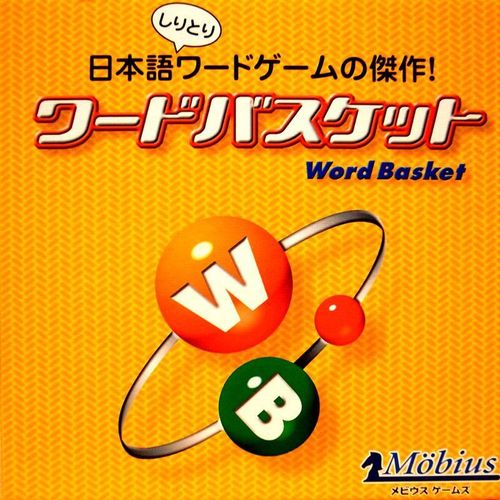
Word Basket
Word Basket Rulebook
Table of Contents
Table of Contents
Components
- Letter cards: 45. One each of "あ" through "ろ", and two of "わ".
- Wild cards: 15
- "Wild 5": 2
- "Wild 6": 2
- "Wild 7+": 2
- "Wild Line": 9 (one each of the "A-row" through "RA-row")
- Rulebook: 1
Setup
- Place the box the cards came in at the center. This is the basket. Alternatively, you may prepare a bowl or similar container.
- Shuffle the letter cards and wild cards together (60 cards in total) and deal 5 cards to each player. This is each player's first hand.
- Divide the remaining cards roughly into 2 and place them face down as draw piles on both sides of the basket.
Starting the Game
Any player turns over the top card of a draw pile and throws it face up into the basket; the game then begins. This card becomes the first "field card".
Play
- Each player thinks of a word that starts with the "field card letter" (the letter of the card in the basket) and ends with a "hand letter" (a letter of a card in their own hand).
- A player who thinks of a word says it aloud and throws the hand card into the basket.
- Example: The card thrown into the basket from the top of the draw pile was "あ". Looking at your hand you have "か", "る", "さ", "け" and "い". You can say "あひる!" (duck) and put the "る" card into the basket. Or you can say "あしか!" (sea lion) and play the "か" card.
- The card just thrown in now becomes the "field card". Each player again thinks of a word that starts with the "field card letter" and ends with a "hand letter" - in other words, shiritori. (The shiritori rules of this game are explained below.)
- In this game there is no turn order for players. As soon as you think of a word, you may play.
Shiritori Rules
- Usable words are limited to common nouns such as "つくえ" (desk) and "コンピューター" (computer). However, well-known proper nouns such as the names of people and places are also OK. For example, "聖徳太子" (Prince Shotoku) and "アメリカ" (America) are OK. If it is hard to judge whether something is "well known", discuss it among all players.
- Words must have 3 or more letters. In this case, the long-vowel mark "ー", the small "っ" (sokuon), and the small "ゃ", "ゅ", "ょ" (contracted sounds) each all count as one letter. All of the following words are 3 letters.
- Examples: "すきー", "らっこ", "しゅみ"
- When the last letter is a long vowel, it connects to the vowel "あ", "い", "う", "え" or "お".
- Examples: "ばたー" -> "あずき", "すきー" -> "いんきょ"
- When the last letter is a small "ゃ", "ゅ" or "ょ", it connects to "や", "ゆ" or "よ" respectively.
- Example: "いんきょ" -> "よーろっぱ"
- When the last letter has a dakuten ["゛"] or handakuten ["゜"], it may connect to either the voiced/semi-voiced letter or the letter without the mark. Conversely, a letter without a mark may be connected to a voiced or semi-voiced letter. In other words, in this game you may ignore dakuten and handakuten.
- Example: "よーろっぱ" -> "はっぱ" -> "ばんど" -> "とんぼ"
- Words ending in "ん" cannot be used (because it is shiritori). Using one results in a penalty. (See the "Penalty" section.)
- You may use a word that has already been played, any number of times during a game. However, the same player must not use the same word twice in a row.
- For words that seem problematic, all players should judge by "common sense".
Reset
When you absolutely cannot think of a word, a player may "reset" at any time. Gather all the cards in your hand together and, while saying "Reset, (number) cards" with the number of cards, throw them face up into the basket. In this case, you may put any card from your hand on top (but a Wild Number card cannot be put on top). Immediately afterward, take from the draw pile a number of cards equal to "the number of cards you discarded + 1" and make them your new hand. Now the card that is on top becomes the new "field card letter".
Penalty
When a card that violates the shiritori rules has been played by mistake and another player points it out, return that card to your hand and additionally add 1 card from the draw pile to your hand as a penalty. If it is not pointed out and the next card is thrown into the basket, there is no penalty and the game continues. You are never penalized retroactively.
Wild Number Cards and Wild Line Cards
In addition to the basic one-letter cards "あ" through "わ", this game has "Wild Number cards" (3 kinds) and "Wild Line cards".
Wild 5
Starts with the field card letter, and you can play it with any word of exactly 5 letters.
- Example: If the field card letter is "し", you can play it by saying "しんがっき" (new school term). Although the card in the basket is "5", the "field card letter" is now "き". If it was "しょくぶつ" (plant), it would be "つ".
Wild 6
Like Wild 5, starts with the field card letter, and you can play it with any word of exactly 6 letters.
Wild 7+
Starts with the field card letter, and you can play it with any word of 7 or more letters (8 or 9 letters is also fine).
Wild Line
It can be used as any letter in the row on that card.
- Example: If the field card letter is "つ", you can say "ついか" (addition) and play the "KA-row" card. In this case the next "field card letter" is "か". If you say "つみき" (building blocks), the card in the basket is the same "KA-row" card, but it is treated as "き".
End of the Game
A player whose hand is down to 1 card must declare "Reach". If you forget this and another player points it out, you add 1 card from the draw pile to your hand as a penalty (even if it is pointed out after you have played, it is a penalty).
Only when using your last card, the word must have 4 or more letters.
The player who first uses up their hand wins, and the game ends.
Special Cases
When the draw pile runs out
If you take cards from the draw pile after a reset and the draw pile runs out, or if the draw pile does not have enough cards, stop play for the moment. Mix all the cards in the basket together and make a new draw pile. Turn over the top card of the new draw pile, put it in the basket, and resume play with it as the "field card letter".
When multiple players throw in cards at the same time
Only the bottommost card (the card thrown into the basket first) is valid. The other players return their cards to their hands. There is no penalty in this case.
When a card thrown into the basket does not land in it
A card that went into the basket is accepted as the field card. If a card you meant to put in did not go in, quickly pick it up and put it in again. If in the meantime another player has put in a card, the card that went in first is valid. The player who put in a card later must return it to their hand. There is no penalty in this case.
When a Wild card is turned over at the start of play
- In the case of a Wild Line card: treat it as any letter of that row. For example, if it is the "A-row", a word that starts with any of "あ", "い", "う", "え", "お" and ends with any letter in your hand is OK.
- In the case of a Wild Number card: turn over one more card and start the game.
When a Wild Line card becomes the "field card" through a reset
Treat it as any letter of that row. For example, if it is the "A-row", a word that starts with any of "あ", "い", "う", "え", "お" and ends with any letter in your hand is OK.
Handicap
For small children and players not yet used to the game, the number of letters in a word is 2 or more rather than 3 or more. Only when using the last 1 card must the word have 3 or more letters.
Another method, if a player is too strong, is to set that player alone to a restriction of 4 or more letters (5 or more letters for the last card). (Increasing their starting hand is not very effective.)
Variation
- Wild cards cannot be used as the last card.