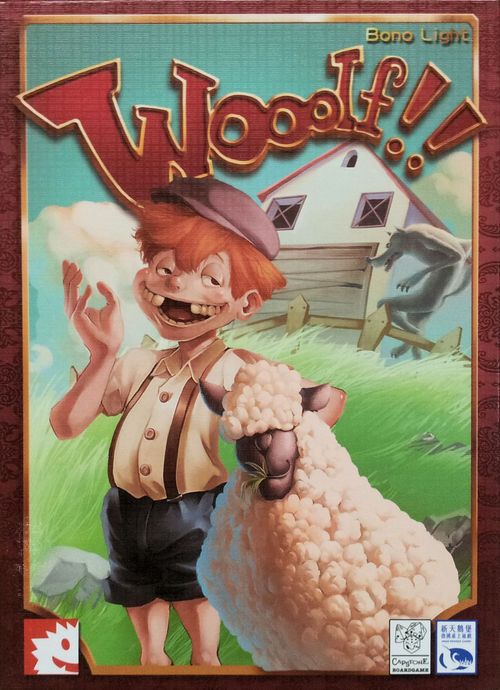
Wooolf!!
Wooolf!! Rulebook
Table of Contents
Table of Contents
Introduction
Each player has two character cards, one of which represents his true identity and the other is only there to add confusion. By asking clever questions and drawing the right conclusions, each player tries to make correct suspicions before the other players. Who has the most points at the end of the game wins.
Game Components
16 character cards for the basic game:
- 7 sheep cards
- 2 hunting dog cards
- 1 hunting dog card (with appearance: "?")
- 2 hunter cards
- 1 hunter card (with appearance: "?")
- 1 shepherd boy card (with appearance: "?")
- 2 wolf cards
4 character cards for the advanced game:
- sheep (appearance: "hunting dog")
- hunting dog (appearance: "wolf")
- hunter (appearance: "sheep")
- shepherd boy (appearance: "hunter")
8 overview cards: in 8 different player colors, numbered from 1 to 8, showing the list of cards needed for the basic game on their front and the cards for the advanced game on their back.
16 question cards:
- 4 x "Do you play one of the characters wolf, hunter or shepherd boy?"
- 4 x "Do you play one of the characters sheep, hunter or shepherd boy?"
- 3 x "Does at least one of your character cards have the character image hunting dog?"
- 3 x "Does at least one of your character cards have the character image hunter?"
- 2 x "Does at least one of your character cards have the character image sheep?"
8 suspicion boards (with wheel): in 8 different player colors, numbered from 1 to 8.
8 error tokens (a black "x" on one side, a red "x" on the other side)
12 question mark tokens
48 clue tokens: 8 different colors with 6 tokens each — Wolf/Hunter, Wolf/Sheep, Wolf/Hunting dog, Hunter/Sheep, Hunting dog/Sheep, Hunting dog/Hunter.
16 score tokens: 10 x 1 and 2 points, 6 x 2 and 3 points.
Overview of the character cards
- Appearance — The symbol in the top-left corner shows the appearance of the character.
- Character image — The large image on the card shows the character, which the card represents (in this case, it is a "sheep").
- Targets — One or two symbols in the lower-left corner of the card show the targets that need to be found.
- Value — The value of the card is given in the lower-right corner.
Character Cards and Game-Play
Overview
In the game there are the characters sheep, hunting dog, hunter, shepherd boy, and wolf. At the start of each round players are randomly assigned one of these characters. It is possible that a character is played by several players or no one. Players keep their character cards and the character that they play secret and try to find out, who plays which character.
Determine Player Character
At the start of a round each player receives two character cards. These are used to determine the character a player has for that round. If both cards have the same character image, then the character shown in the image is the character that the player has. If the character images on the two cards are different, then the card that has the higher value determines the player character.
Note: Only the character image and the card value are used to determine which character a player has. The other information on the card (targets and appearance) play no role for this.
Targets
Each character has two targets, which are shown in the cross-hairs in the lower-left corner of the character card (the character wolf is an exception — it has only one target). A target can be one of the characters sheep, hunting dog, hunter or wolf. An overview of the targets of all characters is given on the left-hand side of the suspicion cards.
For each of the targets of the character that a player has, the player must identify another player who plays the character that is shown in the cross-hairs. It may happen that several players play the same character. In that case, only one of them needs to be identified. In case a character is played by no player, then this must be found out.
Example: Jason has two character cards with the character image sheep, so he plays the character sheep. The targets are "find a hunting dog" and "find a hunter". Jason must now find out one player who is the character hunting dog and one player who is the character hunter.
Example: Thomas has a character card shepherd boy (value 4) and a character card hunter (value 3). The shepherd boy card has the higher value, thus that is the character played by Thomas. He must find a player who plays a sheep and a player who plays a wolf.
Game Set-Up
Depending on the number of players, the character cards shown in table "Character cards for the basic game" are used. The remaining character cards are not used and returned to the box.
Each player gets one overview card, one suspicion card, and a set of clue tokens, all of the same color. Players keep their overview card and suspicion card next to each other in front of them with the printed numbers on the cards visible to the other players. Keep the clue tokens as player's supply next to the suspicion board.
Put the remaining overview cards, suspicion boards, and clue tokens back in the box. Put the question mark tokens, error tokens, and scoring tokens as general pool in the center of the table.
Game Round — Overview
The game is played in up to three rounds. In their turn players peek at character cards of other players, use question cards, or make suspicions. Points are scored for correct suspicions and the player who has the most points at the end of the game wins.
Preparing a Round
- Determine player characters. Shuffle the character cards and deal two cards to each player. Players look at their character cards secretly and then place them face-down in front of their suspicion board, within reach of the other players.
- Deal question cards. Shuffle the question cards and deal two to each player, who take them to their hand. Remaining question cards are not used this round and set aside.
- Determine start player. Randomly determine a start player.
Only in a 4 Player Game
After each player is dealt two character cards, put the remaining two cards face-down to the center of the table, to simulate a fifth player. Take one of the unused overview cards to assign a player number to him. The simulated player does not carry out actions and players cannot use the action "Use question card" to interrogate him. Players can use the action "Peek at a character card", to look at one of his character cards and they can suspect him, when making an early or late suspicion (the actions are explained later).
Sequence of Play
Beginning with the start player and continuing in clockwise order, players take turns to carry out one of the following actions:
- Peek at a character card
- Use a question card
- Make an early suspicion (not on a player's first turn)
Peek at a Character Card
The player whose turn it is takes one of the character cards of another player and looks at it secretly.
If the appearance (in the top-left) on the card shows a character, then the player takes a clue token with the matching character symbol from his own supply and places it in front of the player from who he took the card. Additionally, he announces which appearance he has seen, for instance "He is a sheep!".
If the appearance on the card shows a question mark, the player takes a question mark token from the general supply, places it in front of the other player, and says "I don't know who he is!".
Finally, the player returns the character card face-down to the other player, who places it back next to his other character card again.
- If the player whose turn it is plays the shepherd boy, he must always claim "He is a wolf!" anytime he sees a character card and therefore must put a wolf token in front of the other player. However, if the appearance shows a question mark, then the "shepherd boy" must still place a question mark token and say "I don't know, who he is!".
- When peeking at a character card players must tell the other players which information is given in the appearance of the character cards — and only that information may be shared. Any other information, that is the value of the card, character image, or targets, must not be shared with the other players.
- During the game, players can check out their own character cards and change their order whenever they want.
Note: In a 4 player game, the cards of the simulated player should be shuffled, too, before a player uses the action "Peek at a character card" to look at one of his character cards.
Use a Question Card
The player whose turn it is places one of his question cards face-up in front of another player and states the corresponding question. The player who is asked the question must answer truthfully and turn either the "Yes"-side or the "No"-side of the card towards the center of the table. The card stays in front of the player until the end of the round.
Example: Answer "Yes", turn "Yes"-side. Answer "No", turn "No"-side.
Make an Early Suspicion
Players can choose this action from their second turn onwards.
If the player whose turn it is wants to make an early suspicion, he announces it by saying "I suspect!" and then uses the pointers on his suspicion board to make the suspicion.
The target overview table on the suspicion board shows the targets for each of the characters sheep, hunting dog, hunter and wolf, in the "<"- and "<<"-columns.
Pointer "<" is used to indicate the suspicion for the target in column "<" and pointer "<<" is used to indicate the suspicion for the target in column "<<".
The player positions the "<"-pointer to the number of a player who he thinks plays the target character that is shown in the "<"-column of his own character. He then positions the "<<"-pointer in the same way.
Note: The character wolf has only one target, therefore the "<<"-column shows a "x" as target for the wolf. Players, who play a wolf, position the "<"-pointer to the number of a player, who they suspect to play a sheep and they position the "<<"-pointer to the "x".
Example: Thomas plays the shepherd boy. The target overview table shows the following targets for the shepherd boy: character Wolf in the "<"-column and character sheep in the "<<"-column. When making a suspicion, Thomas positions the "<"-pointer on his suspicion board accordingly to the number of a player he suspects to play a wolf. He positions the "<<"-pointer to the number of a player he thinks is a sheep.
For a suspicion to be correct, it is sufficient to find one player who plays that character. It is not required to identify all players who play that character.
If the player believes that no player is the character that he is looking for, then he sets the corresponding pointer to "0". Finally, he puts the suspicion board face-down in front of him.
The round then continues. Players who have made an early suspicion are out for the remainder of the round although they still must answer questions and the other players can still use the "Peek at a character card" action on them.
Note: They are still allowed to shuffle their character cards before someone looks at one of them.
In a 4 or 5 player game the round ends when 2 players have made an early suspicion. In a 6 to 8 player game the round ends when 3 players have made an early suspicion.
The Final Suspicion
Now all players, who have not yet made a suspicion can make a final suspicion. Final suspicions work exactly the same as described for "Action: Make an early suspicion". Alternatively, a player can also choose to not make a suspicion by positioning the pointers on his suspicion card to the "x". Finally, players place their suspicion boards face down in front of them.
When all players have finished their suspicions, the character cards and suspicion boards are turned face-up and suspicions are checked.
For a suspicion to be correct, players must have correctly identified both targets of their own character. If a target character is not in play, the corresponding pointer must be set to "0" for the suspicion to be correct.
Correct Suspicion: Score Points
- A correct early suspicion scores 2 points.
- A correct final suspicion scores 1 point.
- The player who plays the shepherd boy gets 1 additional point, for each player who plays a hunter or hunting dog, who has incorrectly suspected another player to be a wolf and that other player has received a clue token "wolf" from the shepherd boy.
Example: Thomas plays the shepherd boy, Jason plays a sheep, and Kenneth is a hunter. Jason has already received a clue token "wolf" from Thomas earlier in the game. Kenneth is pretty sure that Jason is a wolf and makes his suspicion. At the end of the round, Thomas gets 1 extra point, because Kenneth - a player who is a hunter - has incorrectly suspected Jason to be the wolf and Jason also has a clue token "wolf" from Thomas. Thomas would not score the extra point, if Jason had no clue token "wolf" from Thomas.
Incorrect Suspicion: Receive Error Tokens
- Players who have made an incorrect early or final suspicion, receive 1 error token.
- Additionally, face up the error token to red "x" side to the players who have made an incorrect early suspicion — they cannot make an early suspicion in the next round. They still can make a final suspicion. As a reminder, they turn the red "x" side of their error token face-up (at the end of the next round, flip the token over to the black "x" side). The other players put their error token in front of them with the black "x" side face-up.
End of Round
Now, players take back their clue tokens. The question mark tokens are returned to the general supply. The player to the left of the one who made the last early suspicion is the starting player for the next round.
End of Game
The game ends after three rounds or when at least one player has received two error tokens.
The player who scored the most points wins. If there is a tie the tied player with the least error tokens wins. If there is still a tie, all tied players share victory.
Example of Play
Five players: Eva (1), Thomas (2), Paul (3), Jason (4), Kenneth (5). Eva plays a "wolf", Thomas plays the "shepherd boy", Paul is a "hunter", Jason is a "sheep", Kenneth plays another "hunter".
Eva peeks at one of Jason's character cards. The character image shows a sheep and the appearance also shows a sheep. Eva says "Jason is a sheep!" and puts a clue token "sheep" in front of Jason.
Now Thomas peeks at one of Kenneth's character cards. Character image and appearance show a hunter. Since Thomas is the shepherd boy, he claims "Kenneth is the wolf!" and puts a clue token showing a wolf in front of Kenneth.
Next Paul looks at one of Thomas's character cards. The character image shows the shepherd boy, the appearance is a question mark. Thus he says "I do not know" and puts a question mark token in front of Thomas.
Then Jason uses one of his question cards, asking Paul: "Do you play one of the characters wolf, hunter, or shepherd boy?". Paul is a hunter. Therefore, he must answer "Yes!" and turn the "Yes"-side of the question card towards the center of the table.
After a few more rounds Eva decides to make an early suspicion (reminder: Eva plays a wolf). She positions the "<"-pointer on her suspicion board to the number of a player she thinks plays a sheep. She sets the "<<"-pointer to the "x". Thomas also makes an early suspicion, ending the round. The other players now decide whether to make a final or no suspicion. Paul and Jason make a final suspicion. Kenneth decides to make no suspicion, and turns the pointers on his suspicion board to "x".
The Results
Eva has made an early suspicion and she has correctly identified Jason to be a sheep. Thus, she receives 2 points.
Thomas has also made an early suspicion. He has correctly identified Eva to be a wolf, but he mistook Paul for a sheep. Thomas gets an error token and turn to red color side, scores no points and he cannot make an early suspicion in the next round. As a reminder, he turns the red side of the error token face-up.
Paul has correctly made the final suspicion that there are no hunting dogs around in this round (he positioned the corresponding pointer to the "0"). Paul has misinterpreted the clue token "wolf" that Thomas had placed earlier in the game in front of Jason — and mistook Jason for a wolf. Thus, Paul receives an error token and no points, while Thomas gets 1 extra point, because he managed to make a player who is a hunter incorrectly suspect a player to be a wolf.
Kenneth has no idea who is who in this round and has made no suspicion. He positioned the pointers on his suspicion board to the "x". He does not score points nor does he receive an error token.
Advanced Game
To prepare the advanced game, replace four cards from the basic game with the four cards of the advanced game as shown in the table "Replace cards for the advanced game".
Replace cards for the advanced game:
| Amount | Card from basic game — Character image | Card from basic game — Appearance | Replace with card from advanced game — Character image | Replace with card from advanced game — Appearance |
|---|---|---|---|---|
| 1 | Shepherd Boy | ? | Shepherd Boy | Hunter |
| 1 | Hunter | ? | Hunter | Sheep |
| 1 | Hunting Dog | ? | Hunting Dog | Wolf |
| 1 | Sheep | Sheep | Sheep | Hunting Dog |
Use the table "Character cards for the advanced game" instead of table "Character cards for the basic game" to select cards for the advanced game during game set-up. The game rules do not change.
Example — Advanced Game
Eva peeks at one of Jason's character cards. It is a sheep with appearance "hunting dog". Eva says "Jason is the hunting dog!". She places a clue token "hunting dog" in front of Jason.
Next, Thomas looks at one of Paul's character cards. It is a hunter with appearance "sheep". As Thomas is the shepherd boy, he says "Paul is the wolf!" and puts a clue token "wolf" in front of Paul.
Paul plays a question card in front of Jason and asks him "Does at least one of your character cards have the character image sheep?". Jason has indeed one card that has character image "sheep" (its appearance is "hunting dog"). Jason answers "Yes!" and turns the "Yes" side of the question card to the center of the table.