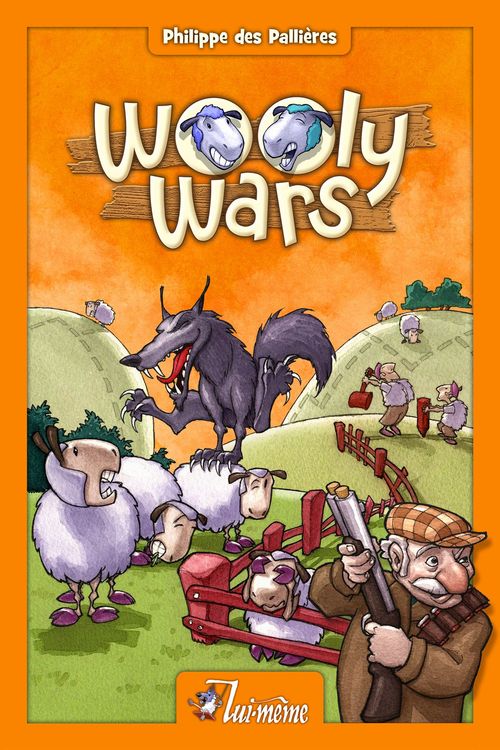
Wooly Wars
Wooly Wars Rulebook
Table of Contents
Table of Contents
Set Up
Object of the game: to build the largest enclosed field with sheep of your color.
Each player draws, at random, a shepherd token to determine their color. On the back of this token appear four sheep and a shepherd, with the front bearing a question mark. Watch out, each player's color is hidden to the other players!
Each player then draws four tiles at random from the bag, which will constitute their starting hands.
The "village square" tile is then played in the middle of the table.
The First Turn
The first player must play one of their four tiles beside the starting tile, taking care to match the landscape of the tiles' edges. For the first turn, it is thus necessary to join a village edge to the starting tile.
The tile played by the first player then causes that player to draw a tile from the bag and add it to their hand. This ends their turn.
And so on...
And So On...
Each player proceeds in the same way: placing a tile next to an already played tile, then drawing a tile (or several, see below).
If the tile played is touching two other tiles already played, the player can draw two tiles instead of one. This is called a Multi-Draw.
In fact a player draws as many tiles as there are tiles touching the one they played (from 1 to 4 tiles can be drawn).
Wolf!
If a player has a Wolf or Hunter token, they can play it at any time, even out of turn.
The player cries "Wolf!" and plays their Wolf tile beside a forest.
A Wolf cancels all the enclosed fields which touch its forest... The "cancelled" enclosures will count for zero at the end of the game, except if...
Bang! Bang!
Except if a Hunter kills the Wolf!
A Hunter token can be played on a Wolf, canceling the effect of the Wolf.
The Hunter can also be played in a forest without a Wolf; it is then forbidden to play a Wolf token in that same forest.
As with the Wolf, the Hunter can be played at any time, even out of turn. It is simply necessary to announce out loud "Hunter!" before playing it.
Revealing Your Color and Calling It Quits
At any time, a player can decide to reveal their color, even out of turn. Simply turn over your shepherd token (marked with a question mark on the back) and then play it, shepherd side up, on the game board as any other tile, then draw from 1 to 4 additional tiles as in a normal turn. You then profit from a free turn and can play another one of your tiles.
Each player can choose to quit playing before the end of the game. The first player to quit receives a +6 Quitting Bonus to their score at the end of the game; the second +3, the third +1; and the last player receives no bonus at all (but will be able to finish quietly by playing all the tiles which remain in their hand).
End of the Game
When everyone has given up or cannot play anymore, each player determines which enclosed field has the largest number of sheep in their color, and which does not border a forest sheltering a Wolf. You receive 1 point per sheep in this field, plus any Quitting Bonus. The player with the highest total wins!
Frequently Asked Questions
After having played a Wolf or a Hunter out of turn, can a player immediately draw additional tiles? Yes, as many tiles as there are tiles in contact with the Wolf or Hunter tile just played (from 1 to 4). For example, by placing a Hunter on a Wolf already surrounded by four forest tiles, the player immediately draws four additional tiles from the bag.
What happens when a player reveals their color during their own turn? This permits a player to take three turns in a row:
- The player takes their normal turn, and draws new tiles.
- They reveal their color, play the shepherd color tile, and take the appropriate number of new tiles.
- They take a "one time only" additional free turn.
Can a player reveal their color or give up out of turn? Yes.
Is it allowed to have "holes" in the landscape, that is to say, empty spaces surrounded by four tiles? Yes. However, a field with a "hole" inside it is not considered closed.
Can a player keep blue sheep and red sheep in the same closed field? No. A pen can be made up only of sheep of the same color.
Does a player have to reveal her color and give up at the same time? No, not necessarily.
When one forest contains a Hunter, another a Wolf, and then the two forests are connected by a new tile, what happens? The Hunter does not kill the Wolf; the Wolf thus remains active and cancels all the fields bordering the forest, unless and until a Hunter tile is played on top of him. However, it is now forbidden to play another Wolf in this new large forest, since there is already a Hunter in it.
Contradicted by the published English rules: When two or more previously separate forests merge, and one of them has a Wolf Tile and the other a Hunter Tile, the Wolf Tile has to be covered by the Hunter Tile to make the fields on the newly-formed forest's edge safe.
When should the points be calculated? The points of a player are counted only when the game is finished. Only then do players calculate points for the largest number of sheep in an enclosed field plus the Quitting Bonus.
Variants
Hand Size Impose a 3-tile hand size to cut down on analysis paralysis. Discard extra tiles of your choice.
No Multi-Draw Instead of the Multi-Draw, grant an additional turn.
Count All the Penned-in Sheep All your completed flocks of penned-in sheep are counted, and the player with the highest total wins.
The Hungry Wolf (or Werewolf) Playing a Wolf on top of a Hunter negates the latter. Basically, the Wolf eats the Hunter.
Multi-Tile Play The Multi-Draw result of your first tile played on your turn determines the total number of tiles you may play on your turn, in addition to the Multi-Draw.
If you played next to just one other tile, then your turn is now over, but if you played a tile next to 2 other tiles, you must still play another tile; if played next to 3 tiles, you must play 2 more tiles; and at most 3 more tiles if you played next to 4 tiles.
Do not draw new tiles for the additional tiles played beyond the first. If combined with the Hand Size Limit, then discard only if still necessary after all your tiles have been played.