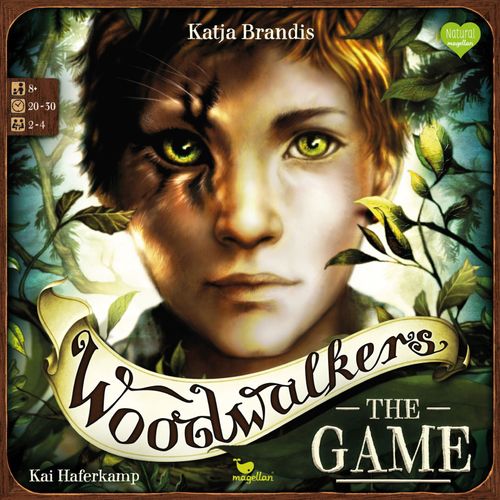
Woodwalkers: The Game
Woodwalkers: The Game Rulebook
Table of Contents
Table of Contents
Game Components and Setup
Components
- 56 Wound tiles
- 4 Dice
- 4 Score markers (in 4 colors)
- 1 Reversible game board with a daytime side and a nighttime side
- 28 Animal tiles (7 each in 4 colors)
- 40 Forest tiles (20 for the daytime side, 20 for the nighttime side)
- 28 Animal cards (7 each in 4 colors)
- 20 Battle mode tiles
- 1 Battle mode marker
Setup
Place the game board in the middle of the table with the green daytime side up.
Mix the twenty green forest tiles, face down, and place them individually on the light spaces in the middle of the game board, face down.
Now each player takes a set of animal tiles, animal cards and a score marker in the same color as well as one of the four dice. Return the remaining animal tiles, cards, score marker and dice to the box.
Place your score marker on the largest space of the scoreboard on the outside edge of the game board.
Place your animal tiles face up on any of the seven matching starting spaces on the game board.
Place your animal cards face up in front of you.
Keep the wound tiles next to the game board.
Then mix the battle mode tiles and place the stack face down next to the game board. Then draw three battle mode tiles and place them face up.
Who's the youngest player? That player is given the battle mode marker and you're ready to duel!
Gameplay
Starting a Round: Selecting a Battle Mode Tile
The player holding the battle mode marker starts the round. This player chooses one of the three face up battle mode tiles and places it away from the game board where all can see it. The symbol on the tile shows the category of duels in this round: Endurance, speed, intelligence or strength.
Then the player draws a new battle mode tile from the stack and places it with the other two remaining battle mode tiles.
Example: Lissa, Isidore, James and Sarah are playing. Sarah is the youngest and therefore holds the battle mode marker. She chooses the tile with the strength symbol from the three face up battle mode tiles. This means, in this round all duels will be in the strength category. She places the chosen battle mode tile next to the game board where it can easily be seen by all, draws another battle mode tile from the face down stack and places it next to the remaining two battle mode tiles for the next round. Then it's James' turn, who is to her left, and starts the round of rolling dice with his move.
Taking a Turn: Moving
After choosing the battle mode tile, players start rolling dice and the next player to the left takes their turn. Is it you? Then roll your die and move one of your animal tiles on the space in the middle of the game board.
The die always shows the maximum number of spaces you can move your animal tile.
You can change directions as often as you'd like with your move.
Rules when moving on the game board:
- You can move one of your animal tiles as many spaces vertically or horizontally along the game board as the number on your die. Diagonal moves are not allowed.
- If you don't want to move your animal tiles, you can also skip rolling your die. Gameplay will then move to the next player.
- You can stop sooner and lose points on the die.
- Remember, only one animal tile can occupy a space.
- If an animal tile is already on a space, you will need to go around and cannot jump or use it to run. The only exception: If there's a duel.
- You cannot move your tile to the starting spaces of another player.
- You can move an animal tile from one of your starting spaces to one of your other open starting spaces. Again: Animal tiles cannot be jumped. However, once your animal tile is outside of your starting spaces, you cannot move it back to the starting spaces.
Where Did Your Figure End?
Here comes the excitement. Where did your figure end:
a) On an open space? Then nothing will happen, and the next player rolls their die.
b) On a space with a face down forest tile? Then turn over the forest tile and look at it.
-
Is it a flag? Place the tile face up on the game board and set your animal tile on it. The points on this flag go to the placer whose animal tile is on this tile at the end of the game.
-
Is it Sherri's Medicine? You can use medicine at any time to remove one wound tile from one of your animal cards. Once used, it is out of play. Place the medicine tile in front of you until you use it.
-
Is it a die? The die tile allows you to reroll your die once at any time. Regardless of whether you use the die to move ahead or to have an advantage in the duel. The tile is then taken out of play. Place the die tile in front of you until it is used.
-
Is it a points tile? You can straight away move your score marker one space ahead on the scoreboard. Then return the points tile to the box.
Example: James rolls a 4 and moves his bison tile to a space with a face down forest tile. He turns it over and it shows a die. James places the tile in front of him. He can use it later in the game to roll again. His animal tile stays on the space that is now open. Isidore rolls a 3. However, he only wants to move his otter tile 2 spaces ahead and stops early. He also lands on a space with a face down forest tile. He turns it over and it shows a flag with a number. He returns the tile to its space face up and sets his animal tile on it. The forest tile stays on this space for the remainder of the game.
c) The space is occupied by another player's figure? Let's duel!
The Duel
If you move your animal tile to a space occupied by the tile of another player, the players will duel:
First both look at the battle mode tile chosen for this round. It shows the duel category: Endurance, Speed, Strength or Intelligence.
Then look at the value of the duelling animals on your animal cards and compare your values. (The values are also printed again in small on your animal tiles). Take note if there are already wound tiles on your animal card. If so, you will need to deduct one point per wound tile from your value. Then both roll the dice, starting with the player who challenged the other to a duel.
Now add the points rolled to the value on your animal cards. Who has the higher total? This player wins the duel. If your total is tied, the challenger loses.
The player who lost the duel must now move their animal tile back to any of their own open starting space. That player must also place one wound tile on the corresponding animal card in front of them. Each wound tile reduces the combat power of the animal in future duels by one point.
Attention! If a player has three wound tiles on their card, the animal is too severely wounded, and the respective animal tile as well as animal card is taken out of the game. The wound tiles are then returned to inventory.
The winner of your duel may move their figure to the now open space or stay on the space, respectively. The player has conquered their position on the game board. If there is a flag tile on the space, the player has also captured the flag - at least until he is in a duel and needs to clear the space. In addition, the winner may move their score marker two spaces ahead on the scoreboard.
Example: It's Lissa's turn, she rolls and moves her wolf tile to the space already occupied by Isidore's otter. Thus, the two animals now duel! Lissa and Isidore first look at the battle mode tile chosen for this round: It shows the strength symbol. Lissa now looks at the strength on her wolf card (a 6) and Isidore on his otter card (a 3). Both now roll. Lissa rolls a 3. So, her strength is 9 (6+3). Isidore rolls a 6. His strength is also 9 (3+6). Since Lissa was the challenger, she unfortunately loses the duel. She returns her wolf tile to an open starting space, takes a wound tile and places it on her wolf card. Isidore on the other hand was able to hold his position. He won, is allowed to stay on the space and moves his score marker two spaces ahead on the points bar.
But what if Lissa had rolled a different number?
- Had Lissa rolled a 4, 5 or 6, her strength of 10, 11 or 12 would have been the clear winner (6+4, 6+5, 6+6); since Isidore cannot roll higher than 6, his strength would not have been higher than 9. Had Lissa won, her wolf tile would have stayed on the space, and she would have been able to move her score marker two spaces ahead on the scoreboard. Isidore on the other hand would have lost his position and would need to return his otter tile to one of his open starting spaces and placed a wound tile on his otter card.
- However, had Lissa rolled a 1 or 2 and her strength been 7 or 8, Isidore would have been the clear winner with a strength of 9.
The End of the Round
Once you have rolled, moved, and possibly carried out an action such as turning over a forest tile or duelling another player, your turn ends. Gameplay then moves to the next player to the left, who will then roll and move.
Watch out: As soon as gameplay moves to the player who started the round and chose the battle mode, that player also rolls and moves their animal tile as explained and possibly carries out the described actions. That player then places the battle mode tile for the round to a discard pile and passes the battle mode marker to the next player to the left. That player may then choose a new battle mode tile from one of the three face up tiles as described in the beginning and place it for all to see. Then the next player rolls, thus starting a new round of rolling.
Example: Sarah, who chose the battle mode tile, is the last to roll this round and makes her move just as all other players. She then passes the battle mode marker to James, who is to her left. It's now his turn to choose one of the three battle mode tiles. After doing so, Isidore starts the new round of rolling.
Since selecting the battle mode tile in the round is counted as a move in its own right, the game for two players only results in a special order in which the player who rolled last in one round may roll first again in the next round.
Example: Sarah and James play in pairs. Sarah goes first and chooses the battle mode tile. Then it is James' turn and he rolls the dice as usual. Then it's Sarah's turn to roll the dice. Once she has made her move, she passes the battle mode marker to James, who may now select the new battle mode tile. Then it's Sarah's turn to roll the die again, followed by James.
End of the Game
If there are fewer than three battle mode tiles left to turn over, a final roll of the dice is played. This then ends the game.
Check the game board to see if your animal tiles are on a space with a flag. If so, you may move your score marker on the scoreboard as far as the number on the flag allows.
Example: Isidore has two animal tiles on spaces with a flag. One has a value of 5, the other a value of 7. So Isidore may move ahead 12 spaces on the scoreboard (5+7).
If a player has more points than needed to reach the last space on the scoreboard, simply start back at the first space next to the largest space on the scoreboard and move ahead from there.
The player with the most points at the end wins the game. If the score is tied, the person with more animal tiles on spaces with flags wins. If it is again tied, the player with less wound tiles on their animal cards wins. If this is also tied, there are multiple winners.
Midnight Duel
If you have played the basic game a few times, you can attempt the nighttime version. But be careful! This requires a good memory.
The nighttime version follows the same rules except:
- The game board is placed in the middle of the table with the blue nighttime side up.
- Use the twenty blue forest tiles, mix and place them face down on the respective spaces on the game board.
- Secretly look at your animal tiles and place them face down on your starting spaces.
You should remember, where you place which animal tile, as the animal tiles can now only be turned over for a duel.
If there is a duel, the player being challenged can take one guess, which animal attacked. If the player is correct, add one point to that player's roll. However, if the player was wrong, the challenger can add one point to their roll.
The player with the most points at the end wins this nighttime challenge!
Characters
- Carag - Puma boy from the mountains
- Cliff - Carag's classmate
- Connor - Exchange student
- Lou - Carag's classmate
- Buddy - Berta's acquaintance
- Henrietta - Exchange student
- Kona - Guest from California
- Mia - Carag's sister
- Bill Brighteye - Combat teacher
- Brandon - Carag's best friend
- Honey - Lou's sister
- Malita - Berta's cousin
- Frankie - Carag's friend
- Chipster - Exchange student
- Nimca - Carag's mom