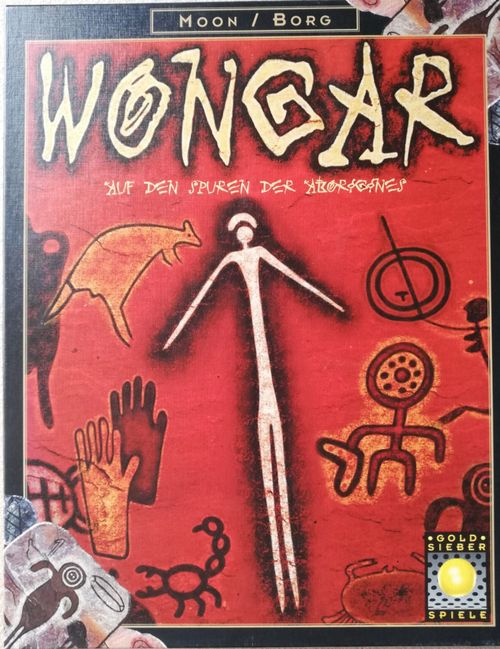
Wongar
Wongar Rulebook
Table of Contents
Table of Contents
Components
- 225 game pieces, called Tjurungas, in 5 player colors:
- 90 Discs
- 75 Cubes
- 60 Cylinders
- 150 small territory cards (10 sets of 15 cards each)
- 43 large ritual cards
- 5 scoring markers in the player colors
- 2 Ancestor figures
- 2 Elder figures
- 1 Boomerang figure
- 1 Scorpion piece
- 1 cloth bag
- 1 rulebook
- 1 game overview / reference sheet
Please keep the reference sheet at hand while reading the rules.
The Game Board
The board shows 10 territories with sacred sites of the Australian Aborigines. Each territory has its own symbol, which is important for setting up the game.
Around the outer edge of the board runs the scoring track, where players' victory points are shown.
On the left edge of the board is the three-part Scorpion track. The piece representing the Scorpion moves along this track. It shows the current game phase and marks a possible end of the game.
Setup
- The board is placed in the middle of the table.
- The Scorpion piece is placed on the lowest space of the Scorpion track.
- Each player chooses a color and takes all the game pieces (Tjurungas) of that color: 18 Discs, 15 Cubes, 12 Cylinders. So each player has three different kinds of game pieces.
- The 150 small territory cards are sorted by their backs. This produces 10 stacks of 15 cards each. Each stack is shuffled on its own. The stack is placed face down in a corner of the territory that carries the same picture as the card backs.
- From each stack, the top card is revealed and placed face up again on top of its stack. If a Scorpion card is revealed this way, it is pushed under the stack instead and the next card is revealed.
- Each player takes twelve of their Tjurunga game pieces (four of each kind) and puts them, together with the pieces of the other players, into the cloth bag. All the pieces are mixed. Then each player draws pieces from the bag one at a time and distributes them across the 10 spaces of the board. Players begin at the Kangaroo territory in the top left and fill the territories row by row from left to right:
- With 3 players: 3 pieces into each territory, plus 3 more pieces into each of the two central territories "Hands" and "Foot".
- With 4 players: 4 pieces into each territory, plus 4 more pieces into each of the two central territories "Hands" and "Foot".
- With 5 players: 5 pieces into each territory, plus 5 more pieces into each of the two central territories "Hands" and "Foot".
- The 43 large ritual cards are shuffled. Each player is dealt two cards face down and takes them into hand. Anyone dealt a card showing the Scorpion symbol gives it back and receives a replacement card instead. The remaining ritual cards — including any returned Scorpion cards — are shuffled again and placed as a face-down stack next to the board.
- The first owners of the Ancestor and Elder figures are determined: One player shuffles the players' scoring markers and draws them one at a time, face down, first one and then a second. The player whose color is drawn first receives both the Ancestor and Elder figures and the Boomerang.
- The Ancestor figure of that first draw is placed on the board in the central territory with "Hands."
- The second Ancestor figure is stood upright in front of that player.
- The Boomerang shows who started this round, and is therefore the starting player for the round.
- The player whose piece is drawn second receives both Elder figures.
- The Elder figure shows a person holding a square in their hand. The square is the symbol for the ritual cards.
- One Elder is placed on the board in the central territory with "Foot." The second Elder is stood upright in front of that player.
- Now all scoring markers are placed on the starting space of the scoring track.
The Territory Cards
Each stack of territory cards contains seven different kinds of cards:
A card showing the symbol of one piece-kind (Disc, Cube, or Cylinder). Whoever takes one of these cards may place up to three pieces of the shown kind. First, one piece must be placed into the territory the card was taken from. Then the player may choose to place up to two further pieces of that kind in one or more territories of their choice — or draw that many ritual cards instead. If a player forgoes placing one or even two pieces, they may draw one ritual card for each piece they forgo.
If a player takes a card for a piece-kind of which they have no pieces left in their supply, they naturally cannot place any further pieces. They may still only draw 2 ritual cards from the stack.
Attention: for the territory cards still lying in front of players at the end of the game showing the symbol of a piece-kind, players receive additional victory points — 8 victory points for each card majority in a piece-kind.
A card with three symbols of one piece-kind. Whoever takes this card places 3 game pieces of one kind of their choice into territories of the board of their choice. None of the pieces has to be placed into the territory the card was taken from. The player may not draw ritual cards instead of placing a piece.
If the player has fewer than three pieces of the chosen kind, they simply place fewer pieces.
Ancestor. Whoever chooses a card with the Ancestor immediately receives the Ancestor figure from its previous owner.
The player must then move the Ancestor figure on the board by one territory. The new territory must be directly adjacent to the previous territory. The Ancestor may not remain in its old spot. A Ceremony, ending in a Scoring, is then immediately carried out in the new territory.
Important! The territory the "Ancestor" card was taken from is not the site of the Ceremony — rather, it is the territory the Ancestor figure is moved into. The course of a Ceremony is explained in a later section.
Elder. Whoever chooses a card with the Elder immediately receives the Elder figure from its previous owner.
The player must then move the Elder figure on the board by one or two adjacent territories. The Elder may not remain in its old spot. A Ceremony, ending in a Scoring, is then immediately carried out in the new territory.
Important! The territory the "Elder" card was taken from is not the site of the Ceremony — rather, it is the territory the Elder figure is moved into. The course of a Ceremony is explained in a later section.
Ancestor and Elder. Whoever takes this card immediately receives both figures from their previous owners.
The player then places both the Ancestor figure and the Elder figure on the board into the territory the card was taken from. It does not matter where the two figures previously stood. A Ceremony, ending in a Scoring, is then carried out in the territory with both figures. The course of a Ceremony is explained in a later section.
Four Ritual Cards. Whoever takes this card immediately draws four ritual cards from the face-down stack and takes them into hand.
Scorpion. This card is described in the following section.
The Scorpion
Both in the stack of ritual cards and in each of the 10 territory-card stacks, there are two cards each with the "Scorpion" symbol.
Territory card and ritual card. If, over the course of the game, a player obtains a Scorpion card — either as a territory card or as a ritual card — three things happen immediately:
- The Scorpion piece advances one space on the Scorpion track. If it reaches the last space of a phase, then upon the next card with a Scorpion it advances to the first space of the next section of the track.
- A territory card is placed face down in front of the player.
- A ritual card is set aside next to the board. In either case, a new card is drawn or revealed. If the second Scorpion is drawn from the stack of ritual cards, the discard pile, the remaining face-down stack, and both Scorpion cards are reshuffled together and placed again as a face-down stack next to the board.
- It is checked whether the player who received the Scorpion card must be moved back on the scoring track. The player is moved back as many spaces on the scoring track as there are players positioned behind them on the track. A player can even be moved back past the starting space.
If a player reveals several territory cards with Scorpions in one round, or receives both ritual cards with a Scorpion, it is checked each time whether they must be moved back.
However, each Scorpion card is handled one after another. For example, if with 5 players the owner of the Ancestor is in first place and reveals 2 Scorpions, they move back 4 spaces for the first Scorpion. If this puts them behind one or more other players, they move back correspondingly fewer spaces for the next Scorpion.
The Ceremony
If a player takes a territory card "Ancestor," "Elder," or "Ancestor and Elder," a Ceremony takes place in the territory into which the respective figures are placed. Whoever, after such a Ceremony, has the most game pieces of one kind in this territory, may advance their marker on the scoring track accordingly.
Fundamentally, only players who own at least one game piece of any kind in the affected territory take part in the Ceremony.
The owner of the Ancestor opens the Ceremony. If this player is not taking part in the Ceremony, the participating player seated next to them clockwise begins instead. The other participating players follow in clockwise order.
Whoever's turn it is may play one of their ritual cards, then place the played ritual card face up next to the board. This forms an open discard pile.
When a player plays a card with the symbol of a piece-kind, they choose one of the following three possibilities:
A) The player removes one foreign game piece of the kind shown on the card from the territory and returns it to its owner.
B) The player moves one of their own game pieces shown on the card from the territory where the Ceremony is taking place into a directly adjacent territory.
C) The player moves one of their own game pieces shown on the card from a directly adjacent territory into the territory where the Ceremony is taking place.
There is also a card with two symbols of all three piece-kinds and a "2" in the corners of the card.
Whoever plays this card may remove two game pieces of one kind of their choice from the territory and give them back to the corresponding player or the two players. If only one game piece of the desired kind remains in the territory, only that one piece can be removed.
Instead, the player may also move two of their own game pieces of one kind from the territory where the Ceremony is taking place into one or two directly adjacent territories, or bring them into the territory of the Ceremony from adjacent territories.
As soon as a player has no more game piece in a territory, they may no longer take part in the Ceremony.
Players play ritual cards in turn, round after round, until no player can or wants to play another card. Then the Ceremony ends and a Scoring takes place.
If a player forgoes playing a card during a Ceremony, they may not play any more cards for the rest of that Ceremony.
Scoring
At the start of each section of the Scorpion track there is a small chart showing how many victory points are awarded for the majority in a piece-kind. The number of victory points depends on whether the Ceremony was triggered by the territory card "Ancestor," "Elder," or "Ancestor and Elder."
| Territory card / Scorpion phase | Ancestor | Elder | Ancestor and Elder |
|---|---|---|---|
| Phase 1 | 2 | 3 | 4 |
| Phase 2 | 3 | 4 | 5 |
| Phase 3 | 5 | 6 | 7 |
The victory points shown go to the player who has the most Disc, Cylinder, and Cube pieces in that territory. Each of the three kinds is scored separately.
The points are set on the scoring track accordingly. The player with the most points wins.
You should now begin the game, and consult the quick-reference rules on the back of the reference sheet if you have questions about the flow of play.
You may also consult the play example at the end of the rulebook to make getting started easier.
If a player takes a card "Ancestor" or "Elder" and draws the corresponding figure by chance into the territory in which the other figure already stands, the Scoring is based on the figure that was moved. This does not create an "Ancestor and Elder" Scoring.
In case of a tie, the owner of the Ancestor wins the tie, or otherwise the player seated next to them clockwise.
Game End and Final Scoring
The game ends when the Scorpion reaches the last space of its track, or when the last card is taken from one of the territories. The round in progress is played to its end.
Each player now reveals all the territory cards they have collected in front of them. Whoever holds the most cards with the symbol for a piece-kind (Disc, Cube, or Cylinder) receives a bonus of 8 points. Each kind is scored separately. In case of a tie, each of the tied players receives 8 points.
The player with the most points wins.
The Game for the Initiated
For players who enjoy balanced games of both luck and tactics, the basic game is exactly right.
The Game for the Initiated builds on the rules of the basic game and offers more tactical and strategic possibilities beyond it.
In what follows, only the changes to the basic game are explained. It is nonetheless recommended to first play Wongar a few times using the basic rules.
Setup
-
Before the game begins, the following cards are sorted out of each of the 10 stacks of territory cards:
- 1 Ancestor card
- 1 Elder card
Each territory-card stack now contains only 13 cards.
From the sorted-out territory cards, each player receives one card showing an Ancestor and one showing an Elder, and places them face up in front of them. It is entirely irrelevant which territory each card belongs to.
The remaining sorted-out territory cards are no longer needed and go back into the box.
-
From the stack of ritual cards, the two cards with the Scorpion and the 5 cards with a "2" in the corners of the card are picked out.
The two Scorpion cards are no longer needed and are put back in the box.
Each player now receives a card with the two symbols of all three game pieces and takes it into hand. If cards remain because fewer than five players are playing, these leftover cards go back into the box. They are no longer needed.
-
Each player places 4 game pieces of each kind as follows:
The owner of the Ancestor begins. They take one of their 12 game pieces and place it into a territory of their choice. Then their left neighbor takes a turn. Players place one game piece each into a territory of their choice, in turn, until all players have placed their 12 game pieces.
Gameplay
1. Revealing territory cards. If the Ancestor reveals one or more Scorpion cards, the Scorpion piece advances on the Scorpion track by the corresponding number of spaces. The cards are set aside, and new cards are immediately revealed.
However, it is no longer checked whether the owner of the Ancestor is moved back on the scoring track.
The Scorpion now only determines the game phase and the possible end of the game.
2. Fulfilling the privilege of the Elder. The owner of the Elder takes the face-down stack of ritual cards. They pick out one card of their choice and take it into hand. They place the stack back next to the board.
Taking a territory card in turn. As in the basic game, territory cards are taken in turn order. However, instead of taking the revealed card from a territory, a player may instead play one of their cards with an Ancestor or Elder.
They immediately receive the corresponding figure from its previous owner. Then they must move the figure onto the board into a new territory, following the rules of the basic game. A Ceremony with subsequent Scoring then takes place there immediately.
If a player has taken a territory card that allows them to take ritual cards, they may pick these out of the stack themselves and take them into hand.
The Ceremony
At the start of the game, each player receives one ritual card with two symbols of all three game pieces. If such a card is ever played, it is removed from the game entirely and goes back into the box. Each player may therefore use this card only once in the entire game.
Now the Game for the Initiated can begin.
A Detailed Example of Play
Let's follow the four players Green, Red, Orange, and Violet through their first round of a game of WONGAR. We limit ourselves here to just a portion of the board. We recommend replaying the sequence yourself. You should pick the cards you need out of the stacks as you go.
Preparation
According to the setup rules, the following starting arrangement resulted on the board (territories A through E):
Player Green received the Ancestor figure and the Boomerang. Player Violet has the Elder figure standing in front of them. Each player also has two ritual cards in hand. Green, as the player with the Boomerang, begins.
The First Round
1. Determine the starting player and reveal territory cards. This step is skipped in the first round, since a starting player was already determined during setup and a card was revealed in every territory.
2. Fulfill the privilege of the Elder. Since player Violet has the Elder figure in front of them, they now take a ritual card from the stack. Since it is not a Scorpion, they simply take the card into hand.
Taking a territory card in turn. Player Green begins. They choose the card in territory B. They place a Cylinder there. They then decide to also draw two more ritual cards. They place the territory card with the Cylinder face down in front of them.
The ongoing first round continues. Red chooses the Ancestor card from territory C.
For this, Red now receives the Ancestor figure from player Green, its previous owner. The Boomerang stays with Green until the end of the round is played out.
Then Red must move the Ancestor on the board by 1 territory and moves it from territory B to D. This immediately triggers a Ceremony there and a subsequent Scoring. Red places the territory card with the Ancestor face down in front of them.
Ceremony. Player Red hopes for victory points for their game pieces Disc and Cube. Since they own the Ancestor, they may play a ritual card first and choose a card with a Cube.
Red fetches their Cube from B into territory D.
Player Orange has a card with a Cylinder in hand, which they also play. With it, Orange removes the green Cylinder from territory D and gives it back to the green player.
Player Green now, just like Violet, has no pieces left in that territory. Both may therefore not play a ritual card and no longer take part in this Ceremony. Player Red is again at their turn, but plays no card.
Player Orange plays yet another ritual card.
Orange plays a ritual card with a Disc and removes the red Disc, since they want to prevent the red player from getting points for it.
With that, they have played their last card and must therefore end the Ceremony.
Scoring. Since no player can or wants to play any more cards, the Ceremony ends and a Scoring takes place. Each Tjurunga kind is calculated separately.
The number of victory points for a kind is shown by the position of the Scorpion on the Scorpion track.
It is still in the first of the 3 Scorpion phases. What matters now is which figure triggered the Ceremony. Since it was the Ancestor, the chart gives 4 points for the majority in each Tjurunga kind.
The majorities are clearly distributed: Orange receives 4 points for their Cylinder and Red receives 4 points for their Cube. For the Disc kind, no points are awarded. Red and Orange move their scoring markers forward accordingly.
The first round is not yet finished, however. After player Red, it is now player Orange's turn to take a territory card. They decide on the card in territory E and draw four ritual cards from the stack. Orange drew a Scorpion card in the process.
Scorpion. The Scorpion card has the following effects: First, player Orange advances the Scorpion piece by one space on the Scorpion track. Then they place the Scorpion card face up next to the board and draw a new card. Finally, it is checked whether Orange loses points. Since two players are positioned behind Orange, they must now move their scoring marker back by two spaces on the scoring track. They place the territory card face down in front of them.
As the last player, Violet takes their turn. They choose the card with the Disc in territory D. Due to the Ceremony, there is no longer a Disc in territory D. This means the violet Disc that they must place here is now the only one in territory D.
Afterward, Violet decides to place one more Disc from their supply into territory A and to draw one ritual card. They place the territory card with the Disc face down in front of them.
Now that all players have chosen a territory card, the round ends.
On the board, the picture now looks as follows (territories A through E, with the pieces and cards as described above).
Before the Second Round
1. Determine the starting player and reveal territory cards. First, the starting player of the new round is determined. The Ancestor stands in front of Red, who therefore now also receives the Boomerang.
Red is thus the starting player of a new round of play.
In territory A, the revealed card from the first round is still lying there. They now reveal the top card of the territory-card stack in territories B, C, D, and E.
In the process, player Red reveals a Scorpion in territory C. The Scorpion advances one space on the Scorpion track.
Red places the Scorpion territory card face down in front of them, and a new card is revealed.
Now the privilege of the Elder is fulfilled, and the players continue by taking a territory card again in turn order...