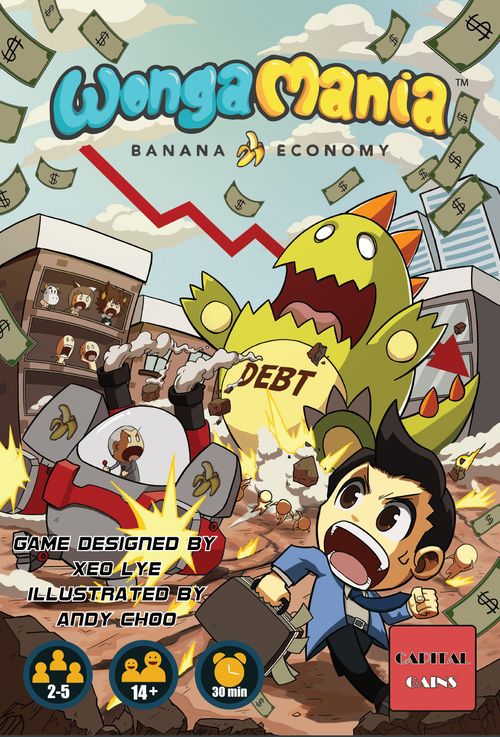
Wongamania: Banana Economy
Wongamania: Banana Economy Rulebook
Table of Contents
Table of Contents
Components
1 Two-sided Economic Cycle Board, 1 Market Board, 56 Asset Cards, 13 Professional Cards, 16 Incident Cards, 21 Global Cards, 15 Trust Fund Cards, 5 Insurance Cards, 5 Bank/Symbol Guide Cards, 1 Score Card, 1 Productivity Die, 1 Economic Token.
Setting Up the Game
Economic Cycle Board
The game board has two parts:
- Income track (outer rim) - Indicates your profit or loss from your Assets. This is where the Economic Token will be placed.
- Price zone (inner rim) - Represents the prices for buying and selling of Stock and Property.
There are two difficulty levels for the board. The side with a single digit on the Income track is the Basic Board, while the side with multiple digits on the Income track is the Advance Board.
Productivity Die
The Productivity Die will be rolled by the Chairperson at the start of each round. The number indicated on the Die is the number of steps the Economic Token is moved in a clockwise direction.
Economic Token
The token indicates the grid within the Economic Cycle for each round, and moves in a clockwise direction.
Market
The deck where you draw fresh cards from. Players are to reshuffle the discarded cards back into Market when Market runs out of cards.
Bank / Symbol Guide
The Bank and Symbol Guide cards are on the flip side of each other.
- Bank - Shows a list of actions which you can take during your turn. You are also to place your freshly drawn card, face down, under the Bank card. This will act as your currency called Wonga.
- Symbol Guide - Gives a summary of various symbols in the game and what they mean.
Trust Fund
Each Trust Fund requires 8 Wonga to purchase and cannot be converted back into Wonga once purchased. Trust Fund will not be affected by Bankruptcy.
Insurance
Insurance can be purchased for 1 Wonga each and is used to cancel the effect on cards with the insurable symbol. Insurance will only last for two rounds, and has to be discarded at the end of two rounds or once it has been used.
Asset
There are 3 different Asset cards and 6 different Asset-Tactical cards. Each Asset card shows:
- The name of the card.
- The Asset Type: Property, Stock or Bond.
- Buying and Selling Price of the Asset.
- Income earned from the Asset each turn.
- Special effect unique to the Asset-Tactical card (Asset-Tactical cards only).
When a card indicates an Asset class, it affects all the cards with that symbol. For example, the 'Bond' on the Banker card affects all the cards with a Bond symbol: Bond, Junk Bond, and Convertible Bond cards.
Asset symbols: Property (house), Stock (chart), Bond (lock).
Opportunity
Opportunity cards are playable cards to be drawn into the hand. There are 4 different categories of cards: Asset, Global, Incident and Professional cards. Each Opportunity card shows:
- The playing cost of the card.
- A symbol that gives the card additional effect.
- Description of the card effect.
Opps!
Cards with the Opps! symbol can be played at any time, even when it is not your turn. When activating the card, shout "OPPS!" and play the card. Should there be 2 Opps! cards played at the same time, the card which is played later will take effect and override the effect of the first card.
Objective of the Game
There are two ways to play this game. The objective varies for the different modes:
- Simple mode - Suitable for first time players and children.
- Victory Points mode.
Simple Mode
First player to accumulate 3 Trust Funds wins the game.
Victory Points Mode
The player with the highest points will win the game.
When a player accumulates 3 Trust Funds, the game ends after the current round is completed. The round ends after the last player finishes his or her turn. Players may use cards such as the Politician card to prolong the round. At the end of the game, players will tabulate their scores based on the Score Card. If there is a tie, roll the Productivity Die. Whoever has the most points wins.
(Important Note: Unused Opportunity cards are not worth any victory points.)
Score Card:
| Scoring item | Points |
|---|---|
| Each Trust Fund | 10 |
| Each Asset | Sell price |
| Each Baby | 1 |
| Each Wonga in Bank | 1 |
| Retrenchment | -8 |
The Game Turn
Players are to perform 2 phases during their turns.
Before the start of each round, the Chairperson rolls the Productivity Die and moves the Economic Token. The Chairperson is the first player. The job of the Chairperson is to roll the Productivity Die and move the Economic Token at the start of each round before his or her turn.
Phase 1: Payday
Players get to collect their salary and any returns that they have made from their Assets.
-
Earn 2 Wonga as salary from Market.
-
Earn or lose Wonga based on the Income track from any Assets in play. The grid on the Income track which the Economic Token is on will indicate the amount of Wonga earned or lost for each Asset the player owns.
(Important Note: The numbers on the Income track will only affect Stock and Property and will not affect Bond unless stated otherwise. Bond will usually give a fixed Income of 1 Wonga regardless of the state of the economy.)
For example, if you own a Stock, a Property and a Bond:
- When Income is +2, you gain 7 Wonga in total: +2 Wonga from Stock, +2 Wonga from Property, +1 Wonga from Bond, +2 Wonga as salary.
- When Income is -3, you lose 3 Wonga in total: -3 Wonga from Stock, -3 Wonga from Property, +1 Wonga from Bond, +2 Wonga as salary.
Important Note:
- The Income is the same for both Stock and Property for the Basic Board.
- The Income is different for Stock and Property for the Advance Board, and you need to refer to the returns for Stock and the returns for Property.
Phase 2: Take Action
Players get to perform up to 3 actions, out of the 6 options as listed below.
Important Note: Players can choose not to take any action. Players can take the same action up to 3 times (e.g. Selling 3 Assets).
-
Draw - Draw a card from the Bank and put it into your hand. Players can replenish their Opportunity cards. Draw a Wonga randomly from your Bank and place it in your hand.
-
Trade - Discard an Opportunity card and draw a new card from Market. Players can swap the Opportunity card that they do not wish to keep. Discard the unwanted Opportunity card and draw a new Opportunity card from Market.
-
Play - Play an Opportunity card. Players can play one of the Asset, Professional, Incident or Global cards.
-
Sell - Sell an Asset. Players can sell a Bond, Stock or Property as an action. Each individual Asset sold is considered as a separate action.
-
Protection - Buy an Insurance. Players can buy Insurance to protect themselves against insurable events. There can only be 1 Insurance in play at any time. Insurance will last for 2 rounds and is to be discarded after two rounds or once it has been used.
(Important Note: You must use your Insurance to block against an insurable event. You cannot choose not to activate the Insurance.)
-
Trust Fund - Buy a Trust Fund. Players can purchase a Trust Fund for 8 Wonga. Trust Fund cannot be converted back into Wonga once purchased. It will not be affected by Bankruptcy.
Bankruptcy
If a player does not have enough Wonga in the Bank to pay back any outstanding payment, the player is forced to sell his or her Assets immediately at the Selling Price based on the grid where the Economic Token is placed on. A player is declared bankrupt when he or she still does not have enough Wonga to pay back any outstanding debt, despite selling off all Assets.
During Bankruptcy, the player will need to:
- Discard all Opportunity cards in hand.
- Remove all cards in play (e.g. Baby, Retrenchment, Pay Raise, Insurance etc.), with the exception of Trust Fund.
- Start the next round as per normal by collecting 2 Wonga as salary and draw 2 Opportunity cards from Market.
Setting Up the Game: Start
Place the Economic Cycle Board (for beginners, you may choose to start with the Basic Board) in the middle of the table and separate the Trust Fund, Insurance and Bank cards from the draw deck. The draw deck is also known as Market. The first player is called the Chairperson. The job of the Chairperson is to roll the Productivity Die and move the Economic Token at the start of each round before his or her turn. The last player gets to pick the starting grid of the Economic Token.
Each player places a Bank card in front of them. Collect 3 cards from Market and place them face down under the Bank card. This is to be your in-game currency called Wonga. All fresh money from Market is to be placed under the Bank card in any order of your choice.
Collect another 4 cards from Market and place them in your hands. These action cards are called Opportunity cards, and can be activated during the game. Players have the choice to discard up to 4 Opportunity cards they do not want, and draw replacement cards from Market before the start of the game. This can only be done once, before the game begins.
The last player picks the starting grid of the Economic Token, and the Chairperson starts the game by rolling the Productivity Die and moving the Economic Token based on the number indicated on the Die.
You are now ready to begin!
Game Variants
Once you understand the rules of the game, you can now use this section to customize the level of difficulty.
The Apprentice: Family-Fun
(Beginner Level. Suitable for family and folks new to board games. Recommended 2-3 players.)
This is a family-friendly set-up that removes the more advanced economic and strategic concepts. This variant will allow young players and novices to understand the basic economic cycle and how it affects various Asset classes. The Incident cards will also help them understand some of the potential personal finance problems which they may encounter in life.
- Remove all 21 Global cards.
- Remove the 2 Economist cards from the Professional cards.
- Remove all 12 Tactical-Asset cards.
- Remove 4 of each: Stock, Property and Bond.
The Strategist
(Beginner Level. Recommended 2-4 players.)
This variant removes most of the "Take-That" (a.k.a. Sabotage) cards within the game, and minimizes the anger and broken friendships due to stressful personal events, such as babies, divorces and illnesses.
- Remove all 16 Incident cards.
- Remove 4 of each: Stock, Property and Bond.
- Insurance cannot be purchased.
The Hardcore Wongamaniac
(Advanced Level. Recommended 2-5 players.)
This variant will stretch the game to a full 1-hour melee. Players will be able to enjoy all the different economic conditions and card combinations that Wongamania can offer. Players who are lagging behind during the early game will have a better chance of catching up.
- Use the Advance Board.
- Requires 10 Wonga to buy a Trust Fund.
Quick Start Rules
- Place Basic Board in the middle of the table.
- The last player starts the game by picking the starting grid of the Economic Token.
- Each player collects a Bank card, draws 3 cards from the draw deck (Market), and places them face down under the Bank card. This is your money (Wonga).
- Each player draws 4 cards from Market and places them in hand (Opportunity).
- The first player (Chairperson) rolls the Productivity Die and moves the Economic Token based on the number indicated on the Die before he or she begins the turn. The Chairperson rolls the Die every round before the start of his or her turn.
- During each player's turn, he or she:
- Collects 2 Wonga as salary.
- Earns or loses Wonga based on the Assets he or she owns.
- Performs up to 3 actions (refer to the Bank card for the actions).
- Game ends when one player accumulates 3 Trust Funds.