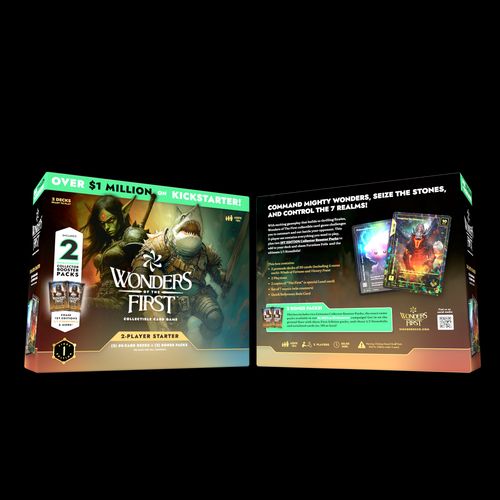
Wonders of The First CCG
Wonders of The First CCG Rulebook
Table of Contents
Table of Contents
Card Breakdown
Wonders cards have the following traits:
- Name
- Card Type
- Class
- Lineage
- Cost
- Orbital
- Power (Items, Spells, and Lands do not have power.)
- Ability (Not every Wonder has an ability.)
- Faction (Not all cards have a Faction.)
In addition, cards feature rarity, set name, card number, ability names, flavor text, etc. But these aren't relevant for gameplay.
The Orbitals are: Petraia, Thalwind, Solfera, Umbrathene, Heliosynth, and Boundless.
Card Types
Wonders — These are characters that add their power in battle and can conquer their realm, taking control of the stone.
Lands — Lands can be played to any realms. If you have at least one land, all cards of that orbital cost 1 less energy. Additional lands of that orbital don't reduce costs, but all lands can be harvested for resources. (See harvest and link abilities below for details.)
Items —
- Some items are equipment, meaning they attach (or equip) to a Wonder you control when they are in the same realm. Equipment cards enhance the stats and/or abilities of Wonders. (See key term 'equip' below for details.)
- Other items are used on their own for activated or ongoing abilities.
Spells — Spells have an effect and are then put in the Abyss.
For each card type, there are three tiers: Legendary, Primary, Secondary. Tiers are used for deck building, which is explained in more detail below.
Areas of the Game
There are five areas where cards can exist:
- The World (in one of 7 realms)
- Deck
- Player Hand
- The Abyss (discard pile)
- Banishment (removed from game)
Whenever a card moves from one area to another, it loses all effects on it and it's treated as a new instance of that card.
Summary
- Each player brings a deck of 50 cards.
- A deck can have 1 of each legendary card, 2 of each primary card, and 3 of each secondary card.
- Flip a coin to randomly see who starts the first turn of the round. The winner can choose to take their turn first or second.
- Each player shuffles their deck and draws 7 cards.
- Each player can mulligan by choosing up to 3 cards in their hand and burying them (putting them on the bottom of their deck in any order), then they draw the same number.
- There are 7 realms on the board.
- On round 1, players can play cards from their hands into realm 1. On round 2 players can play cards into realm 2 or 1. On round 3, players can play cards from their hands into realm 1, 2, or 3, and so forth until round 7. Realms that are available to be played in are called active realms.
- On round 1, players get 1 energy. On round 2, they get 2 energy, and so forth until round 7.
- Players get an additional energy for each stone they control.
- Unspent energy is lost at end of round.
- Each player gets 3 actions each round. Players alternate actions until they are done.
- At the start of each round, each player draws a card.
- One action lets you:
- Draw a card
- Play a card from your hand
- Attack a realm using Wonders in that realm
- Activate a tap ability of a Wonder (or similar ability)
- Take any combination of these actions in any order, alternating between players.
Set Up
Deckbuilding
Each player brings a deck with 50 cards. Tiers determine how many copies of a card are allowed in a 50-card deck.
There are 3 tiers:
- Legendary — One per deck.
- Primary — Two per deck.
- Secondary — Three per deck.
Determine First Player
If you've just played a game against the same player, the loser of the last game chooses who is the first player. Otherwise players flip a coin to determine the first player. The winner chooses who will play first.
The player who plays second chooses whether realm 1 will start on their left or right.
Draw Starting Hands
To start the game, each player shuffles their deck and draws 7 cards into their hands.
Mulligan
Each player can choose up to 3 cards in their hand. They put these on the bottom of their decks in any order and then draw that many from their decks. The first player mulligans first.
Steps of the Round
The game takes place over 7 rounds. During each round the players play cards from their hands into the current round's realm and/or any realms of previous rounds. Each realm starts with a stone to mark who controls it.
- Each player gains energy and actions.
- Each player draws a card.
- Take turns, using actions (alternating, in any order). a. Draw b. Play a card from hand c. Attack d. Activate abilities e. Pass (no action required)
- End Round.
Add Energy and Actions
At the start of each round, each player adds one energy for each round that has happened in the game. For example, on round 5 each player adds 5 energy. Each player also adds one energy for each stone they control. After gaining energy, each player also gains 3 actions.
Draw Cards
Each player draws the top card of their deck.
Take Turns (Use Actions)
A player uses one action or action equivalent (such as a free action) on their turn. Then they pass the turn. Players alternate taking turns until all players have no actions remaining or all players have passed consecutively. There are no restrictions on how many actions can be used or what they can be used for.
On your turn, spend an action to:
- Draw a card.
- Play a card from your hand.
- Attack with all your Wonders in a single active realm.
- Activate a tap action of a card on the board.
Alternatively, you can use your turn for a free action, if available from a card. Tap free, sacrifice free, free attack, attuned, or harvest abilities are played like an action, but don't consume an action. This means you can draw multiple cards, play multiple cards, activate multiple abilities, and attack multiple times each round using actions if you wish.
Instead of using an action on their turn, a player can also pass. When each player has passed consecutively in the round, the round ends. Any remaining actions and energy are lost.
Note: Many cards allow players to gain extra energy and actions.
Timing of Turns and Actions
When you use an action, resolve the action completely before passing the turn to the next player.
Note that it's possible for one player to have more actions than another player, meaning that the player with extra actions can take extra turns at the end of the round. When this happens, the player with no actions remaining will still receive their turn in case they want to do something as a free action, such as harvest or play an attuned card from their hand. If not, they automatically pass.
The Four Uses of Actions
Draw a Card
You can use an action to draw a card from your deck to your hand.
Play a Card
The card types are Wonder, land, item, and spell.
To play a card, use an action and spend energy to pay the cost of a card from your hand. Then place it into an active realm (the current realm or any previous round's realm), or into the Abyss if it's a spell. For example, on round 5 a card can be played to realm 1, 2, 3, 4, or 5.
When you play it, resolve all triggered effects and then pass the turn. Cards can't cost less than 0 energy.
Like any other cards, lands cost 1 action to play from your hand. Lands have the Orbital Link ability. Lands with Orbital Link can slightly reduce the energy cost of cards of the same orbital. They also allow you to play core cards from your hand. See the link keyword ability below for details.
Placement and location of lands doesn't normally have any effect on energy cost reduction or other abilities. Play them anywhere you like in active realms. There's no limit to the number of cards allowed in a realm.
Attack
A player can attack in any active realm if they have any Wonders there. The side with higher total power in that realm conquers that realm and gains control of that stone.
A player is allowed to use actions to attack in the same realm repeatedly, and is allowed to attack in realms where they may lose (although this is unusual). Attacking and losing while in possession of the stone will result in the defender seizing the stone.
The battle begins as soon as a player declares an attack in a realm. Trigger any 'on battle' effects at that point. Battle ends after a stone is seized or fails to be seized. This means 'end of battle' and 'end of turn' effects trigger after resolving stone movement.
Activate an Ability
Some cards have abilities with powerful effects. Usually these abilities can only be activated once per game for each card.
Tap abilities let you spend an action to get an effect. To show the tap ability has been used, tap it (turn that card sideways). It won't untap for the rest of the game. Tapped cards are still able to battle at full power. For example, a card with 3 power may tap to put +5 counters on itself. It can now battle with 8 power even though it's tapped.
Tap free is a type of free action that requires you to tap the card. See Free Actions below for more details.
Timing Keywords
Most Wonders have a timing keyword to show when the ability's effect happens. For some, the player chooses when to use them. For others, they happen automatically when certain conditions are met.
Harvest: A player can choose to activate this any time they could spend an action, just like a tap action ability. Harvesting counts as a tap action, so tap the card when you harvest it.
On Arrival: This effect happens when the card enters the world from a player's hand, deck, banishment, or the Abyss. It doesn't happen when a card moves from one realm to another.
On Attack: This ability triggers whenever its owner attacks in its realm.
On Battle: This triggers whenever a battle happens in that card's realm.
On Death: This triggers whenever the card is put from the world into the Abyss.
On Defense: This triggers whenever an opponent attacks in its realm.
On Play: This effect happens whenever the card is played from the hand to the world. Resolve this triggered ability before the card enters the world.
On Round 4: This triggers at the start of round 4. Resolve this effect before players draw, gain energy or actions, or do anything else.
Tap Action: A player can choose to activate this on their turn by spending an action. Tap the card permanently to show it's been used.
Tap Free: A player can choose to activate this any time they could spend an action, just like a tap action ability, but this does not consume an action. Tap the card permanently to show it's been used. A player can still do this when they have no actions in the round.
Sacrifice Action: A player can spend an action and destroy this card on their turn to activate this ability.
Sacrifice Free: A player can destroy this on their turn to activate this ability. It doesn't cost an action.
Resolving Multiple Effects and Triggered Effects
If multiple effects happen at the same time, resolve those effects one at a time in any order chosen by the active player (the player whose turn it is).
Effects that are automatically produced according to some condition are triggered effects. For example, cards that say "when" or "whenever", "on battle", or "at the beginning of round 3" produce triggered effects.
When triggered effects occur, resolve them first in the order of the active player's choice before resolving the action that created them.
Triggered Effects Example 1: An item says "Whenever an opponent plays a spell, you may discard a card from your hand. If you do, nullify the spell." When an opponent plays a spell, pause the resolution of that spell until you choose to discard. After you discard, then resolve the spell. (If the spell is nullified, it resolves but has no effect.)
Triggered Effects Example 2: The active player's opponent has a Wonder with the ability "When this dies, create a 1 power Skeleton token Wonder in this realm." The opponent also has a Wonder with "When this dies, put +2 counters on target Wonder in this realm." Both Wonders die at the same time, creating two triggered effects. The active player chooses to resolve the +2 counters effect first, making it useless since the opponent has nothing to target. Then the active player chooses to resolve the Skeleton token effect.
Ending a Round and Starting the Next
Free Actions
Some cards let you play or activate them as a free action. This means they still obey all the timing rules of using actions, but they don't consume an action when used.
Pass
A player can choose to pass the turn instead of using an action. When all players have passed consecutively, the round ends. This can result in players losing their remaining actions.
A player with no actions remaining has the option to pass or use abilities such as Harvest, which do not spend an action to use.
A player automatically passes if they have no actions remaining and no abilities to activate.
Round End
When all players have used all their actions and/or all players have passed consecutively, the round ends.
First, unspent energy is lost.
Then, if the last active player has more than 7 cards in hand, they choose and discard down to 7 cards in hand. Then the next player discards down to 7, if needed.
Continue With Rounds
The next round now begins.
The first player continues playing first until at least one battle has been won. Then the winner of the last battle is always the first player.
Players continue until the end of round 7.
Winning the Game
Victory Condition
At the end of round 7, the player with the most stones wins.
In case of a draw, sum the total power of each player's Wonders in the world. The highest total power wins the game. Otherwise, the draw stands.
If at any time a deck has no cards, that player loses.
If all players would win or lose at the same time, the game is a draw.
Game Terms
Actions — Each player gets 3 actions per round. Use an action to play a card, attack, draw, or activate an ability.
Allied Wonders — All Wonders you control.
Abyss — The place where destroyed or discarded cards go. Although it's called "The Abyss," each player maintains a separate Abyss.
Active Realm — Any realm that has been opened. Cards can only exist in active realms. Only active realms can be targeted. Cards can't be moved, Portaled, or otherwise directed to arrive in an inactive realm.
Banish — Banishment is a game area outside decks, hands, the world, and the Abyss.
- If a Wonder or other card is banished, it doesn't trigger "when this dies" abilities.
Battle — Any time a player attacks in a realm, a battle occurs. There's an attacking player and defending player. Sum the power of each player's Wonders in that realm to determine the winner. The winner conquers that realm and seizes its stone.
Bury — Put a card or group of cards on the bottom of its owner's deck in any order of owner's choice.
Counters — Some abilities put + and - power counters on cards. These counters give a permanent increase or decrease to that Wonder's power.
- When both + and - counters are on a card, remove an equal number of counters.
- When a Wonder has negative power, it dies. Wonders can survive at 0 power.
- Whenever a card is put into a location other than a realm (such as a hand, Abyss, deck, or banishment), all counters are removed from it.
- Other types of counters have various effects, such as null counters and shield counters.
Class — Wonders have classes that describe their categories and roles such as Monster, Priest, or Dwarf.
Current Realm — The realm that was opened on the current round.
Destroy — Put a card from the World into the Abyss.
Dies — When a card dies or is destroyed, it leaves the world and is put into the Abyss. "Whenever dies" triggers happen as soon as it leaves the world.
Discard — Put a card from a player's hand into the Abyss.
Enemy — Any Wonder controlled by an opponent.
Energy — Resource used to summon Wonders and play cards from a player's hand.
Equip — Some items have the equipment class. All equipment equips to a Wonder if able.
- When an unequipped equipment is in the same realm with an allied Wonder, it automatically equips as a triggered effect. Its controller chooses which Wonder it equips to if necessary.
- If the equipped Wonder is destroyed and there are no more allied Wonders in that realm, the equipment stays in the realm unequipped.
- If an allied Wonder enters the same realm as an equipped Wonder you control, you may choose to move the equipment to the new Wonder as a triggered effect.
- If an equipped Wonder moves to another realm, equipped cards move with it.
- Players can't normally move equipment from one Wonder to another unless an effect explicitly allows it.
- There's no limit to the number of equipment a Wonder can have equipped.
Enter —
- If a card says "Whenever a Dragon enters, draw a card." it refers to any realm on the board. It won't trigger if a card moves from realm to realm.
- If a card says "Whenever a Dragon enters this realm, draw a card." it refers to that realm only. It will trigger when a card moves from somewhere else, as with flying.
Nullify — When a card is nullified, its abilities are treated as if its ability text were blank. This effect can be permanent, usually marked with a null counter, or it can last a specific amount of time.
- Nullify does not affect classes, counters, or other status effects, just the nullified card's ability text box.
- If a card is nullified after it's played but before it resolves, it still resolves but is treated as if its rules text was blank. A nullified spell goes to the Abyss with no other effect.
Power — Measurement of a card's strength in battle.
Realm — One of the seven battlefields, each with a stone to seize.
Sacrifice — Choose and destroy your own card.
- Sacrifice doesn't target and can't be prevented with a shield.
Stone — A stone marks control of each realm. At the end of round 7 the player with the most stones wins the game. Each stone gives its owner an additional energy at the start of each round.
Seize Stone — Gain control of a realm and the stone associated with it.
Tap/Untap — Turn a card sideways to indicate its ability has been used. Unlike other games, cards don't untap on their own and tapped cards can still battle normally.
Tokens — Tokens are treated as virtual cards.
- Tokens are treated as energy cost 0.
- If a token would be put anywhere besides the world (such as a player's hand, deck, Abyss, or banishment), it stops existing as soon as it leaves the world.
- Tokens entering the Abyss will trigger "Whenever a Wonder dies…" abilities before they stop existing.
- Tokens have the same orbital as the card that created them.
Wonder — A card that has a power stat for battle.
World — The game board, containing all the realms.
Keyword Abilities
Ascend
- A card with ascend triggers an effect at the start of round 7. The effect lasts the entire round and counts as a temporary effect.
- If a card with Ascend is played after the beginning of round 7, it's too late and its Ascend ability won't trigger.
Attuned
- Attuned is a form of free action. When you would spend an action to play an attuned card, instead spend no action.
- Like all free actions, the timing works the same as a regular action.
Deathstrike
- Deathstrike destroys a targeted enemy Wonder after that enemy loses or ties a battle.
- Multiple instances of Deathstrike trigger individually. The active player resolves them one at a time in an order of their choice.
Deny
- When you deny a card, target either your deck or an opponent's deck and put the specified number of cards from the top of that deck into the Abyss.
- The cards are put into the Abyss as a group.
- This means triggered abilities don't necessarily happen in the order they are put in the Abyss. They all trigger at once and are resolved in any order chosen by the active player.
Portal
- Portal means banish this card and then return it to the world immediately.
- Portal effects usually let you return the card to the World in other realms.
- Since a portaled Wonder leaves the world, its equipment unequips and stays behind.
Harvest
- Harvest is a tap free action.
- If you harvest to gain an action, you must pass the turn before you can use the action.
- You can harvest multiple cards on the same turn. If you do, tap them all at once. You can gain multiple actions (and other effects) this way but you can't use the actions until your next turn.
Faith
- Some cards generate faith, which is a separate resource tracked like energy and actions.
- Unlike energy and actions, faith carries over between rounds.
- If a player has any faith and has a card that allows them to spend faith, once per round they may spend faith as a free action to activate one of those abilities.
- If the faith ability says spend "X faith" or "any amount of faith," that amount can't be 0.
Flying
- Flying means when this Wonder attacks, you may move it to an adjacent active realm at the end of the turn. This may let a flier attack in multiple realms in the same round.
Guardian
- Guardian means if you control a stone in this realm, opponents can't take it from you by winning battles in this realm.
Hoard
- Hoard means if you control a certain number of stones, the ability becomes active. Hoard abilities turn on and off immediately when the stone changes control.
Kingdom
- Kingdom abilities become active when their controller controls a certain number of lands. For example, "Kingdom 3: Whenever you play a Solfera Wonder, it gets +1 this round." means nothing happens until you control 3 or more lands in any realms.
Link
- Lands have orbital link abilities such as Petraia link. An orbital link has two important effects.
- First, all cards of that orbital cost 1 less energy to play from that player's hand. This orbital link cost reduction doesn't stack with multiple links of the same orbital.
- For example, if a player has three lands with Thalwind link and one card with Umbrathene link, all the Thalwind cards in that player's hand will cost 1 less energy, and all the Umbrathene cards in their hand will also cost 1 less.
- Second, orbital link allows the player to play core cards from their hand. For example, if a Petraia card says "Core" the player can't play it from their hand until they have a Petraia link card on the board.
- Other abilities such as seek may allow players to play core cards without meeting the link requirement.
- The realm location of a land doesn't matter for orbital link abilities in general.
Seek
- Seek has a number and a criteria, written as "Seek 3 a Wonder with cost 2 or less." This means reveal the top 3 cards of your deck. You may choose a Wonder with cost 2 or less and play it for no cost in this realm. Bury the other revealed cards. (Put them on the bottom of your deck in any order.)
- You can play core cards using seek, regardless of whether you have their link.
Shield
- A shield counter is a one-time protection against death or enemy targeting.
- If a card with a shield counter would die or be targeted by an enemy card or effect, you may remove the shield counter instead.
- The option to remove a shield counter is a triggered effect that happens when that card would be targeted or destroyed.
Stun
- Stun has two effects. First, it taps the stunned Wonder.
- Note that tapping is permanent, so the controller may not be able to use that card's tap ability, ever, although it can still attack and defend normally.
- Second, stun reduces the Wonder's base power to 0 until the end of the round.
- Effects like + and - counters and buffs from equipment are not part of the base power.
- Note that Wonders with less than 0 power die.
Symbiosis
- Wonders with symbiosis copy the abilities of other Wonders after they are played but before they enter.
- This means a card with Symbiosis will copy a Wonder's "on arrival" ability, but it won't copy an "on play" ability.
- When a Wonder with Symbiosis copies an ability it loses all its previous abilities.
- The copying effect is locked on arrival. If the Wonder being copied leaves or changes, it doesn't change the copied ability of the symbiosis Wonder.
- When a symbiosis card leaves the world, it loses any effects it was copying. This means it can't copy anything while it's in a hand, the Abyss, a deck, or banishment.
- Symbiosis can't copy another symbiosis ability.
- For example, imagine Glemmer Bandit is using symbiosis to copy flying from another Wonder. Then a Vobb Stalker enters the world, copying the Glemmer Bandit. The Vobb Stalker would only copy the flying. It would not gain an additional instance of symbiosis from the Glemmer Bandit.
- If a symbiosis ability is temporarily nullified, it won't revert to the previous ability, since symbiosis abilities must be set on play. Instead it will be copying nothing.