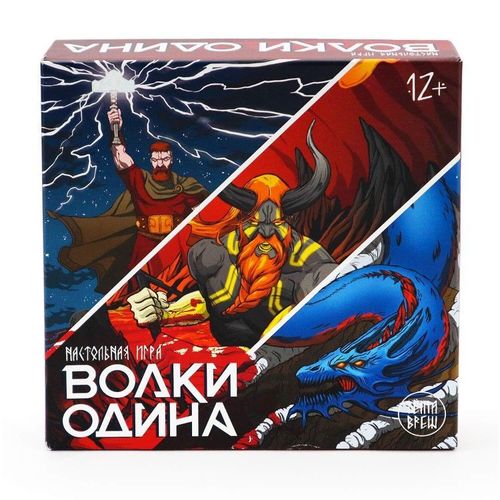
Волки Одина (Wolves of Odin)
Волки Одина (Wolves of Odin) Rulebook
Table of Contents
Table of Contents
Components
- People deck — 110 cards, consisting of unit cards and maneuver cards.
- Deity deck — 17 cards, consisting of red and blue deities and one black (neutral) deity.
- Victory deck — 9 cards.
- Ragnarök cards — 2 cards.
- Rulebook.
- 5 reference cards (player aids).
Component Descriptions
Unit and maneuver cards from the People deck
- Strength — may be permanent or variable. A variable Strength is determined by what is written in the unit's ability.
- Rune (Teiwaz or Eiwaz) — may be important for the use of some cards' abilities.
- Unit ability — read the abilities of your units carefully. They may change their Strength, give an immediate or delayed effect, or even restrict the possibilities of your units.
- Maneuvers — cards without Strength and without a rune. They are played according to the ability written on them. A maneuver is not a unit.
Deity cards
- Each Deity is marked with a Valknut symbol in red, blue or black. Red and blue Deities are hostile to each other. Black is neutral.
- The abilities of Deities give advantages to the player who summoned that Deity.
- Igdrasil — while Yggdrasil is summoned by you, you may at one moment have summoned both red and blue Deities.
- Valkyrie — after determining the winner of a round, take 1 unit from any line into your hand.
- Yormungand — if at the start of a player's turn his line is stronger than all others, that player immediately wins (everyone immediately passes).
Victory cards
Victory cards give their owners Glory points, which determine the winner at the end of the game. Some cards have fixed Glory points, but most give a different number of Glory points depending on the properties shown on them.
Ragnarök cards
The two Ragnarök cards are placed at the bottom of the Deity deck and the Victory deck. Their appearance signals the imminent end of the game.
Game Setup
- Find the two Ragnarök cards and set them aside. Divide the remaining cards into three decks: People, Deity and Victory.
- Shuffle all three decks thoroughly.
- Place the People deck in the middle of the table, in a place convenient for everyone.
- Take, without looking, two random Deity cards, add to them the Ragnarök card with the matching back, shuffle and place on the table. Place the remaining Deity cards on top. Thus, the Ragnarök card must end up as one of the three last cards of the Deity deck.
- Turn over the top three Deity cards and place them in a row next to the Deity deck. This row is the Hall (Чертог).
- Place the second Ragnarök card at the bottom of the Victory deck, so that it is the last card in that deck.
- Each player takes 9 cards from the People deck.
Game Flow
The game is played over several rounds. In each round, 1 or 2 Victory cards are played (depending on the number of players), giving different numbers of Glory points.
During each round, players in turn place unit cards into their line (the row where players place unit cards) to increase its Strength, or into an opponent's line to weaken it. They also play maneuvers, and make sacrifices to summon powerful Deities for significant advantages later in the game.
The round ends when all players pass. After that, the player or players whose line has the highest Strength at that moment take the Victory cards.
The next round then begins, in which new Victory cards are played.
The game ends when, at the end of any round, at least one player has 5 or more Glory points, or the Ragnarök card has been revealed.
The player with the most Glory points wins the game.
Recommended organisation of each player's play area: Victories | Summoned Deities | Line | Sacrifices
Round
The round is started by the player who won the previous round. If this is the first round of the game, the host goes first.
The round proceeds in the following order:
- Reveal the Victory cards for which the players will compete:
- With 3 players — one card.
- With 4 or 5 players — two cards.
- Players take turns making moves until each has said "pass".
- Count the Strength of all lines and determine the winner or winners.
- Discard all unit cards that were placed in lines during the round (summoned Deities remain in play).
- Check whether the game has ended (if any player has 5 or more Glory points, or the Ragnarök card is revealed).
If the game has not ended, a new round begins.
Player's Turn
On your turn (while you have not chosen "pass") you must perform one of the 5 basic actions:
- Place a unit card in any line (your own or any other player's).
- Play a maneuver card.
- Take one unit from your line to the sacrifices.
- Pass (say "pass").
- Draw and discard one card (only after you have said "pass").
In addition, at any time during your turn (while you have not chosen "pass"), you may perform any number of the following additional actions:
- Discard sacrifices in order to summon a Deity.
- Use the active ability of your summoned Deity.
If a player has already chosen "pass" as one of their actions, they may only draw and discard one card. Then the turn passes to the next player clockwise.
Basic Actions
Place a Unit in Any Line
Choose one unit card in your hand and place it in any line (both your own and any of your opponents'), as a line of units. If the line already contains unit cards, you may place the card either to the left or to the right of them. But you may not place it between them!
Note that some cards have an ability that takes effect when they are placed in a line. Most cards will be advantageous to place in your own line; some units are clearly better placed in an opponent's line, but you have the right to place any card in any line.
Also note that the position of units in a line matters. Some units, such as the Archer (Лучник) or the Hirdman (Хирдман), apply their ability only if a certain card lies next to them. (The line may be your own line or an opponent's line.)
Each unit card has a Strength: for some units it is fixed, and for others it is determined by the conditions described in the card's text. For example, the Konung (Конунг) has a Strength equal to 10 minus the number of other units in your line, and there cannot be two Konungs in your line. The Nalyotchik (Налётчик), when placed in a line, lets you take any unit from that line into your hand (except the Nalyotchik itself).
The sum of the Strength of all units in a line is the line strength (сила строя). Line strength determines the winner at the end of the round. It is good practice to announce the strength of your line at the end of each of your turns.
If a unit card leaves a line for any reason, the units close the line: shift the units so that the gap is filled.
Attention! You cannot move units from other parts of a line; you can only shift them to close a gap.
Play a Maneuver Card
Choose a maneuver card in your hand and apply it as written on the card. The played maneuver card goes to the discard pile.
Note that the Wall of Shields (Стена щитов) is usually played not on your own turn but on an opponent's turn, and playing it is not an action.
Bring One Unit from Your Line to Sacrifice
Choose any one unit in your line and bring it to sacrifice: remove it from the line and place it in the sacrifice zone. (If necessary, the line closes.)
Units brought to sacrifice cannot be destroyed, discarded or taken by other players' actions.
At any later moment of your turn, you may discard sacrificed units to summon a Deity or to use the abilities of Deities you have already summoned.
Pass
When you understand that playing further cards cannot bring you any more benefit, you may say "pass" on your turn. You are obliged to pass if you cannot perform any other action.
When you say "pass", you immediately draw 4 cards from the People deck into your hand. (This number may be changed by the abilities of Deities or by Victory cards you already have.)
If the People deck has run out and a new card must be drawn, shuffle all the cards in the discard pile and form a new deck from them.
After passing, you may no longer perform any actions (except drawing and discarding a card, see below), you may not use the active abilities of Deities you have summoned (with the exception of Baldr), and you may not discard sacrifices to summon new Deities.
Attention! Other players may still play cards into your line, destroy units in it, and otherwise affect it.
Draw and Discard One Card (Only After "Pass")
When your turn comes, you may take only one card from the People deck into your hand, and then discard one card from your hand to the discard pile. You can no longer influence the outcome of this round, but you can prepare for the next one.
The Twelve-Card Rule
At no moment may a player have more than 12 cards in hand. If you already have 12 cards, you may no longer draw cards! This includes after passing: if you already have 12 cards, you cannot draw and discard.
Additional Actions
Discard Sacrifices to Summon a Deity
At any moment of your turn, you may send sacrificed units to the discard pile in order to summon to yourself one of the Deities available in the Hall (Чертог). This is not an action, and it cannot be done after you have passed.
- Summoning your first Deity always costs 2 sacrifices.
- If you then want to summon a second Deity of the same colour as one you have already summoned, you must pay 1 sacrifice more than for the previously summoned Deity of that colour. That is, the second Deity of that colour costs 3 sacrifices, and the third costs 4.
You cannot have both red and blue Deities summoned at the same time. If this happens, you must choose which of your Deity cards you keep, and the other is immediately discarded.
Exception: the black Deity Igdrasil (Иггдрасиль). If you have summoned Igdrasil, you may summon both blue and red Deities. The payment rule remains in force. Also, if you have Deities of one colour and you summon the first Deity of the other colour, you likewise start with 2 sacrifices.
A summoned Deity is placed next to a player's line, but it is not part of the line. Therefore no effects on a line can act on Deity cards. You can lose a summoned Deity, or make an opponent lose one, only as a result of the active abilities of other Deities.
Each time a Deity leaves the Hall for any reason and fewer than three Deities remain there, immediately reveal a new Deity from the Deity deck into the Hall. Note that the Ragnarök card may be revealed in this way; the current round then becomes the last round. The Ragnarök card remains in the Hall as a reminder and occupies the place of one Deity. You can still summon other Deities from the Hall, but if the Deity deck has run out of cards, new Deity cards are no longer placed into the Hall.
Use the Active Ability of Your Summoned Deity
From the moment a Deity is summoned, the player receives all the advantages written on its card. Some of them are active. Active abilities may only be used on the owner's own turn, and only while the owner has not passed. They are additional actions, and they may be performed in addition to the mandatory basic action on your turn. You may use a Deity's ability on the same turn in which you summoned it.
- Passive abilities of Deities, which do not require any action from the player, continue to work. This applies, for example, to the Deities Nagelfar (Нагльфар), Freyja (Фрея), Heimdall (Хеймдалль) and Yormungand (Ёрмунганд).
- Some abilities are played after passing by their nature, such as those of the Valkyrie (Валькирия) or Vidar (Видар). They apply at the moment of the game specified on the card.
- If an ability says "once per round", it may be used only once in each round. You may mark that it has been used, for example by turning the card sideways. Do not forget to turn it back at the end of the round; in the next round you can use the Deity's ability again.
End of Round
When all players have passed, the winner of the round is determined.
- Players count the Strength of their lines.
- The player whose line has the highest Strength takes a Victory card.
- If 4 or 5 players are playing and there are two Victory cards, the winner chooses which Victory card to take, and the player with the second-highest line Strength takes the remaining card.
- Tie: if line Strengths are equal, the player who said "pass" earlier wins.
After this, all cards in players' lines and all sacrificed units are sent to the discard pile. Cards in hand stay in hand. Each player keeps all the Deities they have summoned.
Example of Determining the Winner
Three lines are compared (A, B and V). Player A wins.
- Player A's line has Strength: Huscarl 2, Konung 7 (10 − 3), two Hirdmen 14 (7 + 7). Fenrir in player V's line gives everyone a further −5, but Odin ignores this ability. Total: 23.
- Player B's line has Strength: Priest 8, Assassin 0, Troll 0, and three Bonds 15 (each 5: for themselves, for the Assassin and for the Troll), and a further −5 from Fenrir in player V's line. Total: 18.
- Player V's line has Strength: Berserker 5, Bond 1 (only for himself), Hirdman 3 and Hedvig 6 (2 for himself, and 2 each for the Berserker and the Hirdman). Total: 12.
Translator's note: the example as printed gives these per-card figures, and the printed total for player V's line is 12 while the listed card values add up to 15 if they are summed literally; the printed total has been transcribed as it appears in the source.
Game End and Victory
The game ends in one of two cases:
- At the end of a round, if at least one player has collected 5 or more Glory points.
- At the end of a round, if the Ragnarök card has come out of the Deity deck or the Victory deck.
In either case, the player with the most Glory points wins. If Glory points are tied, the player who won the last round wins. If there is still more than one such player, all of them are declared winners.
Note that most Victory cards have a variable value. The specific Glory point value of each Victory card is counted at the moment the winner is determined at the end of the round. In other words, if at some moment during a round a player had 5 Glory points but had fewer by the end of the round, the game does not end.
Card Descriptions
The historical background notes printed under some card descriptions are omitted; only the rules text is transcribed.
People Deck
- Archer (Лучник). When you place an Archer from your hand next to another Archer, destroy any unit in any line.
- This ability triggers each time you place an Archer from your hand next to another Archer. It does not trigger if the Archer moves for other reasons.
- If you placed the Archer in another player's line and its ability triggered, the target is chosen by the owner of that line, not by the player who played the Archer.
- Bond (Бонд). The Strength of this unit equals the number of units with the Eiwaz rune in your line, including the Bond itself. Each Bond in your line therefore depends on the number of cards with the Eiwaz rune in your line. For example, if your line has 2 Bonds, an Archer and an Assassin, each of your Bonds has Strength 4 and the line Strength is 9.
- Hirdman (Хирдман). If another Hirdman stands next to this Hirdman, its Strength equals 7. That is, if two Hirdmen stand next to each other, both have Strength 7.
- Huscarl (Хускарл). When a Traitor, a Nalyotchik or an Assassin is placed in your line, you may discard the Huscarl and cancel that card's effect. The Huscarl's ability may be used at any needed moment, even after you have said "pass".
- Berserker (Берсерк). This unit counts as 2 sacrifices. That is, if you sacrificed this unit, you may then discard it as two sacrifices.
- Troll (Трелл). When you bring any other unit to sacrifice, you may additionally bring the Troll to sacrifice too. This unit allows you to gather the sacrifices needed to summon Deities more quickly.
Deity Deck
- Vidar (Видар, blue). Before the winner of the round is determined, you may play one more unit into any line, or take one unit with the Eiwaz rune from your line into your hand.
- If the round ended because of the Yormungand ability, the winner has already been determined and Vidar does not get to apply its ability.
- Odin (Один, blue). The effects of other Deities do not apply to your line. Once per round: discard a sacrifice and discard any summoned Deity of any player, or return one Deity (except Baldr) from the discard pile to the Hall.
- Specifically: units destroyed in your line are not moved into a line with Nagelfar. Your units cannot be destroyed by Vidar or Nidhogg, and your sacrifices do not go to Garm. The −5 from Fenrir does not work on you, and the Valkyrie cannot take units from your line. However, this does not extend to cards from the People deck, so Traitors, Archers and "Treasons" (Измены) can still be applied to your line.
- If you return a Deity from the discard pile to the Hall, there are 4 Deities in the Hall. Do not add new Deities when summoning until their number is less than three.
- Thor (Тор, blue). Your line's Strength +5. Discard Thor and discard up to 2 summoned red Deities or red Deities from the Hall.
- If you removed a Deity from the Hall, immediately reveal a new one so that there are again three.
- Freyja (Фрея, blue). You may take into your hand the Maneuver cards played by other players.
- Heimdall (Хеймдалль, blue). Once per round: reveal a card from the People deck. If it is a unit with the Teiwaz rune, place it in your line; other cards go to the discard pile.