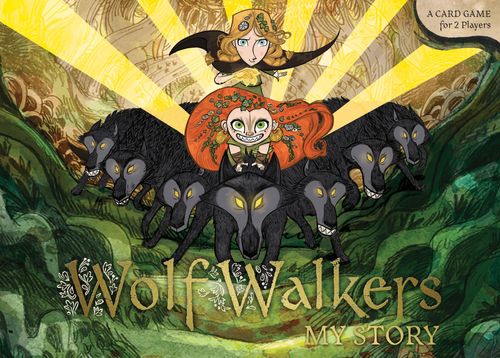
WolfWalkers: My Story
WolfWalkers: My Story Rulebook
Table of Contents
Table of Contents
Game Idea
Over the course of the game you form a 5x5 display of 25 cards. You place two kinds of cards in your display:
- Stories (Geschichten): They show pictures from the story and matching symbols.
- Goals (Ziele): They show particular goals that you can fulfil with your stories.
There are different types of goals. At the end of the game you each score points for the goals fulfilled in your display. Whoever has the most points wins!
Game Overview
- You take turns. On your turn you always take 1 card from the Market and place it in your display.
- Over the course of the game you build a 5x5 display of 25 cards.
- At the end of the game you each score the points for your fulfilled goals. Whoever has the most points wins!
Components
- 55 double-sided game cards (front: Story side; back: Goal side)
- 6 Switch cards (Wechselkarten) - Optional: shuffle them into the deck for more variety in the Market.
- 6 markers - You place them on the Opportunities to show that you have used them.
- 40 cards for the modules - The Quirks (Besonderheiten) and Opportunities (Gelegenheiten) bring variety to the game and give you more options.
- 6 player aids - They remind you of some rules.
Card symbols: Wolf form, Wolves, Merlyn, Forest, Town, Castle, Parents, Townsfolk, Army.
Setup
- Cards. Get out all 55 game cards and each take the 3 player aids of one colour (yellow or black). If you play with the Switch cards, you also need those. Put all other cards back in the box.
- Personal area. Leave enough room in front of each of you for a display of 5x5 cards (about 35x50 cm).
- Deck. Turn the game cards so that the Stories face up. Shuffle them and place them as a deck between you, Stories face up.
- Market. Lay out the top 6 cards of the deck between you: 4 cards as Stories and 2 cards as Goals. These 6 cards are the Market. During the game you take cards from there and place them in your display.
- Switch cards. Optional: Insert the 6 Switch cards into the deck at regular intervals.
- Determine who starts. Whoever of you was most recently in the forest starts. If you play several games in a row, whoever lost the last game starts.
Turn Sequence
Your Turn
1. Take 1 card. Take 1 of the six cards in the Market. Do not turn the card over when doing so.
2. Place 1 card in your display. Place the card you took in your display. A Story is placed as a Story in your display and a Goal as a Goal.
You build your display in the form of a 5x5 grid. You place your first card at any spot in your display. Each further card must be placed adjacent to at least 1 other card in your display (vertically or horizontally). Cards that lie diagonally to each other do not count as adjacent. (Illustration: adjacent spots where you may place your next card.)
At the end of the game there must be exactly 5 cards in every row and column of your display.
You do not have to decide right away in which row and column your card lies, but build your display bit by bit in any direction. It just may not become larger than 5x5 cards.
3. Refill the Market. Place the top card of the deck on the spot that has become empty in the Market. It must have the same side face up as the card you took. The Market must always contain 4 Stories and 2 Goals.
The top card of the deck already tells you which Story comes next, but not which Goal.
4. End of your turn. Your turn is over and the other person is next. If a Switch card is on top of the deck, always remove it from the game immediately. Then turn the 2 cards at the far left and far right of the Market over to their other side. (See the example on the info card.)
End of the Game
As soon as you each have a 5x5 display of 25 cards, the game ends. Count your points for the fulfilled goals in your own display. Whoever has the most points wins! In case of a tie, whoever has fewer Goals in their own display wins. If it is still a tie, you play another game ;-)
In the example, Ida has a total of 41 POINTS.
Goals and Scoring
There are 4 types of goals that bring points in different ways. You can only receive points for Goals in your display. Goals are scored only at the end of the game.
Alongside the rules for the various goals you will find examples of their scoring at game end. They refer to the example display of our player Ida (5x5 display at the end of the game, with goals labelled A to G).
The various symbols appear on the Stories a different number of times. On the player aid you can see how often each symbol occurs in total.
Reading a Goal card: card name; points per Story with this symbol in the row and column of this Goal; points for fulfilling this Goal. A Goal brings you points depending on ... how often you fulfil it, ... OR ... how many Stories with certain symbols you have.
Pattern (Muster)
You must lay out a certain pattern of Stories with the shown symbols. Each symbol must be on a different card. The order of the symbols must be as on the Goal, but you may rotate and/or mirror the pattern. (The player aid shows examples.)
You may fulfil the same Goal several times and receive the points for it several times. To do so, the pattern must appear several times in your display, on different cards. You may not use a card several times for the same Goal (not even if you would use different symbols from it). Patterns for the same Goal therefore may not overlap. You may, however, use each card for several different Goals.
Examples:
- A - Ida has this Goal's pattern once (mirrored) in her display. She has therefore fulfilled the Goal once and receives the points once. = 8 POINTS
- B - Ida has this Goal's pattern twice in her display, on different cards. She has therefore fulfilled the Goal twice and receives the points twice. = 2x6 POINTS = 12 POINTS
- C - For this Goal, 2 Stories with the Parents symbol must lie diagonally to each other. It does not matter what lies on the spots with grey circles. Ida has the pattern twice in her display, but to score it she would have to use one card several times for this Goal. That is not allowed. She therefore fulfils this Goal only once. That she also uses the cards she needs for this Goal for other Goals is no problem. = 3 POINTS
Arrows (Pfeile)
You receive points for each Story with the shown symbol in the row and column of this Goal (so at most 8 Stories). Think carefully about which spot in your display you place Goals of this type.
Example:
- D - Ida has 3 Wolves symbols on Stories in the row and column of this Goal. There are more Wolves symbols in her display, but the others do not count because they are not in the right row or column. = 3x2 POINTS = 6 POINTS
If there is a cross next to the symbol on the Goal, you receive the points from this Goal only if this symbol appears on no Story in the row and column of this Goal (8 Stories in total). You receive the points for a Goal of this type only once.
Example:
- E - For this Goal there may be no Parents symbols on the Stories in the row and column of this Goal. Ida has not fulfilled this Goal, because a Parents symbol lies in the column of this Goal. Ida therefore does not receive the 8 points from this Goal. = 0 POINTS
Two Symbols (Zwei Symbole)
If a Goal shows two overlapping symbols, these symbols must be on the same Story. It does not matter in which order the symbols are shown on the Story. You receive points for each Story with both symbols on it, no matter where in your display it lies. Important: you receive points for each card, not each symbol.
If the Goal additionally shows arrows, you receive points only for each Story with both symbols in the row and column of this Goal (so at most 8 Stories).
Example:
- F - Ida has 1 Story with both shown symbols in her display. = 2 POINTS
Balance / Imbalance (Gleichgewicht / Ungleichgewicht)
Of the shown symbols, you must have an equal number in your display, and at least one. (You do not fulfil the Goal if you have 0 of both.) Every matching symbol on Stories in your display counts (even if the symbols are on the same Story). You receive the points for a Goal of this type only once.
As above, but you must have more of the symbols to the left of the ">" in your display than of the symbols to the right of the ">". You may also have 0 of the symbols to the right of the ">".
Example:
- G - Ida has 5 Townsfolk symbols and 5 Wolves symbols in her display and thereby fulfils this Goal. = 10 POINTS
Ida's total: 8 + 12 + 3 + 6 + 0 + 2 + 10 = 41 points.
Variant: 3 or 4 Players
You can also play WolfWalkers - Stories from the Wolf Forest with three or four players. For this you need 2 copies of this game.
Changes to Setup
Shuffle the game cards from both copies together. Use 6 or more Switch cards.
Changes to Play
- You take turns in clockwise order.
- You may have each Story and each Goal only once in your display.
- If you may not place any card in your display, you must pass and the next person is next.
- If some of you have 25 cards earlier than the others, the game is already over for them. The others keep playing until they also have 25 cards in front of them.
- The phrase "other person" always refers to the next person clockwise.
Changes to the Modules
Use the Opportunities and markers from both copies of the game. Every two people use one of these sets to show what they have used.
Modules
As soon as you are familiar with the base game, you can play with the modules. They give you more options - for example you may place cards diagonally, take the bottom card of the deck, and much more!
With the modules, new cards come into the game: Quirks and Opportunities. The Quirks permanently change the basic rules of the game for you. The Opportunities provide even more variety and have special effects that you may each use once per game. Use either only the Quirks, or both the Quirks and the Opportunities.
Playing with Quirks (Besonderheiten)
If you only want a little more variety, simply choose 1 Quirk. Lay it face up between you and follow the card text. This card changes the basic rules for the entire duration of the game.
Add to the base game's setup as follows:
Lay out 1 Quirk. Shuffle the Quirks and draw 1 at random. Lay it face up between you. This card changes the basic rules for you for the entire duration of the game. The card states at what time it changes something (during setup, during the game and/or at the end of the game).
Playing with Quirks and Opportunities (Gelegenheiten)
Add to the base game's setup as follows:
- Lay out 1 Quirk, as above.
- Lay out 3 Opportunities. Shuffle the Opportunities and draw 3 at random. Lay them face up between you. You may each use the effects of these cards once per game.
- Lay out the 6 markers. Each of you takes the 3 markers of one colour. During the game you place them on the Opportunities to show which of you has already used the effects.
Customize your game. If you only want to play with very specific Quirks and Opportunities, agree before setup to remove some cards. The cards are divided into categories (e.g. INTERACTION, DISPLAY), so you can also remove particular kinds of cards. Or do it the other way round and simply pick out cards you particularly like.
Changes to Play
The rules of the base game change as follows:
- Quirks: These cards change the basic rules for both of you for the entire duration of the game.
- Opportunities: You may use each Opportunity once per game, during your turn. Unless something else is stated on the card, you may use it at any time during your turn. If you want to use an Opportunity, announce it, place your marker on it to show that you are using it, and follow the card text. You may use any number of Opportunities within one turn. You do not have to use an Opportunity if you do not want to. Unless something else is stated on an Opportunity card, you play your turn completely normally.
- All cards that enter the deck during the game are always placed with the Story face up.
- If a card contradicts the rulebook, the card text takes precedence.
- As soon as 25 cards lie in front of you, the game ends for you and you place no more cards in your display, unless an Opportunity explicitly lets you place an additional card at the end of the game (e.g. Last Chance / Letzte Möglichkeit).
- Some Opportunities exist several times (e.g. Second Chance / Zweite Chance).
- The card No Change (Keine Änderung) changes nothing in the basic rules. If you use this Quirk, only the Opportunities affect your game.
- Feel free to take the optional Switch cards out of the game if they cause too much chaos for you.
End of the Game with Modules
The game ends as soon as 25 cards lie in front of each of you. Because of the Quirks and Opportunities it is possible that the other person has 25 cards earlier than you. In that case the game is already over for them, and you play as many turns directly in a row as it takes until you also have 25 cards in front of you.
Solo Variant (Solovariante)
Venture alone into the Wolf Forest... You can also play WolfWalkers solo!
Setup
Set up as in the base game, with these changes.
Market
- Place 1 yellow marker over the card at the top left of the Market. This is the Blocker.
- Place 1 black marker under the card at the bottom right of the Market. This is the Remover (Entferner).
Switch cards
- Optional: Use any number of Switch cards. We recommend 3.
Modules
- If you play with the Opportunities, remove Opportunities number 71, 72, 73, 86, 89 and 94. Use 3 of the remaining markers to show during the game which Opportunities you use.
- If you play with the Quirks, remove Quirk number 68. Lay out 1 card face up as usual.
Turn Sequence
1. Take 1 card. On your turn you take 1 card from the Market. You may not take the card next to the Blocker - it is blocked this turn. Note: you may take the card next to the Remover as normal.
2. Place 1 card in your display. Place the card you took in your 5x5 display.
3. Activate markers. Discard the card next to the Remover, if one is still there. Then move the Blocker and the Remover on by 1 card clockwise.
4. Refill the Market. Then refill the Market as normal and end your turn. If a Switch card is on top of the deck, always remove it from the game immediately. Then turn the 2 cards at the far left and far right of the Market over to their other side.
Example: The Blocker shows which card you may not take this turn (1). The Remover shows which card will be discarded after this turn (2). Maybe you want to secure it before that happens!
End of the Game
The game ends as soon as 25 cards lie in front of you. Count your points as usual. Did you manage to collect more points than in your previous game? Share your result with others under the hashtag #wolfwalkersgame!